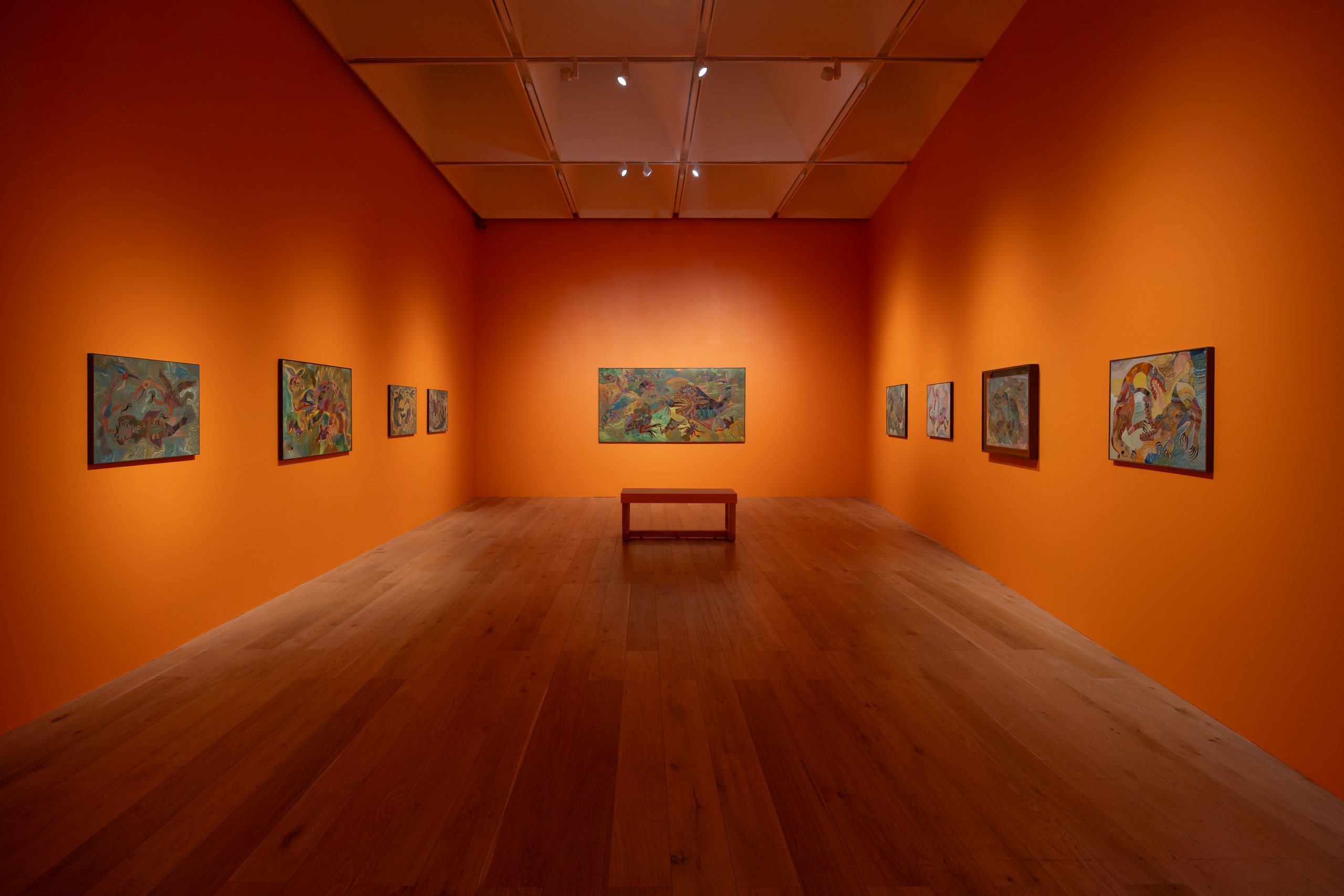
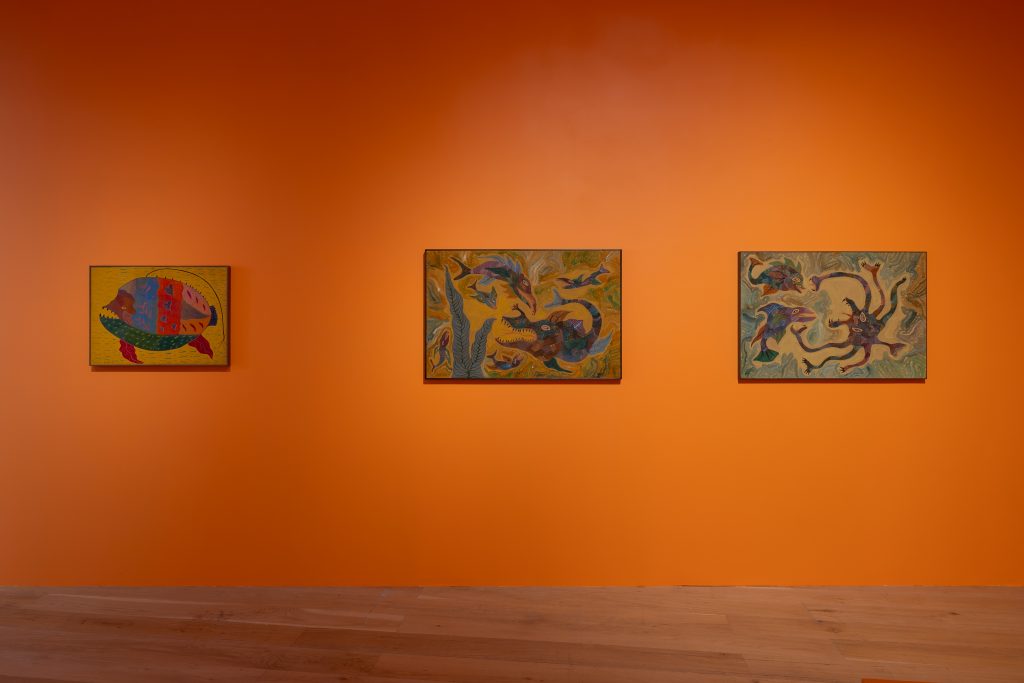
As I walk into the first of three large rooms at Nottingham Contemporary, orange walls from floor to ceiling, my first thought is: where are the birds? I find the title intriguing. And the soul is for the birds is the first institutional solo exhibition in Europe of the Brazilian artist Chico da Silva, bringing together paintings from across his career. I am surrounded by artworks depicting fish that take me back to my own experiences of visiting the Amazon. The background colour in many of the paintings, a dark yellow ochre, is like the water there: brown, murky, sandy coloured. Da Silva’s piranha-like fish embody the electric energy of the territory, a jungle that hides many mystical secrets.
The background colour in the paintings changes to ocean-blues as I move through the exhibition. I spot only one bird in that first room. I took the title very literally, I think. I am birdwatching in the galleries without much luck. But when I move into the second room there they are, everywhere: fantastical winged beasts that resemble the wildlife I have seen there before, but also leave room for me to interpret them perhaps as cryptids—creatures of myths and folklore—from the stories I have heard in the Amazon jungle.
I divide my time with the exhibition into three moments, echoing the number of galleries in which da Silva’s paintings have been installed. A first walk around on my own to take some photos, get a first impression and think about questions. A second moment with Niall Ó Faircheallaigh, Curator at Nottingham Contemporary, who takes me through the work with some context. In the third moment I am, again, on my own, but now with a more informed gaze on the artist and his works. One of the first things I share with Ó Faircheallaigh is my intrigue over the origins of the exhibition title. He shows me a beautiful quote from da Silva, found in a document from an exhibition held by the Pinacoteca de São Paulo in Brazil in 2023.
“I’m not afraid of death, I want to leave some things behind, some books; I won’t leave any paintings… I’m not a Catholic, nor Apostolic, nor Protestant… I like men because my father made me, and I like women because my mother had me… But when I die, it’s all over… And the soul is for the birds… I feel joy, I feel poetry, I feel music inside me, sometimes I feel that a song is coming out of me…So I feel very happy… This music, this life, I fought a lot, I stole nothing, what they took from me, they took from me… May everyone be very happy.”
The three individual rooms that comprise And the soul is for the birds are organised around water, land and fantasy: categories that easily flow and mix between each other in the paintings. There are no artwork labels or titles on the walls. Instead, the orange walls of the gallery and directed lighting create an atmosphere of meaning, one that feels immersive and alive when I stand close to the paintings. During my visit I overhear another visitor asking why everything looks so dark. I feel this too, yet the light is aimed at the works and so the closer you get, the more the paintings reveal themselves. But for some visitors who cannot easily move around the space or stand for a long time, that experience is less available. Access is never a finished question, even in carefully curated and considered spaces.
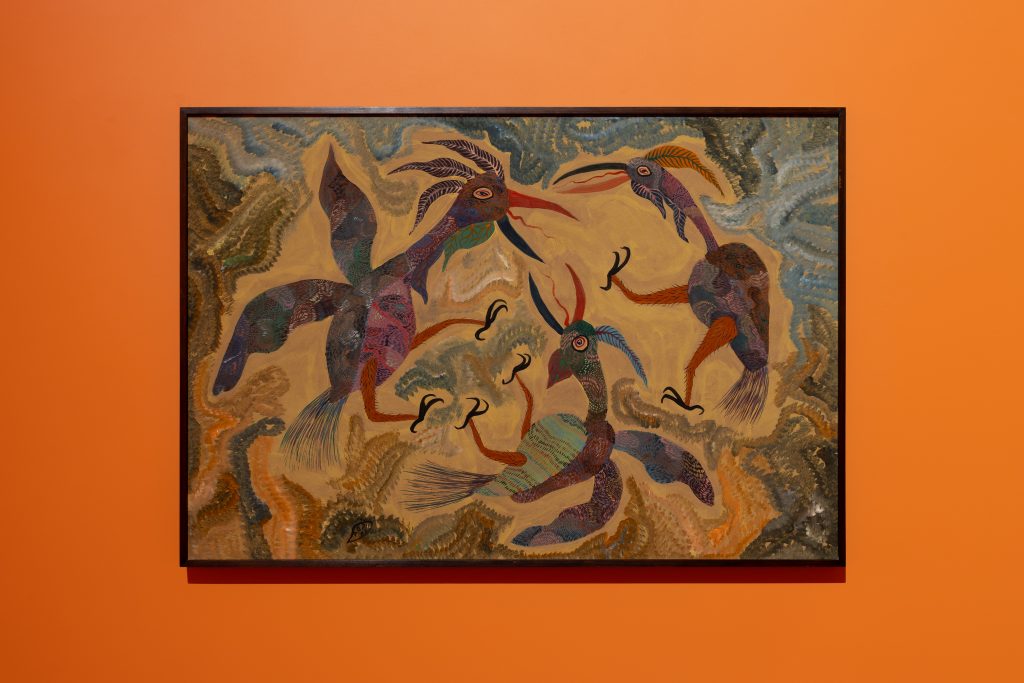
When I check the list of works on the Nottingham Contemporary website, most are ‘Untitled’, aside from some exceptions that name the animals featured in the paintings: ‘Bichos’ (1966), ‘Piranha’ (late 1950’s), ‘Aves’ (1965). Most of the paintings depict two or more animals in what seems to me as a confrontation, a fight for survival. Later in the exhibition, there are variations in the postures of the animals and their relationships with the other subjects. Some appear to be feeding each other, others simply coexisting. ‘Aves’ (1965) which means ‘Birds’ in Portuguese and Spanish, reminds me of a cockfight, a practice that is illegal, but that still happens to this day in remote rural areas of South America, where I (and the artist) come from.
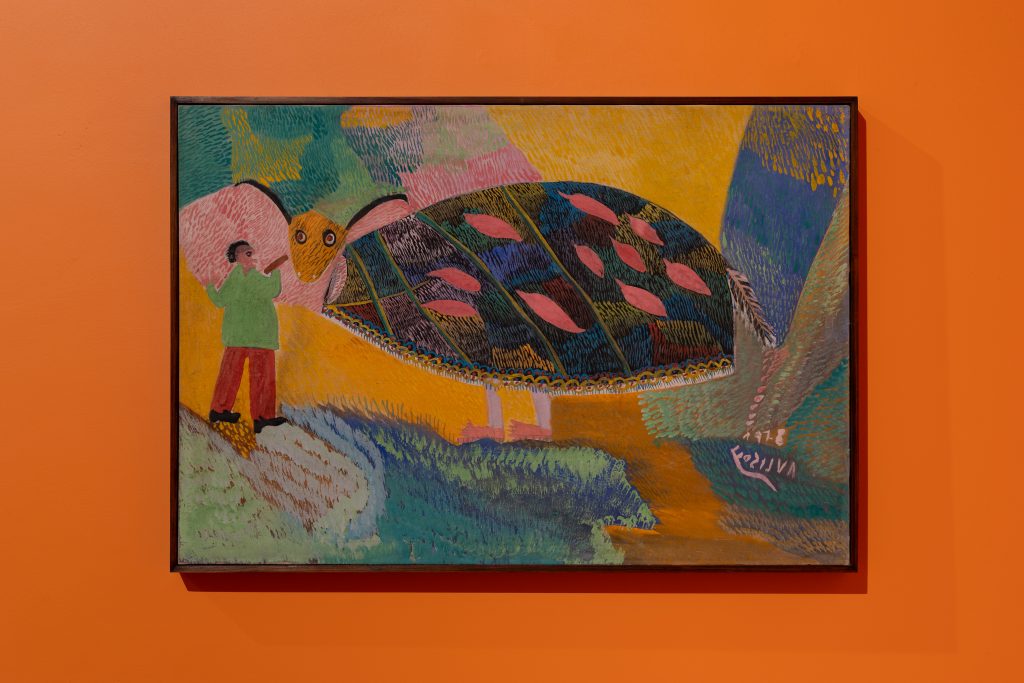
Da Silva’s paintings are captivating and full of details, like embroidery, little lines of bright colours painted in a pointillistic style, filling every section of the canvas; beaks, claws, teeth, nails are everywhere. Only one human figure appears in the entire exhibition, in ‘Untitled’ (1968), a small, modest painting. The figure stands next to an animal that I decide is a cow, which has horns, a tail and a big-ish body, but also has two human feet. It is a rare and strange thing to find a person in a work by da Silva: his practice almost exclusively focused on animals and mythological creatures, drawn from the natural world around him and his own imagination
Moving around the galleries I see all kinds of fantastical animals and, in my mind, I try to name them: a donkey, a hippo, a Tyrannosaurus rex, a cryptid? They might be anything, and I think identifying them is the least important thing. Da Silva’s paintings are colourful and moving, full of conflict, fantasy and the imagination of someone that saw these creatures everywhere, who loved bringing them into his work, and who became a figure of great importance for his community in Fortaleza.
Da Silva worked as a labourer, painting on the walls of fishermen’s houses using charcoal and simple homemade paints, then moving to paper and other mediums after the Swiss artist, critic and art dealer Jean-Pierre Chabloz saw his work in Fortaleza and tracked him down. Chabloz supplied da Silva with more sophisticated materials, and began to promote his work internationally. When da Silva founded and began working collectively with the Pirambu School in the 1960s—an informal studio collective where he worked alongside local artists and neighbours, sharing his techniques and producing work collaboratively— Chabloz publicly criticised this practice, questioning the authenticity of the work being produced. Without Chabloz’s support, da Silva’s commercial reputation collapsed. He struggled with alcoholism and mental health problems in his final years and died in Fortaleza in 1985, largely forgotten by the art world.
I feel a bit embarrassed when I read about the significance da Silva holds in Latin America. I had never heard of him before now. Later that day I call a friend; that friend who remembers everything from our Art History class, and ask him about da Silva. He does not recognise the name either. This unknown figure of the Latin American art-world, whose works I find powerful and joyful, makes me think about the many communities that develop around bodies of water. The many legends in my culture about the origins of life, which always start in the water; the element where life begins and is sustained.
The story of da Silva’s rise and subsequent fall in the Western commercial art world stays with me. The idea that a Swiss critic and art dealer found him and gave his work value is a very particular way of seeing the world, and one of the oldest colonial stories there is. Da Silva, as America, was never ‘discovered’. He was already there, already making, already meaningful to the people around him. Chabloz’s role as an art dealer or gallerist in his rise to fame, and then, when da Silva began working with the Pirambu school, the turn from Chabloz in questioning the integrity and authenticity of what was being produced there. This dismissed a very common and understandable practice of collective working as an alternative means of generating income for communities in vulnerable contexts. To call it corruption is a dismissal of the reality of someone who grew up struggling in rural poverty, and it is one of the legacies of how colonialism works in our minds, even now, when these stories are praised only for as long as they remain profitable. I feel this was also reflected in my experience of never being taught about an artist like da Silva as a young student at Art School.
I leave the exhibition with self-assigned homework. I want to know whether, in the areas where da Silva lived, souvenir objects are still being made for tourists in his colloquial visual style. As far as I can find from searching online the answer is yes: from hammocks to tote bags to little ornaments.
The quote that gives origin to the exhibition title comes back to me when I am deep-dive researching da Silva and his history with Chabloz. It’s a story told many times, with different variations. The encounter with something unique, how meaningful someone can be for the community around them, and the peace that comes at a certain point in our lives when we come to terms with the things that challenged us in the past, when we recognise how ephemeral life is, and how the soul always returns back to the universe, back to water.
Chico da Silva: And the soul is for the birds, Nottingham Contemporary, 6 June – 13 September 2026.
Pamela Vivas is a Colombian curator, producer and writer based in Leicester.
This review is supported by Nottingham Contemporary.
Published 12.07.2026 by Rachel Graves in Reviews
1,610 words