Entering Raisa Kabir’s solo exhibition I only dance, I wish we could sing at the Hub in Sleaford, I felt that I was stepping into a scene of pure queer joy.
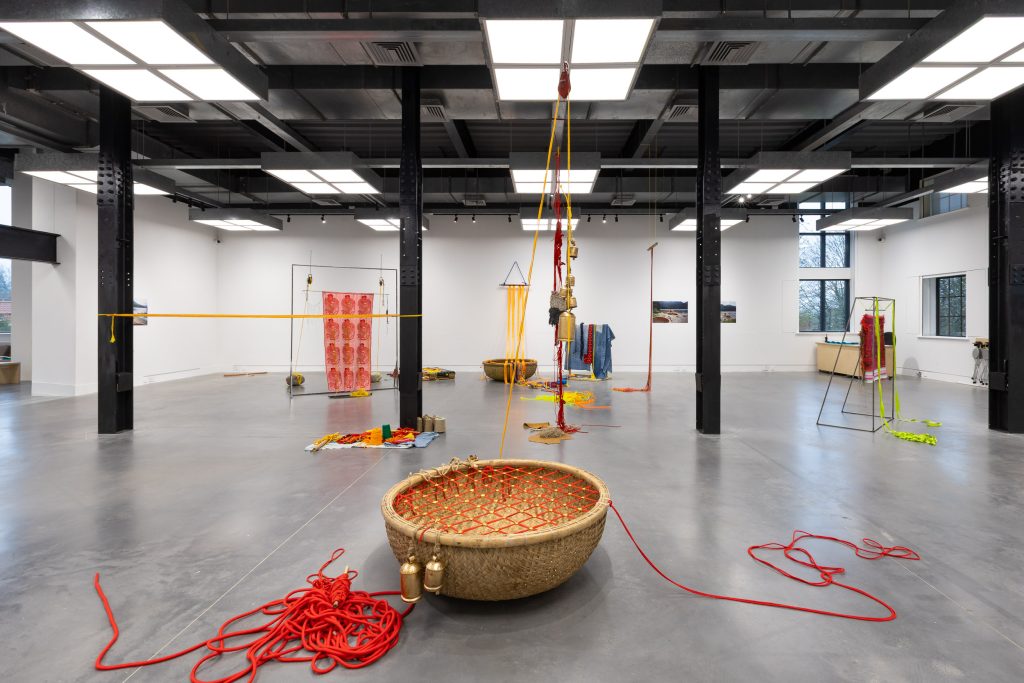
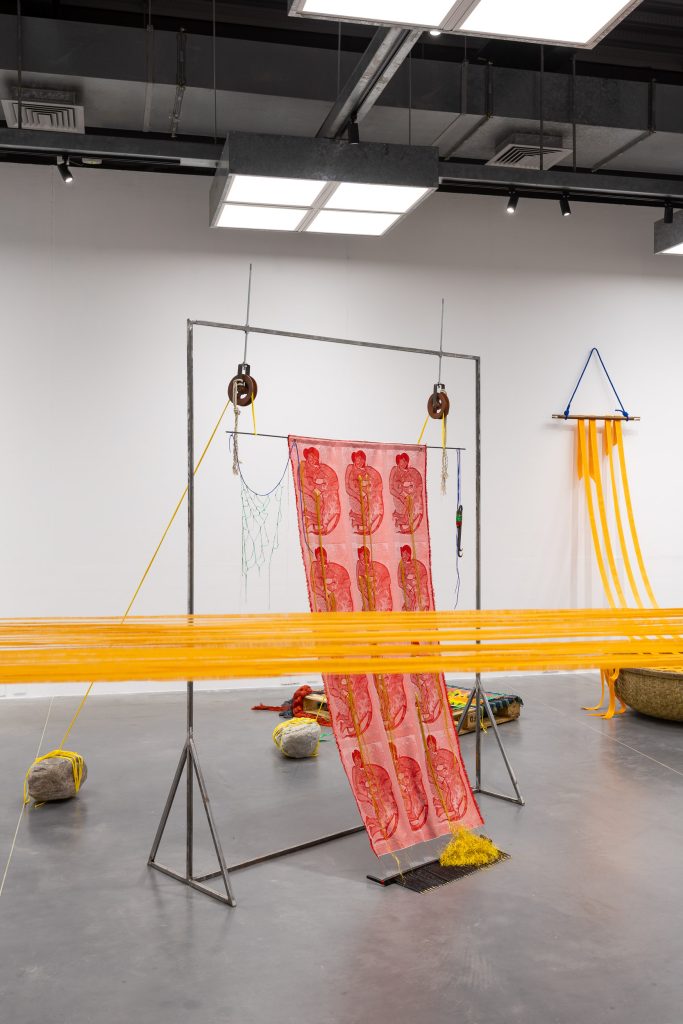
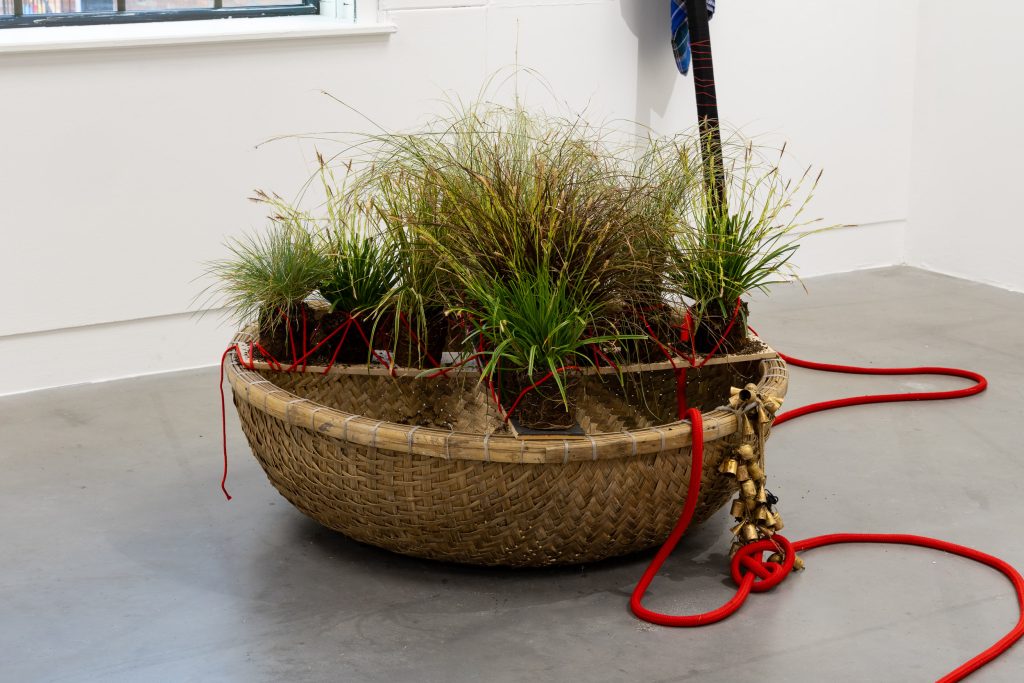
There were the colours: flaming hot pinks, azure blues, golds, oranges. There were the plants, languishing and decadent as cats in a patch of sunlight, cradled in an intricately-woven bamboo coracle, scarlet rope lacing through their leaves. There were the textures: soft blush and red silk weavings draped over cast iron frames. There was the sense of visual decadence and largesse as a form for thinking through tough topics—in this exhibition, the climate disaster—which we might associate with adrienne maree brown’s notion of pleasure activism as a prime mode of queer politics. And then, by chance, two of my favourite people were also in the room. Andrew and Jonny, beloved members of my queer Lincoln family, slap-bang in the middle of all this colour and life. Naturally, I ran into their arms and we spent some time exploring the exhibition together.
I only dance, I wish we could sing features textile, text, photography, found structures and weaving from the London-based, Manchester-born artist. In a short introductory film, Kabir describes the exhibition as ‘pulling together different strands of my research’, stating that their interests lie in ‘these long, long histories of industrial extraction, what we’re contending with in our current moment, and in our potential futures’. The exhibition was developed for the Hub by Exhibitions Manager Joshua Lockwood, shaped by his interest in presenting work by artists who blur the lines between fine art and craft.
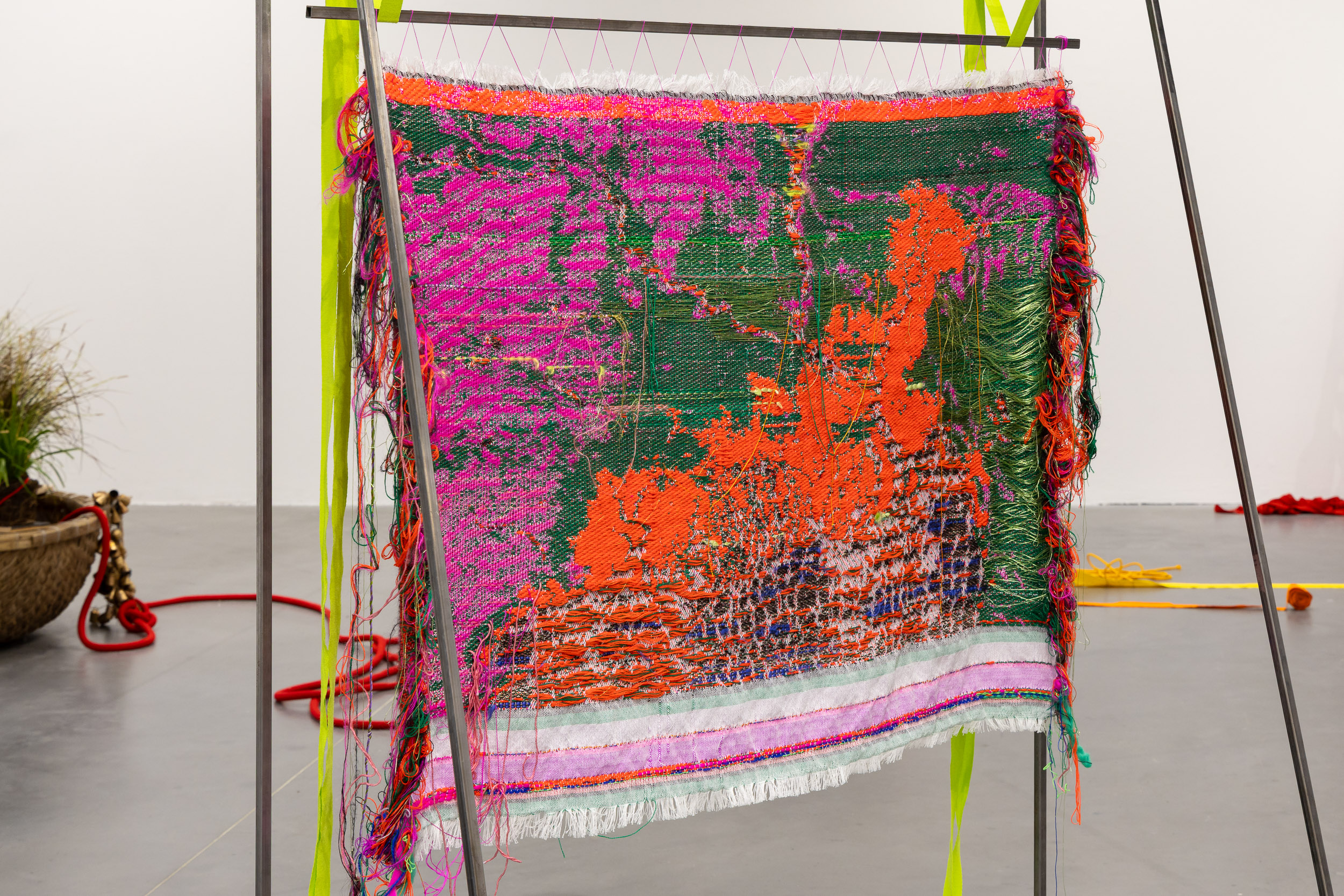
Several specially-commissioned textile works respond specifically to the Hub’s proximity to the River Slea, referencing Sleaford’s history in textile production. Many of the town’s historic mills were built for this purpose, particularly trading in jute for rope and sacking. The Hub’s building itself is a former seed-sorting factory. Whilst working on the show, Kabir also developed an interest in Anna Maria Garthwaite, the eighteenth century Grantham-based textile designer and handweaver who was the first woman to showcase her designs at Spitalfields market in London. One of the new works on show is also directly sourced from Sleaford itself; ‘I Only Dance, I Wish We Could Sing’ (2026) incorporates a wooden palette that Kabir found on the street outside the Hub during the exhibition’s installation, using it as the ‘loom’ for criss-crossing lines of orange, pink and blue threads.
The title of the exhibition comes from a piece of Kabir’s own writing which explores emotional literacy and histories with her mother. All of the works at the Hub gesture in some way towards this desire for communication and connection, the possibility of telling new stories, and the importance of retelling old ones, as in the piece ‘Re-weaving the Archive’ (2022). Several works are also concerned specifically with Kabir’s ancestral roots in Bangladesh and what the future might hold for communities living on the Bengal Delta, a geographical area that is on the frontline of the climate crisis.
There are multiple moments in the exhibition where Kabir combines this textual and textural expression, playing on the linguistic resonance between these two different modes of expression. A handwoven silk hanging, titled ‘Everyday Feels Like Dyeing Over and Over Again’ (2024), actually reads as ‘EVERYDAY FEELS LIKE DYING OVER AND OVER AGAIN’ Kabir draws our attention both to the tricksiness of the English language and to a potential elision between manual labour (‘dyeing over and over again’) and the wearing down of the body through work (‘dying over and over again’). In reference to the title of the show, the artist has said that ‘sometimes, you really wish there were things you could sing about or speak about, that are too difficult to talk about’ and, whilst there isn’t any singing in I only dance, I wish we could sing, there are words everywhere.
I was particularly struck by what looked like a piece of shiny red and yellow plastic sacking on one of Kabir’s coracles, threaded under a wooden strut, with the letters ‘ndian nion’ poking out, suggesting the words ‘Indian Union’. As with many of the works here, through juxtapositions of material, texture and text, Kabir draws our attention to the imbrication of colonialist methods of extraction, the movement of materials along international trade routes, the political histories of these routes and the shaping of land and water as a result. Through the use of reclaimed and found materials, Kabir challenges capitalistic frames of use, usefulness and waste that have, in part, caused the climate disaster, and continue to compound it.
Four coracles form the exhibition’s spine; tiny boats designed to accommodate a single, lone traveller, and made by Kabir especially for this exhibition at the Hub. They thread from one side of the gallery to the other, often spilling their contents: strings of bells, ropes, fluorescent synthetic yarn extending across the floor, lending a tentacular, ‘sea-creaturely’ feel to the work. One of these boats has a meshwork of red warp threads across its top with a weaving sword (a tool designed to push the weft yarn securely in place) nestled inside. Each little vessel has its own distinct character, and yet this flotilla of coracles feel interconnected, held together by invisible threads. Floating apart, yet tethered together; a metaphor that has deep political purchase elsewhere in Kabir’s work.
The artist’s preoccupation with the ongoing climate disaster is particularly clear in this collection of coracles, referencing the ramifications for the Bengal Delta Sundarban, the site of the world’s largest mangrove forest. The Asian Sundarbans are also home to around 7.2 million people, half of whom live below the poverty line. Land mass in the area is decreasing rapidly due to rising sea levels, increasing at double the rate of the global average. By 2050, it is expected that the Sundarbans will most likely be under the sea. Given this, and the wider realities of climate change, one of the urgent questions Kabir asks in their work is ‘how do we make a home on the water?’
There also lies a critique of colonialist cartography; specifically the division of land from water within Kabir’s concerns. In the exhibition’s film, Kabir asks: ‘where are the lines between the water and the land? Are they separate?’ I’m reminded of the work of landscape architect Dilip da Cunha, who considers the imperialist motivations that underpin the ‘line’ of the river as distinct from the land, which have huge ramifications for how we navigate the climate disaster. Kabir acknowledges the experiences of the Bengal Delta from a diasporic perspective. The artist didn’t grow up in Bangladesh herself, but has stated that when she goes to Bangladesh, she knows she can always leave, unlike others who want to leave, and can’t.
Kabir’s work also refuses the hierarchies of meaning-making that so often characterise the art world: between craft and fine art, and between oral histories and folk knowledge and academic discipline. Works like ‘Re-weaving the Archive’ (2022) and ‘Basket Loom Data’ (2026) skewer the privileges of university learning over ancestral traditions and techniques passed down through generations. Speaking to Fadhel Mourali, the artist says: ‘these things that aren’t written down, valuing craft: textiles, fabrics, patterns, fibres, these specific techniques; these are histories, these are archives that need to be acknowledged and valued in the same way as a paper by a white academic textile historian’.
I only dance, I wish we could sing then, is a profoundly ethical reframing of the questions of which bodies get to make meaning in the world, and how. Kabir’s exhibition is, in part, about who and what might hold us now. It is about how, and with what, we are intertwined, and the histories of these intertwinements. It is an invitation to consider our entanglement in these histories and ever-present realities of colonial extraction, the material realities of the climate disaster and the ecological realities to come. Whilst I was enraptured by the queer joy of it all from the moment I arrived, the longer I spent with Kabir’s work, the more I felt caught up in these other threads. This isn’t to say that the joy went away, this work is exultantly, defiantly joyous, and queer in its sensibility, specifically its desire to build refuge for the dispossessed and to make this refuge from the salvaged materials of the Empire that would seek to do this dispossessing. I only dance, I wish we could sing simultaneously holds us in this joy whilst asking ‘what do we need to survive?’ as the artist puts it in the exhibition’s film. Certainly, one of the answers that the show gives to this question is: hold each other close. It is, in Kabir’s words, ‘a beautiful way to sing into a hope.’
Ruth Charnock is a queer writer, artist and facilitator based in Lincoln.
Raisa Kabir: I only dance, I wish we could sing is at Hub, Sleaford, 28 March – 5 July 2026.
This review is supported by Hub, Sleaford.
Published 04.05.2026 by Rachel Graves in Reviews
1,575 words