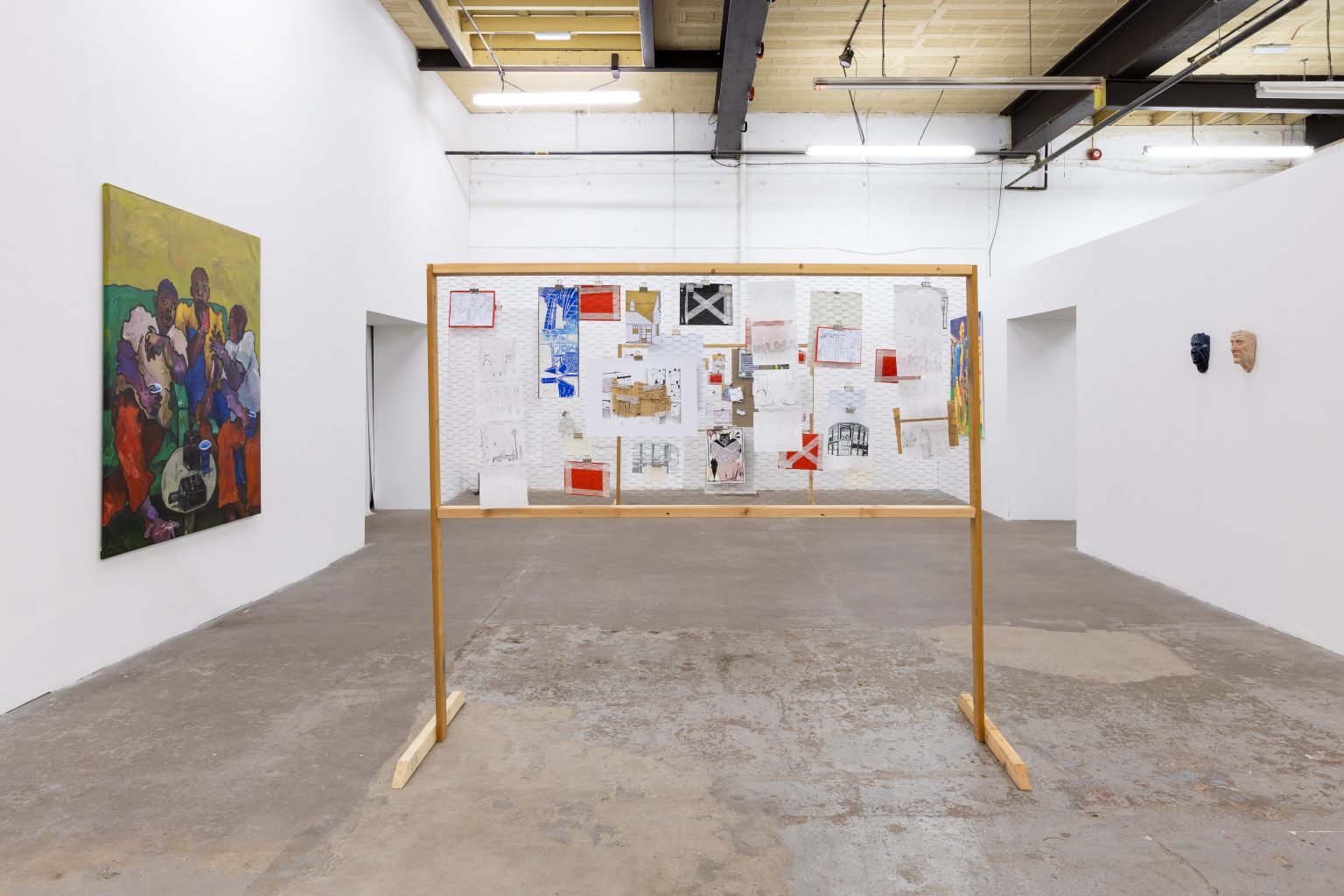
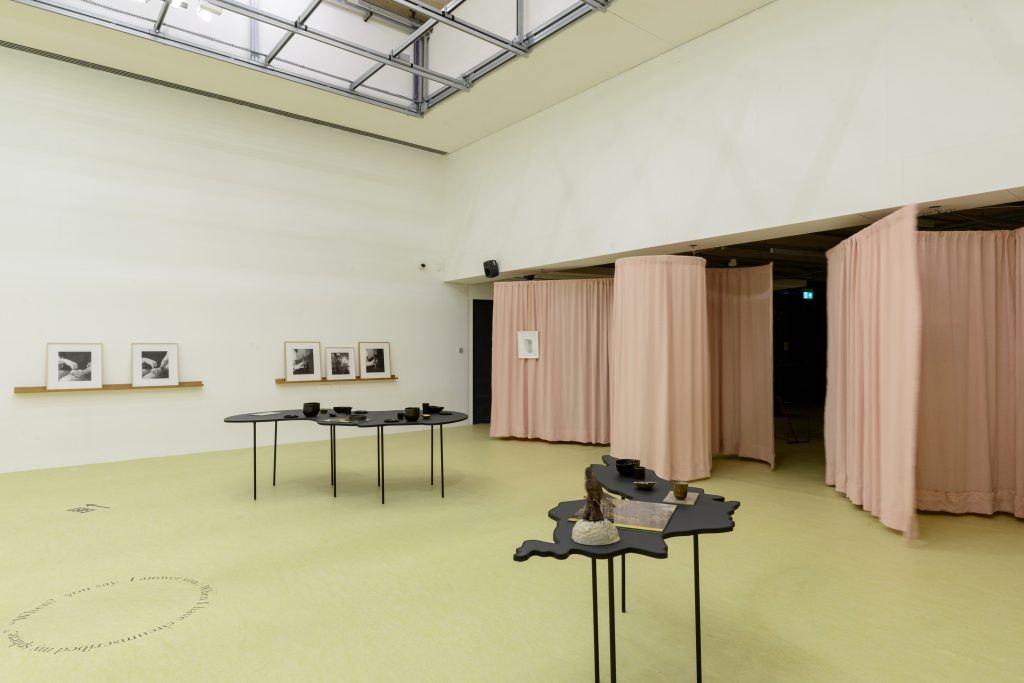
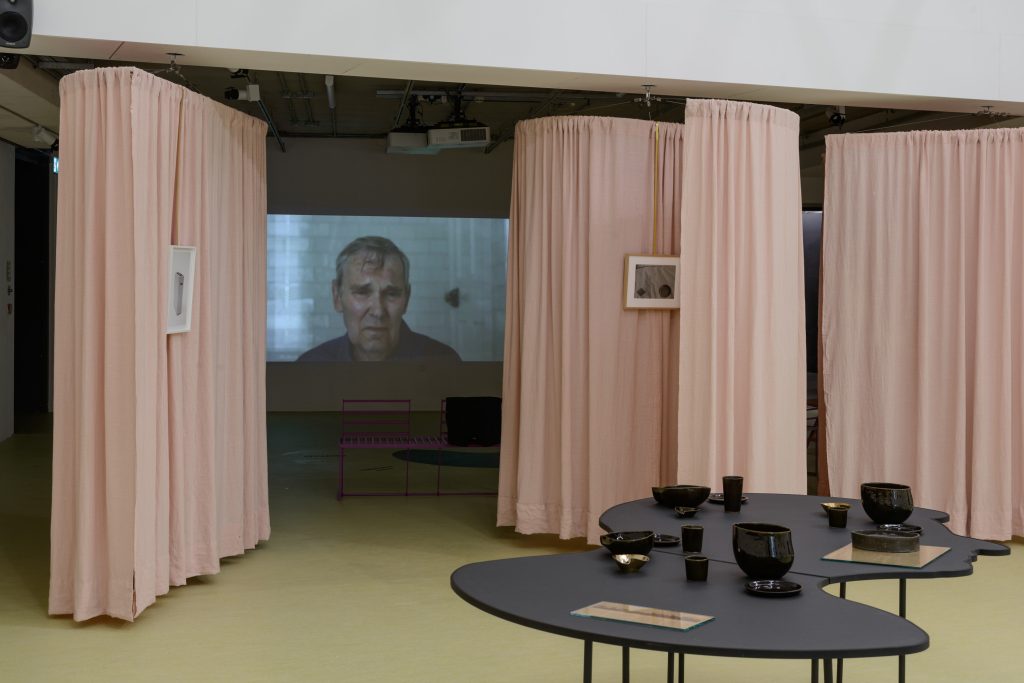
I encountered Becky Beasley’s new touring exhibition, A Gentle Man (Part II) (1975-2029), newly installed at Quad in Derby. An introductory area, positioned just outside the entrance to the gallery, acts as a gateway into the main space and slows me down so I become more aware of entering. Within, I see a space that has been divided into two sections, bisected by a pink curtain. One side contains tables, photographs, ceramic works and two television-sized screens, while the other features a larger video screen with two-seater benches positioned around. The gallery floor is entirely covered in green linoleum, with sections cut out shaped like lakes and silhouetted portraits, as well as ten circular insets containing textual phrases. The scattered phrases are drawn from a range of literacy sources, purposefully out of sequence and fragmented which suggests that identity is made from many voices, not just one. Combining sculpture, photography, video and interior design, the exhibition creates an immersive environment that resembles an interior landscape, a carefully designed indoor space you can enter and move through.
Beasley’s work is deeply influenced by literature and social behaviour, as well as her lived experience of a late-in-life autism diagnosis, depression and aphantasia (the inability to form mental images). Awareness of her aphantasia felt crucial to my understanding of the exhibition, as Beasley skillfully shifts emphasis away from mental visualisation and towards sensory engagement, translating literature into physical space through sound, touch and spatial design.
The artist spoke about no longer feeling alone in her autism since her diagnosis and about feeling more connected, and I was curious to understand how and why this might be the case. Like Beasley, I also received a late diagnosis of neurodiversity, in my case ADHD, and like her I am still discovering what this means for me. The exhibition felt like a personal and insightful window into how she processes life experiences, and through this sharing she offers an extended hand to connect with others, which I found profoundly welcoming and generous.
At the entrance to the gallery, I encountered three-dimensional, tactile models including a maquette of the gallery layout, and an audio piece accompanied by the text-based video ‘Still Water Runs Deep’ (2026), self-penned by Beasley. The audio didn’t try to explain A Gentle Man outright, but instead gently guided me into its emotional and conceptual themes, preparing me for sensory interaction. Listening through noise-cancelling headphones to an audio piece delivered by a robotic AI generated male American-accented voice creates the effect of a dreamlike stream of consciousness. This prompted me to pause and listen, reset and regulate before entering the exhibition itself. In a talk scheduled to accompany the exhibition, Beasley explained that she selected this voice in particular for its comforting rhythm, but that it also reflects her interest in American literature.
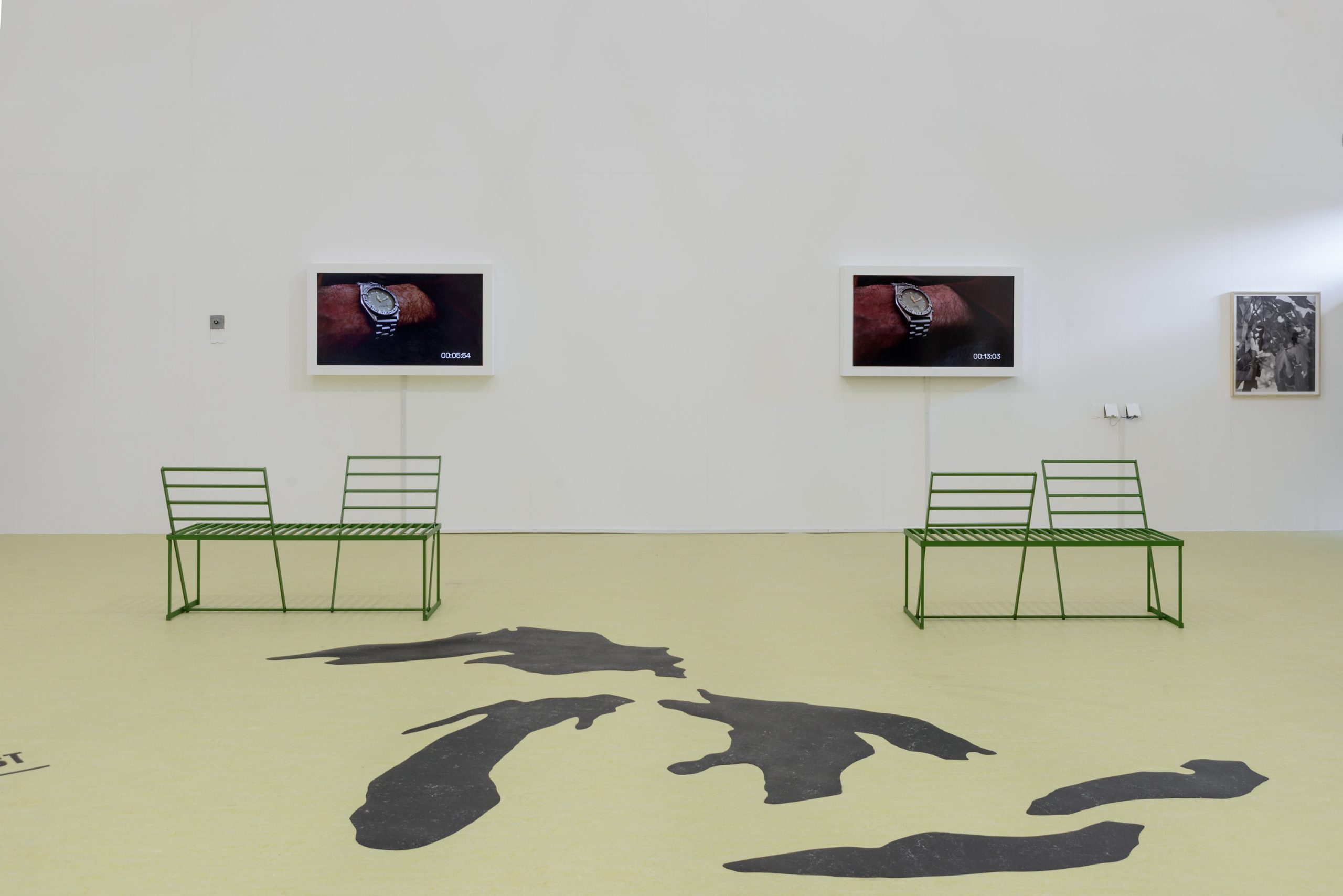
The manufacturer named the green tone of the linoleum used on the gallery floor ‘Wellness Green’ and this is not the first time that Beasley has used the colour in her works to create a relaxing and suggest a natural-feeling setting. Cut-out sections reveal a black underlay, flush to the floor, representing the fictional expanse of ‘Lake Faulkner’ (2026) and ‘The Great Lakes’ (2026). The outline of five North American Great Lakes, a real geographical system, are transposed onto the gallery floor. Across the second half of the gallery floor, and inspired by Beasley’s engagement with American literature, is another silhouette portrait resembling the American novelist William Faulkner titled ‘Lake Faulkner’ (2026). Faulkner’s book As I Lay Dying was a central inspiration for Beasley in making this exhibition and this is embedded conceptually in the work presented in the space. As I Lay Dying is fundamentally about how a person can never be fully known, only pieced together through fragments, perspectives and traces.
A silhouette portrait depicting the American Poet Emily Dickinson is included within the exhibition pamphlet rather than being displayed in the space itself. The pamphlet is an important part of the exhibition and introduces visitors to the ‘clearing’ method, a process intended to deepen engagement with artistic practice and perception. Dickinson’s original image, produced in 1845 by Charles Temple, offers a significant historical anchor and foregrounds the role of silhouette portraiture within nineteenth century visual culture. Dickinson’s presence appears to reinforce Beasley’s exploration of inner worlds and sensory abstraction. Like Beasley, Dickinson’s work sought to construct complex experiences through language rather than imagery, touching on themes of memory, absence and identity.
Four black MDF tables cut into the shape of lakes are positioned on the Linoleum in one half of the gallery. Each table is arranged for an individual: ‘Setting for David (Lake Superior)’ (2026), ‘Setting for Andy (Lake Michigan)’ (2026), ‘Setting for Lucy (Lake Huron)’ (2026) and ‘Setting for Faulkner’ (2026). The naming of specific individuals feels like an invitation to inhabit the space, creating a sense of familiarity and intimacy with the small ceramic works on display. The objects vary in size and form: some resemble bowls, while others include a bird on a perch and some cashew nuts. Initially appearing unrelated, they collectively suggest encounters drawn from the experiences and memories of different people. The clay used to mould the ceramic works, like the material of the linoleum flooring, begins as a soft and malleable material before becoming harder and more solid over time. Both materials suggest something that is shaped, hardened and yet still marked by its origin and this felt significant to the concept of A Gentle Man: suggestions of transformation and the careful shaping of identity and emotion over time.
The frequent appearance of watery metaphors throughout A Gentle Man operates on various connected levels. At the most simple level, water, especially the still water of lakes, suggests calmness on the surface while implying a hidden depth beneath. Water metaphors often represent the mind or emotional states because they are fluid and shifting, not fixed. Both the lake shapes on the floor and the tables are rendered in black, creating a sense of negative space that evokes stillness, absence and the unknown. Rather than signifying emptiness, I felt that this vastness could be an active space for contemplation, where silence and darkness encourage reflection on solitude, interiority and emotional depth.
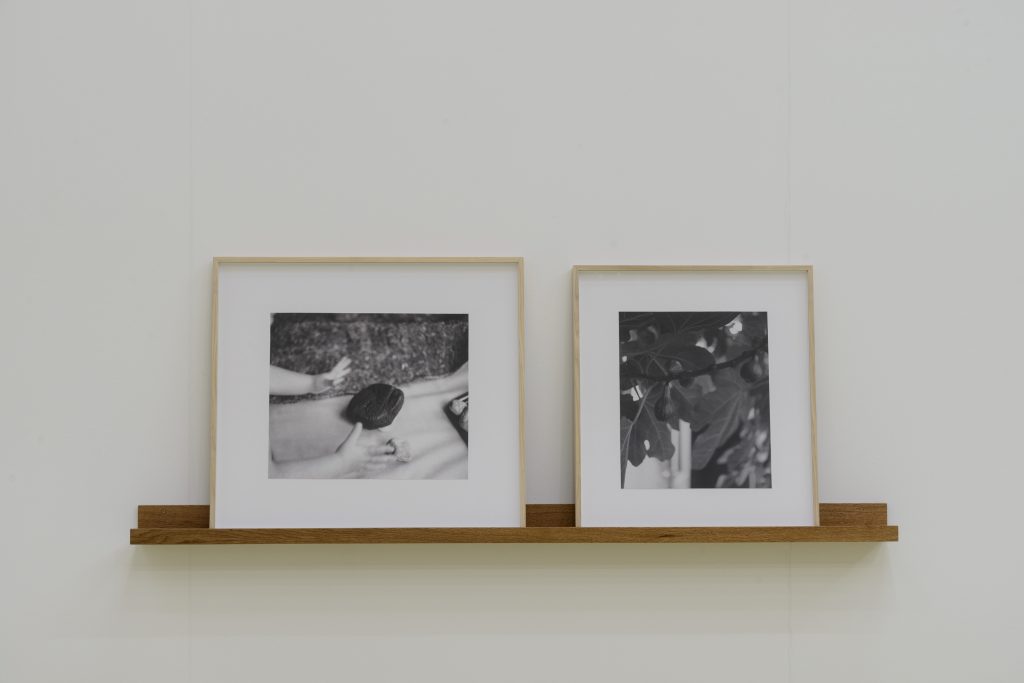
Small groupings of framed photographs lean casually on elongated oak picture shelves that run along the length of two walls at a height that suggests they are intended to be viewed whilst seated. The left-hand side displays black and white photographs of figs and hands. Beasley describes the images of figs as being taken ‘under the canopy of my fig tree’ and the hands reference both a male body and a child’s arm which suggests an intimate, perhaps autobiographical connection. The photographs, rather than being of a uniform medium, include archival digital prints, colour photography, and monochrome hand printed gelatin silverprint. The images are subtle and understated, offering quiet, reflective glimpses of everyday moments and memories. This area of the gallery is filled with natural daylight from a large window that overlooks the outside street and a busy bus stop. It felt like an interesting and possibly deliberate contrast; the calming gallery interior and the movement outside reinforcing the interplay between stillness and activity, interiority and external reality.
Dividing the two distinct halves of the space is a motorised, rotating pastel pink curtain that is draped from ceiling to floor. The curtain rail is shaped to outline the initials H.S.P. which is an acronym for Highly Sensitive Person and the title of a book by the academic Elaine Aaron. The letters are not immediately visible from a standing position, we have to navigate the space with intent and pay close attention, which reinforces ideas of hidden meanings and coded signals that are particularly relevant to neurodiverse experiences. I felt comforted walking through the curtains, embraced by the tactile material playfully moving around me and creating a sense of enclosure through which I momentarily become part of the work. Standing there offers shifting perspectives; playing with the boundaries between private and public, concealed and revealed, and echoing Beasley’s exploration of identity and perception.
‘Conversation Benches’ (2017), six two-seater steel seats, are arranged around the exhibition space and suggest an opportunity for quiet, shared human encounters. I felt invited to sit beside a stranger and watch Beasley’s film works together. Despite the inviting connotations of the title however, the benches did not feel designed for comfort. A tactic by the artist which is no doubt deliberate, and perhaps highlights the ways in which social interaction can be challenging or physically uncomfortable for some neurodivergent people. A less-than-comfortable place to rest offers a good excuse to move along quickly, and encourages movement while also subtly disrupting the flow of visitors around the space. At the shaded end of the gallery, two wadded sweater cushions offer a more intimate and materially sensitive alternative to the benches, further adding to the ways in which comfort and rest are encountered in different parts of the exhibition.
The exhibition title references Beasley’s father and the writer Bernard Malamud while also evoking a broader, more reflective mood within the space. The linguistic distinction between Gentle Man rather than Gentleman, is central. It reframes gentleness as a human quality rather than a marker of class and status. This sense of reflection is extended in the four short films that the ‘Conversation Benches’ are organised around. The films are linked as four chapters on a similar theme, but are experienced separately at different points during the exhibition. Together, they portray the intertwined lives of the American novelist, Bernard Malamud, and Beasley’s father. The final part, ‘A Gentle Man: Chapter 4, Night, Exterior (Spring Rain): A Man Walking Up Broadway’ (2017), presents the artist’s father in old age, vulnerable and contemplative, accompanied by Franz Schubert’s, Winterreise (The Linden Tree) played in reverse. The inversion of sound evokes retrospection, a look back over the artist’s life and that of her family. As I watch, I am moved to reflect on my own life, shaped by memory, regret and remembrance, with memories becoming faded and incoherent with time.
Presented within the film is Malamud’s final written note to himself on the day that he died: ‘Don’t be fragile, Don’t be fragile, Don’t be fragile, Don’t be fragile’. The repetition of this simple line is a fragile and delicate moment, but also holds a tension between strength and vulnerability as it relates to traditional masculine identity and stereotypical notions of what it means to be a man. This is a central concern that runs throughout A Gentle Man; the relationship between masculinity, vulnerability, identity and care. This moment in the exhibition felt particularly poignant, reflecting on the passing of time and memories of ageing parents, experiences I strongly related to.
As Beasley has chosen to explore how people are represented, remembered and omitted through the four key life stages: work, family, chosen family and death, the emphasis in this exhibition on her father rather than her mother, who has been a subject of enquiry in earlier works, is perhaps deliberate.
Ten circular linoleum insets are positioned across the gallery floor, with aqua jet cut text in black words that run around the inner circumference. One of the phrases reads ‘When? You say. I answer you. When I have circumscribed my sphere’ and is taken from the Notebooks of Joseph Joubert (1800). Joubert was a philosopher, and his phrase brings focus to thought, language and the limits of expression, fitting Beasley’s interest in introspection and slow thinking. In placing text on the floor the artist requires us to physically move around the circle to read, encouraging active physical engagement rather than passive observation.
Throughout the gallery the soft greens and pastel pink of Beasley’s tonal palette generate a calm and contemplative atmosphere. I am reminded of institutional or clinical hospital environments, and this felt like a deliberate acknowledgement of the care system, perhaps a subliminal reminder of the importance of self-care.
Creating accessible modes of engagement is clearly a central part of Beasley’s exhibition-making, positioning access not as a supplementary feature but rather as an integral part of the exhibition’s structure and meaning. This commitment, grounded in her own lived experience, closely aligns with the broader conceptual and ethical framework of her practice. The gallery at QUAD has been transformed into a multisensory environment, incorporating sound, various visual elements as well as tactile interaction with the moving curtains and three-dimensional objects.
Through A Gentle Man Beasley invites us to pause, reflect and inhabit her carefully constructed, thoughtful world. It offers meaningful insight into her ongoing experience of autism. I was particularly struck by the artist’s relationship with literature and literacy, and her deep engagement with text and narrative, which takes on an extraordinary dimension through her aphantasia.
Literature becomes Beasley’s primary tool for constructing and reconstructing her experience of the world. Rather than internalising images, she translates text into spatial and sensory form: mapping literary references onto the gallery floor, staging narrative encounters through her table settings and her use of sound to evoke emotional and temporal shifts. In doing so, Beasley processes memory and experience through an alternative, highly personal logic, where meaning is built through abstraction, association and material translation rather than mental imagery. The result is an installation that feels relatable, softly radical, and is a sensory translation of thought, memory and narrative into physical form.
Suzanne Golden is an Artist, Writer, Curator and Director of BACKLIT, based in Nottingham.
A Gentle Man (Part II) (1975-2029) is on at QUAD, Derby, 14th March – 2nd August 2026.
This feature is supported by the artist.
Published 20.04.2026 by Rachel Graves in Features
2,347 words