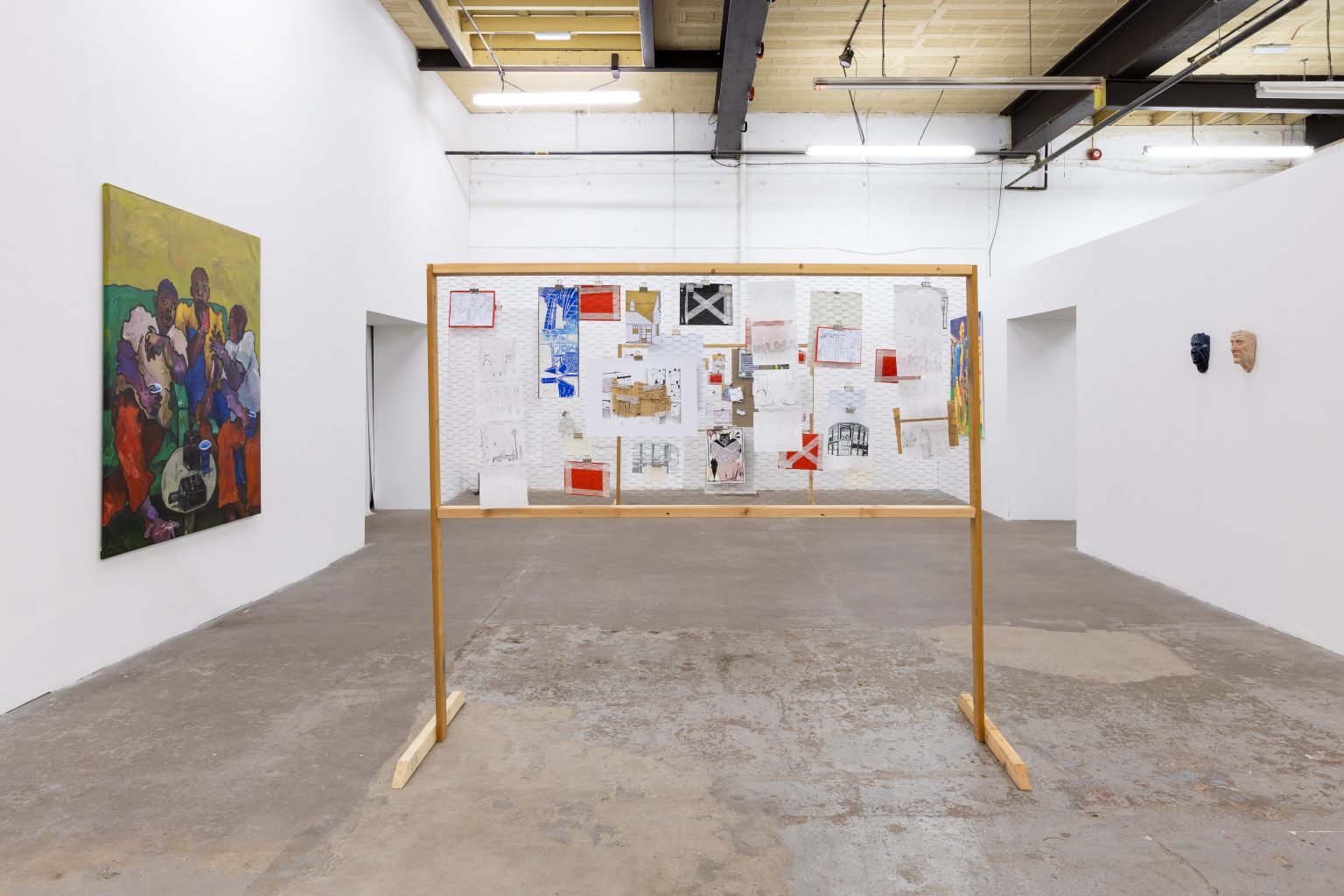
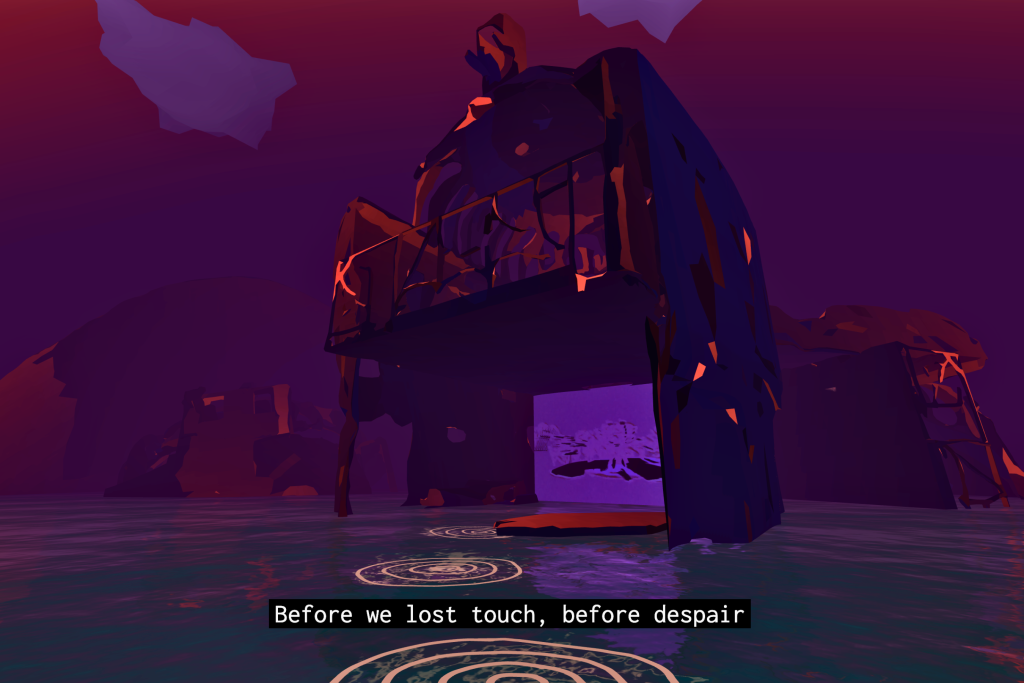
I encounter Earth-Stepper from my bed, in the midst of a chronic fatigue flare. Movement, for now, is limited to the small choreography of keys and cursor. In this context, the work’s invitation to traverse its dark, watery landscape feels both generous and disorienting. A swirling path guides me forward, somewhere between waymarker and sigil, as footsteps echo through the space. It is unclear whether these footsteps are mine or those who have passed through before me? In time, a figure emerges along with text: the ‘Bunny King’, a folkloric guide conceived and designed by the artist, who begins to tell, through text on the screen, the story of a mother and son carrying a father’s body back to his homeland. The journey is halting, repeatedly interrupted, and as I move through the landscape I find my own navigation slipping into its rhythm. Presented by Fermynwoods Contemporary Art, Earth-Stepper by David John Scarborough is hosted online, extending an earlier physical exhibition at Haarlem Artspace into a digital, navigable form.
The tale fragments as it unfolds. The mother and son move, pause, then begin again. Their uneven rhythm is mirrored in the act of navigating the artificial world itself. Progress is slow, occasionally disorienting, the interface unfamiliar enough to resist ease. There is a weight to the narrative but also in the act of moving through it. The imagined burden of the body begins to settle elsewhere, in my hands on the keyboard and the cursor, in the careful negotiation of direction and pace. Breath, labour and hesitation are shared across viewer, mother and son; collapsing the distance between story and experience.
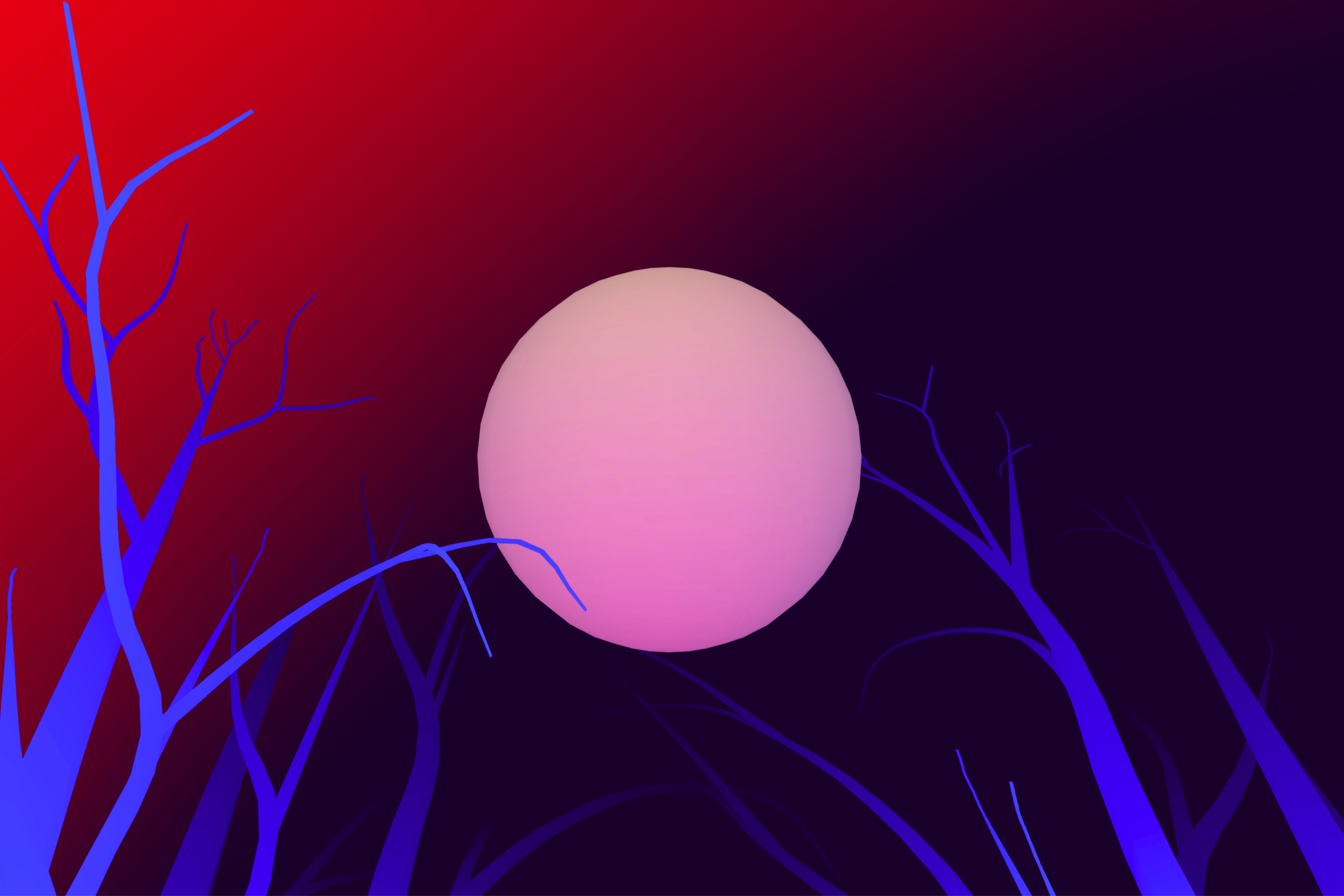
Aesthetically, Earth-Stepper resists naturalism. Its environments are flattened and stylised, rendered in bold, contrasting colours that feel closer to a digital game space than a pastoral landscape we might expect to encounter in an artwork. This sits in tension with the work’s grounding in folklore and ecology. Even the ‘Bunny King’, part mythic guide, part narrator, appears in a T-shirt. The effect is quietly disorienting, raising the question of whether folklore must always present itself as something ancient or whether it can be rearticulated through contemporary, synthetic forms.
There are moments where I almost lose sight of the animal-headed figure entirely, his form camouflaged within the darkness, dissolving into the surrounding palette. I find myself searching for him, unsure if I have missed something or taken a wrong turn. This feels intentional, our otherworldly figure slips between guide and trickster, never fully fixed, his presence intermittent. In this, the work gestures towards what is lost or misremembered over time, how stories shift, fragment and evade capture. It also foregrounds the personal nature of navigation: each viewer’s journey is partial, contingent and shaped as much by what we fail to see as what we find along our path.
As I move through different spaces of the work, the environment shifts and new sensory layers emerge. Standing stones appear in the distance, knotted branches reaching overhead. There is chanting, or something like it, a low song that seems to belong to this digitised forest itself. Our guide’s words anchor the experience, holding the narrative in place as the form shifts around it. His pop-up text begins to recede as I move towards a more traditional, sung acoustic track. Butterflies drift across the sky, the atmosphere softens and it feels almost hopeful. Subtitles that accompany the song signal transition: “doors closing from behind”. Moving beyond the swirling path, I find myself in a series of darker, more enclosed spaces that recall the experience of entering screening rooms in a contemporary gallery. These ‘screens’ flicker with butterflies moving through other landscapes, fragments of journeys that are not mine. It suggests that I am not the first to pass through here. Like all good folktales, this is a story that belongs to others as much as it belongs to the individual experiencing it in the moment.
At one point, I lose my way entirely. The landscape falls into a blue-black silence, and I find myself moving frantically, pressing keys in search of direction. When our regular companion reappears, it is almost a relief. His text says “Ready to burrow deeper, are ye?”, gesturing towards a portal titled ‘Holloway’, a passage that offers temporary shelter. I linger there much longer than necessary. There is comfort in enclosure, in being held within a space that feels defined and navigable. Yet, as soon as I begin to settle, the work pulls me onward, the browser reloading, the next chapter beginning.
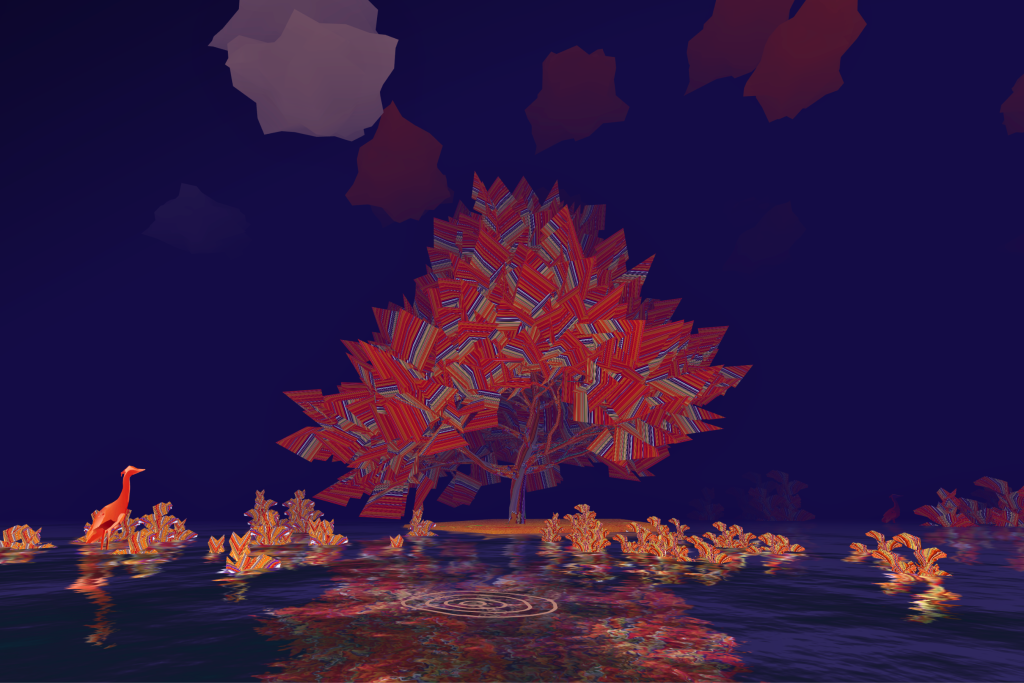
When Scarborough’s world resolves again, I find myself back in the same place from which I exited, but facing a new direction, ready to follow its path. If the first chapter was night, this feels like dawn. Birdsong carries through the space and the palette shifts, dead branches catching the glow of a rising red light. As I move, the soundscape begins to blur. At first it sounds animalistic, then becomes something closer to human, like a radio tuning in and out of a signal. A voice speaks of interconnected lives: tree, human, animal, though its source, like much of the aural elements of the work, remains unseen. The path splits. I choose to move left and the sound softens. I’m unsure if my decision caused this change. At the end of the path stands a solitary tree on a small island, a bird poised beneath, looking upwards. It is a quiet, almost reverent moment. Above me clouds drift slowly. Moving forward, using the up arrow on my keyboard, I approach a set of gates. I use my cursor to look around where I’ve come to stop. The gates are sealed shut but as I wait the Bunny King returns once more and the story reaches a critical turning point: unable to enter, the mother and son bury the father outside, placing seeds with him.
What could not be returned is instead left to take root elsewhere. The desire for return loosens, giving way to a more uncertain form of belonging, shaped not by recovering the past but rather what we can make from it.
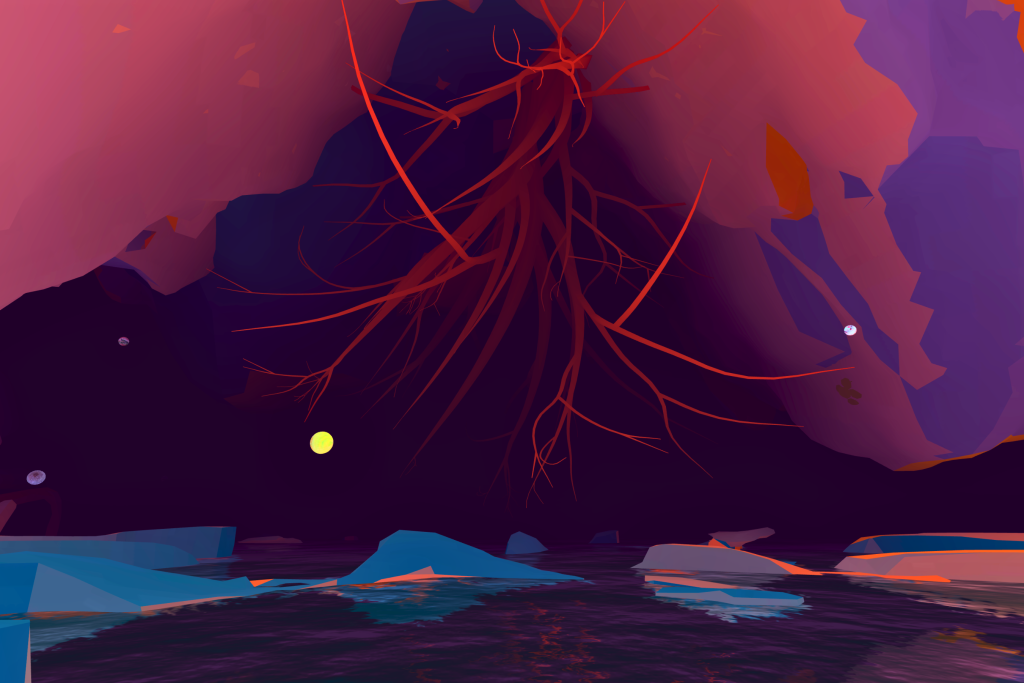
As I complete my journey, the browser reloads once more and I am pulled into a third and final space, one that feels markedly different from what came before. The palette lightens. What was once dark and atmospheric now glows with softer reds and violets, as if the landscape itself has shifted beneath the surface. I move through cave-like tunnels where beetles cling to the walls. Larger uncertain forms appear at the threshold, looming and watchful. I have entered the body of the earth, a space of burial and transformation. The terrain opens and closes around me, narrow corridors giving way to expanses of liquid, where roots stretch outward and insects tower above.
The Bunny King returns (he is never far away), offering a way back to the ‘Holloway’, a familiar location. But I hesitate. I feel a pull to remain, to explore this new terrain further. Retracing my steps (because in Scarborough’s world I can move anywhere I like), I uncover another path. It is here, within this space of burial and transformation, that the story continues. The text recounts what followed: the seeds placed between the father’s teeth take root. From this burial, a copse of trees emerges. “Forest and song now sprung, spring coming on. The body, now sheltered in the bowels of the earth, becoming”. What was once carried becomes dispersed, held not in a single body but across a shared network of growth. This is described as a “familial intimacy of grouped trees”, a phrase that lingers. Here, grief is not resolved so much as reconfigured, transformed into something collective, something that exceeds the limits of the individual.
In one of the work’s more uneasy turns, the narrator tells us how the son, now grown up, reflects “how his mother had been in the way”. It is a fleeting line, but a revealing one. The remark carries a quiet resentment, as though the mother’s presence had interrupted or complicated the relationship between the son and his father. The mother remains tethered to labour, her role necessary but narratively diminished. While the father is transformed into myth, becoming seed, tree, and legacy, she remains grounded in the work of carrying, enduring, and continuing. Filtered through the Bunny King’s telling, her interiority remains just out of reach. Intentional or not, the work exposes how easily acts of living care and endurance are overshadowed by acts of memorialisation.
Earth-Stepper unfolds as a digital artwork where movement (both physical and emotional) is slowed, interrupted, and therefore made meaningful, made real. The act of traversal through its programmed spaces mirrors the real-world labour of carrying, while the fragmented structure of the narration reflects the way human stories are told, retold and alter over time. Folklore here, in Scarborough’s world is unstable yet contemporary, shaped through synthetic forms, shifting voices, and partial, intermittent encounters. Even the narrator himself, an unstable and shifting presence, refuses to stabilise meaning, his form flickering in and out of view. What emerges is a layered narrative built by the artist through careful misdirection and return, as paths are retraced and the story re-emerges in fragments.
As I begin my journey out of the artwork, I remain aware of my own stillness, my body held in place as the landscape fades from view. Earth-Stepper offers a different kind of access to place, for in the virtual world, we can more generously reimagine our physical movements in space. The path continues beyond what I am able to see, forking and looping but never fully revealed. I leave, feeling that this story continues elsewhere, and that others might also encounter it differently. A tale carried forward in fragments, in memory, and in the quiet persistence of what has taken root.
Wingshan is an artist, curator, and witch based in Nottingham.
‘Earth-Stepper’ was developed with AA2A at Nottingham Trent University, Morphē Arts, Near Now, New Media Art Club and Six Minutes Past Nine. The project forms part of the artist’s practice-led research at Modern Painters, New Decorators, supported by Arts Council England, with content developed from an original commission by Fermynwoods Contemporary Art. Made in collaboration with Ama Dogbe, Claire Lleshi, Isaac Robinson and Tayler Fisher
This review is supported by Fermynwoods Contemporary Art.
Published 11.04.2026 by Rachel Graves in Reviews
1,755 words