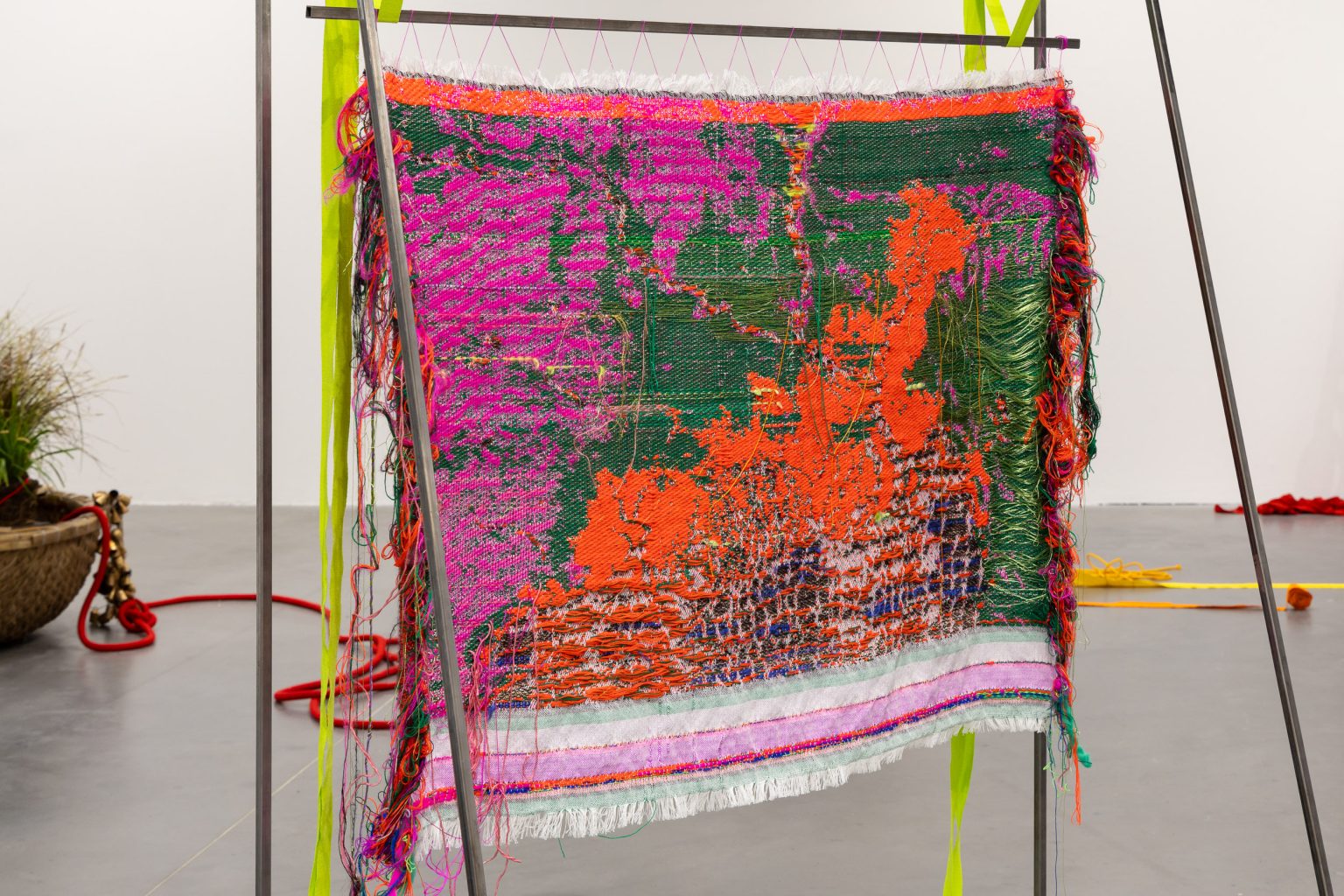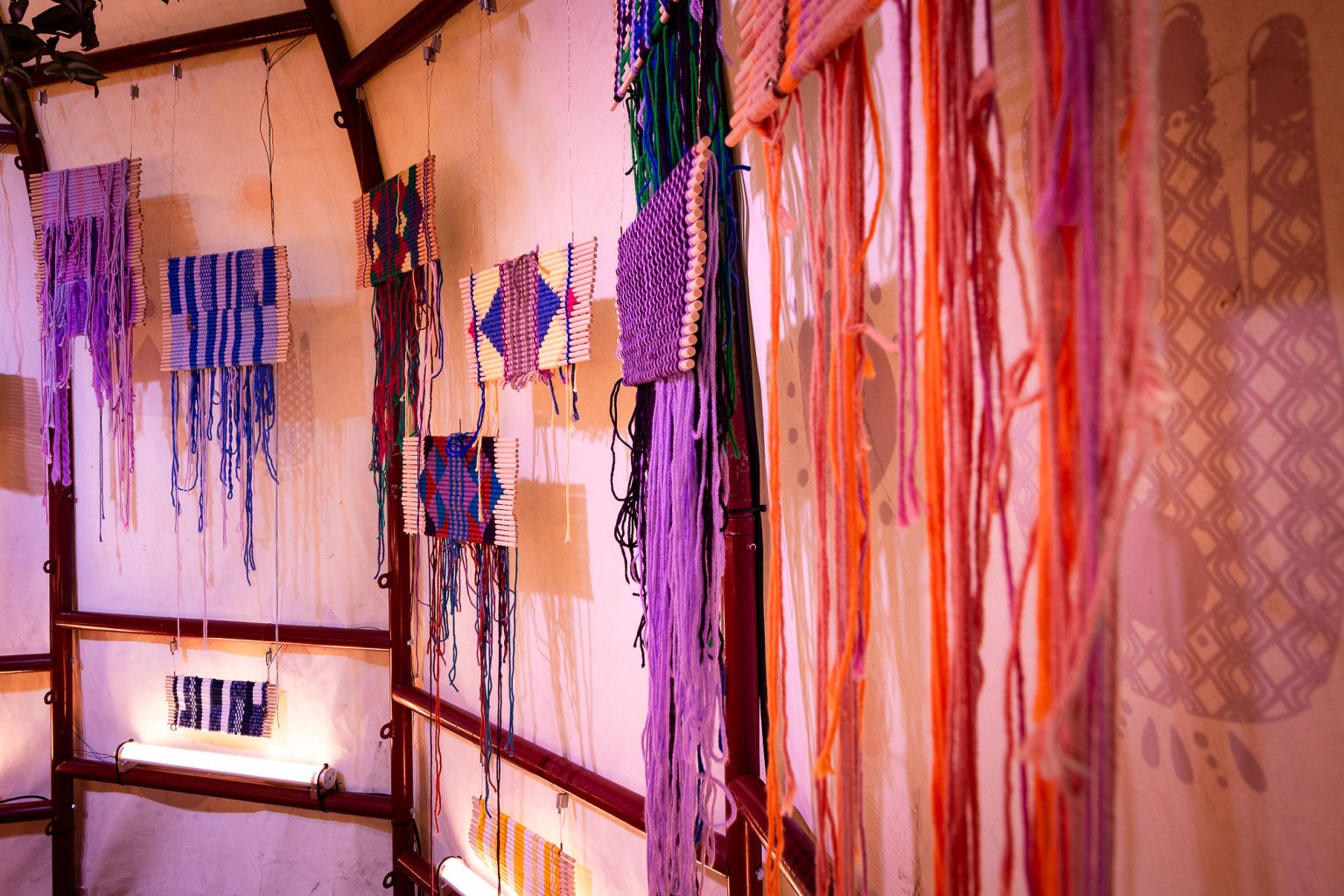
Upon entering the gallery at New Art Exchange I felt like I had been transported somewhere else, an organised explosion of colour, a universe occupied by intricate and detailed handmade objects. Matrika: She Who Makes Worlds is a newly developed exhibition by Saroj Patel that explores women’s strength, ancestral memory and the futures that can be imagined. Several windows allow natural light to stream into the gallery, adding to the welcoming atmosphere that I feel, white walls highlight the colourful works and a mix of sculptures that remind me of totems, plus ceramics, paintings, bells, thread, fabric and other objects are distributed everywhere.
Curated by David Sinclair, Head Curator at New Art Exchange, Patel’s exhibition has been eight months in the making, starting when the artist was selected from last year’s NAE Open to develop a solo exhibition at the gallery. This pathway is an important initiative from the venue, supporting artists with significant opportunities to develop ambitious new projects. In creating her exhibition Patel undertook a residency in Sagra, her father’s village in India, embarking on a journey through memories, and exploring the meaning we give to objects, the stories our traditions tell and the strength of women as a driving force in future building.
Colour and textiles are everywhere in Patel’s practice and I am in my element: I also have a love of colour, an enthusiasm for three-dimensional work, a longstanding interest in how a gallery space can be transformed by the objects contained within it, and the paths visitors make through it. Many of the objects in the gallery were originally created to make sound, but here they are fixed in place and made silent, adding a new depth to their existence.
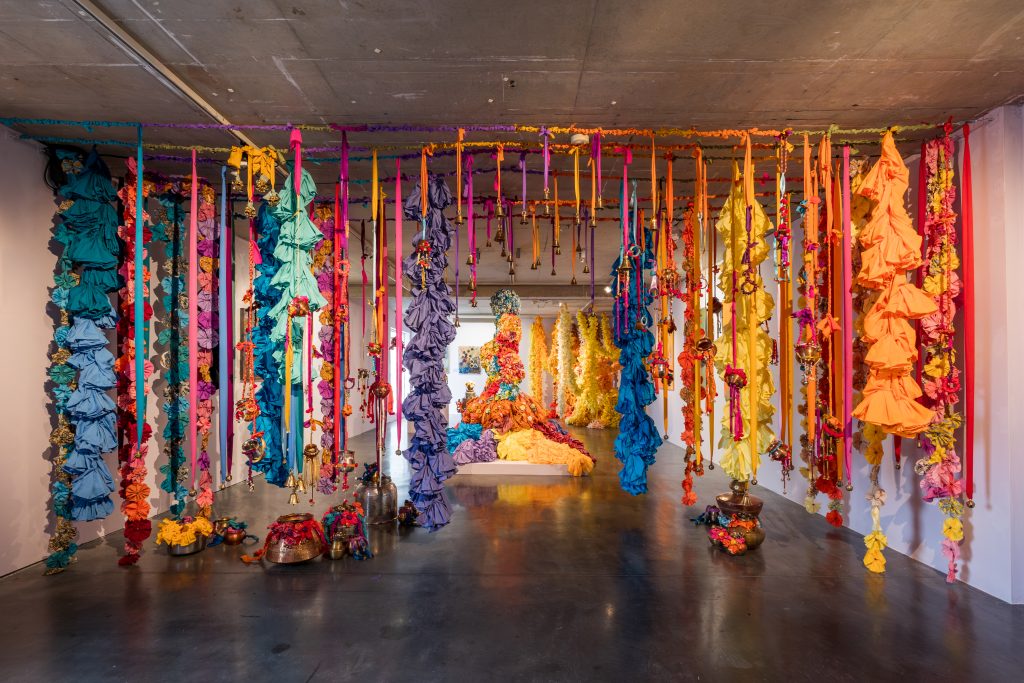
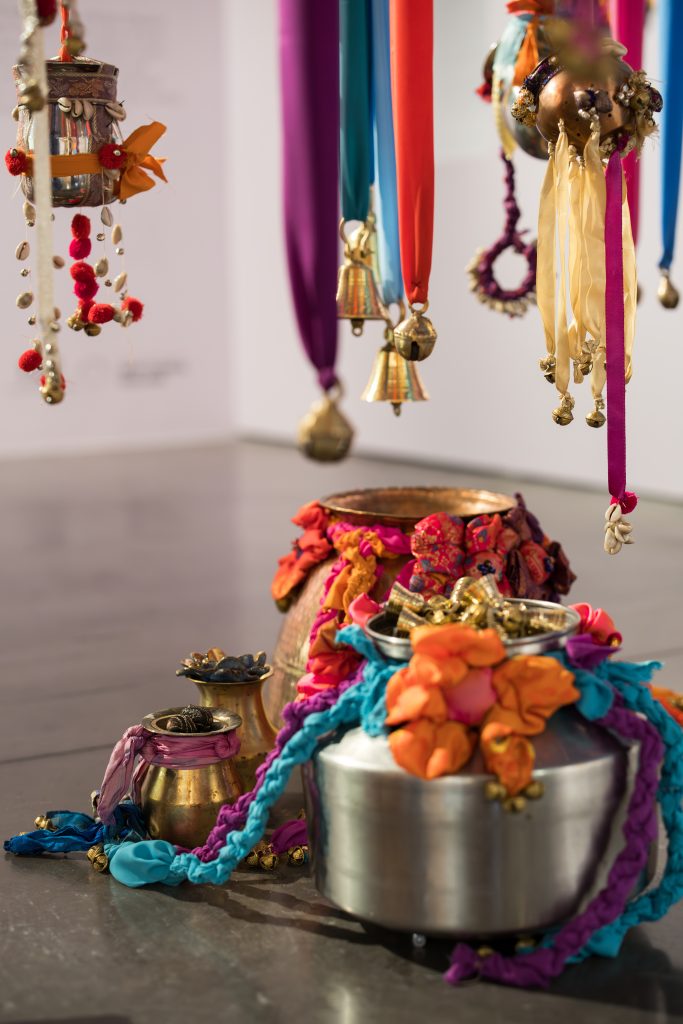
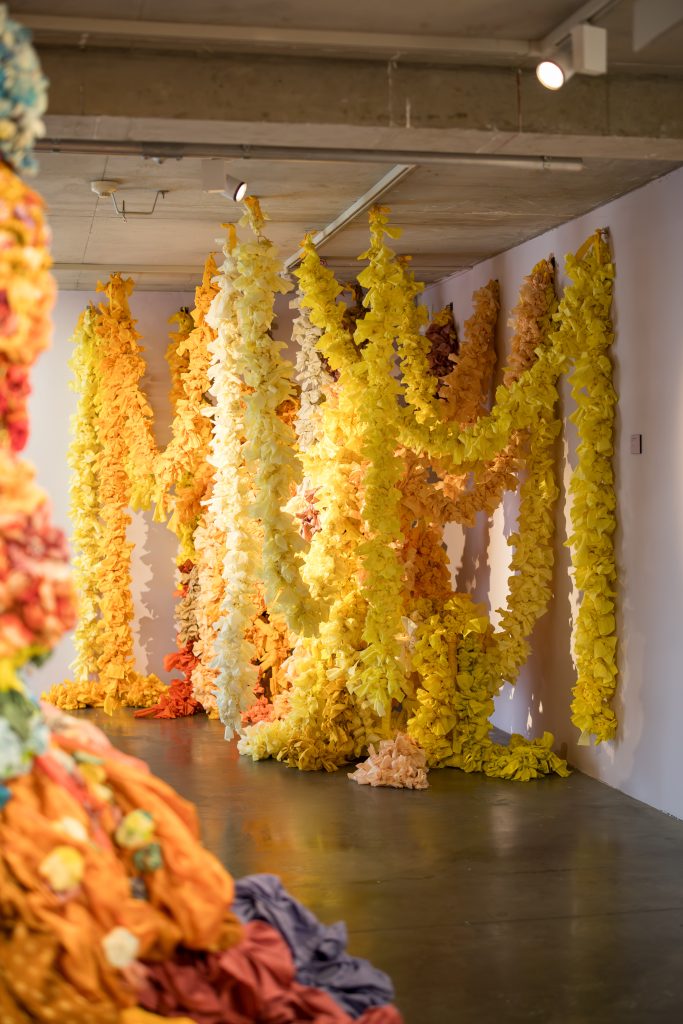
The first work that greets me as I arrive is ‘The Water Carrier’ (2026), an installation of hanging metal vessels and bells, distributed to create the shape of an entrance gate, creating a sense of crossing a threshold into the world of the exhibition. It was originally made by Patel during her residency, where it was hung from a tree. Carefully crafted in collaboration with many of the women that live in the village, many hands helping to make every piece of this wall to wall, ceiling to floor installation. Every hanging vertical line has its own story, a combination of sari material and other fabrics, bells, threads and multifaceted water pots called ‘Lotas’. I could have spent hours imagining and making connections with the people that used or made these things, the markings on the objects show their use over time, and act like a fingerprint of who held them and the stories they shared.
I saw this work at two different moments. At first, in silence just before the artist gave a tour of her exhibition. Returning to the exhibition later, the work was accompanied by an audio piece that carries the voices of the women who helped make it, birdsong and some background environmental sounds. In these different encounters I reflect on the degree to which I want or need to know about the stories behind the artwork. I do not understand the language being spoken, so for me it was like listening to a soundtrack and I wonder if the feeling it instilled in me would have been different if I had understood what these women were saying to each other?
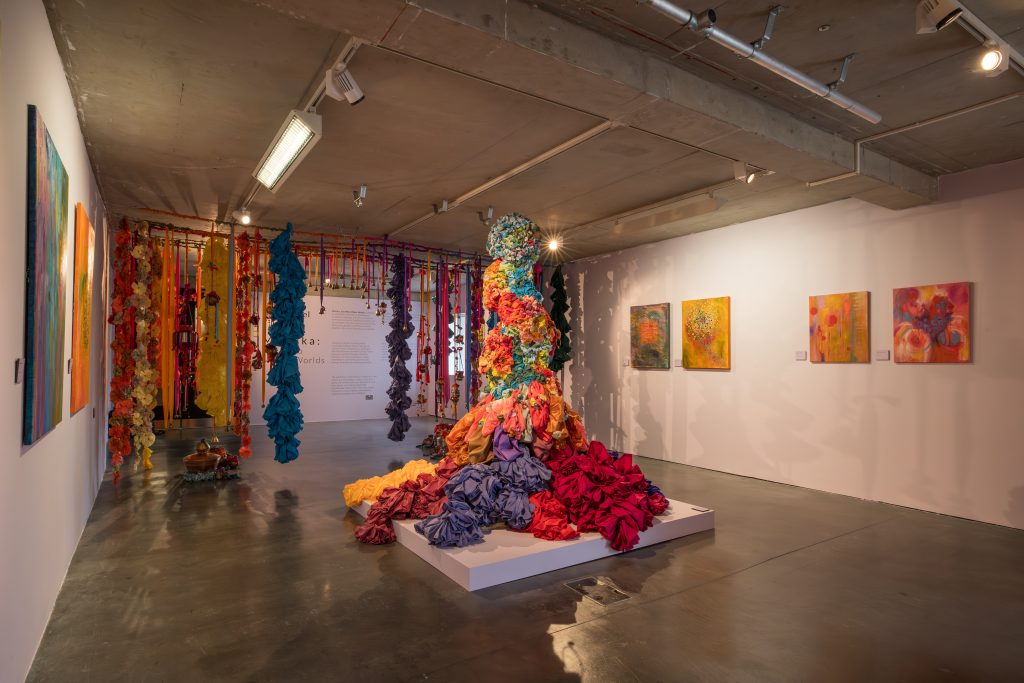
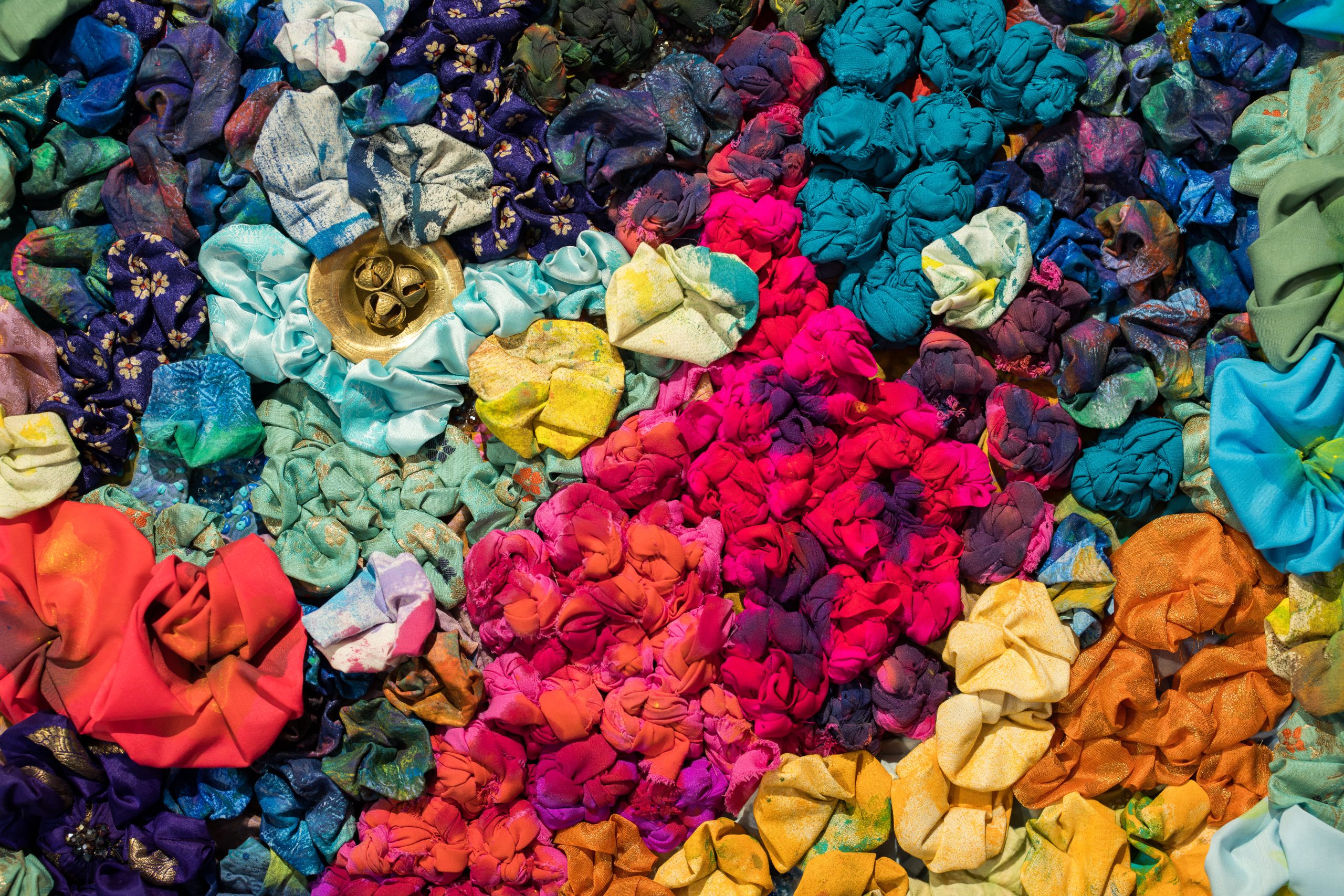
Passing through this threshold the next of Patel’s works, ‘Matrika’ (2026), stands in the middle of the gallery space, an imposing sculpture, taller than anyone in the room and made from fabric flowers of many colours. She feels alive and it reminds me of a volcano: the fire inside, a deep time of nature that is beyond what we can grasp as humans, the eruption of something held inside, the transformation of matter. ‘Matrika’ took the whole eight months of the residency to complete. Patel worked on the other artworks at the same time, but kept coming back to this particular sculpture until placing what she calls the ‘head’ of the piece, and feeling only then that she had achieved what the work needed. I strongly related to this slow experience of making, the time it takes to be fully present while producing an object by hand, with patience, an almost meditative process. The manual labour and repetitive actions of making flower after flower, and that unique state of mind that artists enter into in the meticulous act of crafting.
Painting, included for the first time in Patel’s exhibition, appears very experimental and fluid, with pieces distributed in groups around the walls. Some of them were begun by Patel’s young daughters and later worked into by the artist herself with oil paint and transparent resin, creating a watery, translucent surface texture that seems to reference the water-holding vessels scattered around the gallery. One work stands out in its simplicity: a red dot appears to be floating on canvas in ‘Held Within the Red Dot’ (2026). This is the bindi, the mark worn on the forehead by Indian women, and for Patel it is a motif that carries both a personal and a somewhat cosmic meaning. Patel’s paintings have many layers and are heavily detailed, and, as in her sculptural works, they contain hours of manual, arduous labour. Perhaps because Patel’s practice is primarily sculptural, and probably partly due to my own complicated relationship with painting as a medium, I find myself approaching them and reading their intent as sculptural objects, with their surfaces worked on repeatedly. There are other, more three-dimensional, wall-works dispersed around the room. These are made with fabric in Patel’s characteristic bulbous style, and which again leads me to view even the more painterly works as sculptural, object-like entities.
When I visited, Patel herself was present to guide a small group of visitors through her installation, sharing stories about the making of the objects; her reasons; her thought processes and her mother, who came to the UK as a young woman and built a new life here with great courage; a recurring narrative throughout the artist’s practice. Having learned to play the tabla in her forties, in a class otherwise made up of young boys, the artist’s mother frequently performs at Patel’s exhibitions, and a live event at NAE in July will transform the exhibition into a festive place of music and gathering.
I found it really enlightening to hear Patel’s stories of the making of the exhibition, explaining how her experiences in and memories of India greatly informed the works. In many ways the works speak for themselves on a material level, yet I wonder whether something of the stories so integral to the works’ meanings, could have been captured more in the exhibition interpretation. Whilst context is not always vital to enjoy or appreciate any artist’s work, with a practice like Patel’s that is so deeply informed by experience and memory, it felt perhaps that an opportunity had been missed.
To me, hearing Patel speak about her work helped me relate my own Latin American culture to the artist’s own, recognise common points from very different parts of the world and also to understand the collective origin of some pieces. At the end of the talk, a member of the group mentioned that they had been having a stressful day and that being present in the gallery had really helped them calm down. Hearing this, I realised my experience was similar. Patel’s exhibition is a place I want to inhabit, to take refuge in; to stand under the engulfing installation and move through it, touch the objects and climb the Matrika.
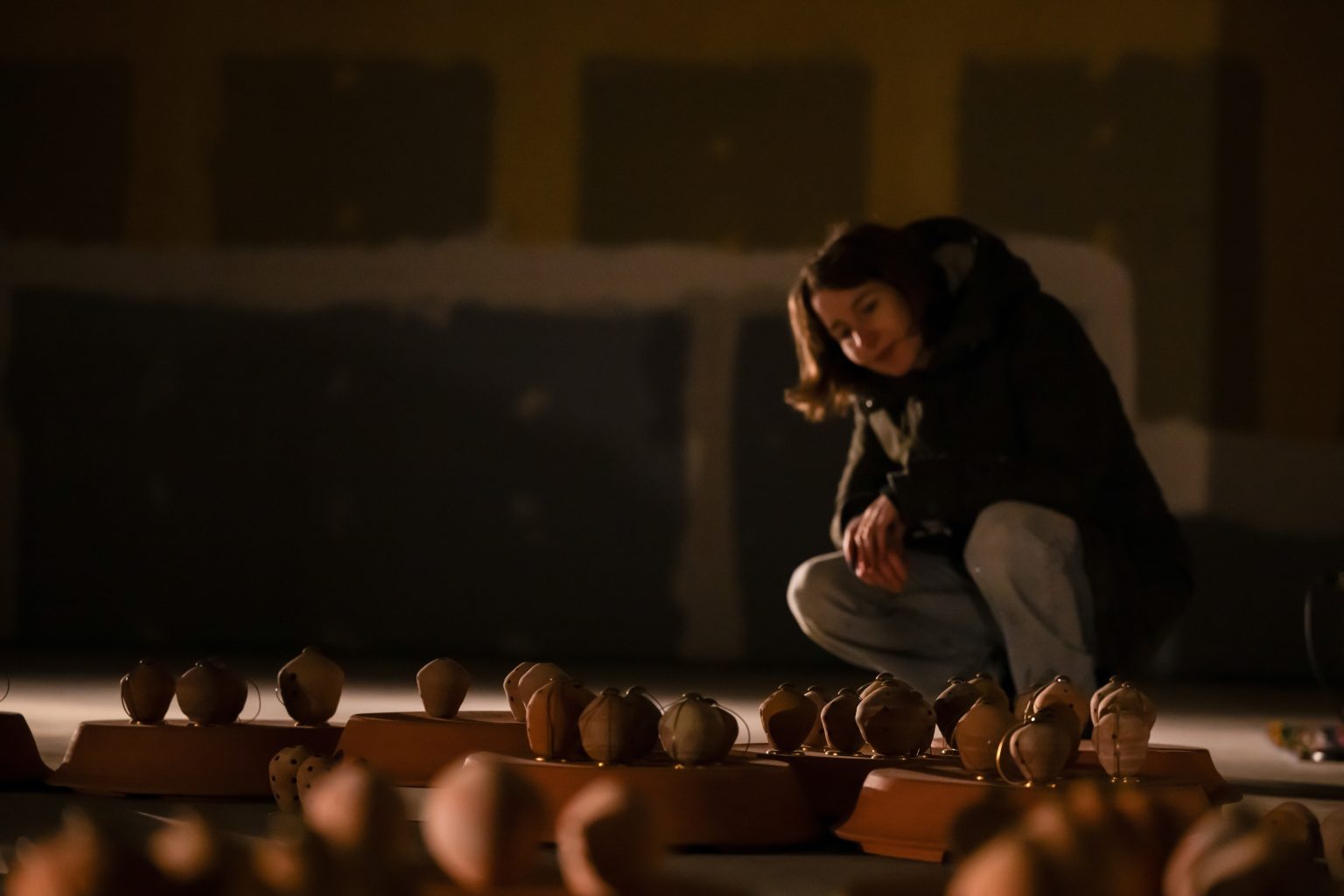
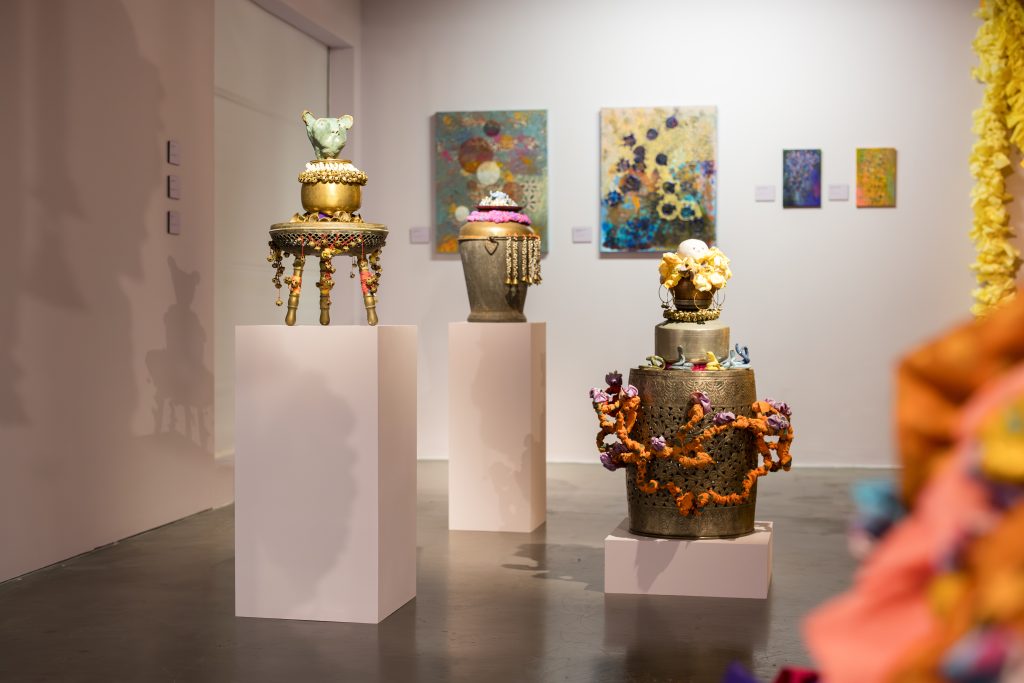
Patel’s ceramics are especially playful and plentiful. I can’t remember all of them (there were so many) and they contain so many details. Yet, even without fully recollecting the abundance of pieces, some hidden, many scattered, they are my favourite works in Matrika: She Who Makes Worlds. Each has its own personality and character, adding emotion and meaning, and at the same time they are really fun, something I appreciate in art: the sheer joy of making. Patel’s objects feel like peeking into portals to other parts of yourself, the artist that takes time to make things; stitching, spreading, shaping; the artist’s desire to discover and explore, and the answers that wait for us at the end of these actions.
In a corner of the gallery, a smaller gathering of yellow, ochre and orange fabrics are inviting. I really want to get inside but of course I’m not allowed. My own professional habit as a curator and producer kicks in, knowing that visitors should not touch artworks. My instinctive behaviour censored by myself! It is a small but telling tension. The work invites a kind of physical closeness and intimacy that the conventions of the gallery world often don’t allow.
Reflecting on the roles of women in society, and thinking of my own heritage as someone who also navigates between two cultures, this feeling of carrying the past while living in the present feels personal to me. I appreciate the similarities that I share with the artist, and the meaning we both give to the objects we use in our work as a way of preserving memory and staying rooted in our origins. What does it mean for someone creative to spend eight months making artworks by hand in an age where everything is processed, industrialised, and expected to be fast or immediate, while also having a daily life with obligations and expectations we have to fulfil? With this tension between external and internal processes that affect us at the same time, Patel becomes, like a ‘Matrika’ herself, the creator of a universe we are invited to peek into.
Matrika: She Who Makes Worlds, New Art Exchange, Nottingham 23 May – 12 September 2026.
Pamela Vivas is a Colombian curator, producer and writer based in Leicester.
This review is supported by New Art Exchange.
Published 29.06.2026 by Rachel Graves in Reviews
1,748 words