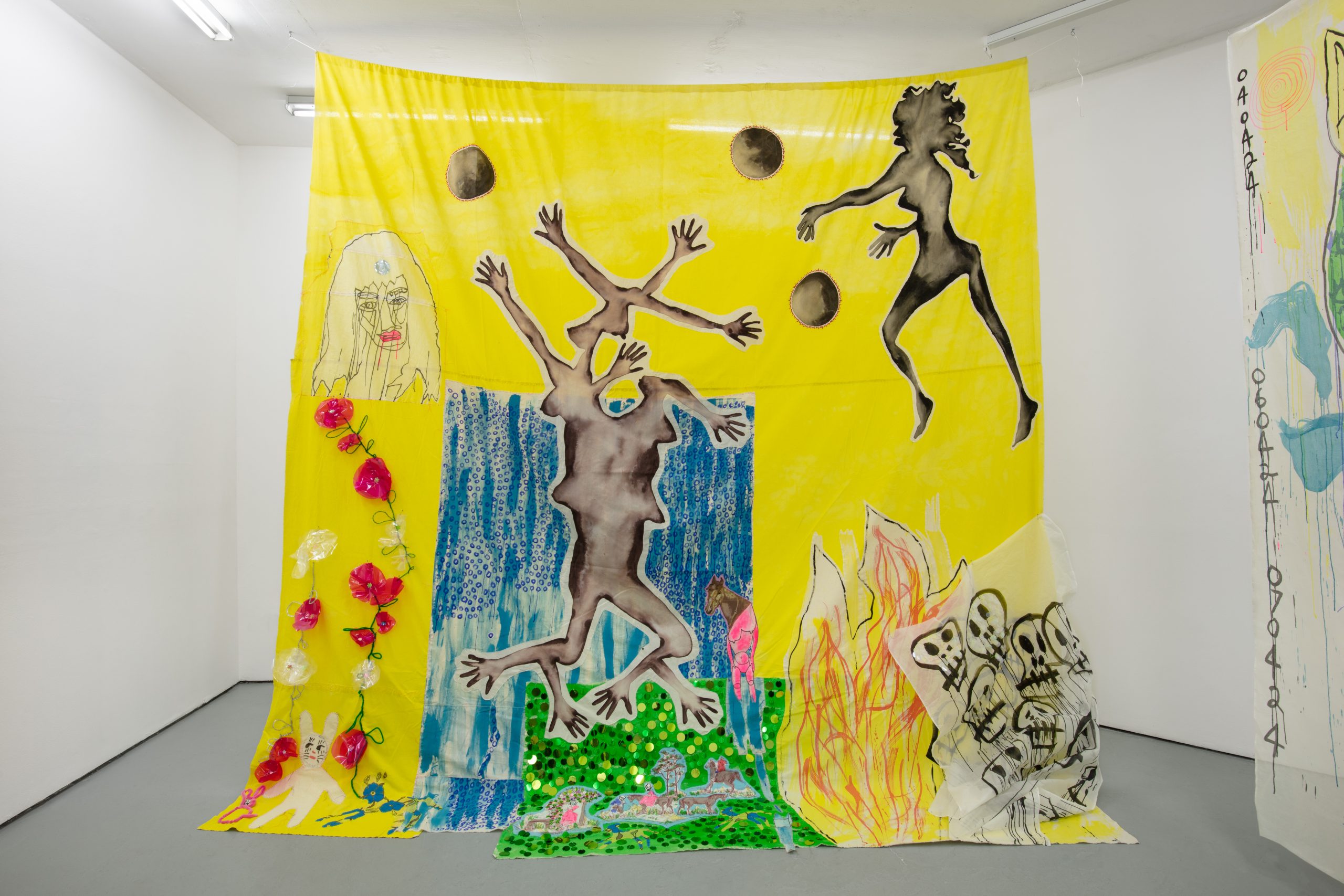
I’ve been waiting for this exhibition for months, looking up Delaine Le Bas online, enticed by her intricate, layered embroidery, the live installation of her home which bursts at the seams with artwork and books and decoration, the unbridled joy of self-expression in her personal fashion. For Le Bas, there is absolutely no distinction between life and art: ‘It’s like one big piece of work’, she says in one interview. Her multifaceted practice encompasses textiles, painting, assemblage and installation, performance and video, all exploring history and memory, her Romani heritage, the public representations of and discriminations against Roma, Gypsy and Traveller people, government, land, ownership, gender. Her works create fantastic, activist sites of resistance and remembering that you step inside and inhabit.
The home has been a key concern of hers for decades, from the years before her first solo show, Room (2005), which created a domestic studio space in Transition Gallery, to Safe European Home? (2011-2016), a collaboration with her late husband Damian Le Bas that took installations across Europe, beginning with a structure built outside the Austrian National Parliament in Vienna that highlighted the ongoing mechanisms of racism in our societies. Speaking elsewhere, Le Bas has described home, rather than school, as the epicentre of her childhood, and how her heritage and family’s practice of handmaking their own clothes made others cast her as an outsider from an early age. Now an internationally acclaimed artist, including a 2024 Turner Prize shortlisting, Le Bas’ new major solo show Un-Fair-Ground at the Whitworth gathers recent works and concerns alongside a new performance and installation, including a selection of works from the gallery’s collection.
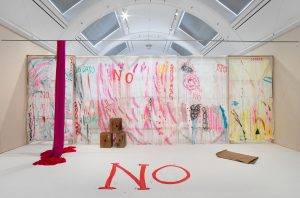
Manchester. Photo by Michael Pollard
The opening night’s performance is a frenetic collaboration with two other activist artists, Ronke Osinowo and Hḗrā Santos, all clad in multicoloured paint-splashed costumes with wide red crinolines, tap dance shoes and various masks, including an angry clown and a black horse’s head, roaming around the stage area where the floor bears the word ‘NO’ in huge red letters. Further ‘NO’s rain down across the backdrop paintings. Ominous refrains in the backing track create a creepy carnival atmosphere which the performers sometimes join in with, shaking bells and tambourines, hitting a xylophone, chanting the word ‘NO’ in chorus. The piece veers between these soundscapes and readings of texts, including Shelley’s 1819 poem ‘The Masque of Anarchy’, Le Bas’ own words, and a text written for the performance by her son, Damian James Le Bas.
The sinister whimsy of the performance piece feels both Lewis Carroll and Punch and Judy, culminating in one masked performer—I think Le Bas—donning an opaque red crinoline underskirt in a Red Queen move that seems like her claiming the main character role, stating repeatedly, seriously, ‘No! They will not steal our joy’. The work’s curious mixture of energies—sinister, playful, serious, reflective—bundled up in the repeated visual and aural refusals of ‘NO’, suggest an injunction to take both the acts of play and negation seriously. We can refuse the status quo, Le Bas says—that power is in us, and in that power is joy. It is a loud, joyous evening indeed, the soundscape continuing as attendees—young and old—play with the strewn around props, shaking the bells, playing the xylophone gleefully.
When I return a few days later, the space is much more sterile. There’s now a navigable route through the huge wooden structure of the performance space, from the stage area where the red ‘NO’ is painted on the floor, to backstage, where the costumes and props are hung with metal pegs on a washing line. Two of the five paintings on semi-transparent sheets of white organdie that served as the backdrop—quick, loose downward strokes of pink and red, with arrows, repeated ‘No’s and Le Bas’ signature curly dates, sometimes marking beginning, working days or completion—have been rearranged to create corridors for visitors to pass through. When they do, the fabric ripples, echoing the movements of Le Bas’ mark making and the movement in Damien Le Bas’ ‘Imperium Romanum Romani’ (2016), a huge map on which he’s detailed the historic movements of the Roma and other Traveller peoples in constellated arrows, which is displayed opposite.
After the wild energy of the performance, the movements left in the space feel like sad shadows. It feels still, sanitised, a far cry from the ‘space that invites new forms of engagement’ that the exhibition text promises. Despite a long list of planned events and activities over the show’s run, I learn from an invigilator that none of them are scheduled for this space. I’m disappointed that the energetic activation of this structure was so brief, and now so firmly in the past—that visitors to the show will only encounter what feels like the shell of the artwork and not the performance itself. In comparison with the photographs of densely layered and totally immersive installations by Le Bas that I’ve looked at online, this space is flat and bare.
Something of the performance’s sense of temporary community does continue, however, in Le Bas’ inclusion of two Manchester artists, Sarah Lee and Leslie Thompson, both based at the supported studio for neurodivergent and learning-disabled artists, Venture Arts. Shared motifs, concerns and even making practices chime between these works, from the embroidery and horse symbol in Lee’s textile work ‘All is Confused by a Horse’s Head’ (2026), and the Marvel characters in Thompson’s three drawings on fabric, including ‘Masters of the Universe and He-man’ (2026), to the use of loose lines and playful composition. Seeing this Romani artist, exquisitely aware of how precious and fraught her own presence in institutional spaces like the Whitworth is, opening the doors to other, local artists who have struggled for representation, for different but congruent reasons, is one method of both reclaiming and rejecting the designation of ‘outsider art.’
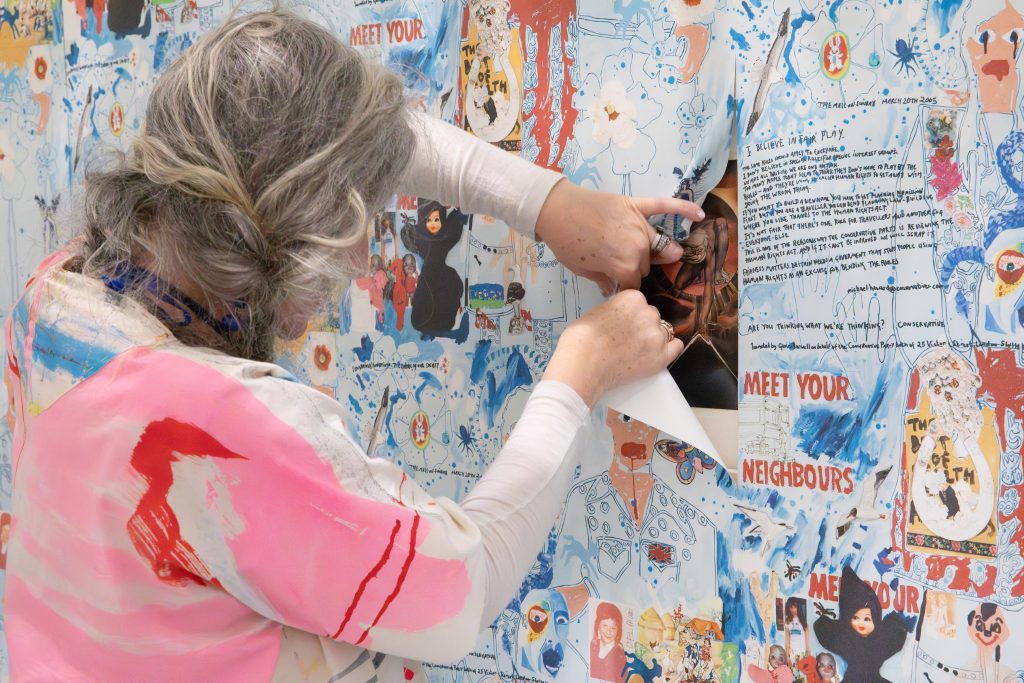
This generous embrace seems key to Un-Fair-Ground. In addition to the works by Thompson, Lee and Damian Le Bas, across the exhibition are more than twenty pieces selected from the Whitworth’s collection, from turn-of-the-century Ballet Russes costumes to pieces by famed Surrealists de Chirico and Miró, and a large number from the Musgrave Kinley Outsider Art collection. Many of these are shown inside Witch House (2026), a calico-roofed wooden structure recreated from Le Bas’ previous exhibitions, whose walls are covered with a newly created wallpaper—a speciality of the Whitworth’s—from one of her early paintings. Its motifs include blue drawn portraits and the outlines of hands, the handwritten text of a letter from a 2005 edition of The Mail on Sunday in support of the Conservative Party’s bid to remove the Human Rights Act protections from Gypsy, Roma and Traveller people, a photo of a witch doll and the slogan ‘MEET YOUR NEIGHBOURS’, part of The Sun newspaper’s 2005 abhorrent ‘Stamp on the camps’ campaign against allegedly illegal campsites in the UK. Holes are torn in the wallpaper to reveal the artworks behind, rough-edged tails of paper hanging down around the apertures’ edges. Le Bas has literally ripped through the racist surface of political life as presented by Murdoch’s billionaire media to show us something much richer and stranger—perhaps our own spiritual capacities, usually suffocated by the daily injustices endured by anyone designated other, outsider. Here are visionary works from Goya, Blake and Rego (all shunned at points by the establishment) alongside repetitive mark-making and highly wrought patterns from so-called outsider artists Shafique Uddin, Pearl Alcock and Madge Gill.
While Witch House offers a collection of works from across history that engage with occult and supernatural subjects, the installation here falls short of ‘exploring the artist’s deep engagement with magic, folklore and witchcraft’ as the press release promised. In fact, there is nowhere in the space or the literature any elucidation of what that deep engagement has been. Similarly, the decision not to label anything is perhaps a method aimed at achieving non-hierarchical relations between the works on show, but left me needing help from the invigilators to orient myself. A few people during my visits presumed that most of the work was Le Bas’ own without question. I can’t help but feel that the amassed artworks in Un-Fair-Ground, whilst presented in the spirit of rhizomatic connectivity and community, take up a lot of space that could be used to present more of Le Bas.
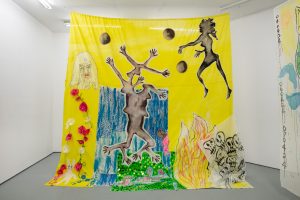
And more of her work is what I want to see. Her huge stitched and painted textile works ‘l’Archipel en Feu’ (2024), which feature curiously humanoid trees, whose roots and branches stretch out into human hands, captivate me. According to Le Bas, these works ‘are indicative of my thoughts about the connection between all beings’. Bright, vast swathes of yellow, green, pink and blue are punctuated by folded, plasticky flowers and shiny sequins. Here is death and heritage and animal life, and even outright protest—Le Bas photographed in a field with a skirt that says ‘NO’ and a placard that reads ‘NO STATE CONTROL’. These works encapsulate the simultaneous power of her refusals and joyous embrace of the world.
Elsewhere I have the sense that I’m walking between the tips of so many icebergs. Her ‘Exquisite Corpse Figures’ (2024), for example, are separated out, their humanoid chimeras— here a cuboid torso and tented head, there cuboid feet and a cat’s head baring teeth and tongue—missing the power of showing them together, as they have been previously. A film work, ‘Delainia: 170765 Unfolding’ is displayed beside ‘Rinkeni Pani’, a photograph of the artist in a forest wearing a multicoloured gown (both 2024). The former is from her 2024 exhibition of the same name at Glasgow’s Tramway, which is briefly noted in the exhibition handout, and the latter a commission for Tate’s 2022 exhibition Radical Landscapes, which I learnt in prior research. The works feel disparate, unconnected to each other or to Witch House behind me. Where the exhibition guide promises ‘a framework [not, unfortunately, a pun on the wooden structures here] for engaging with Le Bas’ practice’, it does so only insofar as situating these specific outcomes beside these specific works from the Whitworth’s collection. Le Bas’ pieces themselves lack the surrounding structures, by way of paratexts or further inclusion of works from larger projects, to really speak to viewers on their own terms.
The gathered negations of Le Bas’ works in Un-Fair-Ground could form a rallying cry against hierarchical power structures wherever they’re found, but instead they sort of dissipate into this melange of gathered works which prevents a deeper encounter with her practice. I wanted more on how she plays with masking and disguise, embroidery, personal memory, and how she conducts deep research into her subject matter. The many beautiful books in the final, calico-clad gallery space, offer to plug this hole. But the fabric sucks up the room’s light and energy, and I can’t find the inclination to sit down and study to learn what I wanted the exhibition to teach me. We could learn much from Le Bas’s ongoing commitment to a collaborative life of artistry and resistance, both at home and within institutional arts spaces. I only wish we’d been given more of an insight into it here.
Delaine Le Bas: Un-Fair-Ground, the Whitworth, 13 February – 31 May 2026.
Jazmine Linklater is a writer based in Manchester, and is a Regional Editor for Corridor8. Her new poetry publication is Snagged on red thread (Monitor, 2025).
This review is supported by the Whitworth.
Published 25.02.2026 by Laura Harris in Reviews
1,967 words