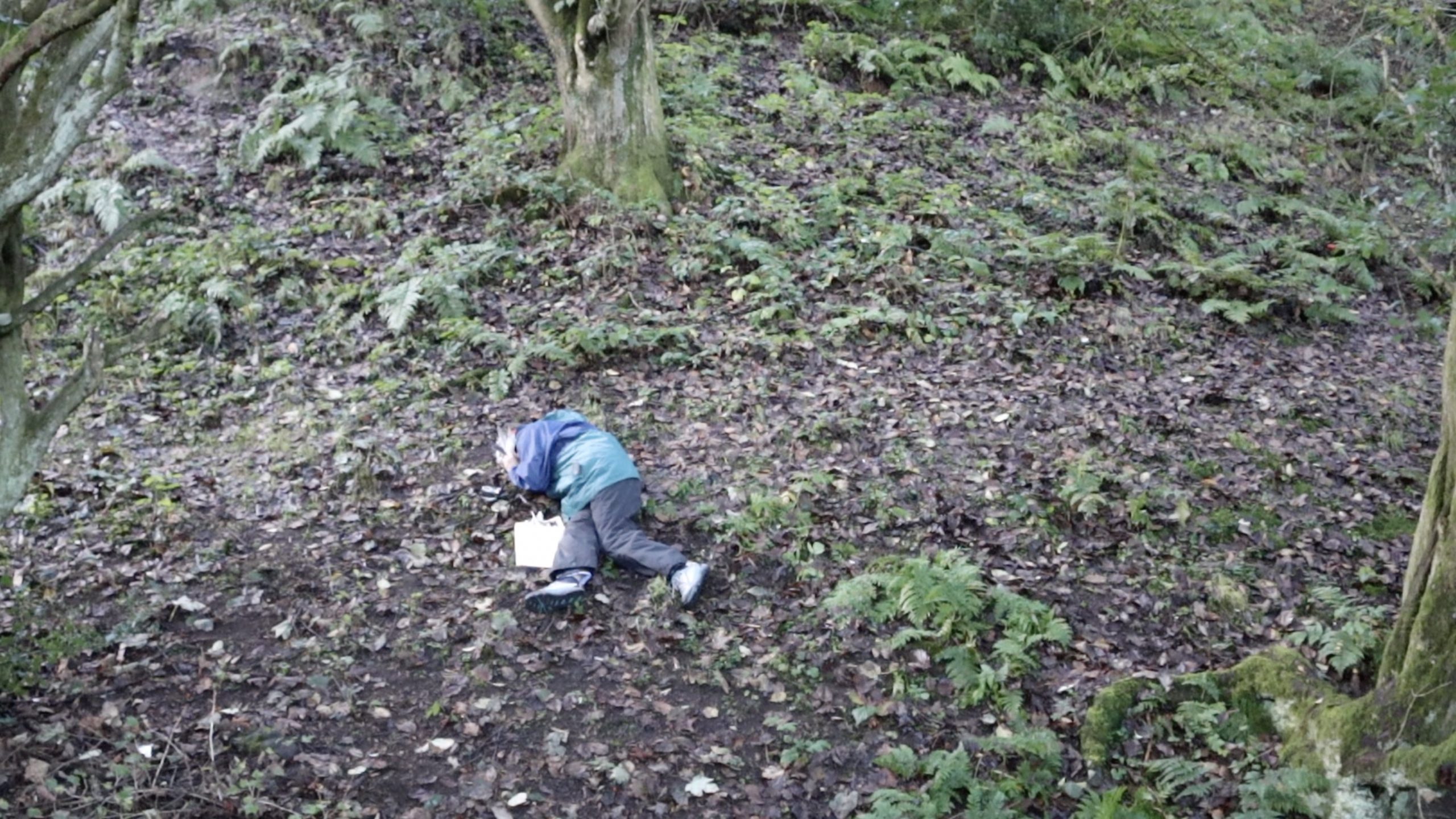
Woodland Bird Woman features a twenty-minute single screen video, notes showing Esther Salamon’s ideas for the exhibition, and some objects displayed in the film. A poignant narrative of multispecies companionship shapes the entire exhibition, encouraging the viewers to reflect on death, memory, and the traumatic legacy of persecution and displacement.
The exhibition represents Salamon’s life’s work. Born in 1951 to Holocaust survivors in Israel, Salamon grew up with images of blackouts, sounds of explosions and stories of death. When she was six, her family emigrated to the United States. There, as a child-immigrant, she carried dead birds lying on the street in the basket of her bicycle and buried them in her family’s garden. It was in 2021 that she began working on the film, which shares its name with the exhibition. The first three parts were filmed at dawn across three different seasons: autumn, winter, and spring. Unfortunately, Salamon did not live to see the work through as she passed away in December 2023. The film was completed in May 2025 by her collaborator Robert Laycock and widower David Stephenson. Parts of it were shown in Poland, but the first full installation made its debut at Newcastle Contemporary Art in September this year.
Salamon’s unusual childhood memory informs the artistic vision behind the entire exhibition. Her unpublished notes, framed and reproduced, are displayed alongside selected objects from the film, which lie on a white wall plinth. The spotlights in some parts of the room make the notes and the objects clearly visible. Even so, the relative darkness suggests that the most significant part of the exhibition is the film itself, the notes and objects mere accompaniments, there to be viewed in relation to the film.
Salamon’s notes include ‘Thoughts in Progress’, extracts from a notebook titled ‘Art Projects’, and post-it notes written during film production. ‘Thoughts in Progress’ from 2004 contains an excerpt from the operatic aria in the final section of the film – ‘Dido’s Lament’ from Henry Purcell’s Dido and Aeneas (1688). The inheritance of an idea from 2004 to a film completed posthumously in 2025 shows that the vision behind the exhibition has been decades in the making. The viewers find in Woodland Bird Woman the evolution of an artistic vision that shows its fierce commitment to the preservation of a childhood memory, relevant even after Salamon’s death.

One of the short notes in ‘Thoughts in Progress’ is particularly striking: ‘I have nothing, not even a grave to visit.’ It captures Salamon’s preoccupation with the unburied dead, evoking the experiences of a young grieving child. The note suggests that Salamon’s efforts to rescue dead birds from abandonment by burying them with dignity are attempts to work through this grief. The image of a young Salamon burying dead birds becomes a symbol of a child’s desire for closure, which gains further significance in her choice to bury nonhuman animals with whom she had no personal connection. The birds are not her ‘companion animals’ (commonly but problematically called ‘pets’ in mainstream discourse), yet by claiming their remains, Salamon binds them to herself as one might a beloved companion animal in their home.
The act of burying the birds is re-staged in the film’s opening. Salamon’s urgent digging and her gradual decoration of a nearby tree with feathers translate her grief into care. In these scenes, the decorated tree becomes a gravestone while Salamon’s feathered cap marks her out as a gravedigger, determined to claim the unclaimed dead. Shot by Salamon while in her late sixties and early seventies, these scenes offer glimpses of an immigrant child’s formative years in the 1950s through the eyes of a mature woman.
The final part of the film, shot after Salamon’s death, transforms the burial into an act of mourning. Wearing her clothes and her feathered cap, Stephenson returns to the same landscape and continues her attempts at remembrance. The act of laying two nests on the feathered tree — one holding a dead bird and another holding a child’s toy, presumably belonging to Salamon — signifies Salamon herself being laid to rest a second time, with the very bird she had intended to bury with her own hands. Through this doubling, the film conjoins the human and the nonhuman. As Stephenson turns his back to the camera, the viewers are invited to enter a shared space of mourning.
The film ends with a young woman rope-dancing to ‘Dido’s Lament’. The aria is sung in baroque pitch by Alison Barton, while the rope-dance is choreographed and performed by Freya Averley. Salamon, whose notes from 2004 reference the aria, had intended to conclude the film with an aerial performance herself. Her cancer diagnosis and subsequent death made it impossible for her to play with the motif of flight through dance. Averley’s riveting performance replaces the one Salamon had wanted for herself. Salamon’s replacement by a much younger woman has the effect of transforming the film into an allegory of the cyclicality of life. Like the tree, the film itself becomes a marker of life and death. Just as the tree withstands the death of Salamon and her bird, the film, constituted by the life and death of Salamon, ends with a celebration of life.
In Dido and Aeneas, ‘Dido’s Lament’ expresses Dido’s grief after her abandonment by Aeneas. Her final act of suicide represents her triumph over her sorrow and her acceptance of death. The concluding lines in the aria, albeit tragic, testify to this triumph:
Remember me, remember me, but ah! forget my fate.
Remember me, but ah! forget my fate.
In the film, Salamon’s re-enactment of scenes from her childhood honours her early gestures of care. The final part culminates with Stephenson’s farewell to both the bird and Salamon. Averley’s performance to ‘Dido’s Lament’ pays a tribute to Salamon — who, like the bird, cannot fly, but whose life and flight were witnessed and will be remembered. The dance claims Salamon just as she once claimed the birds. Although the film is thematically shadowed by death, it shows that life persists: the Salamon who once mourned the absence of a grave now lies in many — her own, the film itself, and among the birds in the trees.
In addition to the notes and the film, some objects from the film also shape the exhibition. These include the clothes Salamon wears in the film and the two nests Stephenson carries to the tree. One of the two nests holds a taxidermized bird. In recent years, Critical Animal Studies has challenged the use of taxidermy for its exploitation of nonhuman life, not least because human exploitation of nonhuman life threatens to worsen current threats to multispecies living in the wake of the climate crisis. The presence of a taxidermized bird, which only exists as a display, unsettles the otherwise coherent narrative of multispecies companionship in the exhibition.

If Woodland Bird Woman falls short of articulating the possibilities of multispecies companionship, it makes up for it with its investment in transnational solidarity. Before Salamon passed away, she noted an important aspect of her artistic intention: ‘This very personal piece [is designed to] resonate with the experience of young refugees who have lost members of their family in regions of conflict and who experience trauma.’ That the exhibition does resonate with the experiences of young refugees grieving their own unburied dead evidences the tragic reality of war and violence, unchanged in Salamon’s lifetime.
The period between Salamon’s death and the posthumous completion of her work coincides with the period of genocide in Gaza, engineered by the Israeli regime and funded by warmongers worldwide. Further, the open day for the public exhibition of Woodland Bird Woman was postponed by a week in England due to a scheduled march by UKIP supporters calling for mass deportations alongside leading fascists such as Tommy Robinson. It is clear why the exhibition was postponed: neither an exhibition that extends solidarity with the refugee and asylum community globally, nor the people keen to attend the exhibition were likely to remain safe whilst fascists marched on the streets under the guise of peaceful protest. Ultimately, those in the march were vastly outnumbered by the anti-fascist protestors in the counter-protest, but the threat that their scheduled march had announced, in Newcastle and across England, was clear.
The genocide of Palestinians, live-streamed in media, combined with calls in Britain demanding the deportation of migrants, refugees and asylum seekers in particular, demonstrates that the stories of violence and hate that Salamon grew up with as the daughter of Holocaust survivors continue to represent the lives of people today. The location or the extent of violence may have changed, but the reality has not. Salamon’s underlying aim to extend and call for transnational solidarity shapes this exhibition, showing the extent of its investment within the wider narrative of multispecies companionship. When viewed in the context of the contemporary political order, the exhibition testifies to the unchanged reality of violence in today’s world.
Despite the trappings of conventional exhibition displays, which may include problematic taxidermic displays for aesthetic purposes, Woodland Bird Woman highlights with success a multispecies encounter between Salamon and the birds, shaped by Salamon’s sense of companionship and willingness to care. Nowhere is the encounter most evidently fleshed out than in the film, where it exemplifies multispecies companionship exceeding the limits of normative human-nonhuman relations. The beauty of this companionship explains why the burial of the birds is an important event. Even though a burial does not hold any meaning for birds themselves, it becomes, here, an act of memorialisation showing human care for nonhuman others. The film, central to the exhibition, becomes an allegory of the cyclicality of life.
Mridula Sharma is a writer and artist based in Newcastle Upon Tyne and is currently part of the Collective Studio at The NewBridge Project.
Woodland Bird Woman was on show at Newcastle Contemporary Art on 26 September and 4 October 2025.
This review is supported by The Collective Studio, an artist development programme at The NewBridge Project.
Published 04.11.2025 by Lesley Guy in Reviews
1,720 words