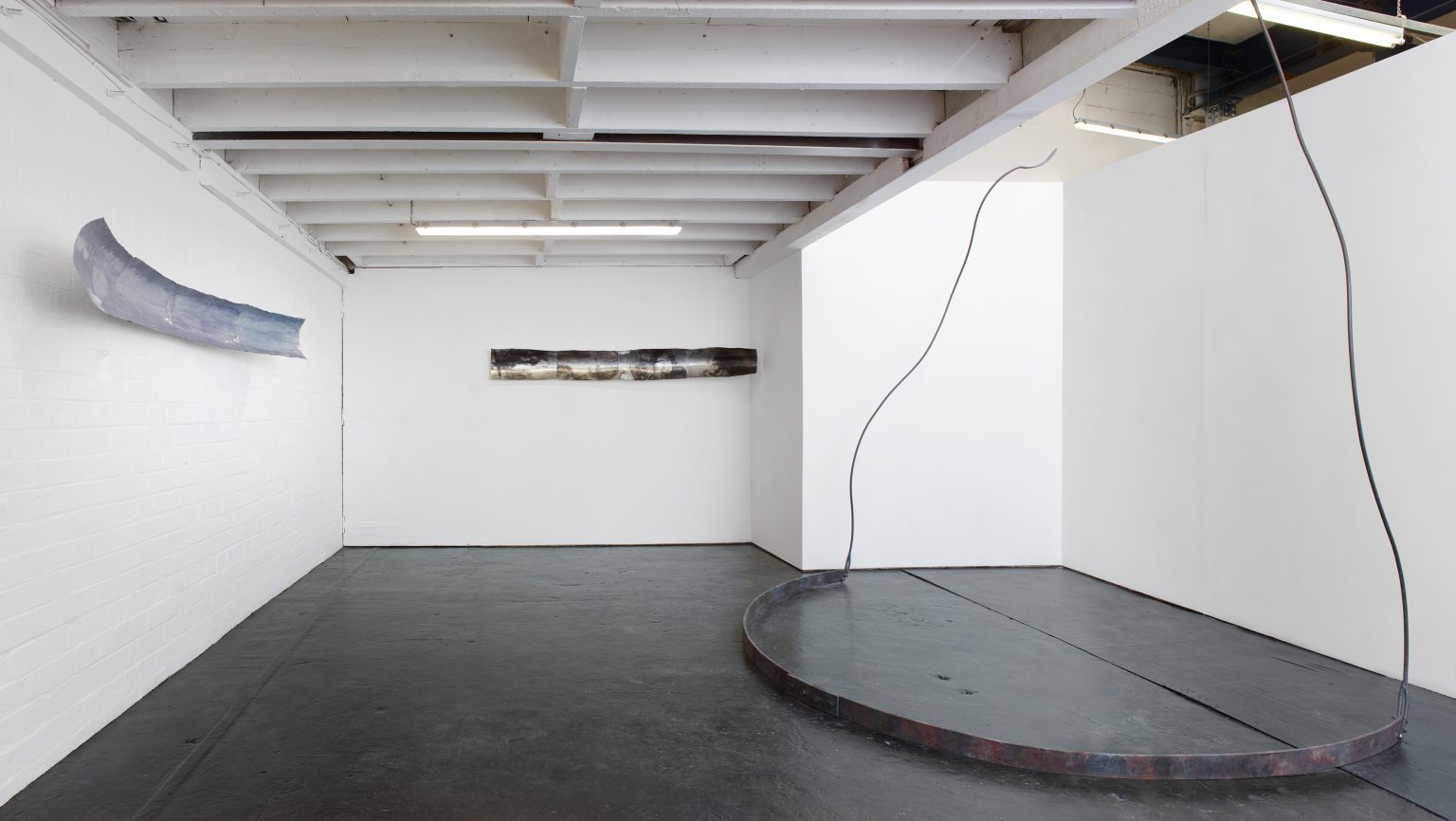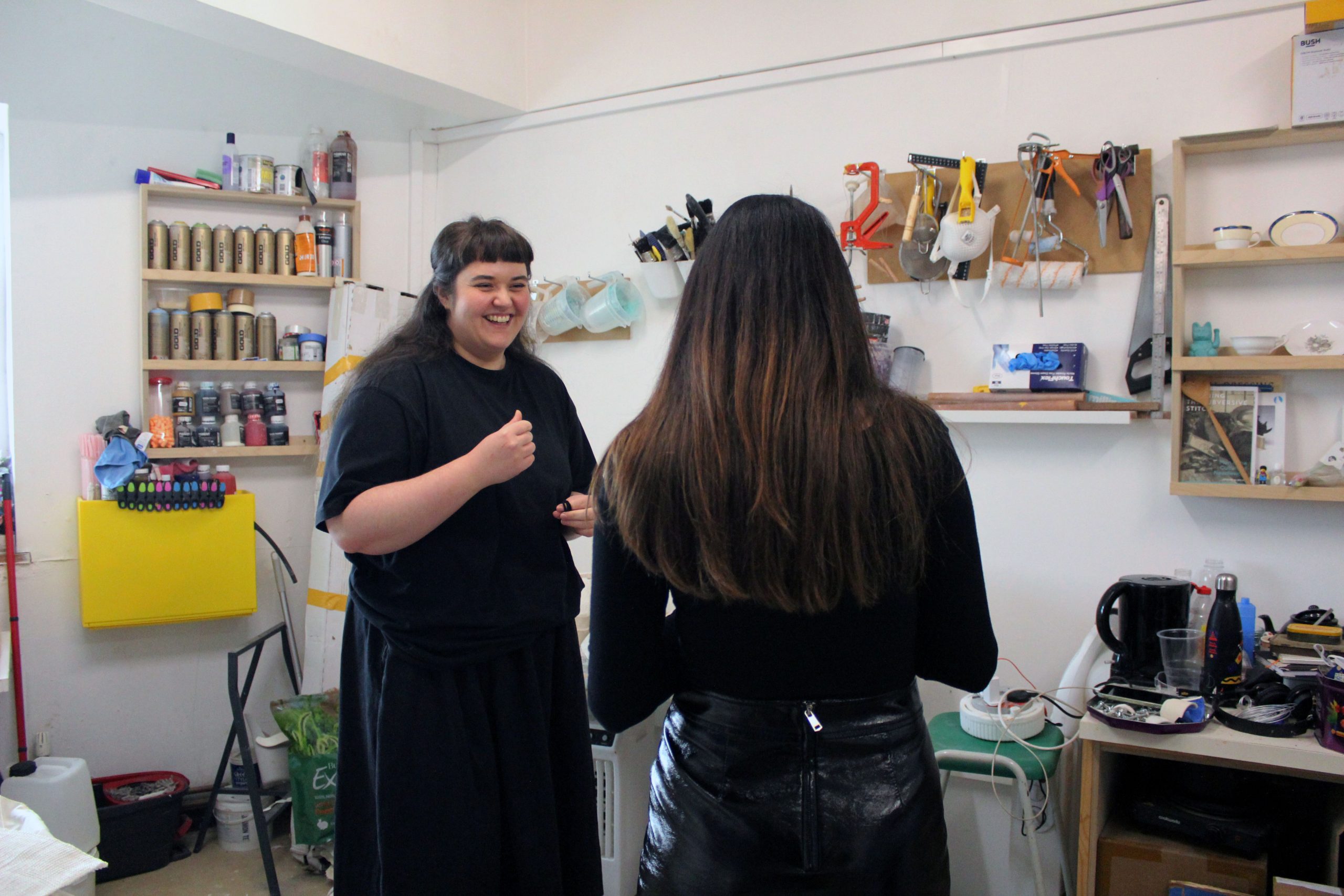
Exchange Place is a large art deco building in Sheffield’s historic Castlegate Quarter. Since 2013, it has been managed as affordable art studios by Yorkshire Artspace, providing a base for over eighty-five visual artists. It’s also home to arts charities Carousel Print Studio and Arts Catalyst. The ground floor features a small street-facing project space, currently used for exhibitions by Arts Catalyst and Yorkshire Artspace’s Testing Ground residencies.
They affectionately call it the fish tank – those giant windows offer nowhere to hide. Working in full view of passers-by is a kind of rite of passage for artists-in-residence at Exchange Place, and one which can feel intimidating to those who might prefer the quiet of a studio. But sometimes, it’s an artist’s willingness to share their trials and errors which can lead to the real creative breakthrough.
For Tyler Mellins, Exchange Place is best understood in these terms: as a kind of laboratory for ideas. As Programme and Communications Officer, he takes an active role in everything from helping artists write funding applications to playing devil’s advocate at monthly crits. ‘I have to become a pantomime villain,’ he says, though on the day I visit, he seems more like a friendly ranger, patrolling the floors and making sure everyone has what they need – in my case, a hot drink and a stack of crisp, colour publications printed to go alongside their most recent series of residencies.
It’s the kind of detail that underscores just how invested in its artists Yorkshire Artspace is, but outside of their close-knit community, it’s a space that can sometimes feel cut off from the rest of Sheffield. The annual Open Studios (this year on November 15 and 16) are a way of reconnecting – alerting curators to emerging artists, developing peer networks, or simply flinging the door open to anyone who ever wondered about the curious things they might encounter within.
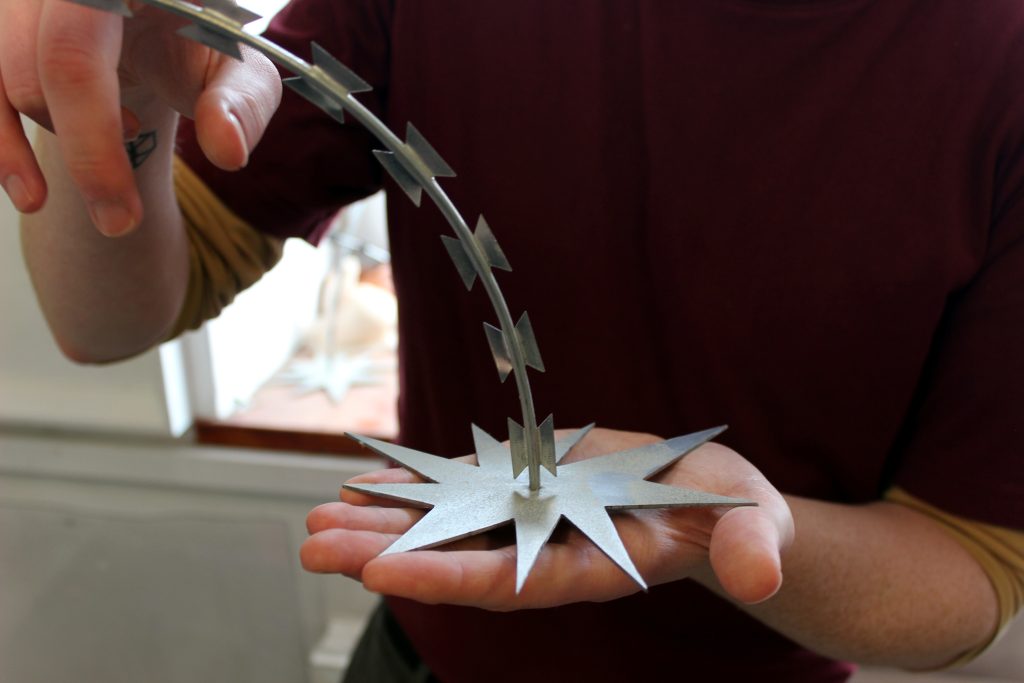
If you happen to visit Thomas Griffiths’ studio, it’s probably best not to touch any of those things. One of the first works they bring to my attention is ‘Splash’ (2024), a collection of welded steel rods studded with razor wire. Your fingers and thumbs might gravitate towards the stem, like a thorny metal rose, but you’d quickly regret picking it up. ‘I tend to give people a warning first,’ Griffiths says. ‘I’ve shredded myself so many times.’
The piece was inspired by the artist’s enduring fascination with hostile architecture and other details that can make a city feel sealed off, inscrutable – spiked walls, manhole covers, utility markings on a pavement – something they’ve observed both in Warrington, where they grew up, and in Sheffield. ‘As a key worker during COVID, I became more aware of blockades and barriers,’ they explain. ‘It made me start thinking in a metaphorical sense about the class system, and about barriers in identity politics.’
Their practice expresses a desire to confront this strategic gatekeeping, the forbidding armour of a city that can feel so closed off and exclusionary. ‘It all comes back to queerness,’ they observe. ‘I think there’s a hostility inherent to growing up queer and being told you’re dangerous. You end up romanticising destruction.’
Griffiths’ work offers up codes but does not crack them for you. However, a wall of inspiration gives some clues. There’s a Claes Oldenburg hamburger, and freeze-frames from Invasion of the Bodysnatchers, Videodrome, Alien – the kind of films where physical appearances aren’t what they seem. Griffiths’ sculptures do this too, occupying surrogate bodies, concealing their true form. There are signs on the walls with arrows that point nowhere in particular, as if reminding me not to take surfaces at face value but to understand our environment as something more cryptic, more porous.
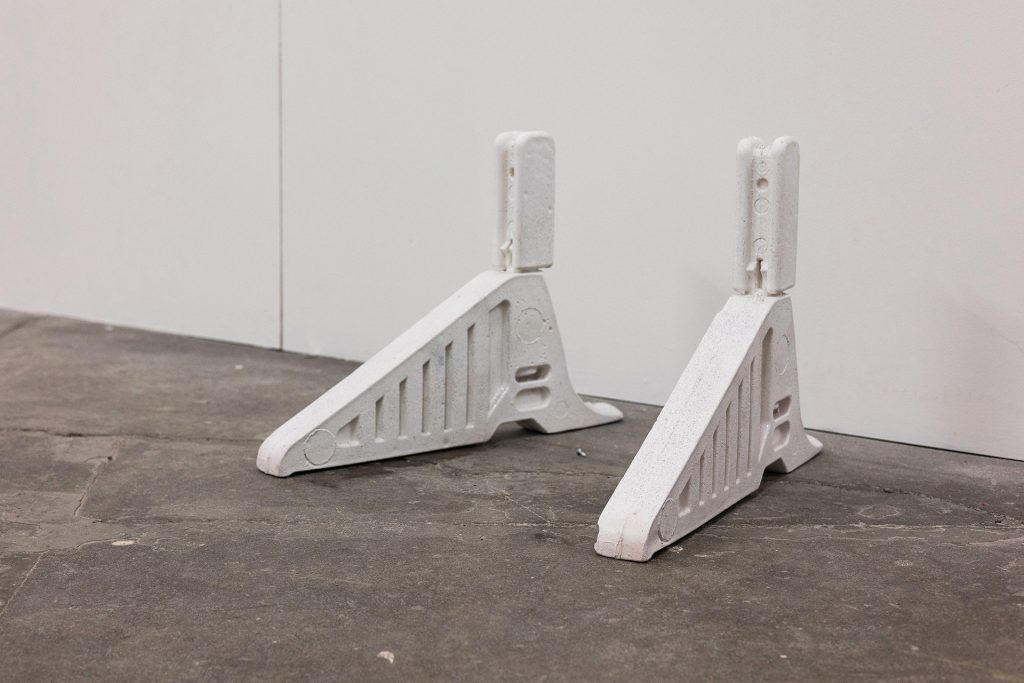
Griffiths is equally interested in the shapeshifting properties of materials, and how a change in texture can alter the way people relate to a piece. ‘Standing in your way’ (2023) is a series of plaster cast traffic sign bases. Arranged in pairs and repainted bold colours, they transform into heeled shoes. Their apparent sturdiness is deceptive – they’ve been exhibited three times, and three times there have been breakages. ‘I was thinking of ways to remake them with foam, defy their solid, grounded nature, and make them more malleable,’ they add. Later, when Griffiths picks up a small pyramid sculpture, I have a hard time guessing whether it’s concrete or sponge.
The ‘Standing in your way’ sculptures might have a wry, even anthropomorphic quality, but generally Griffiths prefers to downplay any humour. A previous exhibition GOALS (2019) at GLOAM, Sheffield, explored the belligerent masculinity of the changing room, featuring deflated footballs, untied laces and slouching lockers. The work spoke authentically about the discomfort and horror of these heteronormative spaces, but now Griffiths prefers a more ambiguous approach, letting the materials voice the ideas.
Masculinity is still a theme, but with a focus on intimacy and individuality rather than aggression or one-upmanship. Like ‘Assimilate’ (2024), a welded and upholstered sculpture of two motorbike seats, inspired by the devil-may-care recklessness of boy racers. ‘Where I live there are no speed bumps, so there are lots of crashes, and it’s typically young lads,’ Griffiths reflects. ‘They’re destructive, ripping up grass, leaving traces, making marks, disrupting the norm. Is it vandalism? Or reclaiming the space for themselves?’ Sensations of desire and risk converge in the black PVC leather, not that I see this with my own eyes. The piece is packaged up during my visit, as though in a state of suspended animation. But it appears suitably muscular and athletic through the layers of bubble wrap.
There have been, Griffiths suggests, times when the work has been almost too subtle for its own good. A vent sculpture produced for their MA degree show was deposited under a glaring strip light, so that the glow cast by its own inner lamp could no longer be seen. For an artist so intrigued by overlooked industrial objects, perhaps they quietly enjoyed that.
The hazards of taking work out of the studio are tenfold, but inviting people across the threshold carries risks too. During last year’s Open Studios, Griffiths was slightly taken aback when a visitor looked them in the eye and asked, ‘How do you connect with this?’ Despite a love of traffic iconography, they are wary of providing too much signage; it’s better when people respond to the familiarity of the materials for themselves, unbuckle their expectations. This year, Griffiths might set up a small exhibition table of sculptures, so that people know where to look when they wander in, rather than getting sidetracked by sanders and power tools.
And yet…something holds them back. ‘I don’t want to spell it all out,’ they say. ‘I don’t like things to be surface level. There’s so much information being fed to us all the time, which you can pay attention to or dismiss. But things have depth, and people should really spend more time with them.’
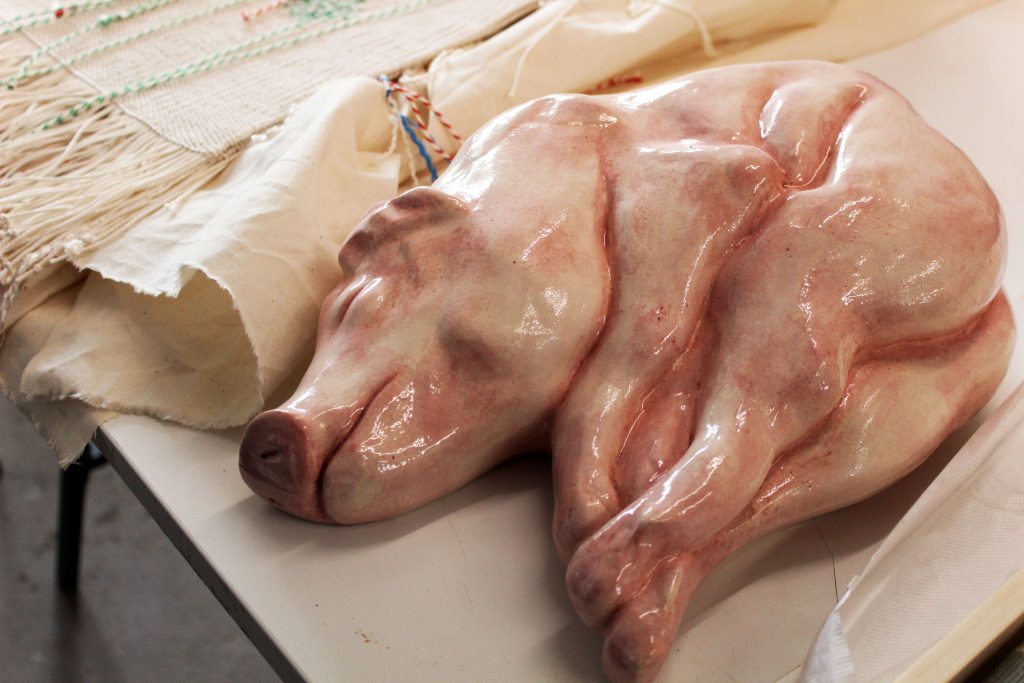
Next, it’s upstairs to Charlotte Dawson’s studio, where I’m greeted by the arresting sight of a small dead pig curled up on the countertop. This clay sculpture forms part of a sequence Dawson has been making to explore the materials and aesthetics of death; not in its raw form, but a more primed, palatable state, the kind brought about by human intervention. ‘It’s based on the vacuum-formed pigs you find in freezers at wholesalers,’ she explains. ‘I used to work in a sandwich shop, so lots of things I make are influenced by the day-to-day. I was interested in preservation and the ways artificial plastics are used, as well as the connection between glazing pork and glazing ceramics.’
Usually, Dawson prepares work with a specific exhibition in mind, but these are ideas that have arrived more sporadically, informed by the particular textures associated with death and remembrance. The buffed surfaces of granite, for example, or brittle plastic bouquets manufactured to withstand however many winters.
Next to the pig is a work-in-progress, a flower image woven in butcher’s twine, the same sort used to string up a joint of meat. She is intrigued by the visual vocabulary of hearts and roses, and how this is used to denote love. It all has a slightly unnerving effect. The pig looks at peace, frozen in its prime, while the butcher’s twine hints sharply at where it might end up next.
Dawson may finish off the embroidery during the Open Studios, which she sees as a welcome moment to share her processes rather than finished pieces. At least, that’s what happened last year. ‘Because of the way my studio is set up, it looks like a workshop, so what I ended up getting was a lot of practical advice,’ she recalls. ‘But I was also at the stage of casting and firing a series of cups and felt stressed about it. It was nice to have other makers come in and tell me everything was going to be fine.’
The cups in question are laid out in impeccably neat rows on the shelves behind her, rims facing downwards. Viewed en masse, rather than as individual pieces, they have a utilitarian, mass-produced quality. They’re suggestive of the kind of tableware that could be rolled out at church coffee mornings, any notions of sanctity upended by their practical purpose. At least, that was the plan.
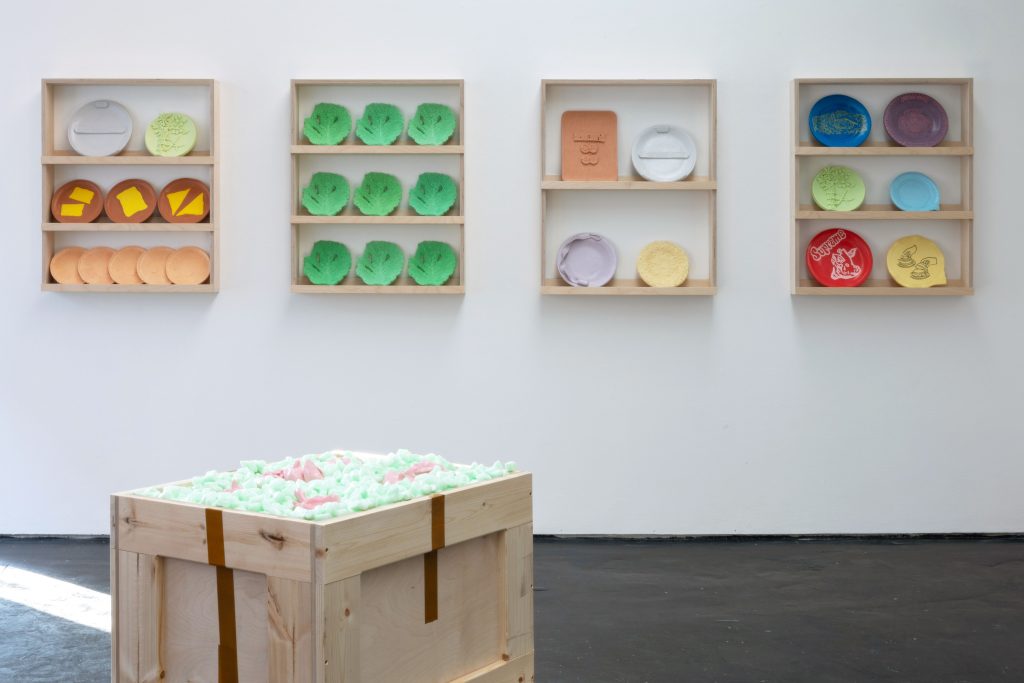
‘I wanted them completely glazed so they could be functional. I don’t think you’d die if you drank from an unglazed cup, but people get very dramatic about it,’ she says, picking one up for inspection. ‘These all originally had stilts to stand in the kiln, but then the stilts made marks. It made me want to glaze the bottom instead of the rim, so now they’re upside down.’
Dawson’s approach is driven by pragmatic decision-making like this. If she doesn’t know a technique, she’ll just learn it. When her residency at Blackpool’s Abingdon Studios was disrupted by lockdowns, she simply got on with the work from her Sheffield studio, creating a dialogue between the two places. After all, she points out, Blackpool exists for many people in the imagination, rather than in bricks and mortar.
The resulting exhibition Here/There (2022), held at both Abingdon Studios and Bloc Projects, Sheffield, featured various sculptures cast in jesmonite, including stacked dinner plates based off Blackpool café menus – a reference to the hospitality and seasonal shifts that are a reality for people who live there. There were also forms directly riffing off the town’s entertainment history, like her six Pelham puppets – garish marionettes reborn as solemn, quasi-religious artefacts. She unboxes one, a witch in soft pastel pink. It stares balefully into the distance, as though recalling a past life under stage lights. ‘People tell me all the time that my work is playful,’ she says, with a note of scepticism. ‘Is it? Everything’s dead! Maybe it’s the colours…’
Or maybe it’s the familiarity people respond to, an abiding sense of comfort in seeing a slap-up meal in the mannered environs of a gallery, for instance. Her sculptures feel deeply personal and invite viewers to think about how they invest objects with meaning and memory. This seems no less true in a studio setting. Shelves teeming with cups and plates appear as cheerful and homely as a French dresser, if you don’t let your gaze linger too long on the dead pigs and carrier bags underneath.
As she retires the puppet to its box, Dawson mentions Saigon 68, a Vietnamese restaurant in Sheffield whose décor had an unexpected influence. ‘I kept noticing the Chairman Mao busts whenever I went downstairs,’ she explains. ‘There was one black bust that had been touched by so many hands that the paint had come off, so it had gone down to the pink plastic underneath. I thought that was interesting: to use Chairman Mao as a handle.’ It’s a perfect distillation of how her work breaks down the dividing line between industry and ritual, everyday and Sunday best.
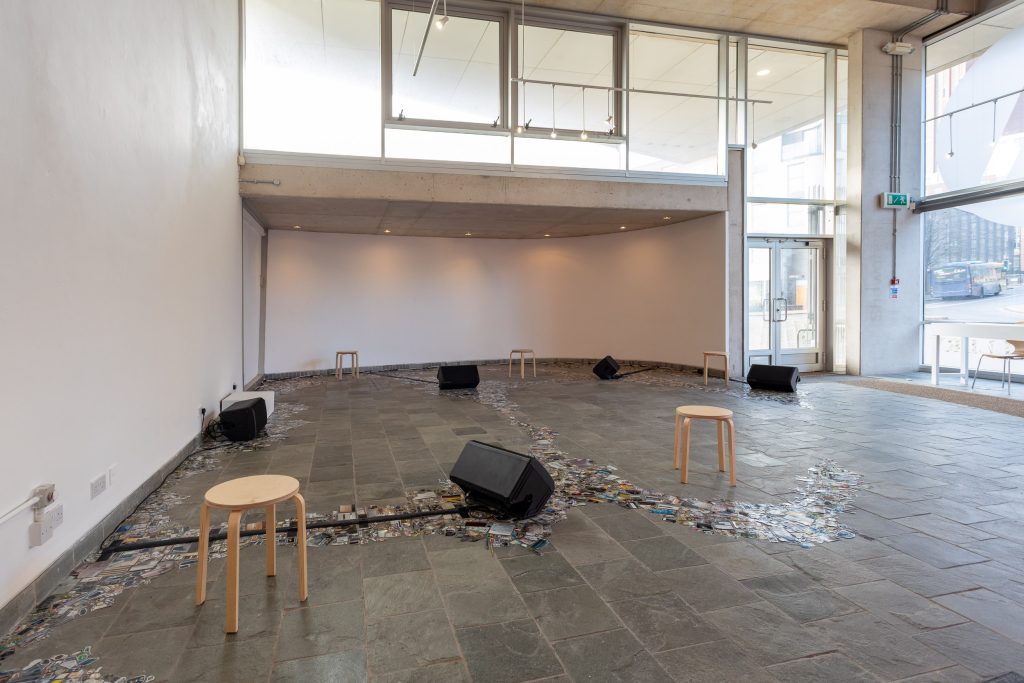
A week later I return to Exchange Place to meet Theresa Bruno, who is busy editing sound recordings for her multidisciplinary piece ‘Labour of Love‘. After assembling a kind of libretto from Mumsnet posts, she invited a local choir to interpret it, resulting in an affectionate exploration of single parenthood which covers everything from loneliness to dating, part-time jobs to child maintenance support.
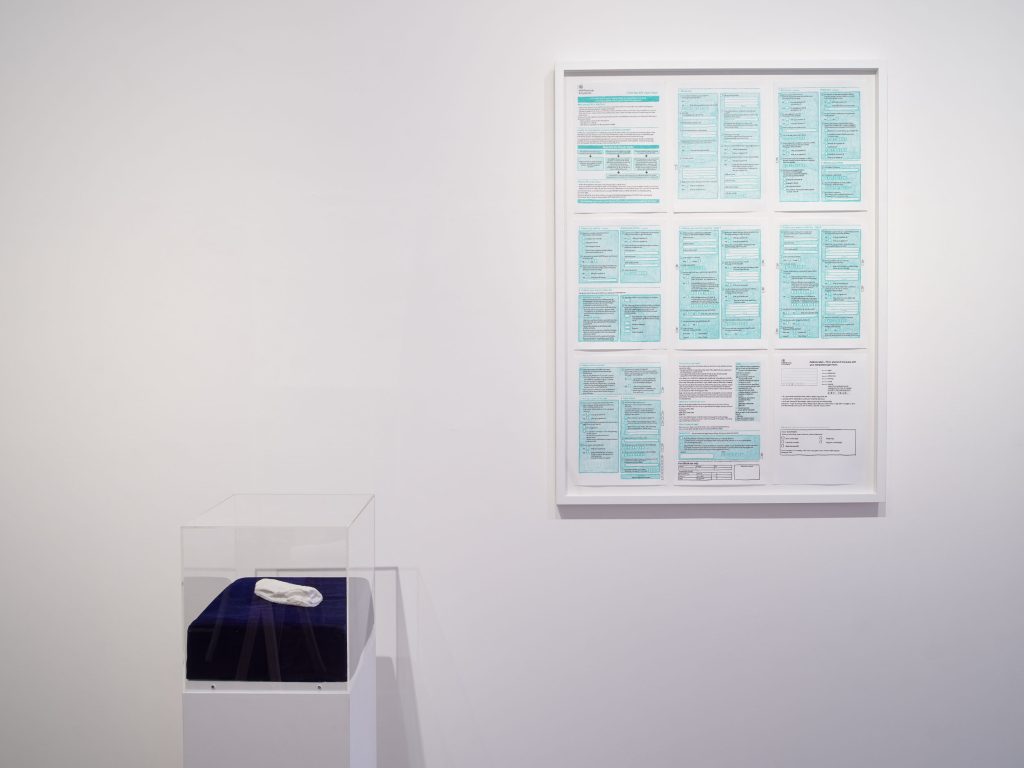
It’s not the first time Bruno has made work about navigating bureaucracy. Above her desk is ‘Benefitted’ (2023), a framed drawing of a Child Benefit claim form, meticulously reproduced in colouring pencil. Growing up in London to a Polish mother, Bruno often found herself tasked with paperwork her mother struggled with due to the language barrier. ‘People asked why I would spend so much time painstakingly making this piece, almost glorifying something that’s so awful,’ she says, ‘but I wanted to proudly represent the support system that helped me. I felt an emotional connection, which I didn’t feel making that.’
She points to the work beside it, ‘Fruit Bowl Painting’ (2010), a catalogue of fruit-related colour swatches. She made this while at Wimbledon College of Arts, back when she loved still life but had yet to find a way of connecting her ethical values to her work. It would take a seven-year break from art to figure that out. She binned all her materials during a period of disenchantment, she tells me, when balancing a practice alongside a full-time job resulted in total burnout. These days, she dedicates an area in her studio to resting and recharging – a philosophy which now informs her practice as a whole.
Much of Bruno’s recent output has been labour-intensive, such as ‘Gargantua’ (2023), part of a Platform residency which involved cutting out every item from the final Argos catalogue. It’s a comment on consumerism and embodied labour, of repeating the same action over and over for economic survival. Bruno’s approach can be double-edged: it has caused repetitive strain injuries, but also allows her to enter a meditative state, testing out materials and techniques at her own pace. ‘My work isn’t about being polished; often I’m learning stuff for the first time,’ she explains. ‘I think it’s because my upbringing wasn’t calm, and art always helped me get in the zone.’
Returning to the ‘Labour of Love’ project, she shows me a cross-stitch she made of an emoji mother and two children. She stitched it for over nine months, through various life events and emotions, including the loss of her grandmother. Working through grief in this fashion offered a way of processing her feelings while thinking more deeply about her own maternal lineage.
Given the project’s focus on networks, it made sense for Bruno to invite others into her creative process. Representing the Mumsnet users as a choir cements the idea of the forum as a place of solidarity and mutual support, while acknowledging the lifelong work and second-guessing that goes into raising a child. ‘These women are going out to a community and saying, “I don’t know what to do!” They’re taking their problems to a panel,’ says Bruno. ‘Which is what I’m learning to do in my own life, and in my art practice.’
Bruno is vocal about how useful she has found the collaborative spirit of Exchange Place, the way a chance conversation in the hallway can open up a whole new avenue of possibilities. Open Studios is a moment to extend that spirit to the wider community. ‘There’s so much talent in the building, but we don’t want it all getting lost upstairs,’ Mellins reflects, as we drift between floors. Visitors, however, will welcome the chance to do just that.
Orla Foster is a writer based in Sheffield.
The Open Studios weekend at Yorkshire Artspace will see over 100 artists and makers open their doors to visitors. Both Exchange Place [Exchange Street, Sheffield, S2 5TR] and Persistence Works [21 Brown Street, Sheffield, S1 2BS] will be open 11am-5pm on Saturday 15 and Sunday 16 November. Click here for more information.
This piece is supported by Yorkshire Artspace.
Published 29.10.2025 by Benjamin Barra in Explorations
2,807 words