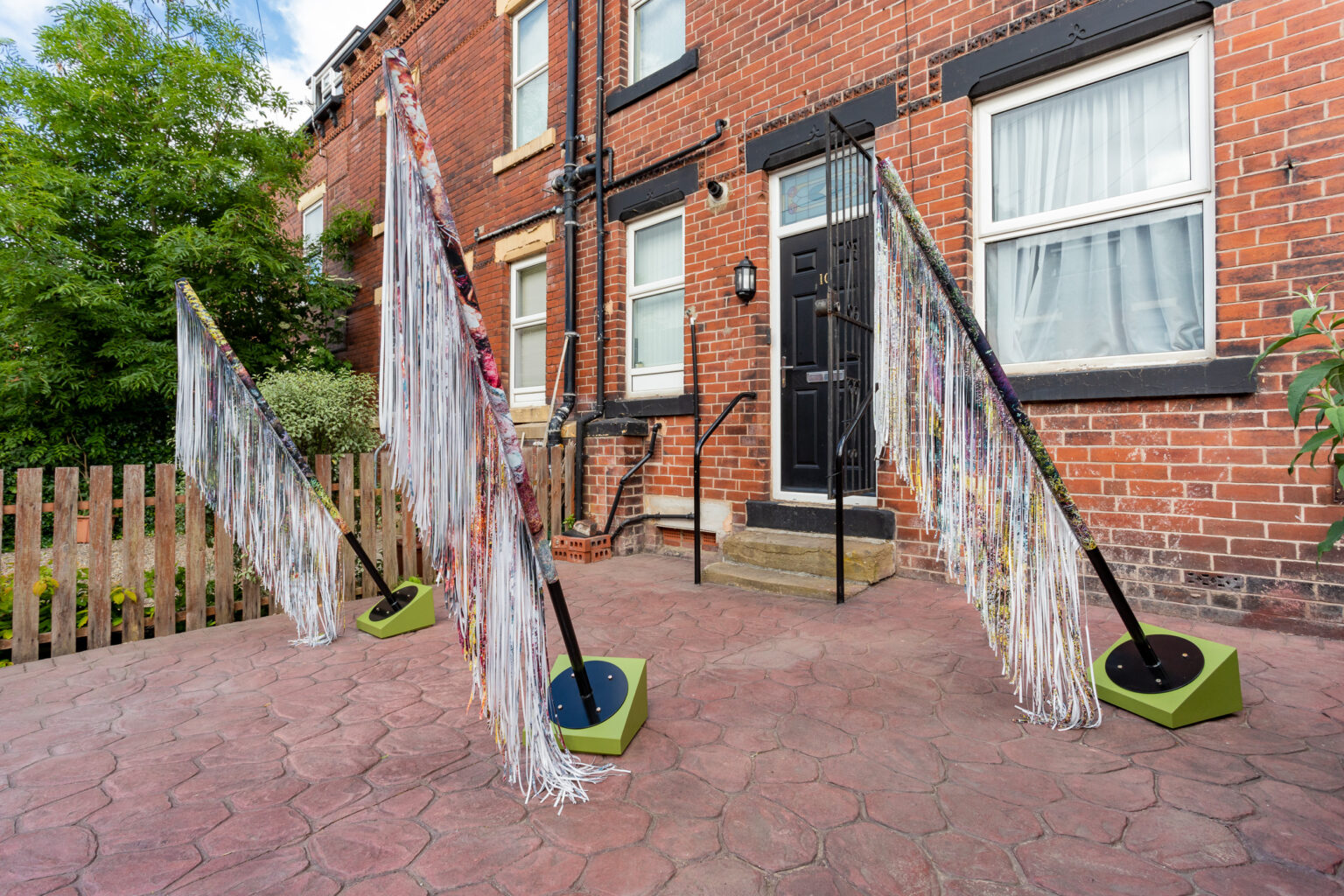
Heavy Water Collective’s Gathering Landscapes: 150 Years of Collecting at Weston Park Museum and Ryan Mosley’s When the Day is Done at Graves Gallery make an unlikely pairing: one a deep excavation of Sheffield Museums’ collections, the other a solo painter’s intimate mythology of figures. That both shows turn out to be preoccupied with the same condition – the position of humans in a world that contains and outlasts them – is either coincidence or something Sheffield is putting in the water.
There is a vitrine in Gathering Landscapes that holds, among other things, a small bottle of volcanic ash collected from Mount Vesuvius in 1872. It sits alongside a jet brooch from the 1850s, a piece of Cotham Marble – limestone so ancient that its surface has settled into patterns resembling fossilised landscapes – and a length of stainless steel that has bloomed in the furnace into something resembling a coral formation. Together, these objects seem to make a series of arguments so compressed that they take a moment to unfold: that what we gather from the land carries the land inside it; that in geological time, the border between natural and industrial relic is arbitrarily drawn; and that collecting is a form of longing.
Heavy Water Collective – Maud Haya-Baviera, Victoria Lucas and Joanna Whittle – have been invited by Sheffield Museums to delve into a collection numbering over one million objects, the majority of which have rarely seen the light of public display. The result is an exhibition that thinks seriously about what it means to curate at all – especially from such a collection, in which the impetuses of selection, desire and ideological framing are embedded by the museum’s long practice of acquisition. It is also, more quietly, a show that highlights a kaleidoscopic array of elegiac practices across millennia related to landscapes lost, transformed and misrecognised.
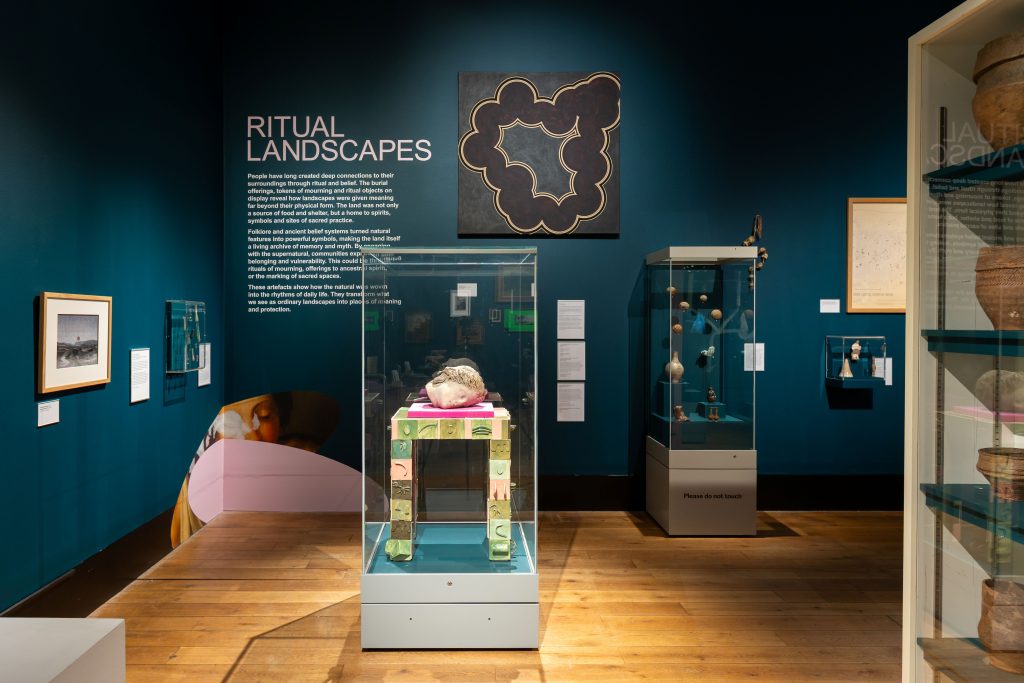
Gathering Landscapes begins at a geochronological scale. Limestone hundreds of millions of years old, ammonites, mineral samples from mountain ranges across the world are somehow not flattened into mere specimens by their vitrines but allowed to retain their strangeness. Among the slightly newer objects is a figure carved from Sheffield millstone grit sometime between 43 and 450 CE into the shape of a small child kneeling as though in supplication. It is one of Medea’s children, who in myth were murdered (or mercy-killed) by their mother after their father abandoned her. Unearthed during excavations for a factory at Wincobank or Wharncliffe Side, the figure spent twenty-two years in service as someone’s garden ornament (during which its nose was shot off with an air gun) before entering the museum’s collection. Mythological time, historical time, industrial time, and moments of casual suburban negligence are compressed into a single, kneeling form. Mirroring it is Haya-Baviera’s ‘The Tears of Artemis’ (2025): a tiled plinth that the artist calls a ‘visual reliquary’, upon which is set a two-thousand-year-old stone head of the goddess Artemis, dredged from waters near Pozzuoli and donated to Sheffield in 1875.
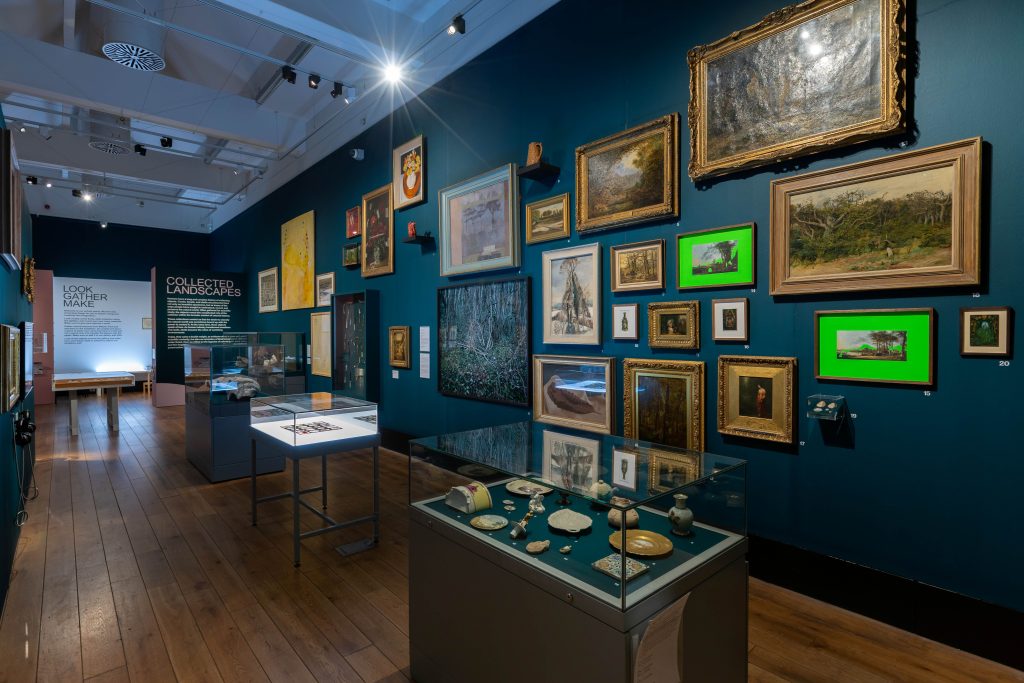
A group of seascapes spanning two centuries is assembled nearby. George Boyle’s ‘Moonrise at Sea’ (1914), Henry Moore’s ‘Sea Shore’ (1879) and Paul Jean Clays’s ‘The Calm’ (1870) keep company with a mid-nineteenth century coastal storm previously attributed to Joshua Reynolds but now catalogued simply as unknown. Alongside them hangs Whittle’s own ‘The Calm (Heath) (Vlaanderen)’ (2025). Whittle’s piece is painted on copper, a material that tarnishes with exposure, carrying the record of its own encounter with atmosphere and time, here placed in conversation with Victorian oils that have survived with a century and a half of institutional care. Nearby, two vitrines are labelled ‘Drawer of shells’ and ‘Drawer of fossils’, their contents subdivided into curio arrangements. There is something about these biological/geological, found/named collections within a collection that cut to the core of this exhibition’s enquiry. To take a shell, to claim it, to label it, to fix it within a taxonomy that did not exist before humans arrived on the beach speaks to a human impulse that has been deeply destructive. And yet the impulse that fills someone’s pockets at the shoreline is barely distinguishable from wonder, the simple desire to hold something beautiful and strange. Gathering Landscapes is not naive about the politics of that desire, but it does not presuppose all its outcomes.
One of the exhibition’s highlights is a display of glass lantern slides made in the 1900s by Henry Clifton Sorby, the Sheffield-born self-taught microscopist who built a laboratory in the cabin of his boat and gathered marine specimens while out at sea. Backlit as they are here, the specimens – including Obelia gelatinosa,[1] a colonial hydrozoan that, when illuminated, looks startlingly like a winter tree in silhouette – glow with the uncanny beauty of things seen at the wrong scale. Sorby collected because he could not stop looking. Gathering Landscapes honours that compulsion while refusing to leave it unexamined: the same Victorian impulse to gather and classify that produced these exquisite slides also produced the ideological architecture of empire, the dispossession of land, and the conversion of landscape into mere resource that has precipitated our current crises.
More of Heavy Water’s own artworks appear within the collection displays, as interlocutors rather than interruptions. These works draw on witchcraft, iconography, folk magic and mourning rituals. Victoria Lucas’s smooth, jesmonite ouroboroses, ‘Self-Destructive Acts I’ and ‘II’ (both 2025), flip the esoteric symbol for endless cyclical rebirth. Lucas’s ammonite-like ‘Snakestone (Coal) I’ and ‘II’ (both 2024) nestle almost indistinguishably among the museum’s ancient mineral fragments and debossed tablets. Many of the pieces are in the form of containers, hollows, dishes and depressions, with the ceramic ‘Pilgrim Bottle (Rock) (Sun)’ (2025) by Whittle created in response to a first-century Pilgrim flask from the collection. Whittle’s ‘Bottle (Oak)’ and Lucas’s ‘Internalise (lacrimal)’ (both 2025) are placed in dialogue with Bronze Age vessels excavated by the Victorian antiquarian Thomas Bateman, and with small glass bottles (dated between 50 BCE and 400 CE) once believed to have been used to collect the tears of mourners at funerals.
These newer works do not illustrate the collection’s objects so much as infiltrate and activate them, drawing forward the residues of belief and loss that institutional display tends to suppress. The bottles are a case in point. Long described as ‘lacrymatories’ – vessels into which mourners dropped their tears – they are in fact perfume and unguent bottles, found in graves because of their use in funeral rites rather than as collectors of grief. The archaeological reality, that these are vessels of ritual care for the dead, is, if anything, more moving. That both readings have circulated, and that neither fully displaces the other, makes them an oddly perfect emblem for what Gathering Landscapes is doing throughout: returning to objects the complexity that standard institutional display tends to flatten, and asking what it means that we keep reaching for the same stories about what the dead leave behind.
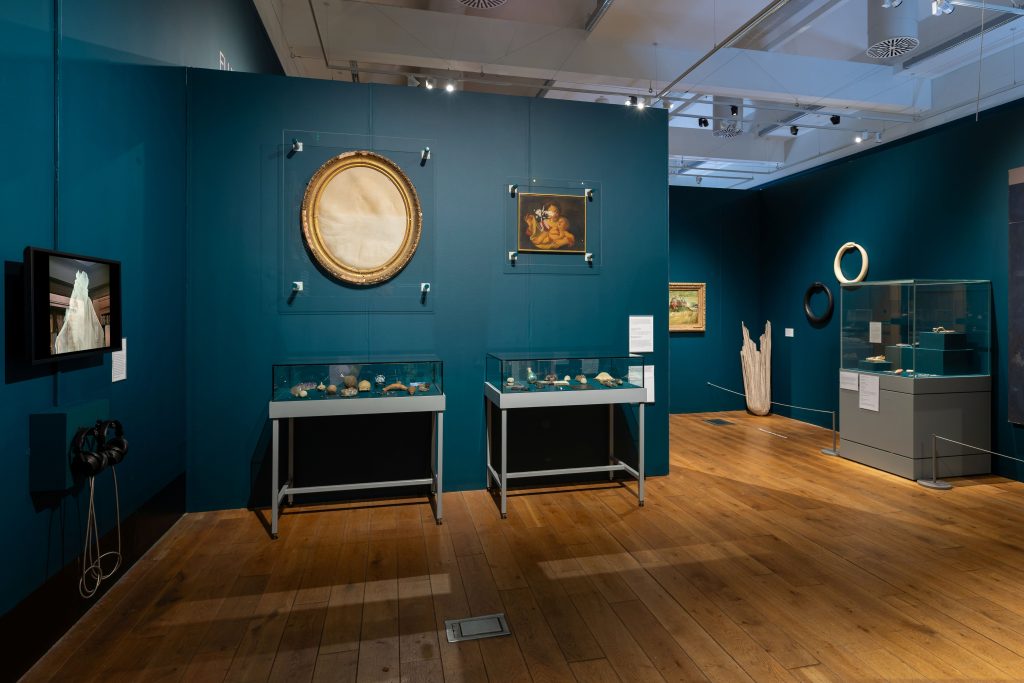
A previous intervention into the collection is shown in a nearby portrait. Painted by an unknown artist, it depicts one Joseph Rogers – or rather, it used to, and perhaps will again. It was in storage at Kelham Island Museum during the 2007 floods, from which it emerged damaged. Rogers’s portrait is shown here in an in-between state, covered carefully in white facing paper to safeguard it from further deterioration until conservation can take place, with only the ghostly outline of its subject visible. The decision to include it here, among objects concerned with archiving, persistence and loss, is perfect, enfolding that flood into the show as a kind of wanton collaborator. What remains of Rogers is what the water decided to leave.
What Heavy Water has achieved in this large, salon-style hang – a deliberately dense, floor-to-ceiling arrangement – is a productive argument about the conditions under which landscape gets made into art. The format is not merely a nod to Weston Park Museum’s Victorian origins; it recreates the conditions of pictorial density in which nineteenth century audiences often encountered landscape painting. Industry and pastoralism, the scientific and the spiritual, the extracted, the defiled and the mourned: these are not presented as opposites to be reconciled but as a set of ongoing, unresolved tensions that the collection contains.
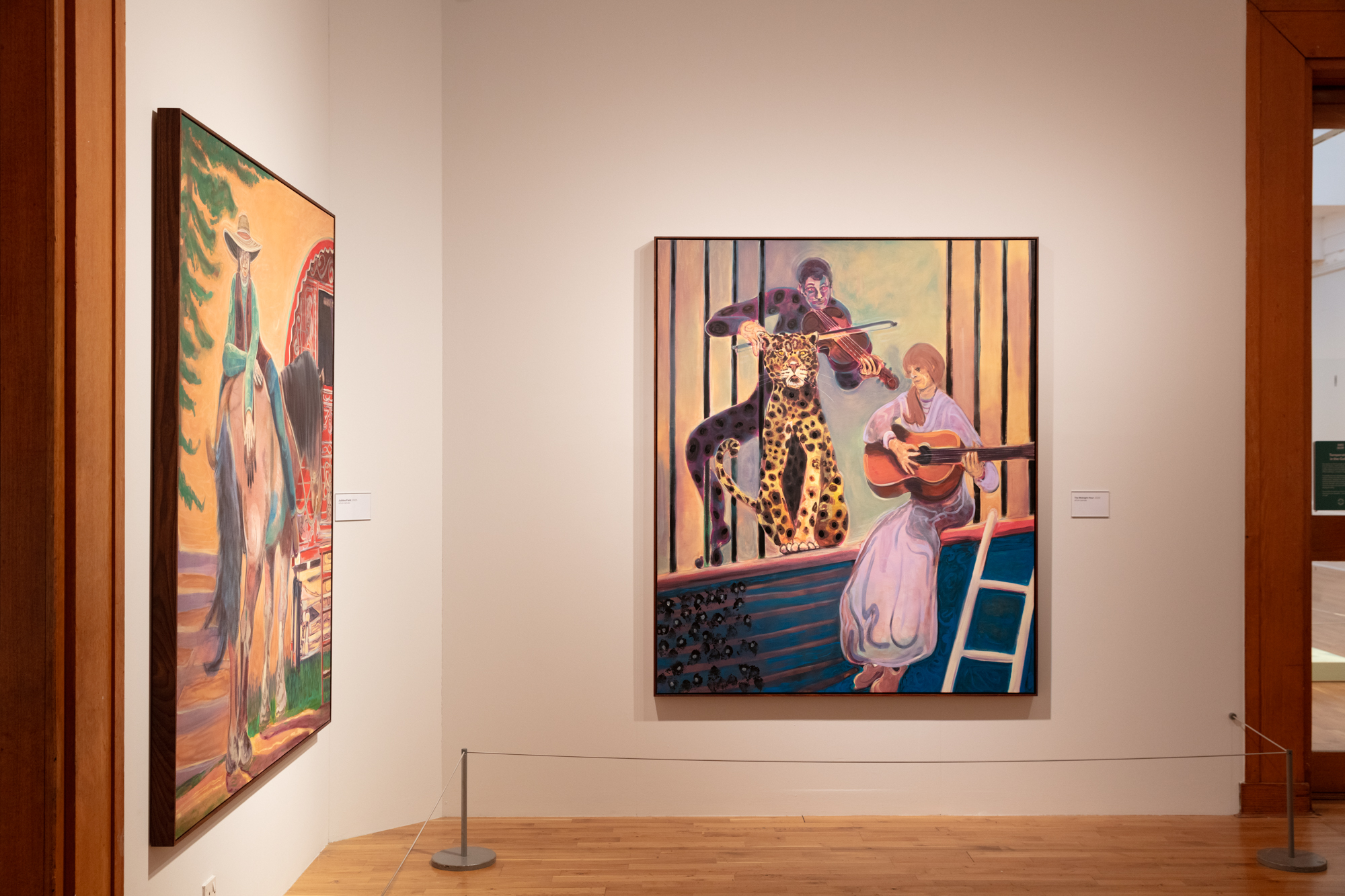
Across town at Graves Gallery, Ryan Mosley’s When the Day is Done offers a different kind of immersion in time and landscape. Where Gathering Landscapes proceeds by accumulation – cases and plinths and lightboxes accreting meaning across the room – Mosley’s paintings loom, lining the gallery rooms with an almost architectural presence. Walking between his works, I had the impression of moving through the arcaded passage of a cloister, each bay opening to offer a glimpse of successive otherworldly visions. Both shows, in their very different registers, seem preoccupied with situating the human figure within engulfing landscapes that appear indifferent to it – or that are, at least, operating on an entirely different scale.
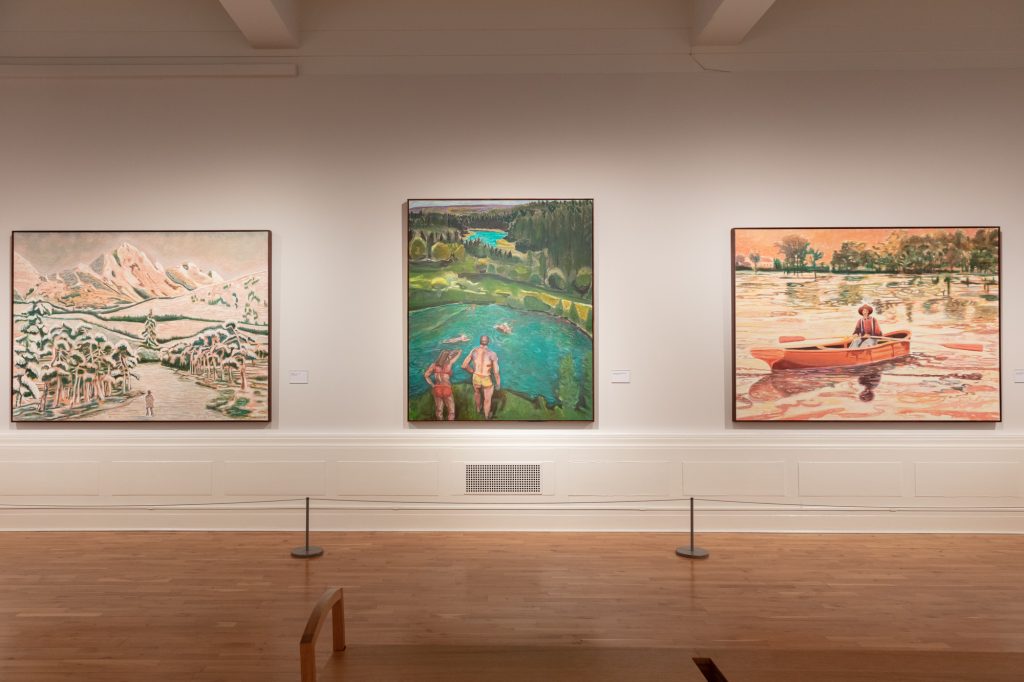
Mosley’s figures carry a similar sense of dislocation as the neatly arrayed specimens and artefacts of Gathering Landscapes. They inhabit their canvases as though they have arrived from somewhere or somewhen else: musicians, wanderers, bathers, observers, all rendered in loose, undulating brushwork. In ‘Riverbank Empire’ (2026) and ‘Under Lavender Hill’ (2024), a notable shift in the relationship between figure and landscape asserts itself: where Mosley’s figures have typically dominated the frame, here the environment presses back, expansive and indifferent, with figures absorbed into it rather than set against it. The coloured ground of the canvas – Mosley has left it visible at the edges and between forms – tends to halo each figure, as though they are lit from behind or from within. These are not figures observed in scenery, but figures conjured from it, as though dreamed up by the place itself. Peter Doig is an inevitable point of comparison, though where his practice is rooted in specific, historically freighted geographies – Canada, Trinidad – Mosley’s mythology is deliberately unmoored from any fixed place or time and seems much more internally driven.
In contrast to the dense museological display of Gathering Landscapes, Mosley’s exhibition is all but rinsed of institutional apparatus: the paintings are given room, and the rooms are given to the paintings. The mythological figures populating his canvases do not represent any single tradition so much as a composite personal iconography – one that draws loosely on folktale, carnival and the pastoral sublime. They are all placed in landscape, never entirely at home in it. The musicians in ‘From the Rooftops’ (2023) play perched on city structures that barely register their presence, whilst a slightly unsettling trio of spectators framed by the suggestion of a balcony in ‘Street Music Below’ (2023) seem significantly separated from any life going on beneath, a fuzzy void taking up almost all the space behind them. The figures in ‘Under Lavender Hill’ (2024) stand at the brink of water as though waiting for permission to enter. There is a hesitant quality to their postures – trepidation at a landscape ready to engulf them.
That elegiac note resonates throughout the show at Weston Park too. The bottles of volcanic ash, the Sorby lantern slides, the Bronze Age urns, the kneeling child who lost its nose to an air gun: all are objects gathered against the erosion of time. The museum itself is a monument to this refusal – to the human insistence on holding things, on keeping. Gathering Landscapes is not uncritical of that insistence; it knows that the urge to collect is also the urge to possess, and that the land collected from is never neutral ground. But it finds, within the deep strata of Sheffield’s collection, something that exceeds those histories: an abiding, unruly veneration of the world that Mosley’s wondering figures seem to share.
Jay Drinkall is a writer and editor from Humberside.
Gathering Landscapes: 150 Years of Collecting at Weston Park Museum is on at Weston Park Museum, Sheffield, from 28 November 2025 – 1 November 2026.
When the Day is Done: New Paintings by Ryan Mosley is on at Graves Gallery, Sheffield, from 26 February – 4 July 2026.
This review is supported by Sheffield Museums.
[1] So named and labelled during Sorby’s time; now Hartlaubella gelatinosa.
Published 01.05.2026 by Benjamin Barra in Reviews
2,092 words