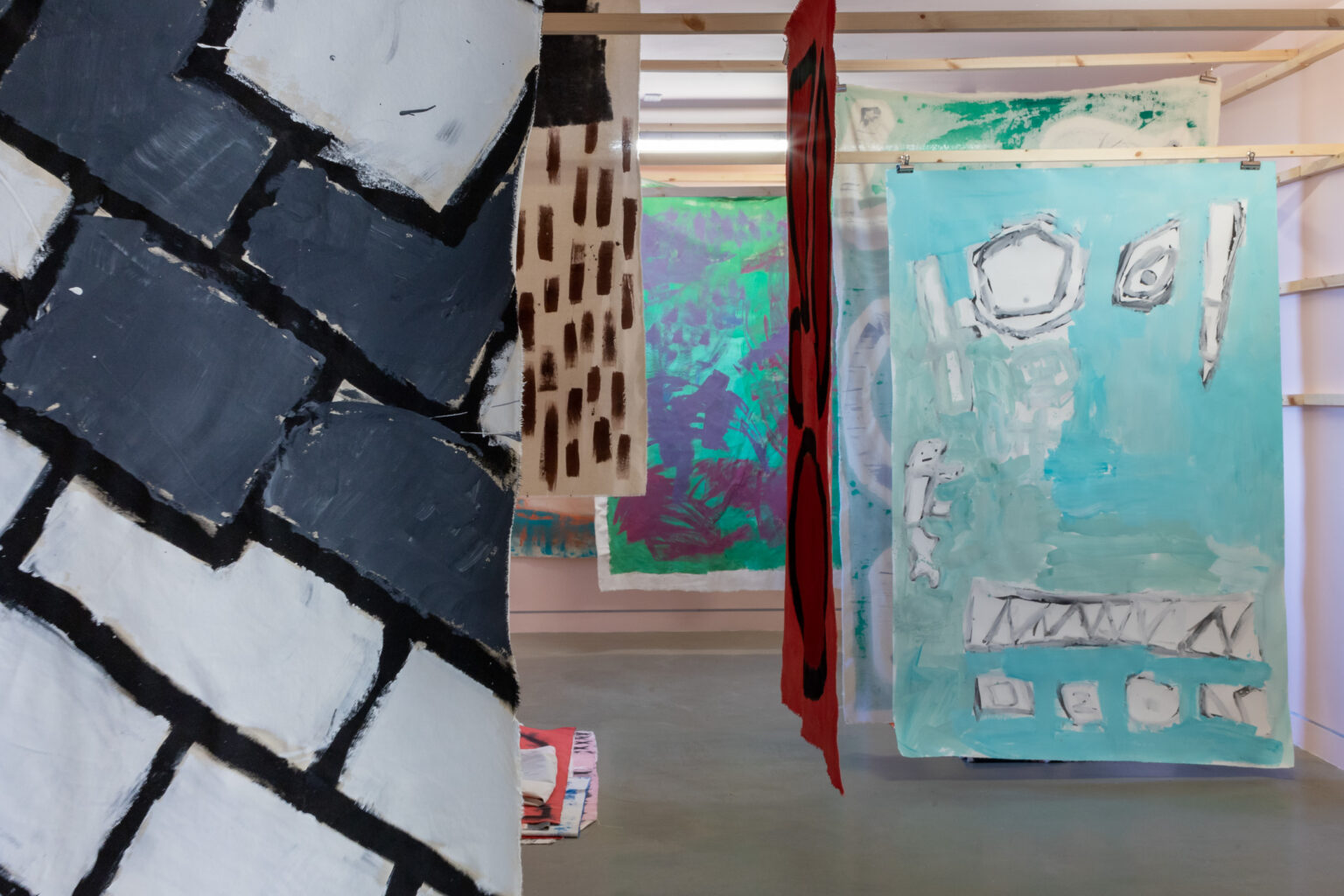
The Memorial Gestures exhibition at the 1912 Mill at Sunny Bank Mills is the culmination of the first fourteen artist, writer and translator residencies spanning the last three years at Holocaust Centre North, based at the University of Huddersfield. One of the Centre’s aims is ‘to humanise a history that contains what most of us can scarcely imagine’, in the words of curator Paula Kolar, and to this end, they invited those in residence to approach, through their creative practices, the complex historical events and individual stories detailed in the Centre’s archives. Jordan Baseman, Laura Fisher, april forrest lin 林森, Maud Haya-Baviera, Irina Razumovskaya, Matt Smith, Ariane Schick, Tom Hastings, Rey Conquer, Hannah Machover, Laura Nathan, Chebo Roitter Pavez, Sierra Kaag and Nathalie Olah present diversely sensitive responses in the vast, light-flooded space.
Kolar is keen to highlight the connection to the archives and has chosen april forrest lin 林森’s ‘The Gaps Between the Unforgettable’ (2023) to greet the audience as they enter. In this short video, installed within a fort-like surround of archival boxes, archive materials are handled carefully, accompanied by texts and images that speak of memory, recall and making sense of archive materials. ‘The Gaps Between the Unforgettable’ introduces us to the idea of careful contemplation as creative practice.
The artworks are numbered and prompt a sequenced viewing from here on in. Behind ‘The Gaps Between the Unforgettable’ is Maud-Haya-Baviera’s video ‘If by Night, A Stranger’ (2025). These neighbouring works begin a dialogue without overly impacting on the independent viewing of each individual work. ‘If by Night, A Stranger’ features the artist performing expressive emotions inspired by the letters of Alice Mendel from November 1938, when Mendel was attempting to find her way out of Germany following her husband’s arrest during Kristallnacht (Night of Broken Glass). A second woman in the film interprets these expressions into British Sign Language. The meaning in each translation seems increasingly imprecise and disjointed, drawing out questions of how well words, gestures and imagery can portray emotions.

Adjacent, Irina Razumovskaya’s ‘Archaeology of Absence’ (2025) is a large ceramics installation of several window-shaped slabs. These sculptures contain several dualities: at the same time appearing like windows and like tombstones, the outward facing reverse sides are carved into tiles that echo the sanitised arrival spaces of concentration camps. As the viewer is invited to enter the small space created by the hanging ceramics, we see cracked interiors with silver-coloured threads running through some of the slabs, which reflect the viewer slightly and are akin to a European type of kintsugi – the Japanese art of repairing ceramics with precious metals that highlights repairs and imperfections rather than hiding them.
Nearby is Maud-Haya-Baviera’s ‘Aching’ (2025): two ceramic hands, not quite touching, one with a red glaze. Also inspired by Alice Mendel’s letters, the hands resonate with the two women in ‘If by Night, A Stranger’ – touch and meaning just out of reach.
A large desk-like structure draws attention with its scale and a familiar-yet-unusual bespoke build that also vaguely resembles a house. Arranged with ceramic magnets on the sloped ‘roof’ of the desk’s writing surface and in the side drawers, small envelope-scale etchings complete Hannah Machover’s installation, entitled ‘as far as possible’ (2025). Drawing from personal family history and letters in the archive, Machover creates narratives with visual language. Shapes and symbols appear and disappear, repeated visual motifs becoming apparent when examined closely. A booklet functioning like a map key gives quotes from the letters that inspired the etchings.
In contrast to Machover’s small, detailed etchings, Chebo Roitter Pavez’s series of large-scale drawings ‘A Glimpse at the Abyss’ (2025) form a concave arrangement of information to immerse oneself into. From left to right, the panel starts with the word ‘everything’ or ‘all’ in Hebrew, and ends with a black hole symbolising ‘nothing’. The handwritten stories of sixteen Holocaust survivors are transcribed onto the panels along with iconography from the Middle Ages. These tapestry-like drawings weave narratives related to the present day rise in Nazism and fascist ideologies with personal narratives from the archives.

Jordan Baseman’s video ‘These Were Not Simple Deaths’ (2023) is placed in a quiet spot with a small sofa. In a similar set up to a previous installation at Holocaust Centre North, the video requires an intimacy between the work and the viewer. In a large group show such as this one, honouring each individual work must have been a careful undertaking, evident in curatorial decisions such as this, which gives the viewer enough space to be immersed in the individual work whilst being able to reflect on connections between pieces.
Towards the back of the gallery space we find Laura Nathan’s site-specific installation made up of several components, ‘Unpicking: The Gannex and I’ (2025). Nathan performs and documents the laborious task of physically unpicking a Gannex coat over the course of eight months, which becomes also an unpicking of cultural heritage. Gannex fabric was invented in 1951 by Lithuanian-born Holocaust survivor Joseph Kagan, who went on to establish textile factories in Yorkshire. The words and testimonies of workers in the factories were absorbed by Nathan whilst the artist took apart the fabric coat and attempted to reweave it by hand – a patient, symbolic repair, actively absorbing the history of the garment.
A mustard-yellow circular carpet with a low hanging lamp and books create a domestic-looking oasis in the huge space. This is Arianne Schick’s installation ‘Manny’ (2025) – a portrait of Emmanuel Culman and his parents, Holocaust survivors Edith and Emil Culman. An animation projection of an anthropomorphic car, inspired by a drawing from the Culman collection in the archives, beams down onto a book that documents Manny’s life in letters and notes between himself in the US and his parents in Leeds. This portrait of post-Holocaust life memorialises the survivors in an intimate setting that invites visitors to sit with the familial connections, as you might look through a photo album offered up in someone’s home. In reading through the book in a linear way, with the animation a steady, often comical reminder of distance and movement in its various expressions, we gain a close insight into post-traumatic survival on a very personal level.

Sierra Kaag is Memorial Gestures’ current translator in residence and was challenged to create a piece of work for the exhibition from her written work in progress. She embraced this challenge with a collaborative film made with curator Paula Kolar based on the book Max Liebermann: Der Künstler und der Führer (The Artist and the Leader) by Arthur Galliner. A copy of the same edition held in the archives is presented alongside the video, which montages documentation of the journey of the Friedman family that embodies an interpretation of Kaag’s translations.
A corner section of the gallery is demarcated as a film screening room for ‘Hard Lands’ (2025) by Maud Haya-Baviera, who made pilgrimage to a former concentration camp where her grandfather was held during the Second World War. The film depicts derelict and overgrown buildings in a stillness marked by absence. There are no people in the film, which draws our attention to the only human presence: that of the artist, behind the lens – a descendent of the survivor who was once here. In this tracing of her family history, Haya-Baviera invites us into a visually meditative encounter.
Matt Smith presents a triptych of two photograph collages with a central ceramic tiled grid entitled ‘§175’ (2025) – the legal code used to criminalise same-sex desire in Nazi Germany, which remained on the statute books in West Germany until 1994. The left panel features photos from the archive, in which Smith noticed possible same-sex relational body language. It is not determined whether the people in the photographs were in fact friends, lovers or family members – i.e. whether the individuals were gay – reflecting the assumptive nature of these accusations and subsequent incarcerations at the time. Before being fired in the kiln, the central white clay brick panel had the names of 175 ‘pink triangle’ prisoners murdered in a Sachsenhausen subcamp written on in graphite. The graphite was burnt away in the firing process, erasing the names to leave a blank white tile for each person. The third panel depicts two images of the same ‘pink triangle’ prisoner, before and after castration. Not wishing to reproduce these images, Smith cut them directly out of a Nazi medical publication. The homophobic shame associated with ‘pink triangle’ prisoners often meant families did not keep contact with or documentation of their loved ones, and therefore there are few archive materials of them. Smith’s work memorialises their erasure and profound absence in our histories.

Laura Fisher presents three works: ‘Space Between’ (2023), ‘Taussend Küsse’ (2023) and ‘Red Cross Blanket (2023). Fisher has chosen to show copies of the original photographs of the hands she renders in graphite in ‘Space Between’. Additional tiny photographs in black and white depict the people whose hands they belong to. ‘Taussend Küsse’ (A Thousand Kisses) is a tactile hand-embroidered book, which ‘is everybody’s favourite’, as Fisher notes with affection. The invitation to handle the book and look through its pages has been a success in achieving Fisher’s desire for people to tactilely relate to ‘A Thousand Kisses’ of Hilel Erner, whose letters the work depicts. ‘Red Cross Blankets’ hang in the space, which, with its own history of 180 years of cloth production, is a fitting location for the knitted cotton blankets and the work’s new interpretation of historic artefacts.
In contrast of scale and presence are Rey Conquer’s ‘Conversation Time’ vinyl text pieces (2025), installed on the windows of the gallery space. These fragments of text, often openings of letters, are translations of those in the archives from refugees and victims of Nazi persecution. The black vinyl text with transparent negative space creates subtle interruptions to our view of the outside world. Quiet voices that could easily be glanced over, unless you look closely, convey uncertainty in snippets of seemingly ordinary conversations about extraordinary circumstances.
Stacked on a plinth surrounded by glitter are Natalie Olah’s ‘THE SECRET OF SURVIVAL IS NOT TO BE NOTICED’ (2025), as a prelude to her writer-in-residence book. This ephemeral work disappears over time as viewers take the artists’ newsprints one by one. Olah presents an inquiry into the archives of Holocaust survivor Iby Knill, who hand-made and repaired clothes. A survivor of several concentration camps, including Auschwitz, as well as the subsequent ‘death marches’, Iby’s post-war life was varied, creative and demonstrative of extreme resilience. The newsprint style document Olah presents is a memorial to Iby and her life, survival itself and aesthetics of care.
Care is a theme throughout the exhibition. The sensitively handled subject matter, individual stories and archive materials are evidently cared for, and interpreted and represented to the world with close attention. Another thread that weaves through the exhibition is the notion of absence: the absence of people in Maud Haya-Baviera’s ‘Hard Lands’, the absence of bodies, faces or other defining characteristics in images of hands in Laura Fisher’s ‘The Space Between’, and the erasure of the graphite during the firing process in Matt Smith’s ‘§175’. Irina Razumovskaya’s ‘Archaeology of Absence’ speaks directly to the theme with headstone-shaped ceramic memorials, almost devoid of colour, creating negative space through their arrangement.

The subject matter and medium of textiles connect the works of Laura Fisher, Laura Nathan and Natalie Olah and, more subtly, the tapestry-like nature of Chebo Roitter Pavez’s series of large-scale drawings ‘A Glimpse at the Abyss’. In the context of a repurposed textiles mill building, these works anchor the exhibition. Whilst a few artists responded to the space (Irina Razumovskaya work was made site-responsively, for example), many artists made their work before the space was selected, and it may therefore have been a curatorially responsive choice to find a space that resonated with the themes of the exhibition.
Visual resonances can be found between some of the works also: the hands in Laura Fisher’s graphite drawing ‘Space Between’ speak to Maud-Haya-Baviera’s ‘Aching’ ceramic hands and the BSL interpreter’s gestures in ‘If by Night, A Stranger’; the white tiling in Irina Razumovskaya’s ‘Archaeology of Absence’ speaks to Matt Smith’s white ceramic tiled grid ‘§175’ – both consciously connotative of sanitation.
Some artists have chosen to include their own histories within their work, and many have personal connections and resonances with the stories and artefacts within the archives. Others have focussed on the narratives of survivors and their families’ histories in present day memorial. Some artists have focussed on thematic inquiry with idiosyncrasy. This provides viewers with a rich insight into the archives. Far from a formulaic inquiry or prescriptive process, it is clear that there has been great scope for individual artistic responses.
The processes of the residencies are also brought to light and reflected on in several of the works. The characteristics and limitations of archives and memorial are drawn upon in reflexive and thought-provoking ways. Time is evidently another theme that arises – from the passing of time since the archive materials came into being, to the time spent in residency, and also the time relatives spent apart, incarcerated and persecuted.
In looking back through history with the lens of artistic inquiry, we can also look at the present and futures that may unfold. Some works are in progress, yet to be fully manifested, and some artists cite the residency as being pivotal in the trajectory of their practices. The Memorial Gestures exhibition at Sunny Bank Mill represents a moment in time, bringing these artists, writers and translators together in their varied responses to Holocaust Centre North’s archives. It feels important that their work is, in turn, documented and interpreted with the sensitivity and cohesion that they themselves have individually and collectively achieved.
Memorial Gestures was exhibited at the 1912 Mill at Sunny Bank Mills from 6 – 28 June 2024.
Alice Bradshaw is an artist, curator and writer interested in discarded, everyday materials and words.
This review is supported by Holocaust Centre North.
Published 09.07.2025 by Benjamin Barra in Reviews
2,413 words