New Faces, New Focus is a collaborative touring exhibition that asks what happens when museum collections are placed in conversation with the people whose stories they have often overlooked. Developed through the Going Places programme, twelve exhibitions across the UK bring together local communities with artists and museum teams to create new work inspired by archives and lived experience. Through photography, textiles, sculpture, film and historical material, the project explores questions of place, identity, migration and belonging, transforming museums from repositories of the past into spaces for contemporary reflection.
Open Eye Gallery’s contribution unfolds across four Merseyside venues, The Atkinson, Kirkby Gallery, The World of Glass and Open Eye Gallery itself, while parallel strands have been developed with Armagh, Banbridge and Craigavon Borough Council and Aberdeenshire Council Museums Service. Spanning multiple regions, the project resists a singular narrative. Instead, it reveals how personal histories intersect with local heritage, creating unexpected connections between people and places that might otherwise seem far removed from one another.
As soon as I enter Open Eye Gallery, I see so many faces. It reminds me of being young and looking through stacks of old family photos. Each photo has a story and a memory. I see how everything imprints on a person and how we are shaped by external events completely out of our control. The first work to draw my eye is a large blue and white cyanotype on fabric, collaboratively made by a group of young people in Aberdeenshire. All under the age of 18, each member of the group lives in supported housing after experiencing forced migration and displacement. Over six months, they worked with the council’s collections to research and explore photographic processes from as far back as the Victorian era right up to the present. In response to these creative workshops, the young people produced a series of cyanotypes, each a direct contact print of one participant’s face and a material record of their presence. Shapes suggest sudden movement, vulnerability and uncertainty, while the imprint of an image burned into fabric by light becomes a metaphor for the way a moment can hold a story. These young people live lives contextualised by transience, and their cyanotypes suggest a search for permanence. Hung high in the gallery, the work encourages us to look up and beyond ourselves, towards the experiences of others.
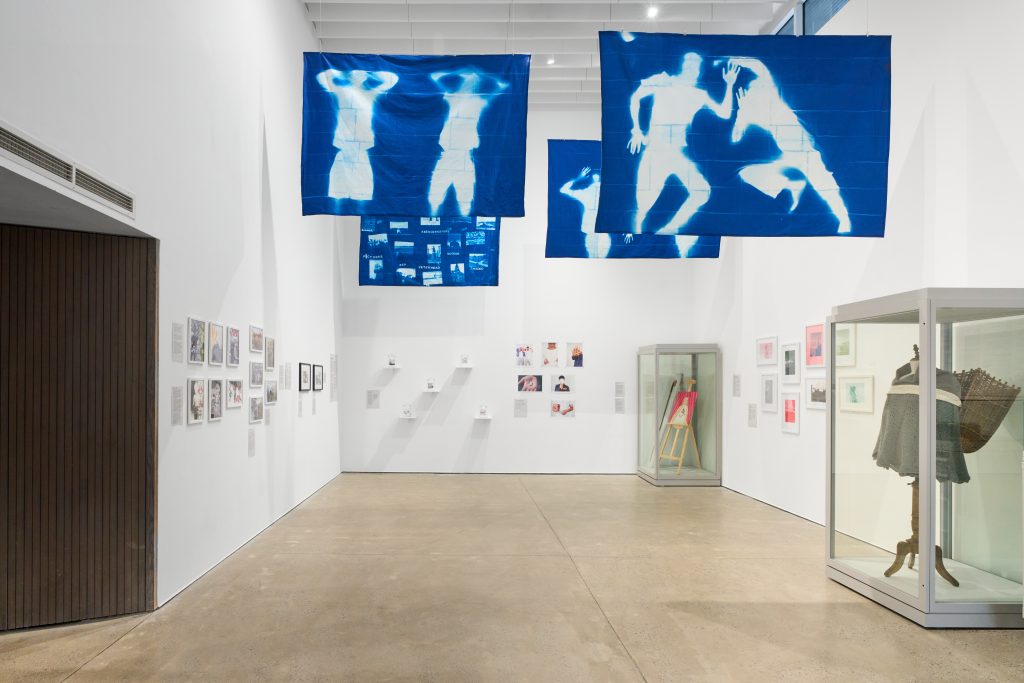
In a display case containing documentation of Aberdeenshire’s villages and the decline of their fishing industry, objects open up questions about movement and migration. A postcard written by a local man who emigrated to Canada in search of work, a small bottle of oil from the North Sea, a corn bunting and a fret-sawed painted horse sit alongside other archival material. This ephemera becomes a set of points of recognition for local communities, demonstrating how cultural connections can survive through the most ordinary of things. The process is mirrored in ‘Photographic Portraits’, a collection of six photographs created by the same young people who made the cyanotypes. Visibility is a central concern. One image shows a person with their hands covering their face, leaving only one eye visible; another shows a hand holding a cricket ball. I think about what it means to see, search and document. This mixture of emotion and everyday, banal pleasure gives the exhibition its emotional range, moving from painful personal histories to moments of levity. It reflects how everything exists in tandem: how joy can exist within trauma.
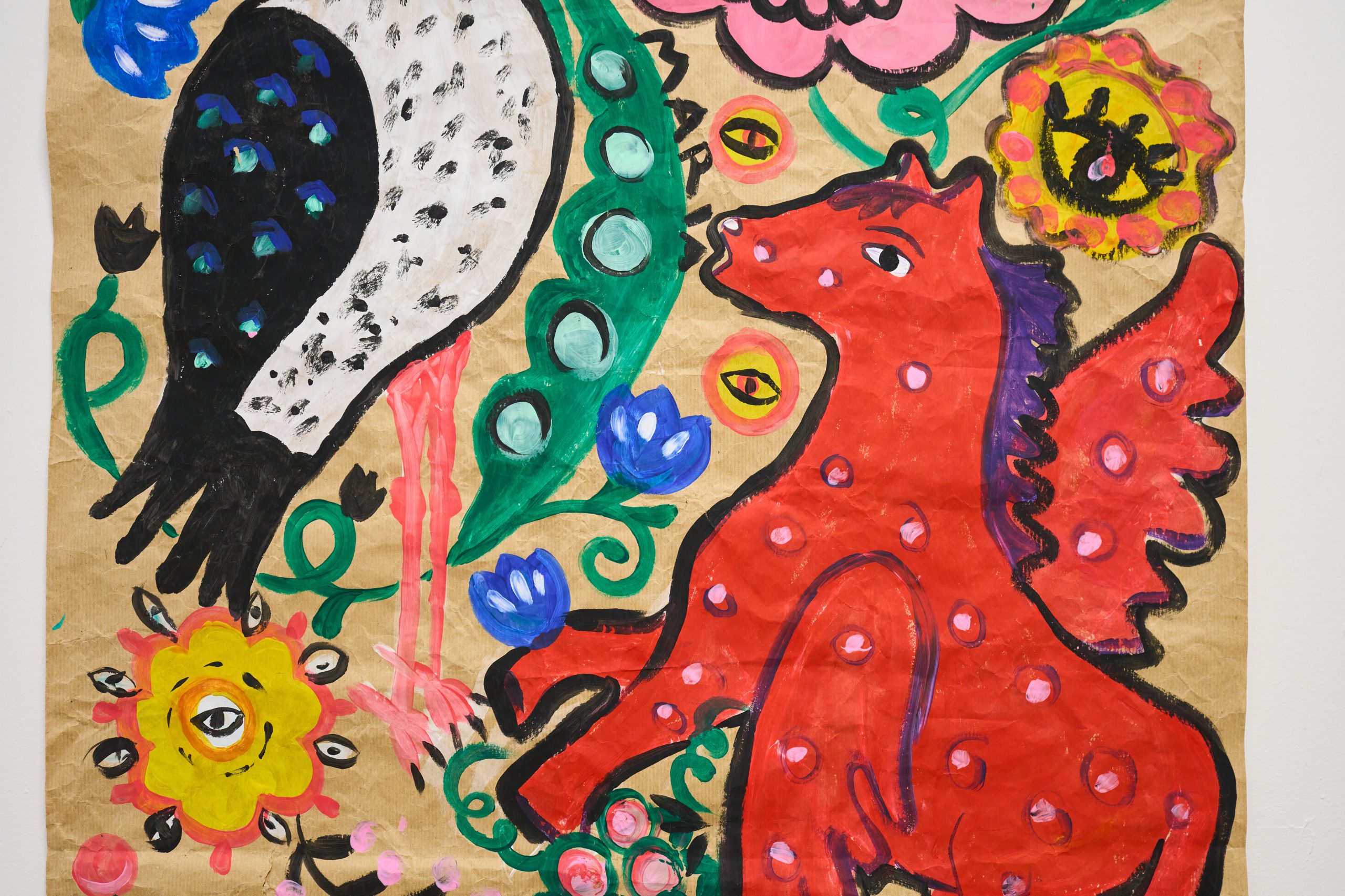
Nina Karestka’s photograph ‘In the Dunes’ (2026) fizzes with colour. It features Ukrainian artist Victoria Ustymenko wrapped in her hand-painted artwork, made on brown paper and covered with imagined animals, flowers and leafy patterns. Referencing Ukrainian culture, personal memory and the legacy of Ukrainian artist Maria Prymachenko, the work turns nostalgia into a form of shelter as the artist is depicted engulfed by her work. The painted surface is consuming, yet it also acts as a shield against the stormy grey sky behind. This relationship between memory, history and protection is also present in the works on display at The Atkinson, where Karestka worked with displaced Ukrainian communities now living in Sefton to explore the vast archives of both The Atkinson and Open Eye Gallery.
Old black and white photographs of Ukrainian family and rural life are recontextualised, adorned with traditional embroidery and offset against white material embroidered with similar patterns. The installation has the intimacy of a domestic interior; I feel as though I am stepping into someone’s kitchen or living space, reminded not simply of the past, but of how close that past can feel. Alongside these photographs are collages by the project’s participants Olena, Tetiana, Inna, Andrii, Valentina and Viktoriia, which explore their journeys through conflict and upheaval. Their use of colour becomes a defiant gesture against the despair they feel at the forced migration caused by the war in Ukraine. It expresses strength and resilience while returning to the exhibition’s wider themes of belonging and home.
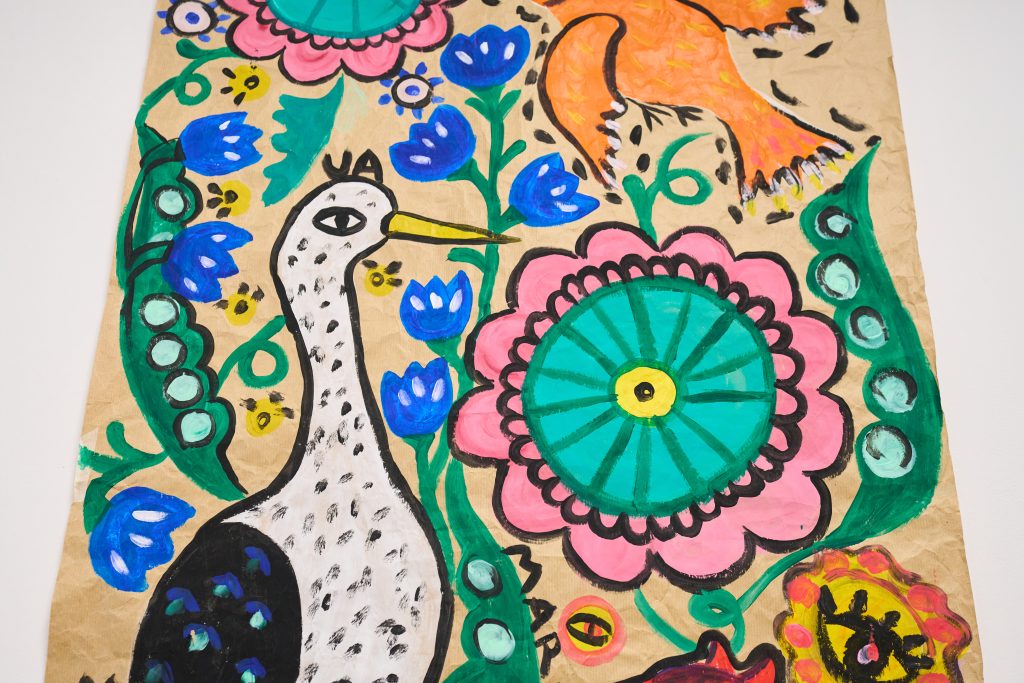
Also at The Atkinson, project participant Vita Mahlovana’s intricate paintings in the traditional Petrykivka style show birds and flowers through detailed brushwork and layered tones, while a chair positioned in front of the paintings invites prolonged looking. I take a seat and look closely at the detail. The artist writes that the war between Russia and Ukraine was the reason she moved to Southport, and that it was in England that she discovered her talent for painting. She also writes that she no longer paints and may never do so again, as ‘it feels almost impossible to continue painting’. She doesn’t say why. In this context, the works take on an extra charge as records of creativity in the wake of terror, preserving a connection to the domestic at a moment of profound upheaval. The project stresses the importance of moving beyond the statistics and headlines perpetuated by right-wing media to see the individuals behind stories of migration: their strength, humour, resilience, fears, memories and hopes.
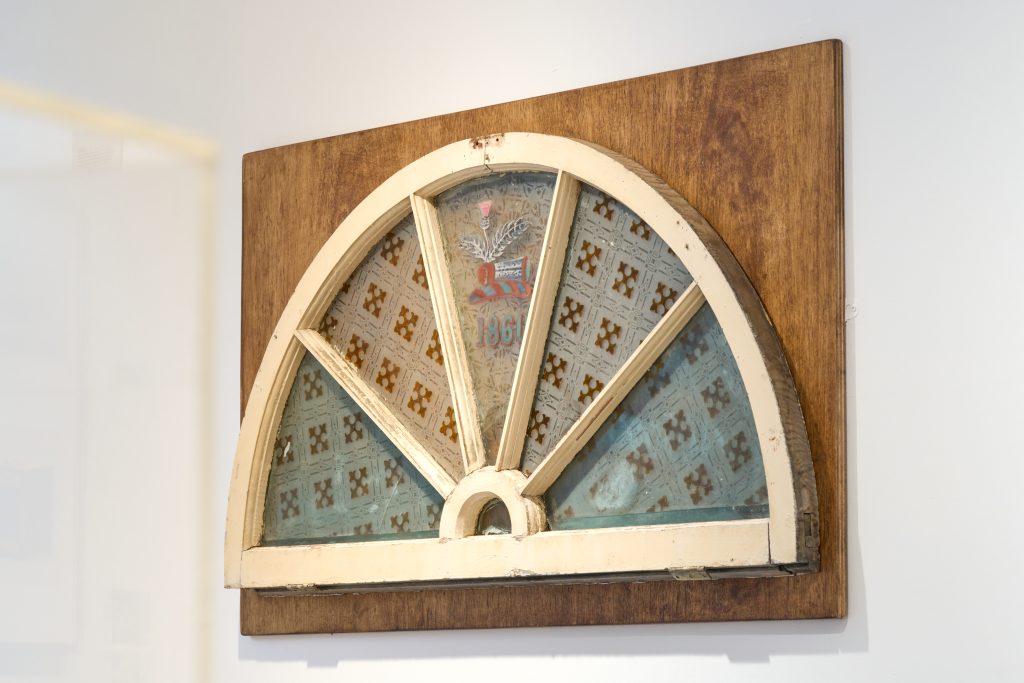
Back at Open Eye Gallery, work from the Armagh artists is shown alongside the St Helens and Knowsley projects. This collection of sculpture, collage, painting and architectural fragments in glass explores identity and heritage. A window and frame rescued from an nineteenth-century house bring the past directly into the gallery. Artist Joanna Laba uses a key as a playful symbol of the way museum archives can unlock personal memories, but can also gate-keep. Her beaded curtain, made from hand-rolled paper and needle-felted beads, incorporates wool dyed with ‘gifts from nature’, allowing plants to leave their own colours and stories. The combination of craft, memory and place gives the work an almost nostalgic sense of making and gift-giving.
A particularly strong and emotive connection emerges between Karestka’s work and Rosalind Lowry’s ‘Meeting Point’ (2026). Lowry’s work depicts a building wrapped in lines that symbolise the journeys of everyone involved. The idea of being wrapped in heritage recurs across the exhibition, suggesting the comfort people can find in the past. I notice how the lines cross rather than follow a single route, evoking the way individual histories overlap and influence the trajectories of others. Memory here is not static: it travels between people and places.
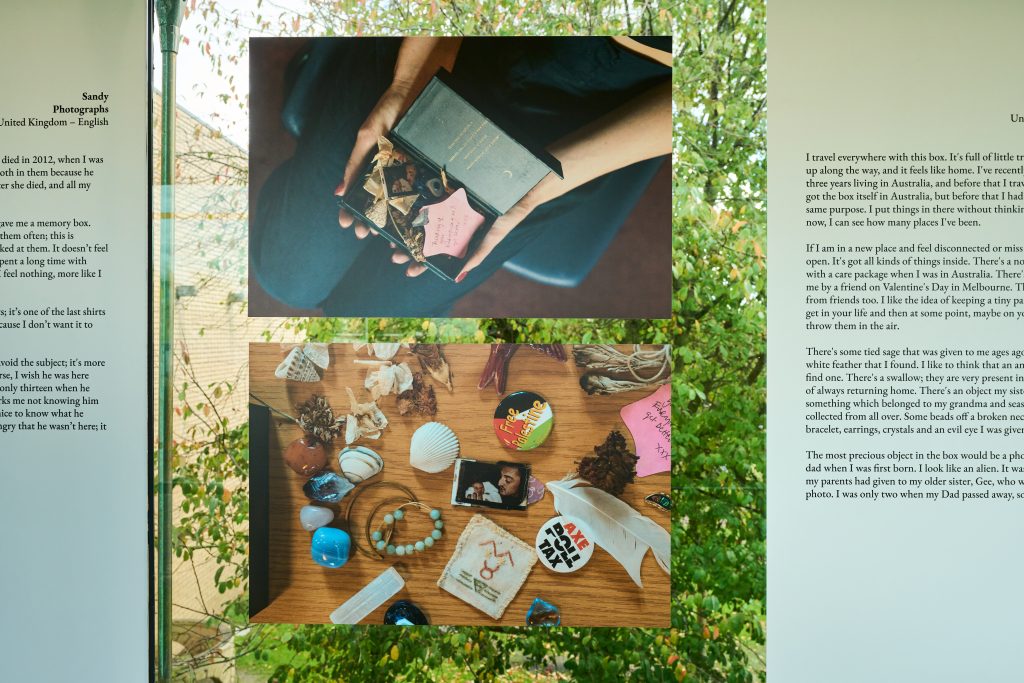
At The World of Glass in St Helens is a collaborative project by artist Abdullrhman Hassona and the Cafe Laziz community, a space where food and language are used to build connections between refugees and local residents. Since 2025, the group and the artist have taken part in workshops and conversations that explore their feelings and experiences through art making. Hassona describes the process as ‘a way of bringing people together and drawing out an artistic side that is already there’. The resulting photographs of their activities show objects against blank backgrounds, concentrating attention on their personal significance. One image, again of a key, prompted repeated discussions about displacement in the group; it represents the hope of one day returning home to Palestine. Expanded at The World of Glass, the photographs span a bridge that connects the museum’s rooms, an apt symbol for the way conversation can create connections. The objects seen in the photographs become carriers of grief and loss, but also of memory and hope. I see a toy, a children’s book, a collection of Polaroids and bracelets, each demonstrating how something apparently so ordinary can hold immense emotional and historical weight. This piece underscores how value is rooted not in money but in connection, and how talking and sharing can strengthen communities at a time when they are being divided by violence incited by damaging right-wing beliefs.
At Kirkby Gallery, photographs also document lives and personal journeys. Lead artist Anoosh Ariamehr reflects on their experience of photography as ‘holding not only images but time, silence, memory and the possibility of another story’. The piece provides a starting point, while community members carry those images somewhere new. One story presented here follows Sue Emery, a local resident, and her journey into nursing. Inspired by a uniform given to her as a child, the photograph shows Emery with her colleagues, all in uniform, and becomes a quiet record of how a seemingly small early encounter can go on to shape a life. My own grandma left a small town in Ireland to nurse in England; if she hadn’t made that decision, I wouldn’t be standing here, looking at these photos, writing this piece. Reflecting the ideas seen in the Cafe Laziz project, this collection makes the everyday seem monumental.
Ariamehr’s piece, ‘Between Remaining and Fading’, turns inward, exploring self-perception and the ways we grapple with the journeys we undertake. This sense of reflection runs throughout the works at Kirkby Gallery: collaborative creation gives people space to consider who they are in relation to the paths they have travelled. ‘A Self That Passes Through Me’ and ‘Reclaiming My Face’ are purposefully blurred to create multifaceted self-portraits, reflecting how our identity is continually in formation, shaped by the choices and beliefs of the societies we live in. The starkness of the black and white images places emphasis on shadow and movement. The absence of colour reflects how understanding your sense of self can be crippling and draining.
New Faces, New Focus: The Stories We Share is an ambitious project, but its scale, though epic, never feels like the point. (It’s probably impossible for anybody to encounter all of the works, as they spread across the country.) What matters is the accumulation of individual stories and the way they begin to speak to one another in hyper-local ways. Across Merseyside and beyond, photographs, objects, textiles and a plethora of archival materials become preserved memories while allowing local communities to reinterpret them. The project does not suggest that everyone has the same history; rather, it finds common ground in the human impulses of remembering, belonging, mourning, creating and making a home, wherever that may be. Its greatest strength is this movement between the personal and the collective. By giving community voices space within regional museums and galleries, the project demonstrates how collaboration can turn everyday experiences into histories worth seeing and remembering. At a time when violence and hatred from the far right are on the rise and heritage is politicised, the works and the locations they inhabit act as symbols of defiance. The project calls for people to realise just how similar we all are. But this collection isn’t an anarchic rebellion; it is a momentous collage of life that offers its message in a palm, not a punch. Again and again, an image becomes more than a record: it becomes a fragment of a life, holding stories shaped by time, war, industrial change, forced migration and diaspora.
New Faces, New Focus exhibitions are available to see for free at:
Open Eye Gallery, 10am – 5pm, Tue – Sun, until 20 December
The World of Glass, 10am – 4pm, Wed – Sun, until 20 December
The Atkinson, 10am – 4pm, Mon – Sat, until 27 February
Francesca Tibbles is a writer based in Liverpool
The review is supported by Open Eye Gallery
Published 05.11.2026 by Natalie Hughes
2,057 words