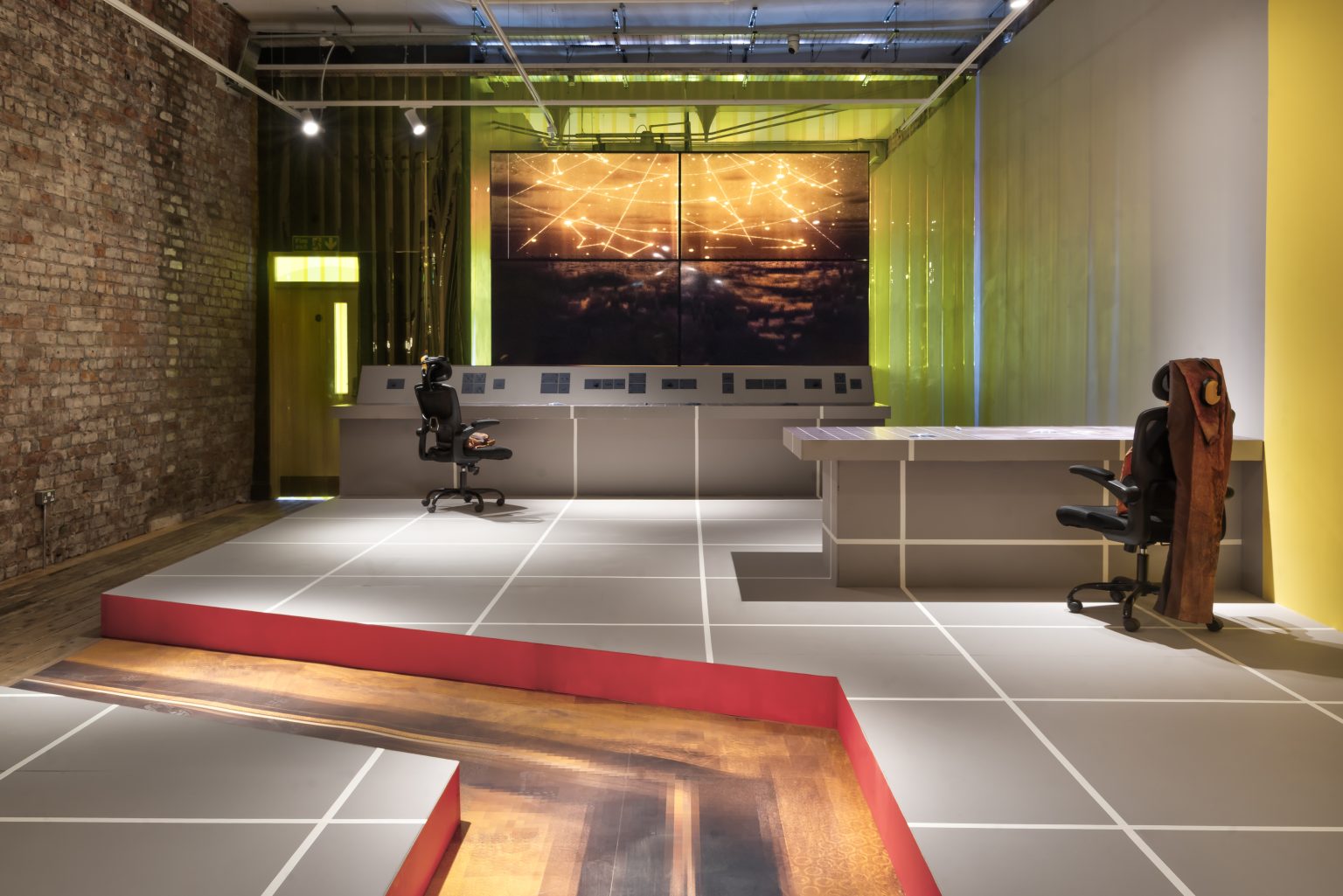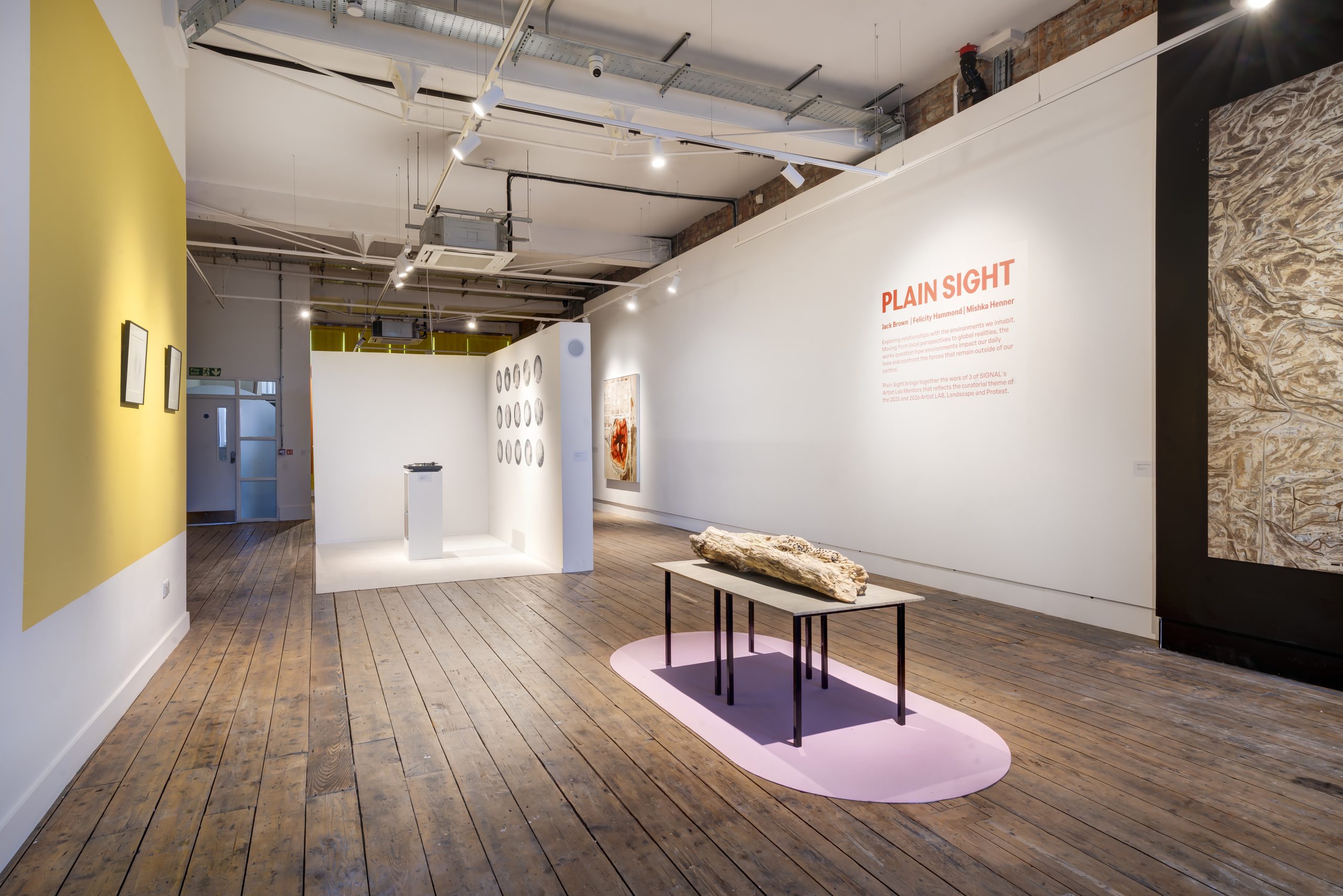
Plain Sight is the title of a provocative exhibition of work by Jack Brown, Felicity Hammond and Mishka Henner at SIGNAL Gallery in Barrow-in-Furness. In this exhibition, all three artists explore landscapes transformed by technology, extraction and consumerism. Though their methods and materials are very different, their work is thematically connected. The exhibition title derives from the idiom ‘hiding in plain sight’, which refers to something fully visible that is unnoticed, and is an apt title for this exhibition, which asks us to look closely at our environment and question what is right in front of us that we don’t see. Exhibiting Henner, Hammond and Brown together makes this a conceptually strong three-person show. All three artists have links to Barrow and have worked as Artist Development Lab mentors at SIGNAL.
I was immediately struck by the dramatic but simple exhibition installation. Mishka Henner’s ‘Kern River Oil Field, Kern County, California’ (2012-13) attracted me immediately upon entering the gallery. The piece is huge, covering an entire wall. It is a large-scale photographic print on aluminum and made from hundreds of screenshots taken from Google Earth. It is brown and earthy in colour, with long grey lines that crisscross the image. As I got closer, I saw that the lines were roads and pipelines. The clarity of detail is extraordinary. Cylindrical structures in the landscape cast such sharp shadows that at first I thought they were a collaged element and only when I got up close did I realise they were two-dimensional shapes. As I examined the piece, tiny scribbles became thousands of oil pumps. In a moment, this undulating landscape switched in my mind to an endless, horrible, destroyed alien planet, where nothing was alive or growing. The exhibition handout explained that Henner carefully stitched together digital screenshots taken from publicly available earth-imaging satellite platforms on his computer. In using images from databases on his computer screen to create his images, Henner has removed the camera lens entirely from his process. He shows us a reality we could never see in its entirety from the ground; its full horror can only be captured from above by satellite, and its scale is incomprehensible. Indeed, another theme the exhibition explores is the profound transformation of photography as it shifted from analogue to digital.
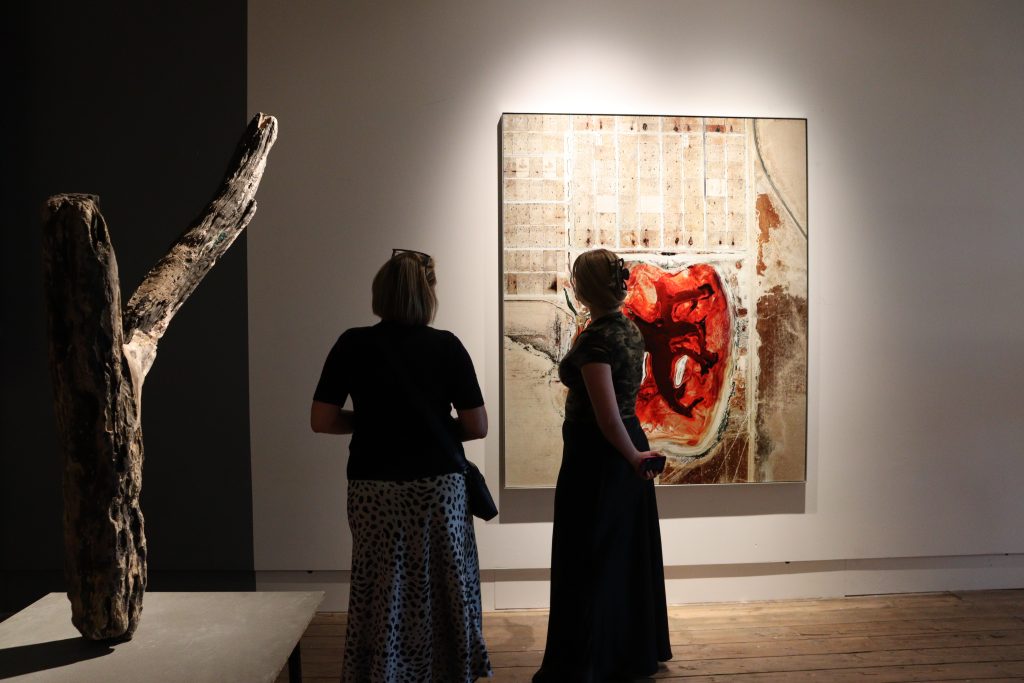
Henner contributed another equally unsettling piece. ‘Coronado Feeders, Dalhart, Texas’ (2012-13), an image of enormous feedlots where cattle are fattened in a horrific system of industrial agriculture. This is a huge archival print mounted on foamex and constructed from high-resolution screenshots. Unlike ‘Kern River Oil Field, Kern County, California’ it is surprisingly colourful. The upper half of the print contains a geometric grid while the lower half of the print is an enormous red, brown and sand coloured shape. The exhibition handout informed me that this reddish shape was a ‘vast lagoon of urine and manure…visible from space.’ It looked to me like a hole or wound filled with blood. The geometric structures in the upper half of the image, on closer inspection, turned out to be cattle pens. ‘Coronado Feeders, Dalhart, Texas’ is an even more disgusting and appalling image of extraction where living animals are fattened in record time for maximum profit.
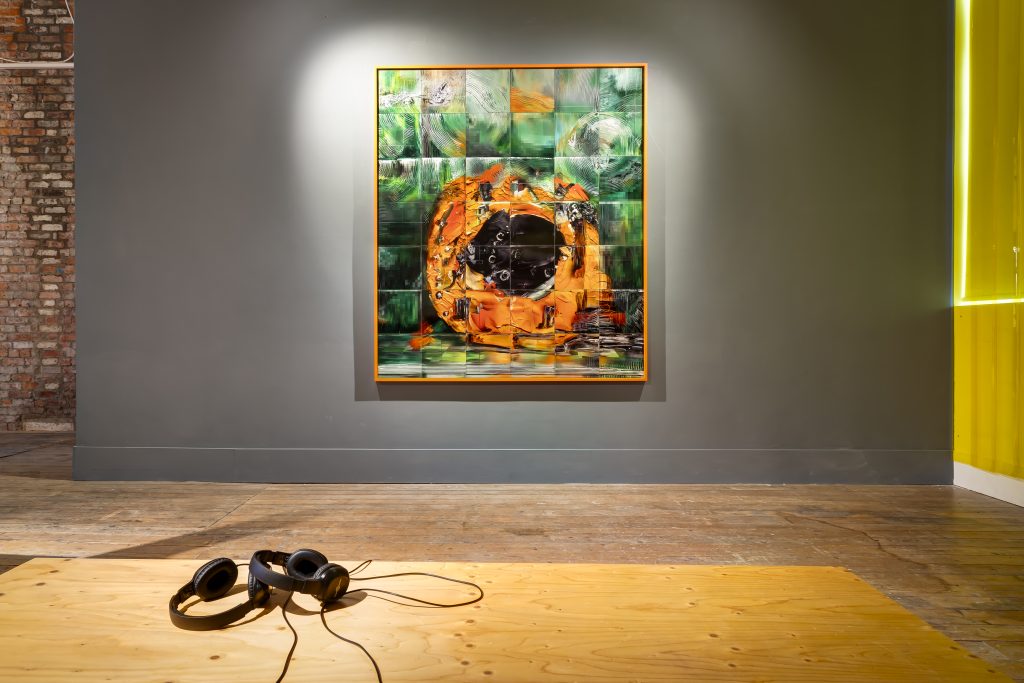
‘Model Collapse’ (2025) by Felicity Hammond extends the theme of exposing hidden environmental realities in a different direction, providing a terrific companion to Henner’s work. Where Henner shows abstract images that derive from the real world, Hammond creates abstract images through repeated processes that cause photographic information to degrade. Hammond uses photographs of real events, such as her previous exhibitions or earlier projects, which she then reworks with AI processes. She uses generative AI, prompting it to reinterpret the photographs she has provided. The title ‘Model Collapse’ is a technical term based on the repeated errors and distortions that occur when AI loses any connection to reality through repeatedly generating information based on previous AI models. The exhibition handout lists ‘Model Collapse’ as a C-Type , or chromogenic, print mounted on di bond, a traditional type of photographic print. For ‘Model Collapse’ Hammond has used data from an earlier artwork, ‘Variations’ (2024-2026), that she processed using AI. She then reworks the image in multiple ways, even using painting and collage. She reprocesses, reedits, reworks and rephotographs the image until it becomes the photographic print that the viewer sees hanging on the wall. Hammond addresses the concept of hidden in plain sight in multiple ways. She uses her art to try and understand the implications of data mining and the hidden extractive processes and environmental implications of digital technology. The results are unsettlingly beautiful. The colours of her pixelated and AI generated shapes mimic painterly marks, but hide complicated technological processes.
Included in Plain Sight is ‘Reactor’ (2026) a moving image animation with audio created in Barrow for a previous exhibition. ‘Reactor’ addresses the implications of autonomous warfare, which makes the piece extremely powerful and specific to the context of Barrow, where nuclear submarines are built. We see the glitches and breakdown of the moving image before our eyes revealing the instability and degradation of data. Headphones provide a soundtrack which imagines the thoughts of an autonomous submarine. In this piece Hammond points to the multiple historical and present realities of industry, resource extraction, the economy and technology hidden from plain sight.
Jack Brown is the third artist exhibiting in Plain Sight. He told me that when he was working with young people as an artist in the TIDAL project of workshops and labs, he met them outdoors rather than in the classroom. On Walney Island they collected large pieces of driftwood shaped by the sea. Plain Sight contains three driftwood sculptures, each of which has fake nails from salons pressed into the wood. The bright, artificial nails are incongruous but beautiful, like strange mutant fungi. For the young people, the acrylic nails reference their own explorations of gender and self- adornment, which they transferred to the driftwood. In the gallery, Brown’s work is placed near Henner’s ‘Kern River Oil Field, Kern County, California’, leading the viewer to make connections between these two artists’ works. Both artists address consumption. Even tiny colourful nails are part of a larger system of oil extraction, from which plastic is manufactured. Both are also part of a system of production and waste that leads to environmental damage.
A poetic and subtle series of prints by Brown continues the theme of hidden in plain sight. ‘The grease marks left by a passengers hair on a bus window’ (2018-19) are digital prints on paper that look more like drawings or etchings. Reminiscent of forensic procedures, Brown made the work by collecting the greasy smudges and lines of hair left on bus windows using charcoal on sticky back plastic. He then enlarged the tiny marks and printed them on paper. Brown makes visible the almost invisible traces of human presence in public places.
All three artists use beauty to lure the viewer to look closely at their artwork, but as we come closer, we become aware of another story hidden in plain sight. Each piece reveals unexpected details. As I walked through the exhibition, I noticed connections between the three artist’s work reinforcing ideas about the limits of seeing, raising questions about digital images and our relationship to our environment. This work is strange, mysterious, beautiful and terrifying.
Plain Sight, SIGNAL, Cooke’s Studios, Barrow-in -Furness, 6 October – 28 November 2026.
Caroline Bagenal is an artist and writer based in Hutton Roof, Cumbria.
This review is supported by SIGNAL.
Published 24.10.2026 by Jazmine Linklater in Reviews
1,299 words