“Once…. In the future, there was a place where ideas and thoughts fractured. It was a forest, it was a fortress, it was filled with secrets from the past. Journeys occurred where groups of adventurers found their way through the shadows and echoes.
Here we stand at the precipice of a fragmented tomorrow. Here we gather the fragments of lost knowledge, piecing together the memories they tried to erase. The shadows and echoes we chase will soon demand a choice: will you let the fractures divide you, or use them to build a stronger world?”
— Opening lines from ‘The Darkforest As’ (2026)
The upstairs gallery at FACT is a dark, windowless space. Stepping into this boxy cave to contemplate the artworks and ideas of others always feels like crossing a threshold into another world, with its own time and logic. There is no view of the outside to allow the mind a moment’s break. It can feel claustrophobic; it is always disorientating.
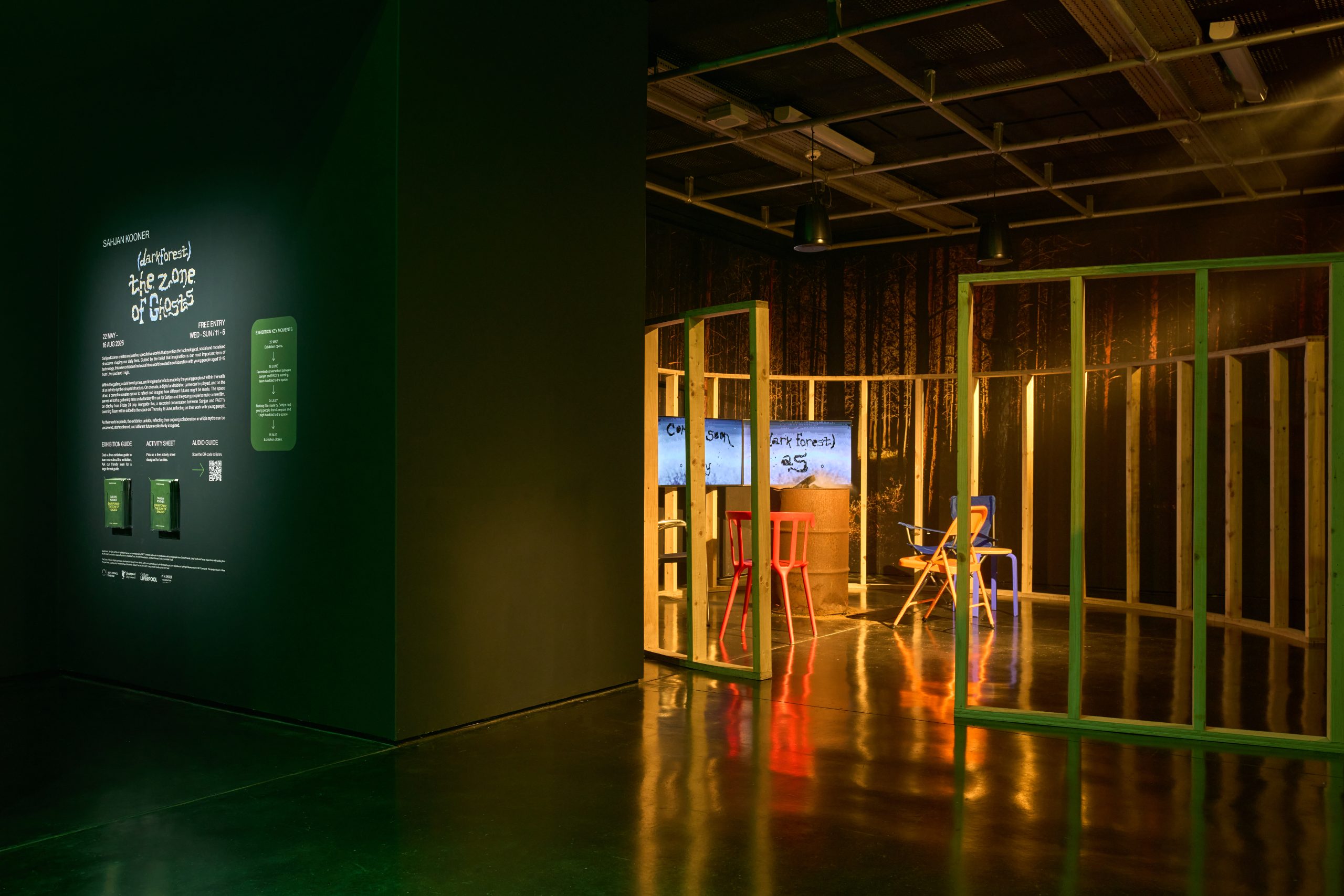
For me, this exhibition space rarely works. But for (darkforest) The Zone of Ghosts, I can’t think of a better setting for artist Sahjan Kooner’s immersive installation. Created in collaboration with young people from Liverpool and Leigh, the exhibition brings together film, tabletop and digital games, imagined artefacts and a carefully constructed environment in which stories can be gathered, exchanged and reassembled.
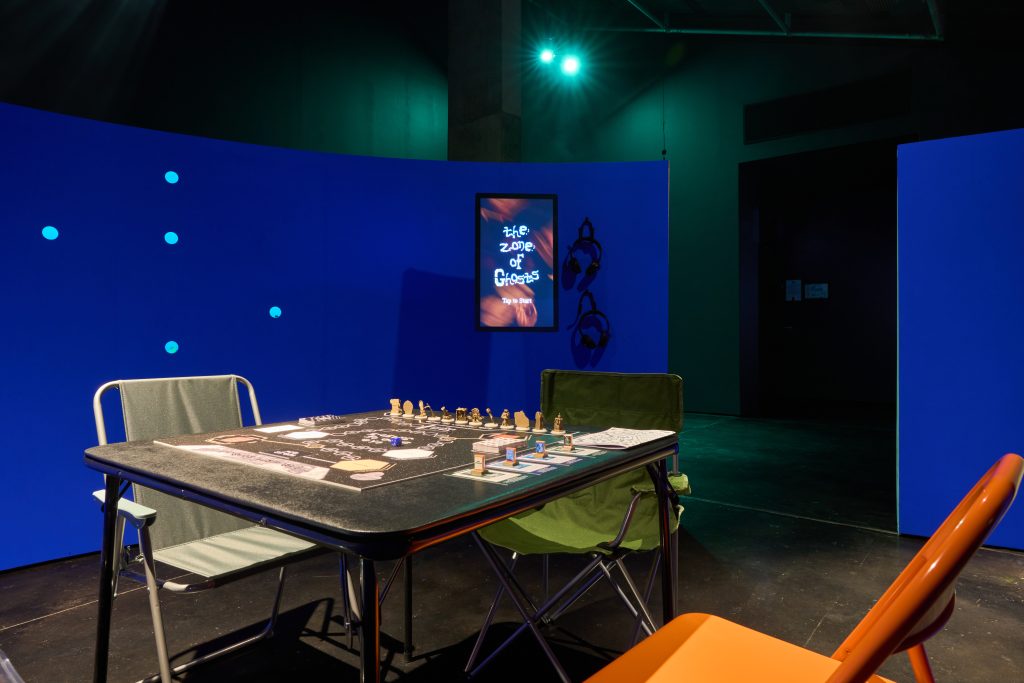
As I walk into the room, a soundtrack of nocturnal birds plays. Two curved wooden frames, much like stud walls without plasterboard, divide the space. One houses a board game; the other a flickering fire in an old oil drum, beside screens showing films. The title tells me I am in a dark forest, and I have to use my imagination to believe this. Before I have even engaged with the artworks, the spatial design has made me complicit in its reality.
This is characteristic of Kooner’s practice. Their films and installations operate less as discrete artworks than as environments in which histories, technologies, memories and imagined futures collide. Drawing on mythology, science fiction, ecology and personal and collective histories, Kooner uses speculative world-building to ask how inherited stories shape our understanding of the present and what futures might become possible if those stories are disrupted.
Here, that approach becomes collective rather than autobiographical. Kooner is not simply telling young people’s stories; they are creating the conditions in which young people can become storytellers, myth-makers and authors of possible futures. Imagination is not an escape from reality, but a technology for reorganising it.
I chose to watch the films.
In the first, a group of young people dressed in shonky homemade costumes, cobbled together from cardboard, silver foil and what looks like ventilation ducting, stand beside a cardboard representation of Stonehenge. They are from the future and are on a quest to piece together the past from relics encountered during their travels through the dark forest.
It is a playful imagining of experiencing our world out of time and context: piecing together a shared origin story from ruins, deciding what fragments matter and beginning to map a way forward as a community. But beneath the playfulness is something more unsettling. Who decides what survives? Who gets to interpret the fragments? And what happens when the stories we inherit have already been damaged, distorted or deliberately erased?
These questions sit at the heart of Kooner’s wider practice. Memory is treated not as something fixed, but as unstable material: fragmented, contested and continually reconstructed. The dark forest is therefore as much an archive as a fantasy landscape. Its ghosts are not simply figures from the past; they are the traces, absences and possibilities left behind when official versions of history fail to account for lived experience.
It also feels uncomfortably close to the way information reaches us now.
Much of what we receive is mediated through screens, fragmented, stripped of context and requiring verification. Algorithms, commercial interests and AI increasingly shape the informational worlds we inhabit. IRL — in real life — spaces in which we can share ideas, disagree and negotiate our way towards heterogeneous communities are increasingly hard to find.
“Here we stand on the precipice of a fragmented tomorrow,” the film tells us.
The line names the present as much as the imagined future. Yet Kooner does not propose a return to some supposedly coherent past. Instead, they ask what might happen if we embrace fragmentation as a creative condition. If the future is unstable, perhaps that instability creates a space in which it can still be contested.
Given that young people are the inheritors of the future, what exactly is it that they are inheriting? Do they want what this world is becoming, and if not, what opportunities do they get to imagine it otherwise?
The second film is a recorded conversation between Kooner and FACT’s Learning Team. Kooner recalls asking the young people what they wanted to see in the future, only for them to respond that no one had asked them that question before.
It is a simple observation that exposes something profound about participation. Young people are routinely described as the future while rarely being given meaningful opportunities to articulate what that future might look like.
Kooner addresses this contradiction by treating participation not as consultation, but as world-building. The young people’s ideas, stories, objects and characters become the material from which the fictional world is constructed. The project also demonstrates that this kind of collaboration requires time. Relationships, trust and rapport cannot be manufactured in a couple of weeks, nor can creative ideas necessarily be forced into a predetermined outcome.
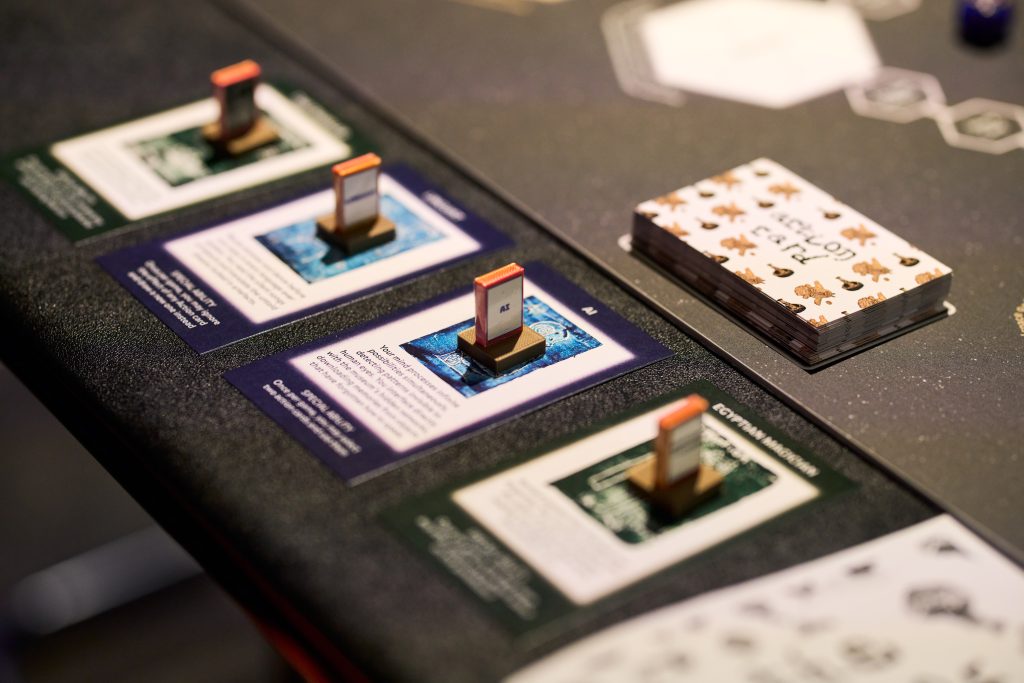
The project began when FACT’s Learning Team worked with Global Friends, a youth group based in Leigh, to reimagine Wigan Museum’s collection. Together they produced ‘The Zone of Ghosts’ board game, in which players recover magical objects and place them in ‘Sanctuaries’ to reunite fragmented histories. Scenario cards disrupt the game: the ‘Memory Mist’, for example, forces players to swap characters and continue with different personas.
Nothing is stable.
That instability reflects the uncertainty of the future, but it is also fundamental to Kooner’s methodology. Games, fantasy and speculative fiction allow uncertainty to become productive. Instead of pretending history is fixed or the future predictable, participants are invited to experiment with both.
Kooner and the Learning Team half-joke that we are no longer able — or allowed — to imagine the future. It has been cancelled by climate collapse and capitalism’s cannibalisation, for which there appears to be no alternative.
But what if our imaginations are being held hostage by false paradigms?
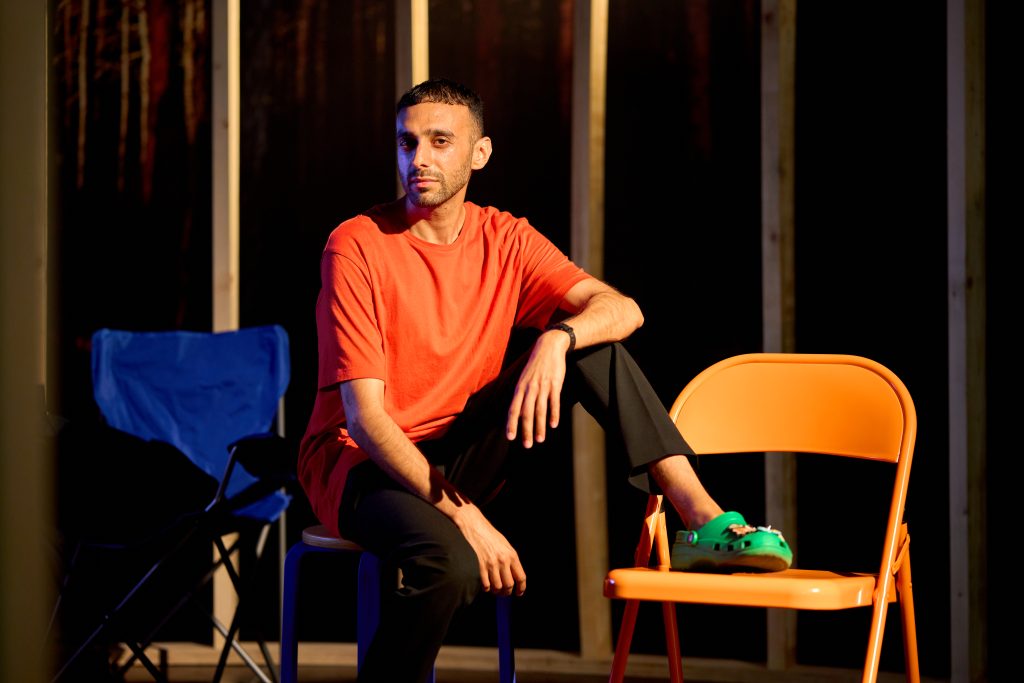
Kooner’s practice suggests that imagination might be one way of breaking out. Their conception of imagination as a form of technology is particularly pertinent. Technology is usually presented as something external to us: increasingly sophisticated machines that will determine what comes next. Kooner reverses this relationship. Imagination becomes a technology through which we can prototype different social arrangements, retrieve suppressed histories and rehearse alternative futures.
Perhaps this is also why the exhibition’s roughness matters.
The cardboard costumes, makeshift Stonehenge, wooden frames and oil-drum fire could easily be dismissed as amateurish. But the materials announce that this world has been made rather than discovered. They expose its construction. We are reminded that worlds — cultural, political and technological — are made by people, and therefore can be remade by people.
The young people’s desires for their future are revealing. Rather than simply dreaming of individual success, they centre community and real-life connections that embrace difference. The project does not provide them with a polished vision of tomorrow; it gives them a space in which to rehearse the social relations they might want that tomorrow to contain.
This is where the exhibition becomes more than an engaging participatory arts project. It offers a proposition about what an art institution might do differently. Rather than presenting young people with an established cultural history and asking them to find their place within it, Kooner creates a situation in which they can question the archive itself, invent new histories and imagine different futures.
The museum, gallery, game and film become porous. The distinction between artist and participant becomes less fixed. Past and future bleed into one another. Reality and fiction become tools for examining each other.
The ghosts, then, are not simply those who have disappeared. They are also the possible worlds that have not yet been allowed to exist.
Projects such as (darkforest) The Zone of Ghosts offer a model for a different kind of art world: one that enables imagination to flourish rather than simply reproducing crumbling power structures. Its most radical proposition is not that young people should be given a voice, but that institutions should be prepared to listen to what happens when that voice changes the work.
As political theorist Lea Ypi wrote in a recent Tribune article, “practicing politically committed art means returning to this unfinished struggle for the universal” — using aesthetic education to challenge dogmatism and our inherited relationship to the past.
Kooner’s exhibition takes that proposition somewhere tangible.
It asks us to gather the fragments.
To accept that they will never fit perfectly.
And then, together, to build something from them.
Natalie Hughes is the Merseyside and Cheshire Editor of Corridor8.
Sahjan Kooner: (darkforest) The Zone of Ghosts runs until 16 August 2026.
This review is supported by FACT.
Reference:
Ypi, Bl. (2026) The meaning of commitment , Tribune. Available at: https://tribunemag.co.uk/2026/07/the-meaning-of-commitment (Accessed: 12 August 2026).
Published 14.08.2026 by Laura Harris in Reviews
1,619 words