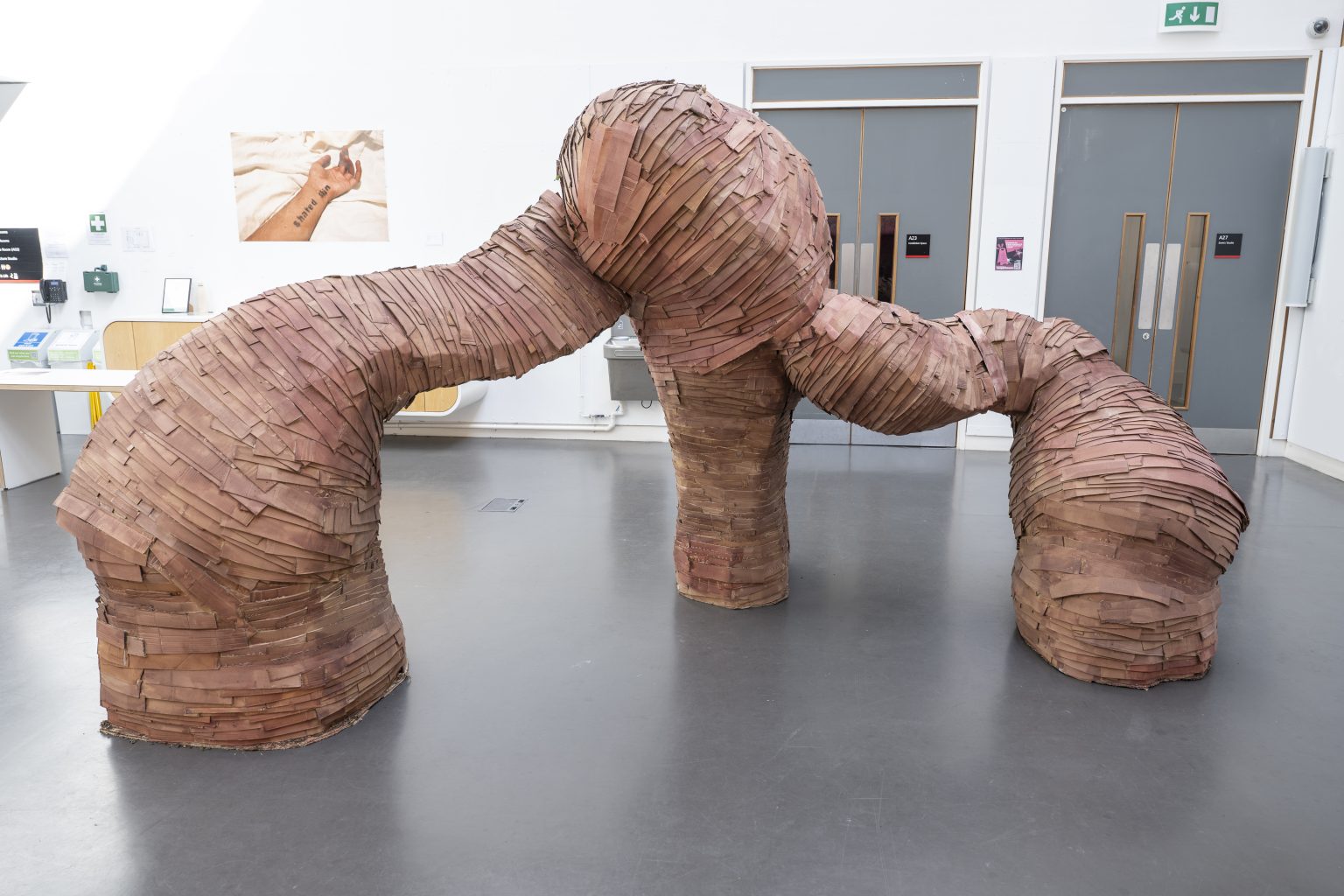
STRATA is the 2026 postgraduate Fine Art exhibition at Newcastle University, bringing together work by students across the department’s new one-year MA, two-year MFA and PhD programmes. The exhibition reflects the breadth and depth of contemporary practice within the department, foregrounding a richness and diversity that speaks to its distinctive history of fostering experimentation, independent studio practice and interdisciplinary approaches. STRATA considers these practices as distinct yet interrelated geological layers, formed through different experiences, material processes, disciplines and stages of artistic development.
With a myriad of routes and levels through the show, the familiarity of the Hatton Gallery draws us in first. Nestled between columns and spanning the expansive walls, Lauren Shakespeare’s paintings show no sign of hesitancy. Drawing unapologetically from the artist’s own personal experiences, the works are united by hazy reds, browns and blacks, punctuated by turquoise neon blues. Figures emerge from queer spaces and fleeting encounters, while fringed and blocked leather, stitched and studded onto the walls, creates a collision between the formality of painting and the lived-in materials of queer identity. Large-scale portraits such as ‘An Infernal Tormentor’ (2026) and ‘Hey Man, Nice Shot’ (2026) sit at the heart of this atmosphere. The latter captures an intimate moment of shedding, the artist seemingly disrobing a ghostly layer of themselves and leaving it pooled on the floor. In ‘Nutshell’ (2026), bodies disappear beneath fringed leather jackets within an orange-lit toilet stall, bringing private, bodily realities sharply into focus. Together, Shakespeare’s works balance intimacy with concealment, testing portraiture’s ability to contain the messier, embodied realities of queer experience.
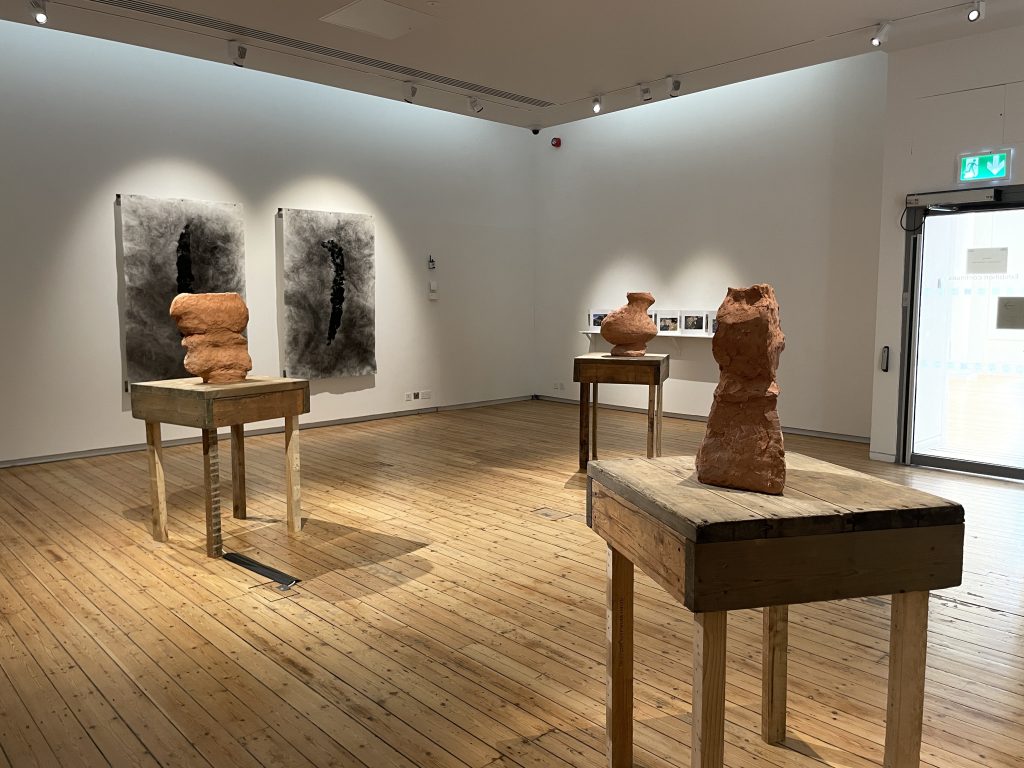
Transitioning from the light of the main gallery, we enter the dim recesses of Elizabeth Oughton’s assemblage. ‘Entanglements in Place’ (2026) brings together materials drawn from the landscapes of the North East and Cumbria, exploring ideas of time, place and memory while allowing the materials themselves to become active agents. Spot lit, large terracotta vessels sit on scarred sculptors’ tables, their rough surfaces bearing evidence of the artist’s tools and hands. From within come the sounds of repeated tapping, scraping and knocking. Opposite, a wall mounted life-size light box illuminates a latex transfer taken from a boulder, the skin capturing lichen, mould and staining as a delicate imprint of its surface. Nearby, Oughton also exhibits two large drawings using deposits of smoke, coal and charcoal to create elongated forms, while washes of soot settle into the paper’s creases and grain. An accompanying concertina book introduces a documented human presence: camouflaged among rocks, the soles of human feet emerge between crevices and grass. Accompanying each book image, Oughton titles each picture with phrases such as ‘a place of industry + play’, the landscape becoming both geological and lived space. Together, Oughton’s intimate works invite meditation on histories embedded within the materials, making the landscape both subject and collaborator.
In the expanse of the Hatton’s back gallery, David Loftus’s large-scale paintings explore memory and how digitalisation transforms its source material through layers of process. Shifting between abstraction and figuration, scribbled memories, washed-out doodles and ghostly silhouettes emerge across tactile surfaces. Works such as ‘Play Park’ (2002) ‘Duck’ (1998) and ‘Florence Cathedral’ (2004) combine oil, acrylic, spray paint and gesso, where pixelated forms meet staining, washes and textured marks.
Printmaking is equally integral to this body of work. In ‘Carpark Football Cards’ (2006), printed imagery is buried beneath layers of paint, while ‘Carpark’ (2004) contrasts tie-dyed calico with crisp black pixels captured through silkscreen printing. Here, digital images and physical materials become increasingly entangled as source imagery is repeatedly manipulated and obscured. Elsewhere, graphite, charcoal, marker pen and monoprint transfers create a quieter dryness. ‘Bridge’ (2006), ‘Slide’ (2001) and ‘Slide II’ (2000) evoke fragmented memories through derelict landscapes and deserted playgrounds that seem to draw from the artist’s childhood memories or possibly a car boot sale find. Despite this variety, Loftus maintains a strong visual continuity, balancing technical precision with experimentation. Through collecting, scanning, layering and reworking fragments of the past, memory becomes something materially and digitally remade.
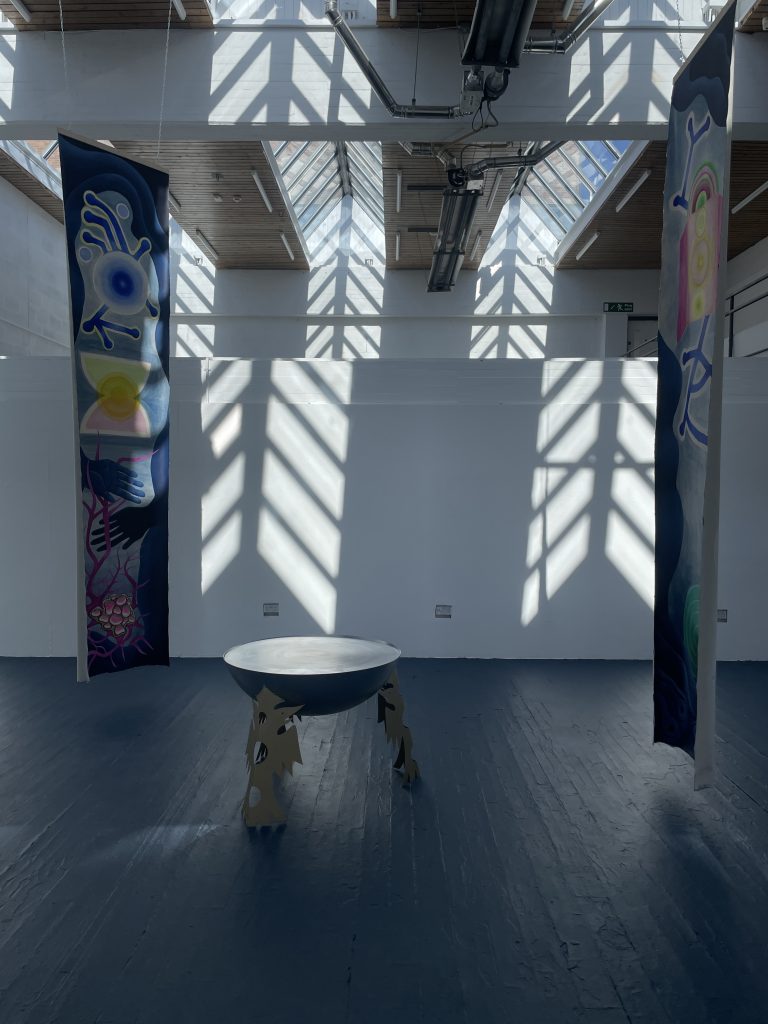
In the daylight-lit studios, intersected by shadows from the glass roof beams, three hand-painted banners hang the 10-metre height of the space, facing inward towards a polished metal table or altar. Natalie Martin’s work creates an atmosphere at once ceremonial, futuristic and strangely familiar. Across the surface of these floor-to-ceiling banners, stylised images bring quasi-spiritual and mystical symbols into contact with the digital world. Outstretched hands, eyes and circuit boards drift amongst clouds, spheres and fields of light, while organic structures sit alongside intricate circuitry, suggesting relics of lost civilisations and imagined futures. Cool blues, coral reds, pinks and yellows recall the spiritual abstraction of artists such as Hilma af Klint and Anna Cassel, positioning Martin’s imagery between the symbolic, technological and unknowable. This ambiguity extends into the installation: rough-edged banners, reminiscent of public murals or union halls, contrast with the cold sheen of a circular altar, precariously supported by delicately thin gold feet. Together, these elements suggest a ceremonial space displaced from time, poised between past and future, as though awaiting participants for a ritual yet to begin.
Contrasting with Martin’s colourful work, Ellen Cherriman’s sparse installation brings together photography, text and objects to explore trauma and the body as a site of memory, vulnerability and agency. Photographs capture marks left on the artist’s own skin, while a wrinkled white shirt suspended on a hanger is echoed in an image of the garment soaked through against the artist’s body. Nearby, a long fine gold chain draped over a wire spanning the room evokes culturally familiar notions of delicate femininity. Restriction becomes more explicit in a large-scale self-portrait, where cling film binds the artist’s head and body, creating an unsettling sense of confinement and suffocation that suggests societal pressures placed upon female identity. Opposite, a cast of the artist’s chest rests beneath the handwritten statement, ‘my body is neither subject nor object, but a physical material that remembers. I remember.’ Resembling a damaged historical bust, its silver surface and draped fabric recall traditional representations of beauty, while leather straps suggest armour and protection.
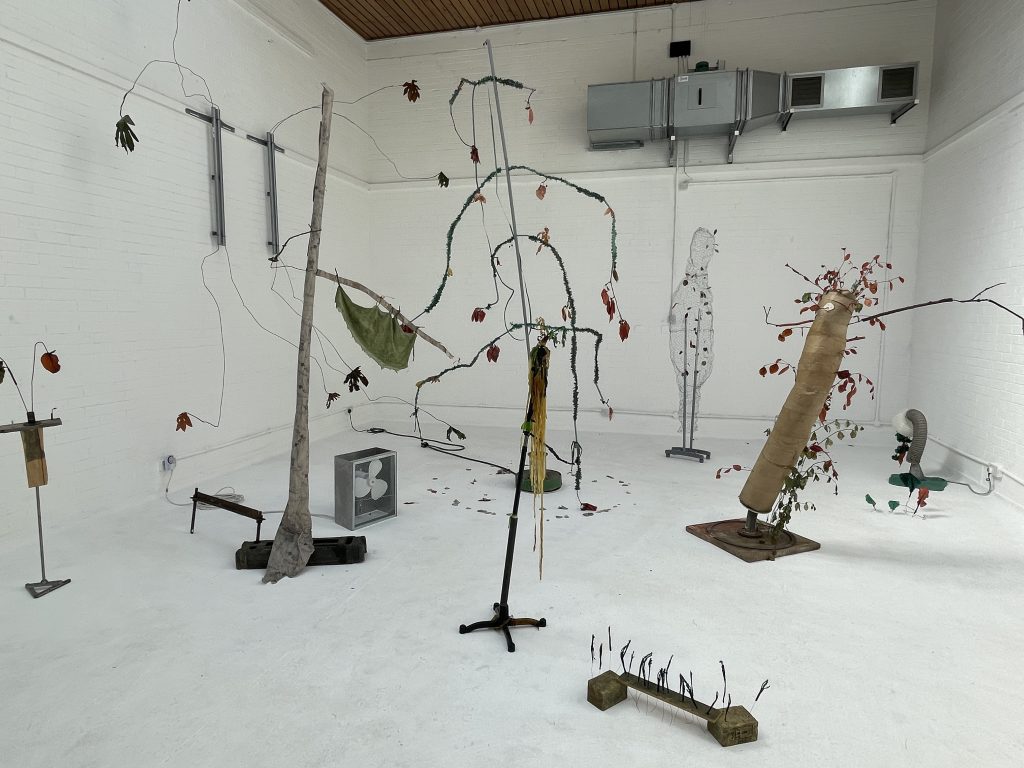
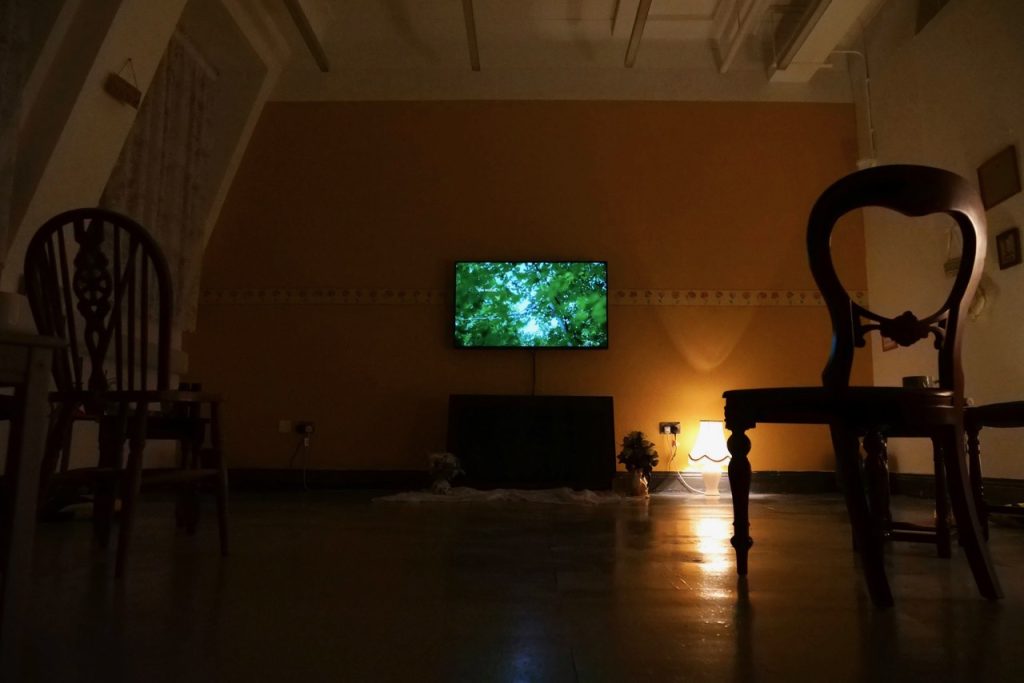
Down in the department’s basement studios, Marlene Rosch brings together discarded objects and natural materials in a delicately precarious multimedia landscape installation, ‘Ich habe eine Nase/I have a nose’ (2026). Three-dimensional drawings assemble wood, metal, plastic, wire, carpet tubes and fringed astroturf alongside dead leaves, shrivelled berries and branches, creating an environment that feels simultaneously comic and melancholic, artificial and alive. At its centre, a slowly rotating tree-like structure extends its arms, occasionally brushing against other nearby structures, objects and an electric fan. These gentle collisions evoke the continual interactions between bodies, objects and their surroundings. Elsewhere, imitation becomes deliberately unconvincing: printed bark paper disguises one structure, undermined by a frayed, tired-looking towel, while leaves and shoots coated in bright green resin appear suspended between a point of preservation and decay. In the corner of the space, precariously stacked monitors show silent digital animations of leaves, grasses and branches twisting, bending and pulsating, echoing the movement and creaking of the nearby sculptures. Through this uneasy coexistence of organic and artificial, movement and stillness, Rosch creates a playful yet melancholic reflection on how we construct, remember and navigate our environments in a changing world.
Memory, poetry and sound lie at the heart of Annie Weatherley’s installation. A sea of life-size forms constructed from wire, handmade paper, linen, bed sheets and scarves stands among remnants of domestic routine: clothes racks, hangers, chairs, suitcases and the studio sink. Cutting through their ghostly stillness, the accompanying sound work ‘No Wound Underneath’ (2026) carries a woman’s voice and song alongside running water, evoking the repetitive rhythms of domestic labour and memories embedded within them. The female body recurs through precarious, pupae-like figures of white, cream and faded pink hand-made papers, splitting and stretching under their own weight. Interwoven scarves and fabrics evoke nostalgia and ancestral femininity, transforming domestic materials into vessels for histories and stories passed between generations. Elsewhere, exposed wire figures carry spine-like trails of paper scrolls, suggesting concealed words held within the body, while faintly embossed letters hanging between these works emerge almost imperceptibly from bleached paper pulp, bar a smudge of ink or dirt to highlight the text. Bound together by Weatherley’s evolving processes of making, repurposing and breaking down, these fragile forms present memory as something continually carried, fragmented and reformed through bodies, materials and domestic rituals.
Continuing the dynamic use of the studio spaces next door, Freddy Williams’ immense installation commands the room, engaging the senses through charred wood and imposing swathes of canvas stained with mud from the River Tees. Suspended by rope, the fabric descends in peaks and troughs that echo the river’s movement. Beneath, a platform of charred planks invites audiences to enter, their footsteps punctuated by carved footprints exposing the bright wood grain below.
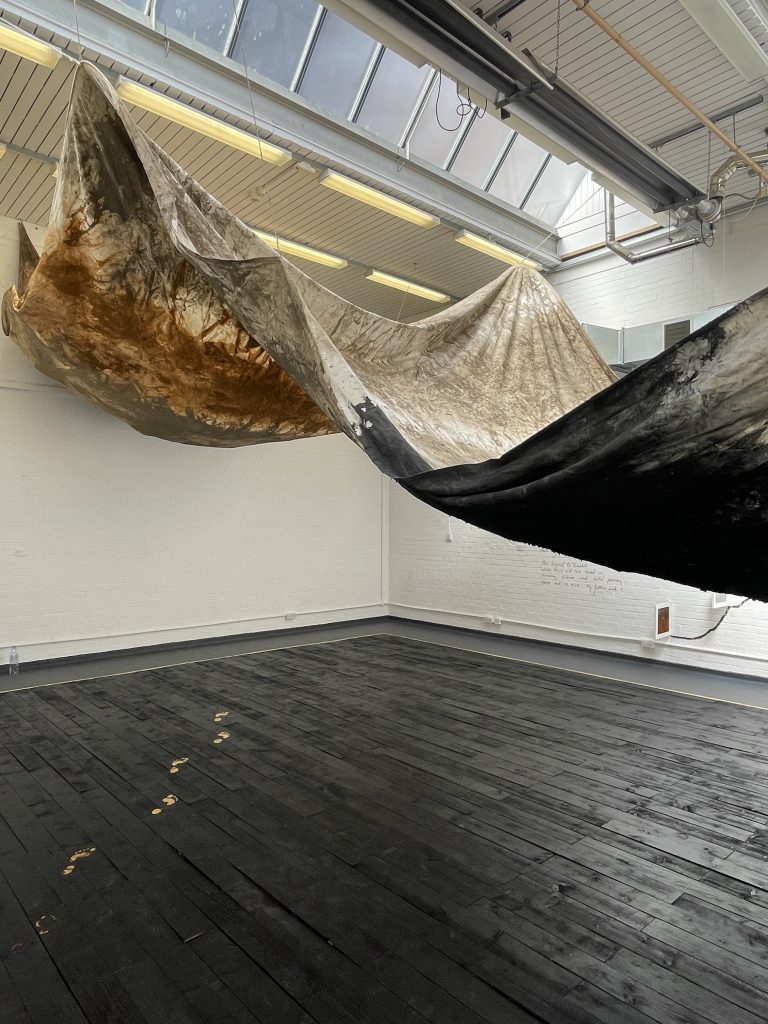
Mary Oliver’s words, ‘Attention is the beginning of devotion’ (from “Upstream”, (2019)), frame Williams’ environmental concerns, encouraging close engagement with materials through their weight, texture, smell and physical transformation. This relationship between place and material extends across weathered steel sheets lining the walls of the studio. Four of these steel sheets framed in different UK-sourced timbers record environmental effects from Simonside, Heaton, Lynemouth and Hadrian’s Wall, while ‘Shore to Summit’ (2026) traces the meandering geography of the River Tees.
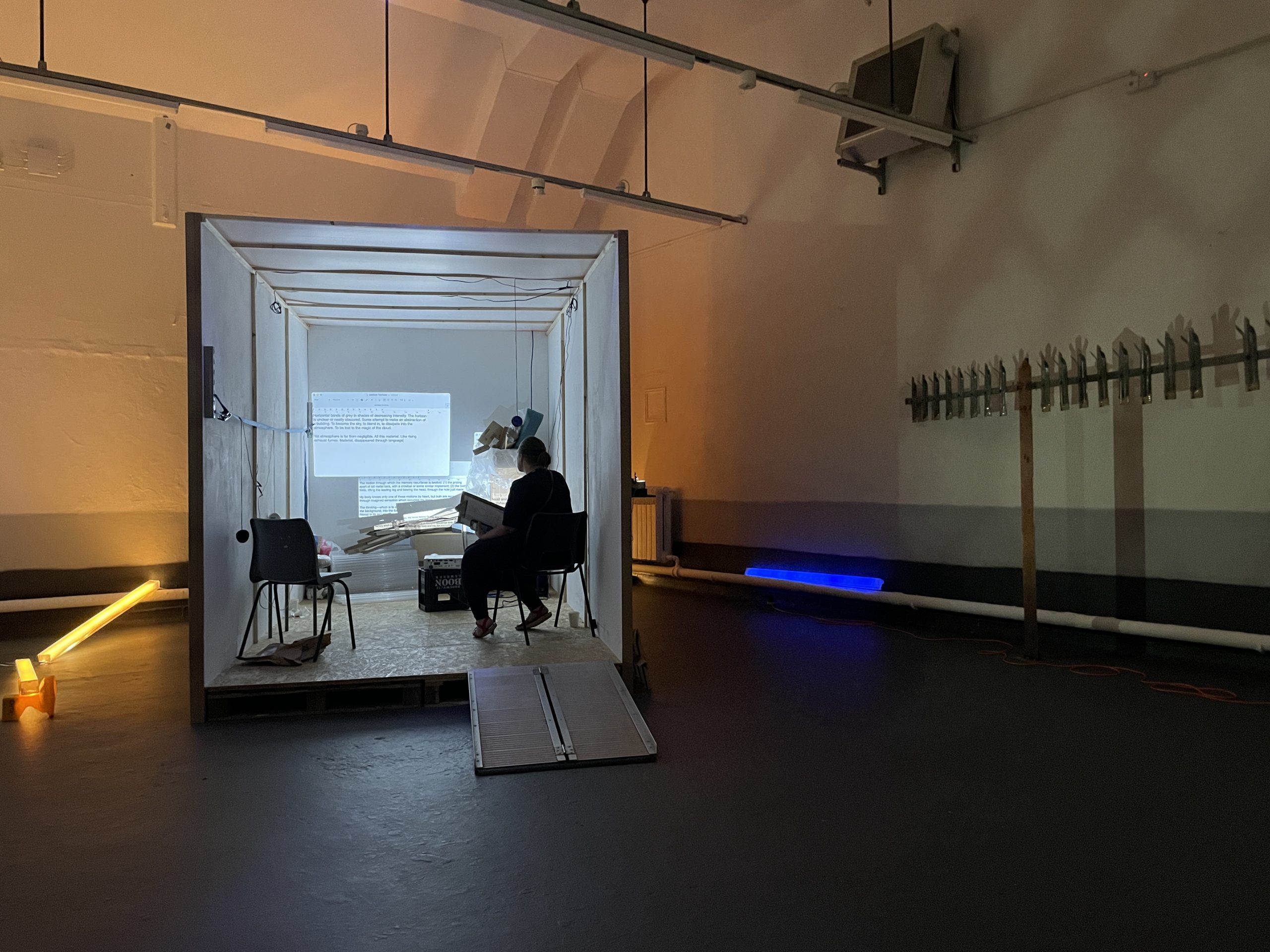
Ascending from the basement, the degree show culminates upstairs, where Nancy Daykin’s dimly lit installation ‘Fulfilment/forcing a hiccup in its sequence’ (2026), emerges among corridors of graffiti-clad walls and limbless plaster casts. Stained strip lights, flickering tailgate oranges and static blues gradually reveal the architecture of the space, forcing the viewer to acclimatise. Galvanised security fencing forms ‘Palisade A-D, E-F (‘differentiated bodies are made to shimmer’)’ (2026), its sharp prongs and cut-out voids framing shifting shadows cast by objects and the smartphone torches positioned to illuminate the surrounding space.
At the centre of the room, a ramp leads us into an open and sterile lit container. Within ‘Remotely manned system (forcing a hiccup in its sequence)’ (2026), a projected film on the back wall draws our attention to a screen recording of the artist’s computer desktop, where notes, memories and associative thoughts open, close and overlap in their numerous windows across the container’s interior, accompanied by spoken transcriptions through numerous dangling headphones. Packaging and discarded materials stacked against the walls reinforce associations with storage, logistics and transportation, while discarded coffee cups leave a trace of human presence. Nearby, mounted on the external walls of either side of the container, ‘#future#delivery#drone 1’ (2026) and ‘#future#delivery#drone 2’ (2026) consist of hidden wall mounted phones obscured by perforated paper packaging, playing out the combined sound hooks of social-media audio like TikTok, moving torchlight casting dancing shadows and the whirring hum of delivery drones. Together, these mimic a human presence that’s fundamentally absent at the same time. Daykin’s deliberately fragmented environment rewards slow investigation, occupying an uneasy space between fascination and unease as technology, memory, logistics and human desire converge within an increasingly automated culture of consumption.
Across STRATA, the works share an ambition of scale and a commitment to a material, multisensory experience. At a moment when digital modes of making and exhibiting are increasingly prominent, accelerated by the development of AI, the exhibition asserts the continued importance of direct engagement with materials, fabrication and process. Tactility, texture and the handmade emerge as counterpoints to digital smoothness, giving these works a physical and emotional presence grounded in individual authorship and imagination. Together, they offer a layered portrait of postgraduate Fine Art that is diverse in form and independent in voice, yet connected through a shared commitment to experimentation and the possibilities of contemporary practice.
Jonathan Long is an artist, filmmaker and arts educator based in Newcastle upon Tyne.
STRATA, Newcastle University Fine Art Department and Hatton Gallery, 15 August 2026 – 29 August 2026.
This review is supported by Newcastle University.
Published 08.10.2026 by Lesley Guy in Reviews
2,023 words