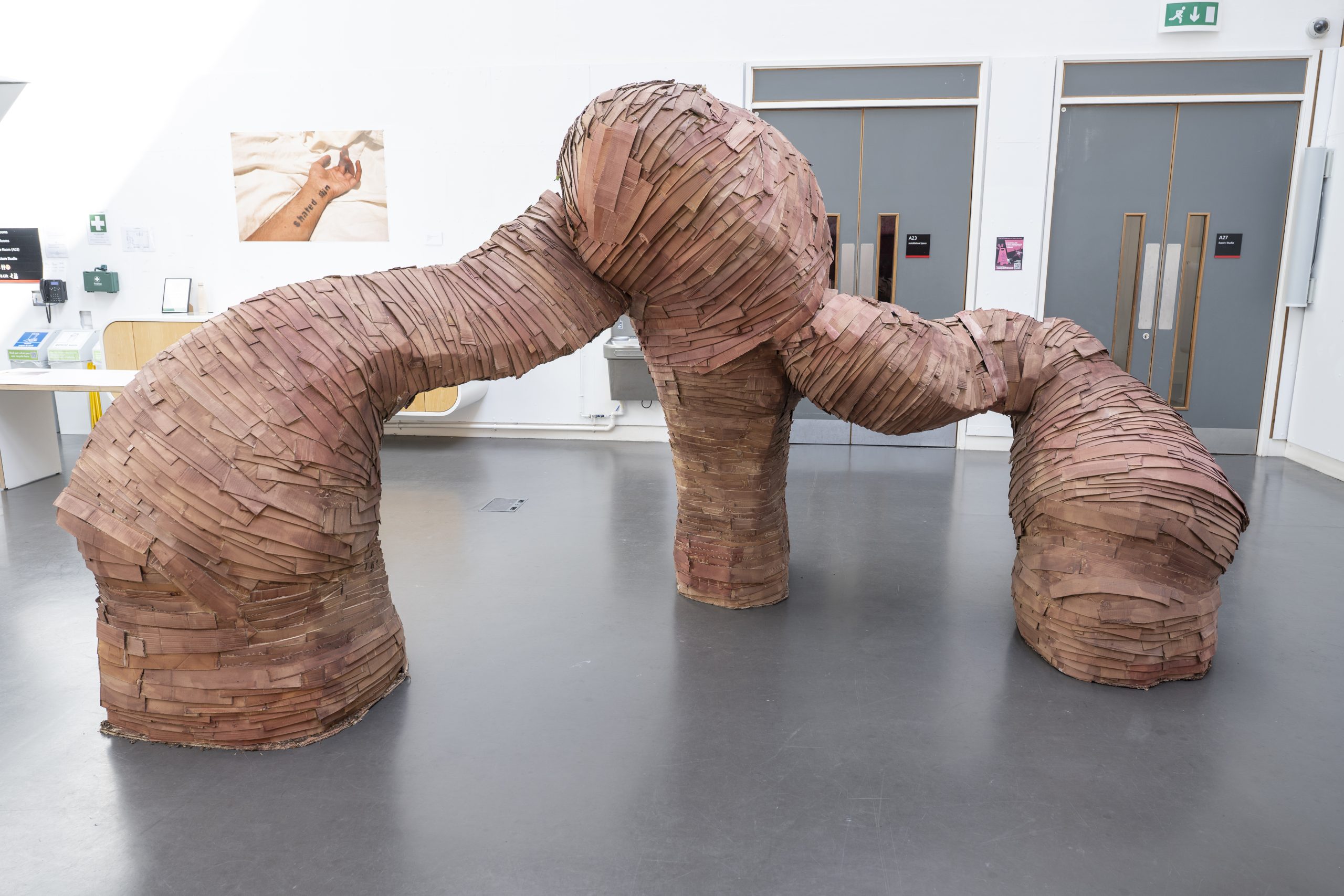
A digital print of a fallen arm resting on a bedsheet, poised somewhere between surrender and death, bears the words ‘Shared Skin’ across the flesh. This was the first work I encountered in the LICA Building: Nico Sharma’s ‘I knew you under its touch, and it knew us (Mud poem)’ (2026). I noted the phrase without knowing it would become a fitting reflection for the exhibition itself. Rather than a collection of individual practices, the degree show gradually revealed itself as a conversation between artists, each contributing to something larger than the sum of its parts.
I was aware of the temptation that comes when visiting a final degree show, to look beyond the work itself and to ask who will succeed, who will develop this practice further, who might become the next significant artist. Lancaster University’s The Fine Art Degree Show, spread across the Peter Scott Gallery, the LICA Building and the students’ studios in Bowland Annexe, quietly resists that impulse. Rather than encouraging speculation about future careers, the exhibition demands the works be experienced now and understood as significant pieces. These are not nascent works awaiting future validation. They exist fully in the present. Across the exhibition, bodies, landscapes and imagined technological futures speak directly to contemporary fears, hopes and critical perspectives. They make runways for future lines of flight, certainly, but they are also unapologetically of now.
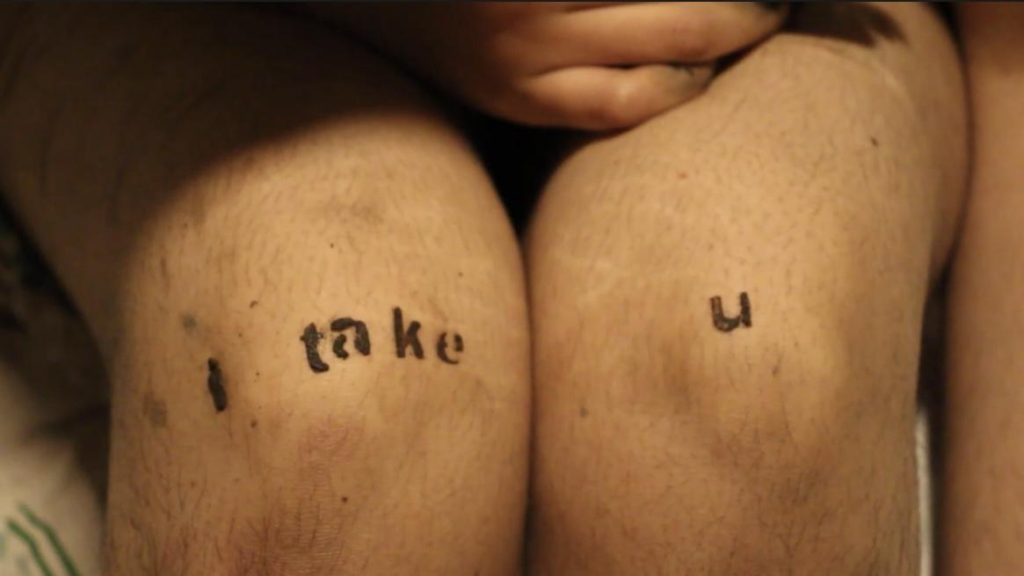
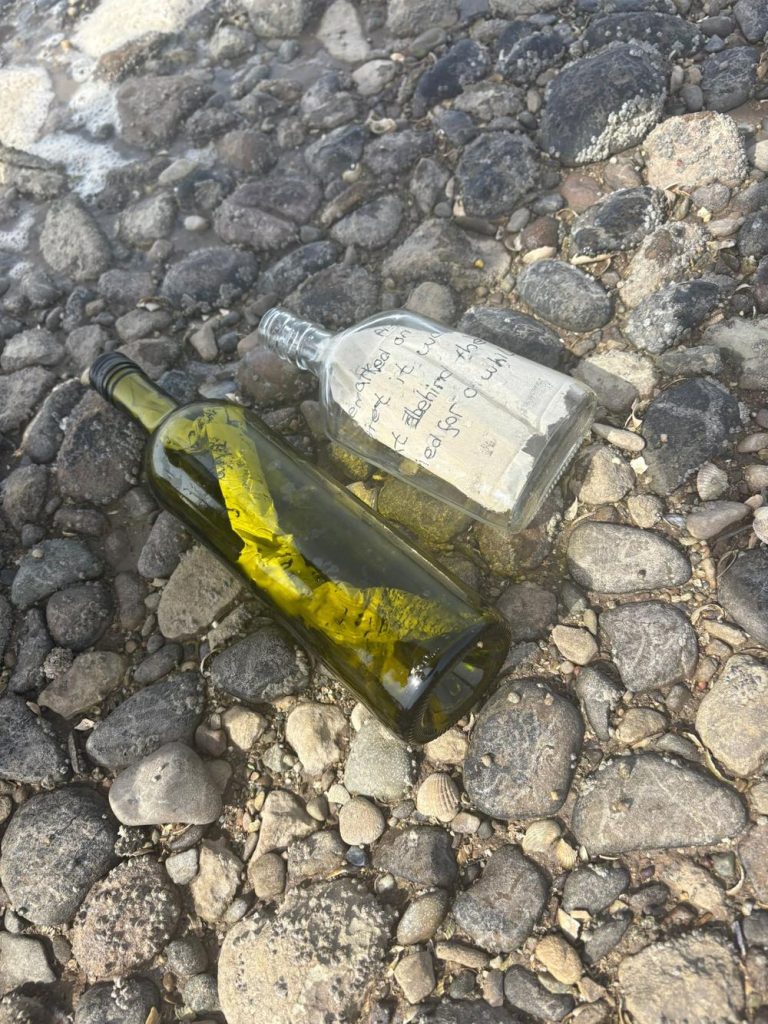
It was through Eleanor Moyses’ paired works that the exhibition’s wider structure began to reveal itself. ‘Untitled’ (2026), shown in the Peter Scott Gallery, presents five rows of six framed photographic negatives etched with fragments of poetry across celluloid light and shadow. Landscapes, objects and figures appear to offer narrative while continually withholding certainty. It is an impossible knowing in plain sight. Encountered later in the Bowland studios, ‘Messages to the Dead’ (2026) draws an unexpected line back to the earlier work. It recalls Chris Marker’s La Jetée (1962), where still photography carries the emotional weight of cinema. Here, Moyses begins with her grandfather’s photographs, not simply as family archive but as artistic material. His images become the surface onto which she writes, responds and remembers, weaving her own voice into an inherited visual history. Neither work completes the other. Instead, the relationship between generations unfolds through grief, memory, loss and love, while the movement between gallery and studio becomes part of the work itself. It was here that I began to understand the exhibition less as three separate venues than as a single dialogue unfolding across them, where meaning depends as much on what happens between encounters as within them.
That reading is supported by the exhibition’s curatorial ambition. As Fine Art Discipline Lead Jen Southern explains, the Peter Scott Gallery encouraged students to present a distilled work within a professional gallery setting, with each piece hinting at ideas explored more fully elsewhere. Bernadette O’Toole and the wider curatorial team have curated an exhibition in which the relationship between gallery and studio enriches both, revealing not only finished works but the practices, decisions and experimentation from which they emerged.
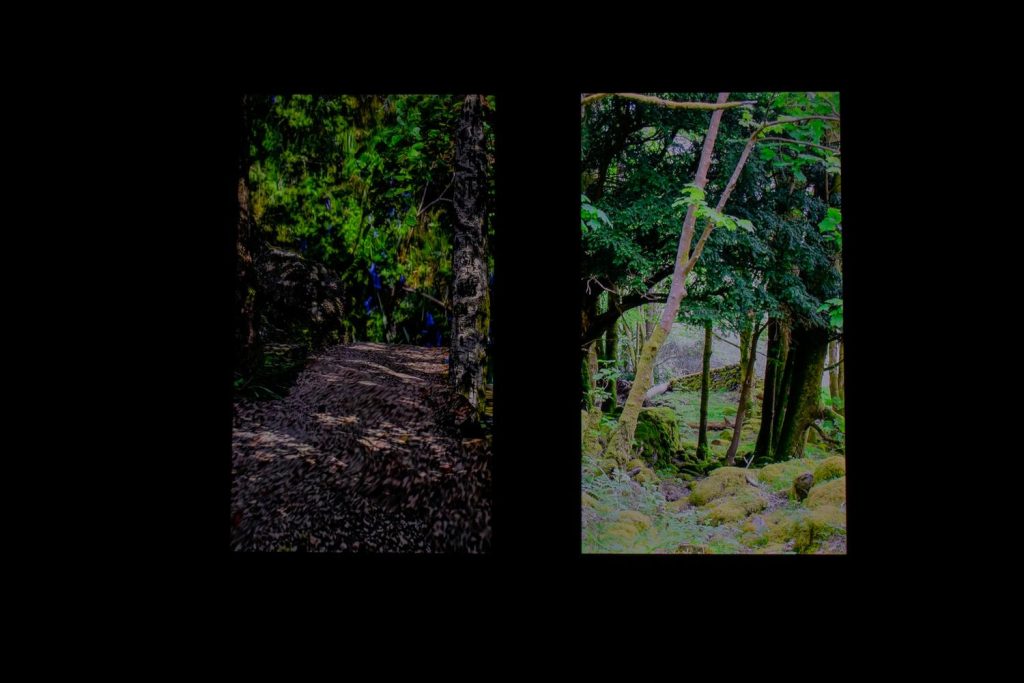
A similar unfolding occurred in Emily Ogden’s ‘Projections in False Spaces: Thirlmere’ (2026). This looped video installation first appeared in the gallery through abstraction, collage and mapping which then deepened in the studio into a meditation on changing landscapes and lived geography. Ogden achieved this through a longer version of the documentary, with sound, spoken testimony and immersive darkness drawing the viewer into this interplay of virtual and actual space. Personal reflections from spoken interviews overlaid wider questions of place, social change, ownership and use. The artist’s exploration of real and virtual mirrored the ways in which digital sharing and social media bring new challenges to an already contested rural territory.
Legacy threaded through much of the exhibition, although rarely as nostalgia. Abi Moore’s ‘Field Notes on Memhoriza Posthumana’ (2026) occupied both gallery and studio through two distinct installations: in the gallery, an ordered desk; and in the studio the remnants of an abandoned data centre. Moore’s artist’s statement describes capturing ‘the friction of living in a world where the artefact and the organic are permanently blurred’. The movement, from a gallery display into studio space, suggests that even our technologies are beginning to acquire the qualities of landscape and ruin. Steel, circuitry and memory become subject to the same slow processes of decay as the organic world they once appeared to oppose. The dynamic between the gallery and the studios amplified the distinction between works selected for display and the expansive thought, experimentation and practice that might otherwise remain unseen. The studios themselves carried traces of three years of conversations, experiments, failures and discoveries by allowing us to feel the spaces of creation, experiencing more fully what lies beyond the gallery walls.
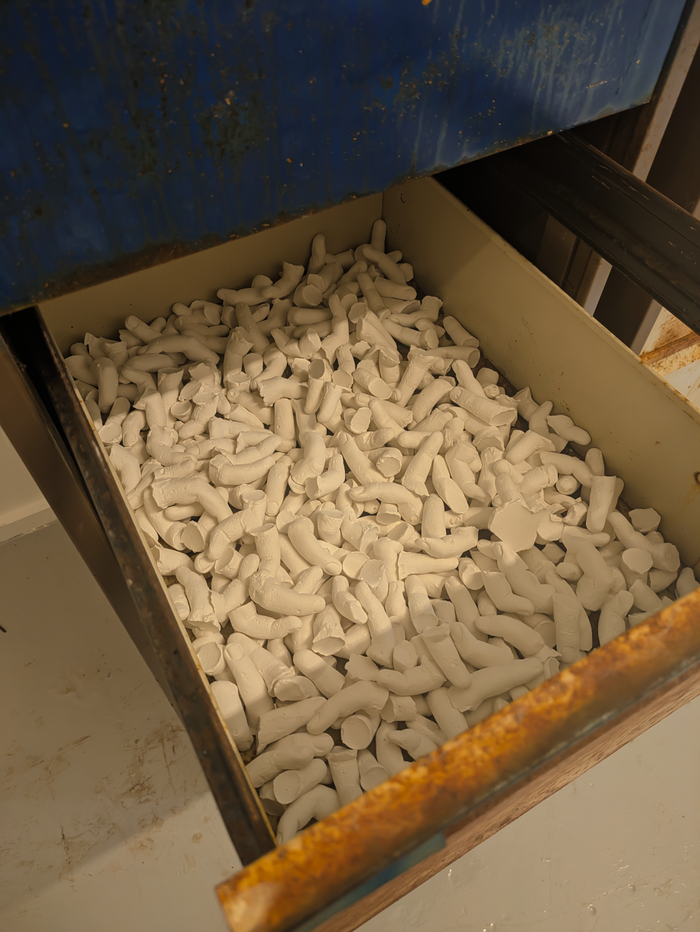
Nearby, Mischka Mae Andrew’s ‘Case Closed’ (2026) transformed an entire studio into a suffocating bureaucracy. Obscured Polaroids, mundane administrative debris of tape and pins, autopsy reports, decrepit filing cabinets holding lost lives. The horror is made more visible through the surrealness of hundreds of plaster fingers crammed into drawers. Collectively, they suggest institutions in which humanity survives only as evidence, records or data. It could be 1960s East Germany viewed through a grim prism. It could just as readily be contemporary Britain. Shifts to data-driven societal flows are perhaps more hidden in a digital realm; the crudely doctored Polaroids remind us that the same dehumanising impulse lies beneath both. Read alongside Moore’s installation, Andrew’s provocation provides further warning about the direction they see society taking.
Yet the exhibition does not leave the viewer within these institutional futures. Elsewhere, bodies, landscapes and ecologies insist on other ways of imagining the present.
If Moore and Andrew imagine futures shaped by technological and bureaucratic systems, other artists return insistently to the body. Not as something fixed or idealised, but as vulnerable, mutable and alive. Virginia Hewitt’s ‘Surface Memory’ (2026), a series of acrylic paintings, lingers over flesh with remarkable sensitivity. Pink midriffs, folds, shadows and shifting tones reject idealisation in favour of an unromantic beauty found in ordinary bodies. Sophia Hodges’ ‘Long Live the New Flesh’ (2026) suspends gouged strips of latex like mutated vellum, simultaneously skin and not skin, inviting fascination as much as discomfort. Elliott Smith’s ‘Bastard Breasts’ (2026) pushes these questions further through sculptural forms in the gallery and a film installation in the studio, where humour, horror and what they describe as ‘unapologetic queer chaos’ dismantle inherited assumptions about gender and embodiment.
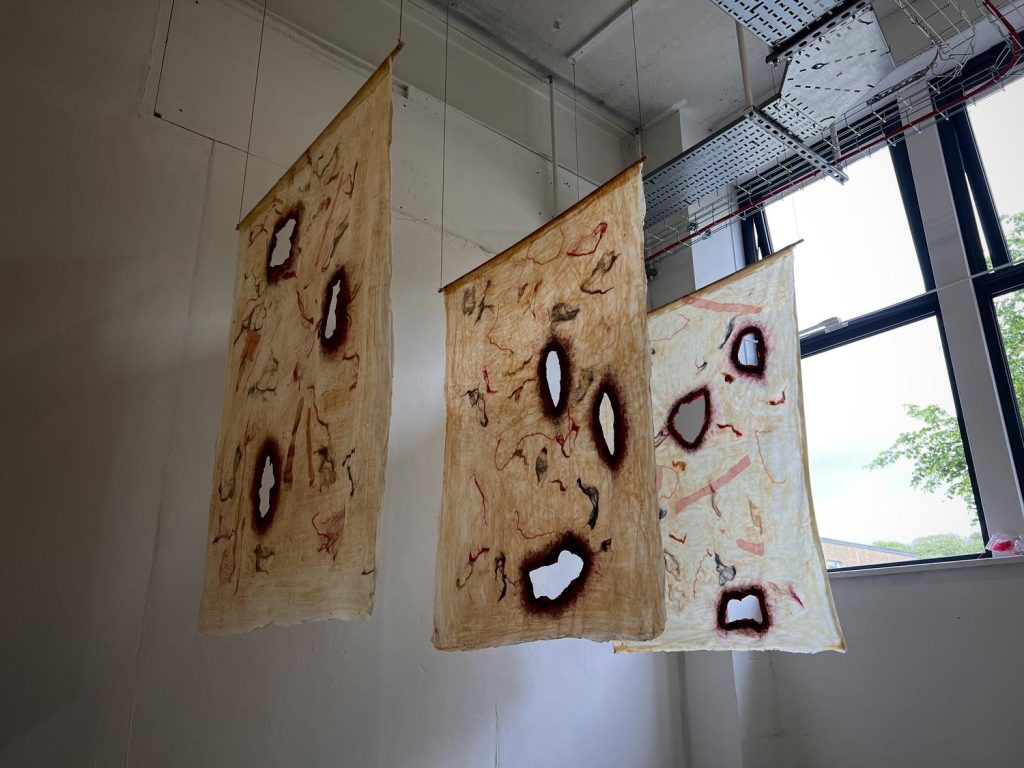
Elsewhere, the body expands beyond the human. Grace Le’s ‘Exposure’ (2026) transforms mould and bacteria into oversized felt forms that oscillate between attraction and repulsion, while Emma Humphreys’ ‘Friend or Foe’ (2026) populates the gallery with colourful papier mâché creatures whose ambiguous expressions become a kind of Rorschach test, revealing as much about the viewer as the work itself. Alongside Harriet Treble’s quietly hopeful ‘Utopia North West’ (2026), these practices offer a counterpoint to the institutional anxieties explored elsewhere in the exhibition. Rather than surrendering to systems of control, they imagine bodies, ecologies and futures that remain open, unstable and capable of transformation.
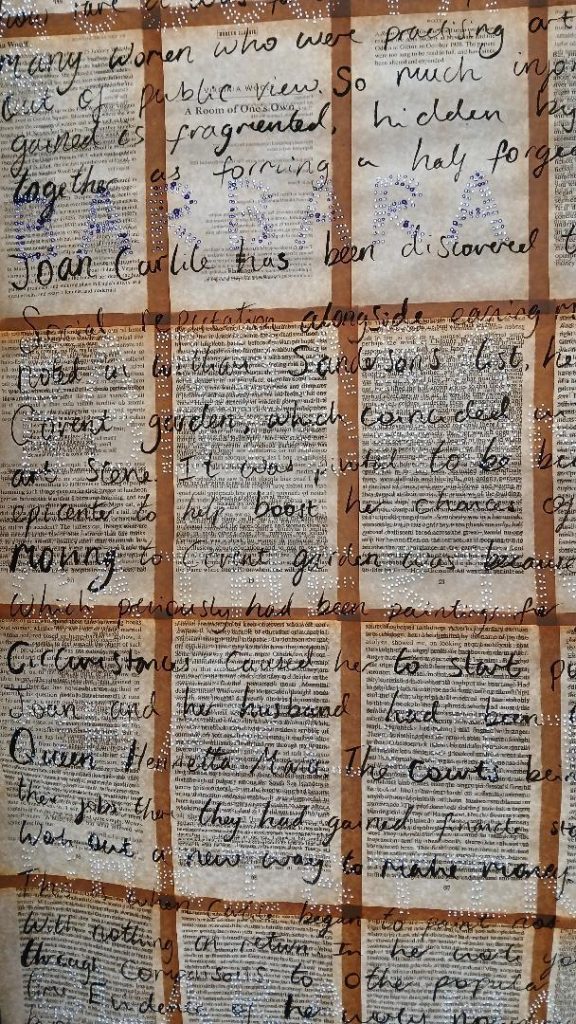
Lucy Davies’ ‘Between the Lines’ (2026) physically writes into the spaces between the printed lines of Tracy Chevalier’s novel The Glassmaker (2024), using the page itself as both material and metaphor. The intervention makes visible the voices that history, and often literature, leaves unsaid. Davies describes ‘a whole ecosystem of creatives found in the gaps, each individual contributing to another so that all can be heard’. Later in the piece, she observes that there will always be ‘more gaps to fill and more to be said’.
Leaving the exhibition and crossing the campus, the motorway tracing its familiar ribbon through the landscape towards Lancaster and the wider North West, Davies’ words lingered. They describe not only her own intervention but the exhibition itself. Between gallery and studio, between artists and audience, between university and region, this cohort revealed precisely such an ecosystem. The works spoke across buildings, across disciplines and across one another. The privilege of visiting this degree show was not to speculate about what these artists may become. It was to encounter them here, together, speaking with clarity, generosity and urgency into the gaps where, for a moment, every voice could be heard.
The Fine Art Degree Show, Lancaster University, Peter Scott Gallery, Bowland Annexe and LICA Building, 15–24 June 2026.
Dr Peter Shukie is a writer, educator and filmmaker from Wigan but now based in Blackburn, Lancashire.
This review is supported by Lancaster University.
Published 21.07.2026 by Jazmine Linklater in Reviews
1,452 words