
At All Saints Church in Earls Barton, seven halos of light orbit slowly, hovering overhead, suspended just out of reach. Halo, by the Swiss-Danish artist Tobias Zehntner, reimagines this sacred space by quietly working with its architecture, function and community, inviting audiences to experience wonder and connection without being overtly religious.
The golden bulb fittings look like candle holders, while the lights themselves replicate the warm glow of candle flames. The movement of each light is coordinated by a motor that is programmed by the artist to subtly vary the speed at which the lights rotate. At moments, the bulbs align in parallel and brighten before drifting apart again, forming a gently shifting constellation. This choreography of light, symmetry and movement creates an environment for contemplation, activating the church’s historic architecture, which includes a spectacular late 10th-century Anglo-Saxon tower.
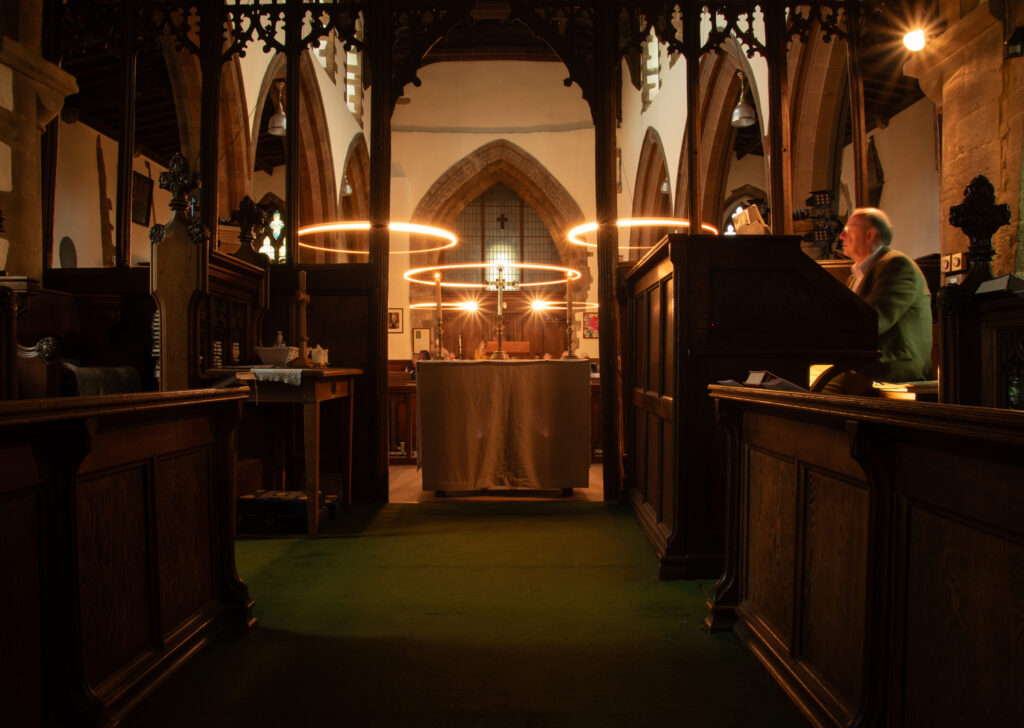
Halo is presented as part of Fermynwoods Contemporary Art’s Love + Light programme, a season of light-based artistic interventions across Northamptonshire, aiming to address the climate crisis by fostering awareness, inspiring action and cultivating a deeper connection with the Earth and its inhabitants. Halo sits slightly adjacent to the season’s environmental focus, instead providing an experience that is uplifting, searching for hope at a time when hope is sparse. Belgium-based Zehntner is a repeat collaborator with Fermynwoods. Light, movement, space and time are recurring themes in his work, with a focus on first-hand experience that is often manifested through kinetic works and installation. Fermynwoods’ Director James Steventon likens the organisation’s approach to working with artists to a solar system: some artists pass through in a blaze like comets, but most remain planet-like in Fermynwoods’ orbit, with the organisation supporting them as they pass by at different moments in their careers. Fermynwoods is well-established in its approach to artist development and has a clear focus on growing experimental, thought-provoking art in unexpected and often rural contexts across Northamptonshire.
I was born and raised in Northamptonshire, and like many young people with an interest in arts and culture, I often felt frustrated by the lack of venues, opportunities and support for creative careers in the area. The county has struggled to secure arts funding, develop large-scale institutions and build sustainable creative ecosystems: factors that have contributed to its unfair labelling as a cultural cold spot. Northamptonshire also suffers from an identity gap. Although geographically part of the East Midlands, it has the feeling of a liminal space: not quite South East, not quite West Midlands nor East Midlands, and is frequently overshadowed by the ‘stronger’ cultural identities of neighbouring areas. Yet, the county has a distinct character and no lack of artistic talent, creative potential or deeply ambitious individuals and committed organisations like Fermynwoods. Northamptonshire also has a rich history that connects with Zehntner’s own, with Northampton being an important strategic centre within the Danelaw during the 10th century when the county was under Danish control.
The churchgoing community of Earls Barton has warmly welcomed Zehntner and his installation, programming and hosting music events that enrich the Halo experience and foster a sense of shared ownership. George Turvey, a young, local composer, has contributed several powerful, site-specific compositions that sit amongst the accompanying Belgian organ music for the opening night, bringing to the village a flavour of Zehntner’s home. Workshops exploring light and movement invite participation from local young people as well as Fermynwoods’ regular audiences. At the entrance to All Saints, two posters illustrate the project’s openness: one, clean and branded, was designed by Fermynwoods; the other, announcing Halo’s public programme, was created by members of the church community and features a clip art banjo pasted over a pixelated image of the installation. Fermynwoods’ willingness to share control over programming, branding and institutional image in favour of genuine inclusion exemplifies a rare, generous approach to collaboration.
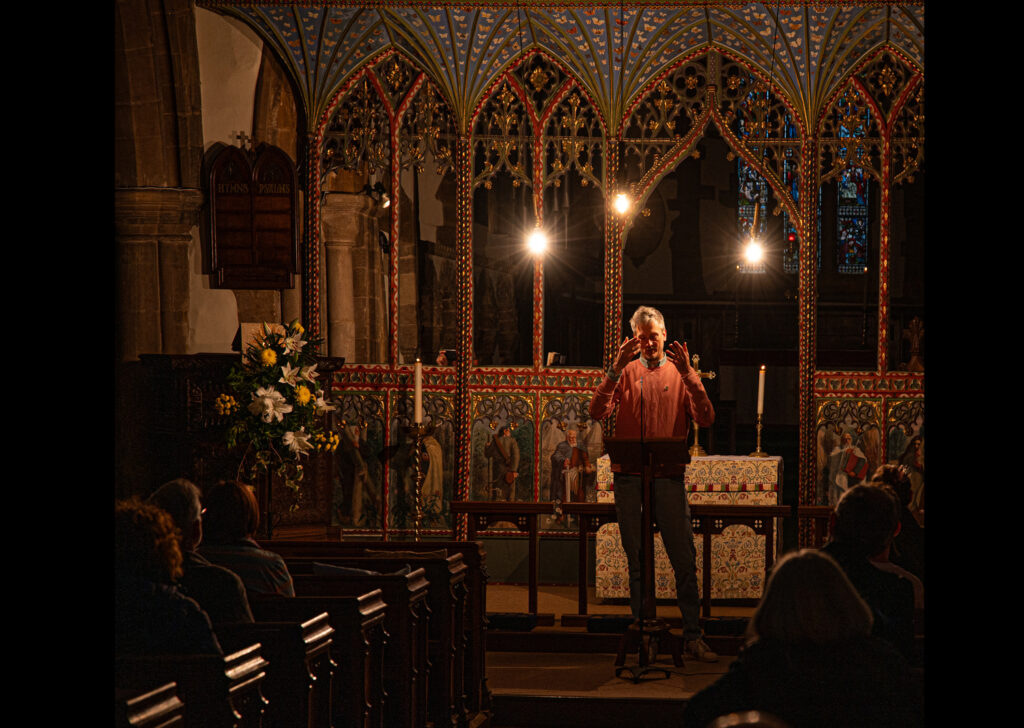
Contemporary art is widely inaccessible, often presented beyond a threshold that many publics do not feel comfortable in crossing, be that the glossy entrance to a white cube gallery or in this instance the heavy wooden doors to a place of worship. However, Zehntner’s work itself is accessible in that you don’t have to ‘get it’ to feel it emotionally. Really, there is nothing to ‘get’. James describes Halo as ‘good art’, aesthetically harmonious, experiential and open in meaning. Zehntner explains that much of his motivation is simply to see an idea resolved in a space – a strong statement in a contemporary art world hyper-focused on justification. Art within places of worship can also serve as a mechanism for storytelling and sensory connection, however. The timing of Halo’s switch-on at 3pm on Good Friday, the noted time of Christ’s death, adds a resonance that has not been explicitly promoted, but rather provides a subtle nod to the installation’s setting, and to the vicar and wardens who will care for Halo during its two-week run.
Halo works because of its site-specificity. While conceived and previously shown elsewhere, it’s the perfect fit for All Saints. Like Olafur Eliasson’s immersive spectacles, Zehntner’s installation transforms space, inviting sensory engagement and spatial awareness. Yet, unlike Eliasson’s often monumental works, Halo doesn’t overpower, rather it shares the clarity and quiet restraint of fellow Belgium-based artist Ann Veronica Janssens’ work, which similarly explores light and perception with a minimal, contemplative approach. Halo disrupts nothing, instead augmenting what is already there, gently drawing attention to silence and space. Zehntner, a trained draughtsman with a background in video and photography, leans into the architectural specifics of the church with the grace of someone who understands how to add without overwhelming. He likens the work to a magic trick: striking in its execution, whether or not you know how it’s done.
Tobias Zehntner: Halo was at All Saints Church, Earls Barton, Northamptonshire, from 18 April – 1 May 2025, curated by Fermynwoods Contemporary Art and funded by Northamptonshire Community Foundation’s Compton Fund.
Colette Griffin is a curator, artist developer, artist mentor and arts writer based in Nottingham and working across the Midlands.
This review is supported by Fermynwoods Contemporary Art.
Published 19.05.2025 by Rachel Graves in Reviews
1,056 words


