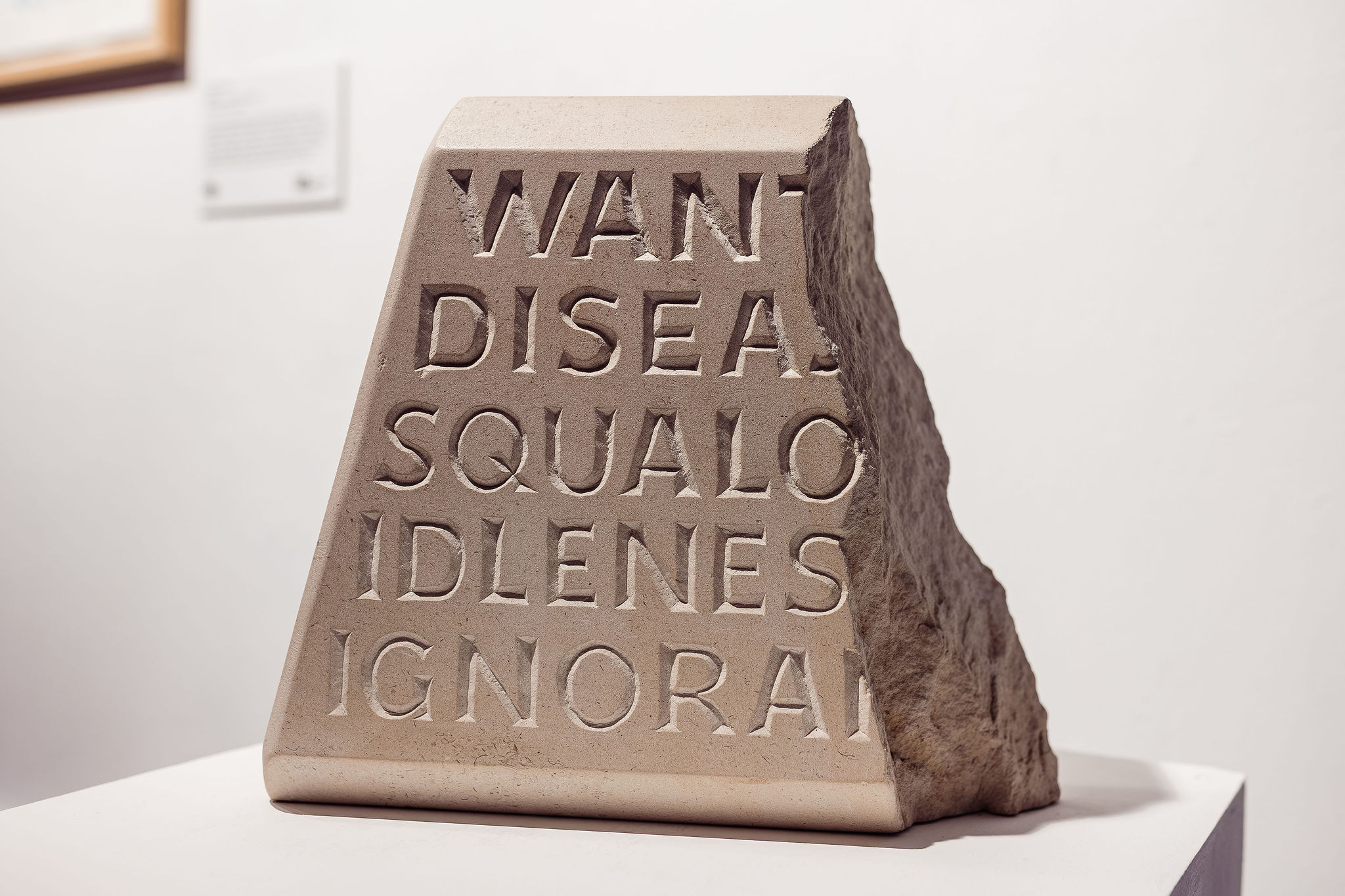
‘The work can’t exist without the fault,’ sculptor Tony Heaton OBE tells me as we sit in his studio in Southport, everything coated in a fine layer of stone dust. He’s referring to his piece ‘Split’ (1994) – the title expertly hand-carved into a hunk of ash wood once rejected by a wood-turner because of a natural fault in the grain – but the sentiment easily encompasses all of Heaton’s work currently on display at Lancaster University’s Peter Scott Gallery.
Tony Heaton: Serial Dissenter, curated by Sarah Martin, is programmed by Lancaster Arts as part of their 2026 programme on the theme of‘Dissent’. Exploring and dissecting the theme through performance, visual art and music, their aim is to explore dissent in many forms, from the extremes of political protest, overthrowing corrupt regimes, to simply engaging in the difficult conversations. For a strong-willed artist like Tony Heaton, being disabled in an ableist society, dissent is often the only option.
Working as a sculptor, arts administrator and disability rights activist, Heaton addresses inequality, dehumanising oppression through discrimination and negligence, as well as the negative aspects of charity, and much more. Although these themes are heavy, unsettling and upsetting, in true dissenter fashion, Heaton seems to rebel again, approaching his art with a defiant sense of humour, drawing you in with playfulness before exposing the severity of the subject.
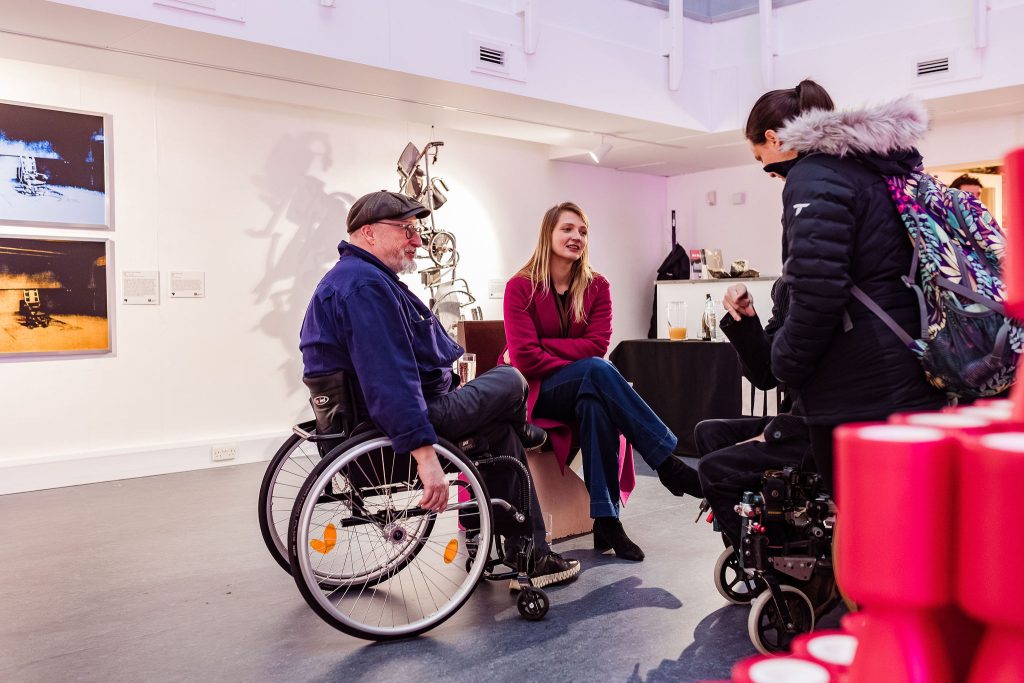
He tells me of a friend who now lives in an apartment building that previously housed the Intensive Care Unit of the hospital where, at the age of sixteen, Heaton was admitted after a life changing motorbike accident, leaving him needing a wheelchair and crutches. His smile widens as he admits to regularly asking this friend, ‘have you seen any ghosts yet?’. I sense that his humour is part of the same driving force that has propelled his headstrong career whilst also guiding him through life; approaching adversity with a raised middle finger, smiling.
Heaton tells me that despite studying sculpture at Lancaster University (1986-1989), the exhibition doesn’t feel like much of a homecoming. He says that, for whatever reason, no further networking opportunities arose. This came as a surprise, adding to his ‘still quite conflicted’ feelings towards his student years, which were marred by the university’s limited disabled-access, which he says left him feeling isolated from his classmates – having to leave lectures via different exits, taking him further away from socialising with his peers. Accessibility issues also tarnished what should have been the pinnacle of his university career: his degree show.
In his final year he created ‘Wheelchair Entrance’ (1989), a deceptively simple piece consisting of a strip of wood suspended from two pieces of rope with the title neatly painted across it – displaying Heaton’s then side-career as a sign-painter. The piece was designed to be hung across the only entrance at the time to that year’s final exhibition – also held in the Peter Scott Gallery – comically hindering access for everyone but wheelchairs users; upending the usual dynamic of spaces designed for able-bodied people. However, in a bitterly ironic twist, not only was his hanging choice rejected on grounds of ‘health and safety,’ but the entrance, located at the top of a small flight of stairs, was not even adapted to allow wheelchair access. The artist was forced to leave his wheelchair and, with the help of his friends, clamber said stairs to attend his exhibition; he describes the whole discriminatory situation as bizarre.
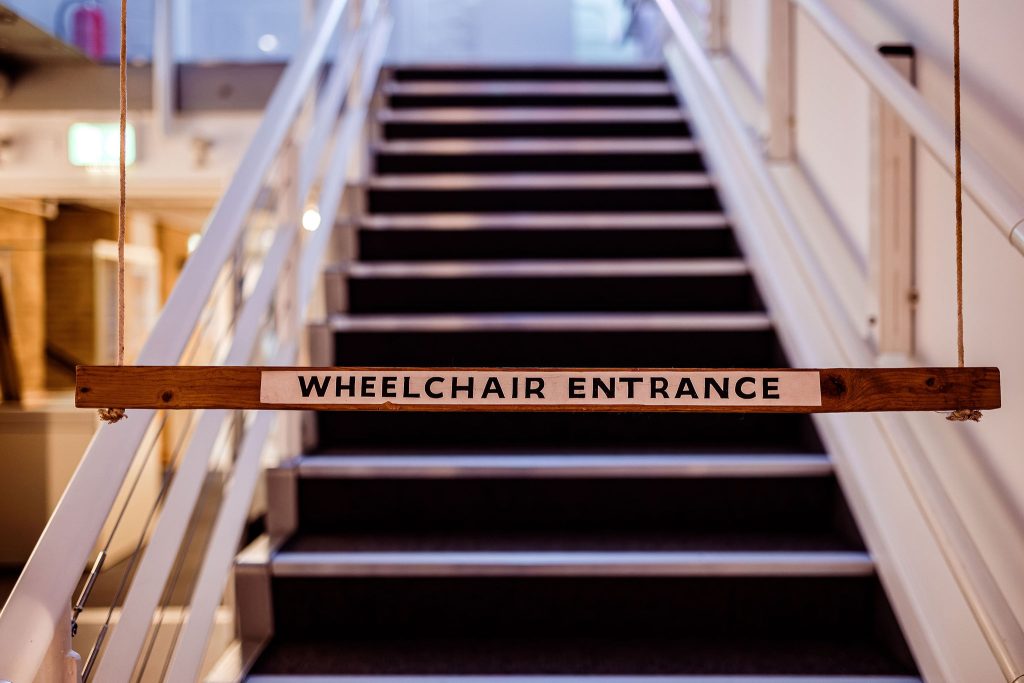
Thirty-seven years later, the Peter Scott Gallery now has an accessible entrance for all, and Heaton has brought ‘Wheelchair Entrance’ back to Lancaster and repurposed its original intent. It now blocks the staircase to the upper floor of the gallery which, despite a lightweight stairlift, is still inaccessible to many.
He uses this disadvantage to create a powerful interplay between his early and more recent work. ‘Wheelchair Entrance’ is not simply blocking off part of the gallery, it also frames the glowing crucifix of ‘Tragic/Brave’ (2019), positioned as an enticing symbol of redemption at the top of the inaccessible stairs, viewable only from a distance for everybody. Consisting of a neon light sign spelling the words ‘tragic’ and ‘brave’ in the shape of a cross, the bleak relevance of its words is known all too well by the disabled community, Heaton comments, as they seem to be the only two adjectives that ‘lazy’ journalists can muster for stories regarding the differently abled.
As much as we might want to travel up the stairs with the artist, that desire is warped by the presentation of the mezzanine-style upper gallery itself, left deliberately darkened, creating a looming sense of somewhere out of bounds. Heaton explains to me that this was entirely intentional. He has never been up to the upper gallery floor as access had not been catered for, so he wanted to express disabled people’s segregated experiences, being inherently excluded from many public and private spaces for able-bodied viewers. By restricting access to that level, the artist reshapes and reclaims the gallery as a space that works for him, whilst offering an exercise in moving able bodied people’s perceptions away from their everyday experiences.
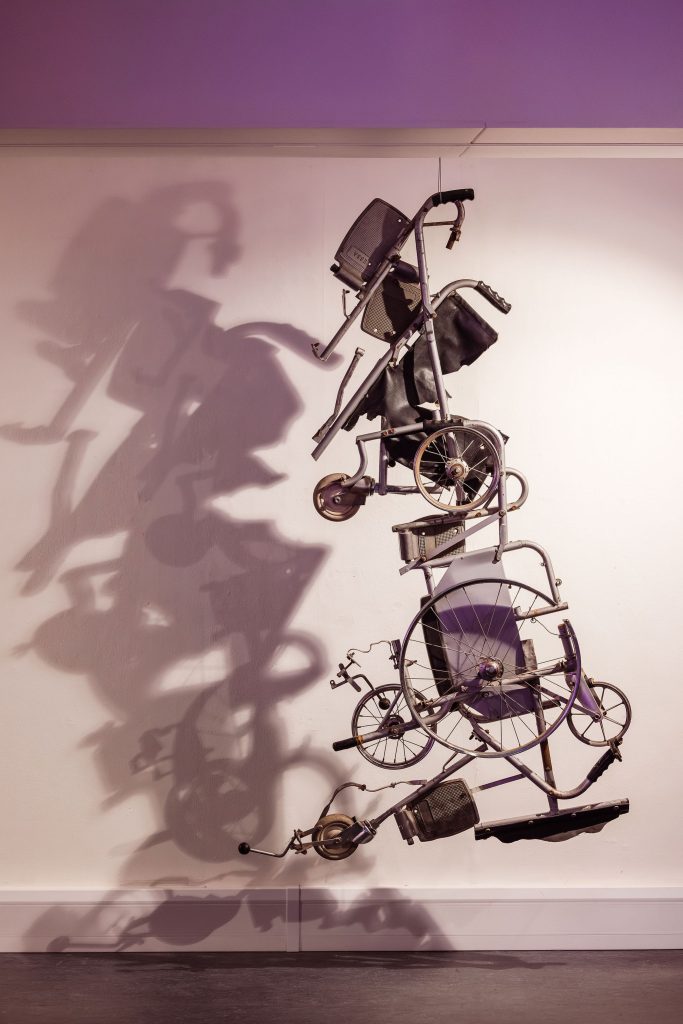
This is how Heaton dissents. He examines difficult situations and translates them into clear-headed works of art embedded with humour. ‘Great Britain from a Wheelchair’ (1994) also addresses this issue through its verbal and visual pun, utilising a pair of former NHS wheelchairs. These are dismantled, bent and beaten to form a map of the country mounted on the wall. The twisted metal and stressed plastic convey a sense of anger and frustration at inaccessibility, whilst the precise execution demonstrate Heaton’s ability to clearly conceptualise negative experiences as positive inspiration. ‘White on White’ (2002) hilariously takes aim at those who patronise disabled people and expect gratitude for the morsels of aid they offer. Seventeen conservators’ white gloves – designed for handling delicate objects – are posed and framed on a white background to spell out ‘smile fuck’ in British Sign Language (BSL), made one year before BSL was officially recognised as a language by the UK government, and a full twenty years before it received full legal recognition. This message, similar in tone to a wealthy employer expecting unquestioned devotion from their minimum wage workers, points out an insensitivity in the power dynamics of charity and aid. Written in BSL, however, it also directly addresses the users of that language, letting them in on the joke before anyone else.
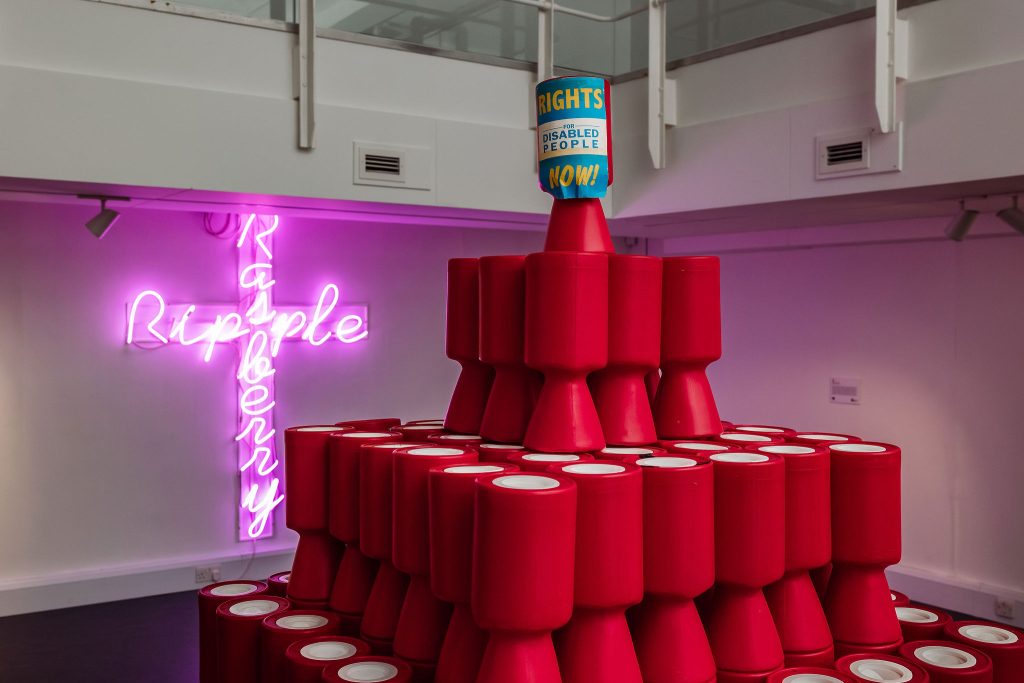
Another example of Heaton’s balance of wit, outrage and the ongoing theme of reclaiming autonomy is ‘A Bigger Ripple’ (2018), a second, larger neon sign comprised of two crossing words: ‘Rasberry’ (sic) vertically and ‘Ripple’ horizontally. Heaton describes this piece to me as ‘highlighting the social model of disability’. The UK-based disability-led arts organisation Shape Arts, of which Heaton was CEO between 2008 and 2017, explains this social model: ‘a person isn’t ”disabled” because of their impairment, health condition, or the ways in which they may differ from what is commonly considered the medical “norm”; rather it is the physical and attitudinal barriers in society – prejudice, lack of access adjustments and systemic exclusion – that disable people.’
The piece addresses this model via the implication of the phrase ‘Rasberry Ripple;’ a rhyming slang slur for people with mobility disabilities. The missing ‘p’ from ‘Rasberry’ challenges the notion that a word missing a letter must be ‘wrong’ and ‘faulty’, highlighting the subtle oppression found in the language used by both gatekeeping institutions and supposedly charitable organisations, othering people and cashing in on their misfortunes. The missing letter underlines this as a conscious effort as this ‘mistake’ is actually easy to overlook, appearing at the intersection of ripple’s double p; if it wasn’t pointed out, this ‘fault’ might even go unnoticed.
In addition to this, Heaton explains that this slur, much like the weaponised words reclaimed by other marginalised groups, is now used by certain disabled people as a way of reclaiming the narrative. He’s referring to the Crip Art movement’s ethos of reframing disability from the disabled person’s perspective, acting as commentary on their experience as well as that experience being a source of resilience and inspiration, as well as reclaiming the language of former slurs.
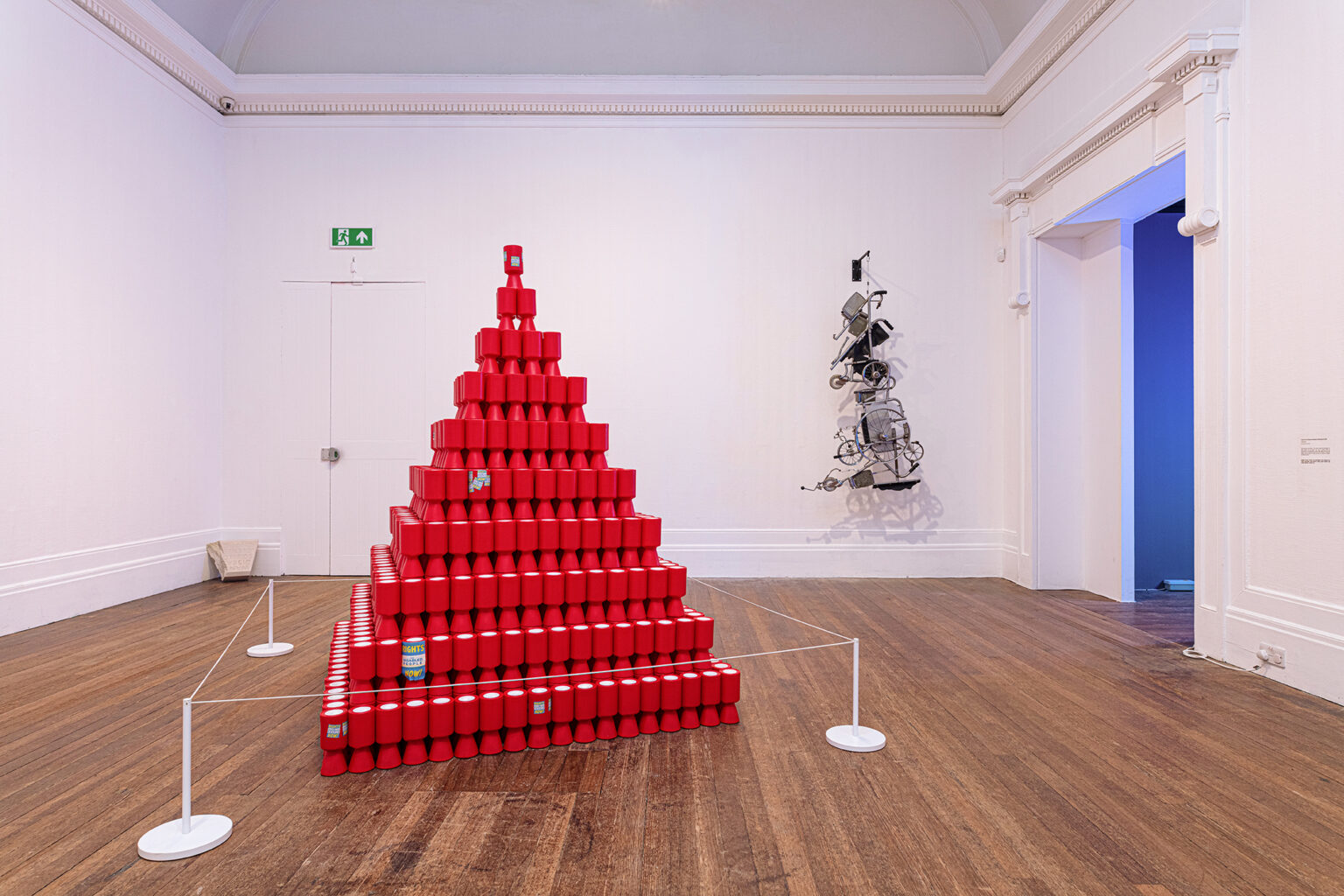
The attitudinal barriers of this unjust social model are also addressed in the visually-dominating ‘Shaken not Stirred’ (1992). A striking seven-foot pyramid constructed of 1,683 red plastic charity collection tins occupies the centre of the room, seemingly awaiting the slightest mishap to come and topple it all. This fragility is entirely the point, with the piece originally being the object of a filmed performance artwork, protesting against TV’s dehumanising charity Telethon – television network takeover events, which at times lasted over twenty-four hours, that used excessive sob-stories reducing disabled people to pitiable charity-cases rather than human beings. As an act of protest against what was deemed to be ‘show us your stumps voyeurism’, Heaton hurled a Doc Marten-booted prosthetic leg at the plastic pyramid, bringing it crashing down. This performance is documented in the photomontage ‘INTO WHICH…’ (1992), also on display in the gallery.
With Telethon being cancelled thanks to the protests, ‘Shaken not Stirred’ (1992) continues to articulate Heaton’s ongoing distrust of charitable organisations. ‘Charity constrains you’ he states, going on to cite a quote he attributes to David Attenborough: ‘It fascinates me that giving to charities is considered noble and praiseworthy, but creating a society that doesn’t require charity is considered socialist and bad.’
Serial Dissenter is inherently a political exhibition, but it is also an exhibition of varied artistic choices. Explaining his ability to move from one medium to another with ease, Heaton describes himself as ‘primarily a conceptualist’, stating: ‘Ideas come from everywhere… you don’t control ideas, you just need to be alert to the possibility’. There is an interesting contrast at play between his emphasis on reclaiming of control from a variety of oppressive forces, whilst relinquishing control when it comes to the ideas behind his work. There he lets snippets of information, conversation or some material detail gestate until it eventually emerges as a spark of inspiration. It seems that the creative process is something of a psychological reprieve from the heavy lifting his dissenting requires.
Heaton’s approach to ideas may equally result in video art, wood carving, light-sculptures, ready-mades or paintings. But his willingness to investigate and experiment with each idea differently has at times left collectors and dealers humorously frustrated. ‘We can never spot a Tony Heaton’, he has been told, though personally sees this as a positive rather than a problem. Wearing the comment like a badge of honour, he explains how making art that is instantly recognisable as a specific artist – something the financial side of the artworld often banks on – is ‘the last thing I want to do’, referencing his friend and fellow artist Franco B’s exclamation that such art is ‘dead art’. From this perspective, we find the artist once again dissenting.
At Lancaster Arts he even challenges gallery etiquette by allowing some of the pieces to be handled by visitors. ‘Damaged (Five Giants)’ (2020) a piece carved from a keystone discarded by a stonemason due to a fault, and the previously mentioned ‘SPLIT’ (1994) can be carefully touched, allowing insight into the tactile nature of stone and wood carving. The exhibition also includes ‘DIY Crucifixion Kit’ (1989), a box containing a hammer, nails and crucifix along with instructions, and ‘Square Triangle Chair’ (1989), a wooden chair designed to look unstable despite being completely functional. These were pieces made as a student, designed to directly challenge a conservative teacher who ‘crucified’ his pupils for their creative choices. As a result, interaction with these pieces is encouraged. This element of the exhibition prioritises individuals who gain better understanding through touch and gives them a place to feel included.
With the importance of touch being highlighted in this way, it is not surprising to learn that Heaton’s current preferred medium is stone carving, describing the untouched surfaces of marble and various other types of stone as ‘like a blank piece of paper’. Whilst sometimes planning with preliminary sketches, he often lets the natural properties and imperfections of the rock determine the form as he feels his way with the masonry chisels; he explains this whilst showing me a work-in-progress of a small, human figure that has undergone severe changes due to the marble breaking in an unpredicted way, resulting it in being short, stocky and somewhat knotted, yet elegant in its smoothed finish.
A prime example of this method is ‘YOU LAUGH’ (2021), the idea for which emerged from the rock’s uneven surface unexpectedly, after having sat in the courtyard of his studio for months. It is carved from a single piece of statuary marble, a material chosen throughout art history to depict gods and legends because of its luminescent qualities when in direct light. Instead of gods, however, Heaton has beautifully depicted five simplified human figures sitting close together on a bench, with one of them facing the opposite direction, with ‘You laugh because I’m different. I laugh because you’re all the same’ carved onto the back.
According to the accompanying publication printed by Lancaster Arts, this piece references statistics that suggest around 20% of the UK population, or one in five people, is disabled. In true Heaton humour, the figure representing disabled people has their perfectly carved bare arse facing outwards, as if the sculptor is saying ‘I’ll give you something to laugh at’. And it’s meaning is carried further in the curation. ‘YOU LAUGH’ is the only artwork exhibited outside of the Peter Scott Gallery. It sits at the centre of the university’s library, where students and staff pass by every day, the serial dissenter appropriately giving them something to study and learn.
Tony Heaton dissents by refusing to be quiet, rejecting the idea that a disabled person ought to be grateful for half-hearted handouts while not making a fuss about their struggle, rebelling against the belittling narratives of being weak and useless. This exhibition is about reclaiming autonomy in a world that throws slurs at you for having a disability. Heaton is a serial dissenter because he has had to be, there wasn’t a choice. He took up the mantle, made it his career, and made people listen. The conversations his work sparks might make you frustrated, make you angry but, no matter what, will wake you up to ugly truths.
Tony Heaton: Serial Dissenter, Peter Scott Gallery, Lancaster Arts, 13 Feb 2026 – 27 Mar 2026. Supported by the Henry Moore Foundation.
Kyle Natham Brown is a writer and artist based in the North of England.
This article is supported by Lancaster Arts.
Published 23.03.2026 by Jazmine Linklater in Interviews
2,506 words