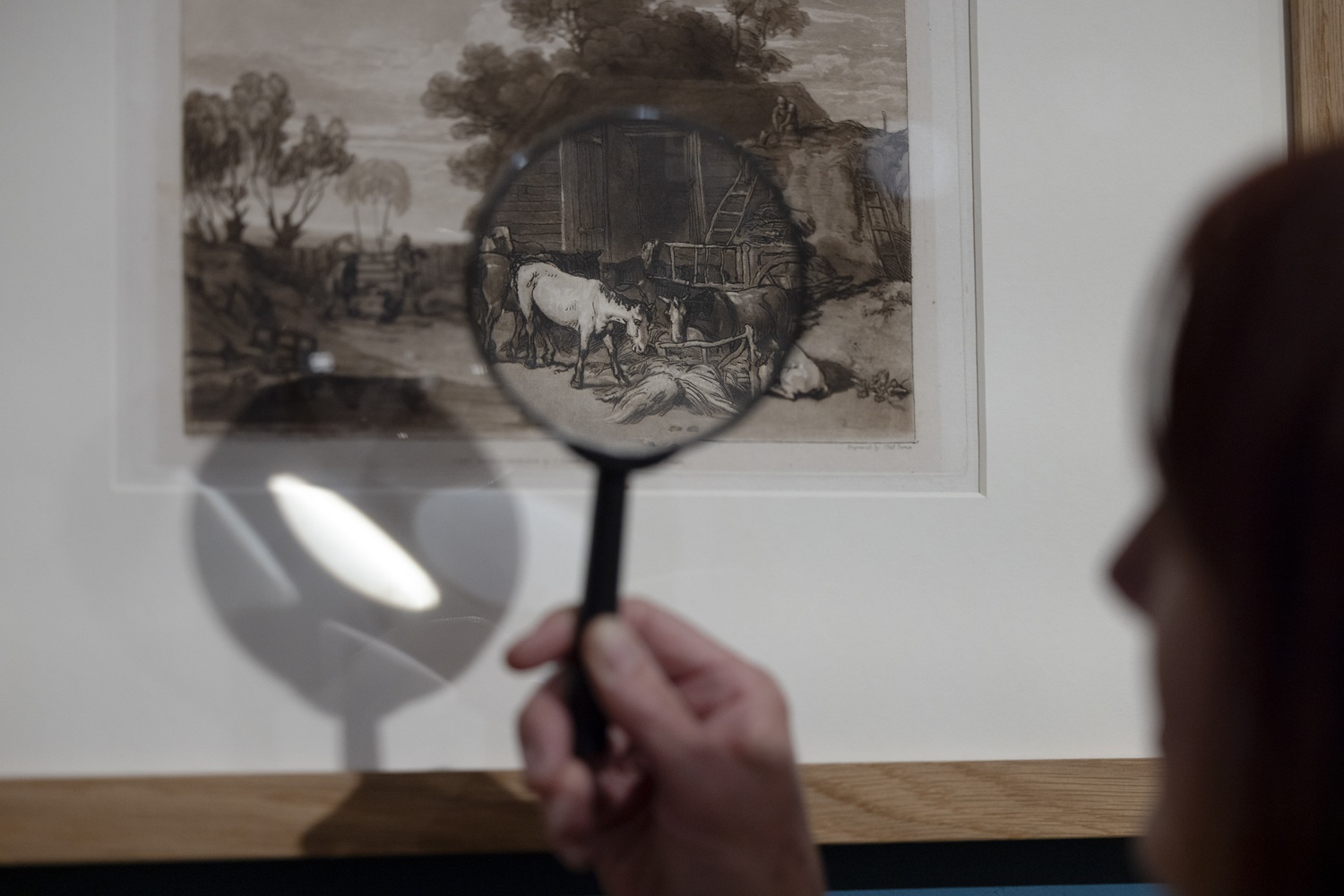
This Spring sees 250 years since the birth of Britain’s most renowned landscape painter, J.M.W. Turner, born on 23 April 1775. The Whitworth marks the occasion with a stunning exhibition that combines a series of previously overlooked prints, alongside watercolours from their own collection. As part of the exhibition programming, the Whitworth hosted a special celebration evening and book launch one day after the anniversary of Turner’s birth. This included the launch of a substantial exhibition catalogue, a classical music performance in two parts, a panel discussion and a curator-led tour of the exhibition.
In Light and Shade explores Turner’s under-appreciated, but remarkable series of landscape prints, the Liber Studiorum. Translating as ‘Book of Studies’ and published in fourteen parts from 1807-19, this series of prints was created using the mezzotint process, at a time when both mezzotint and landscape were seen as inferior arts, during Turner’s most successful and productive period. Featuring all seventy-one of Turner’s Liber prints, this exhibition reinforces the importance of printmaking in Turner’s practice, and his determination to elevate the significance of printmaking as a fine art medium. It is understood that Turner valued mezzotint and etching as processes equal to his more commonly known oil paintings, as these print-making techniques offered something different in terms of tone and texture for Turner, in his lifelong determination to represent the many facets of landscape as a fine art. As a method of printing that produces subtle tonal qualities of light and shade through an arduous process of rubbing, engraving and polishing copper plates, mezzotint was seen by Turner as an ideal method for the creation of landscape art, despite its uncommon usage at the time. By seeing the mezzotints in tandem with paintings, we can examine the differences in tone, line, and atmosphere in similar ways as Turner might have himself.
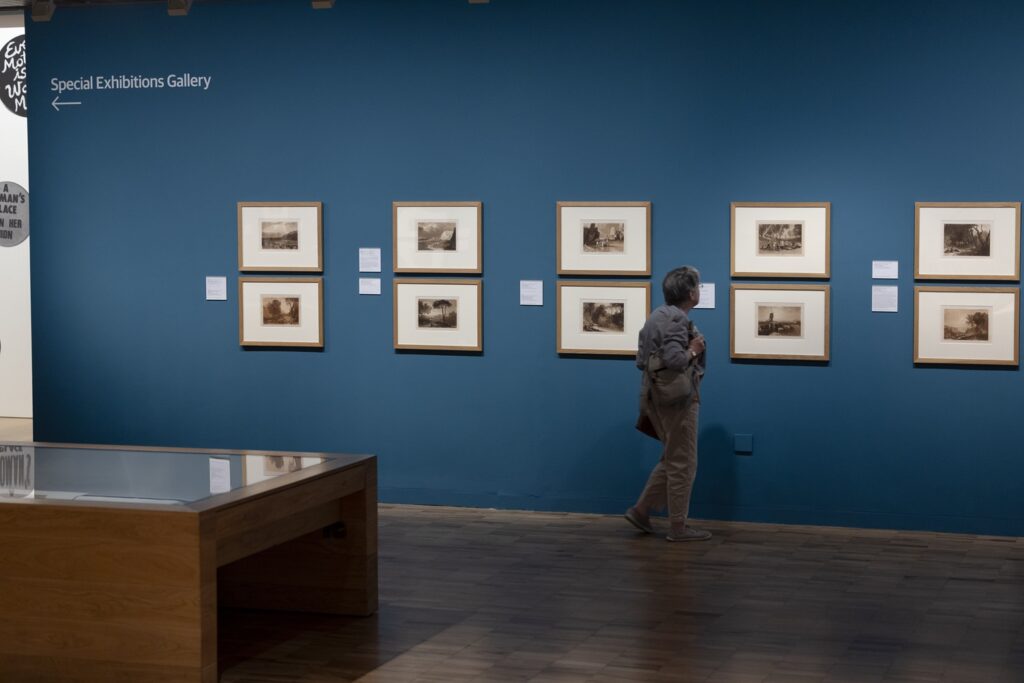
On the evening, visitors were treated to a rendition of popular music from Turner’s era by the Manchester-based Talland Quartet. Formed during their time at the Royal Northern College of Music, just a stone’s throw away from the Whitworth, this string quartet performed compositions by Turner’s contemporaries Haydn and Mozart whilst visitors perused the displays of brown-ink mezzotints in the adjacent gallery. The music meant for a more immersive experience and I felt absorbed into the warm sepia of the mezzotints, bathed in the glow of the evening sun that backlit the blinds of the south gallery windows.
The exhibition is comprised of two rooms, each painted with a different shade of marine blue on the walls, complementary to the warm brown ink of the mezzotints. The exhibition has two main entrances, and so two possible starting points, depending on which side of the gallery you enter. In the room closest to the park side entrance of the gallery we encounter the Liber prints organised in a salon hang. With two or three rows of prints hung together, the arrangement encourages a sense of exploration and travel through the space. In the middle of gallery are cases full of curious objects that aid exploration, such as engraving tools, painting palettes, and other ephemera found from Turner’s studio.
The Whitworth have the largest collection of watercolours by Turner outside of London, and some of these are displayed alongside the Liber prints in the next gallery, along with the Whitworth’s only oil painting by Turner in their collection, ‘Off Margate Pier’ (c1840).
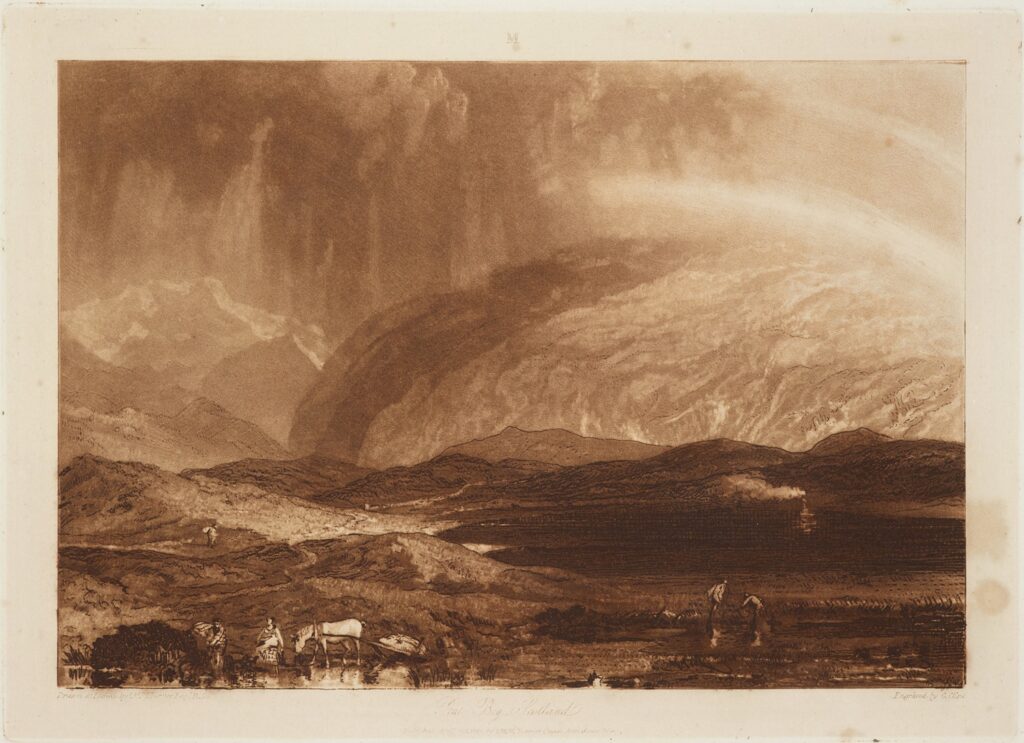
During the Talland Quartet’s performance, the melodic elegance of Mozart and Haydn breezed through the galleries as visitors explored, encouraging movement between the landscape works. It is perhaps easy to preconceive of prints as static, but the fluidity and flow in Turner’s mezzotints are dynamic and captivating through their subtle gradational tones – which is greatly helped by their curation in pairs with watercolour paintings. In ‘Storm in the Pass of St Gothard, Switzerland’ (1845), a watercolour painting from the Whitworth’s collection, we see storm clouds swirling, enveloping, almost consuming the landscape. The ferocious weather exposes the figures depicted on the rugged landscape, who are seemingly fleeing across a bridge over violent waters. It is a classic example of what most people expect from a late Turner – gestural, expressive, sweeping and painterly. This watercolour is paired with a piece the exhibition catalogue describes as ‘one of Turner’s most celebrated and evocative Liber plates’: ‘Peat Bog, Scotland’ (1812). Published more than thirty years prior to the painting, this mezzotint has all the vigour seen also in the watercolour, all the gesture and expression, though here, the storm is subsiding and hope is restored in the landscape. The figures are settled, the ground water is calm, and a rainbow seems to be forming. It is a depiction of an after-event, a dynamic window into changing atmospheric conditions.
Other pairings highlight even closer resonances. Nineteen of the seventy-one mezzotints show scenes also captured in paintings, but as the curator Imogen Holmes-Roe was quick to explain in the talk, these are not copies. The pair of works depicting the Clyde is a clear example. The watercolour painting ‘The Fall of the Clyde, Lanarkshire – Noon’ (1802), was completed seven years prior to the print ‘Drawing of the Clyde’ (1809) being published, and there certainly seems to be no hierarchy between them – they both contain exquisite craftsmanship in mark-making and technique, with a sense of accomplishment and completion. Both works depict cascading water, bustling trees on either side of the riverbank, and bathers resting on the rocks nearby. Neither looks like a study for a large oil painting, nor seems to be a copy of the other – certain subtleties have changed, such as the angle of the view and some changes in the trees, as there seems to be more growth and maturity in the landscape features of the mezzotint. The tonal qualities of the mezzotint give the subject more drama, tension and depth, in a way elevating the pastoral, whilst the watercolour is softer and more delicate. These two works present different versions of a single scene, and this pairing demonstrates the limitations we might find by viewing Turner’s explorations into landscape art only in one media. The tonal explorations between different media show an explorative investigation by Turner into the intricacies of tone and atmosphere. Both media have seemingly contributed to Turner’s ongoing study of the depiction of vibrant landscapes.
After the first half of the musical performance, we made our way upstairs to the Grand Hall, for an in-conversation talk with the exhibition curator Imogen Holmes-Roe. Joining Imogen on-stage for the discission was independent art historian Gillian Forrester and fine art curator for Manchester Art Gallery, Hannah Williamson.

The speakers elucidated some of the finer details and obscurities of the Liber collection. Amongst the illuminating material being presented, the panel were all keen to clarify that the Liber prints were always intended to be seen by Turner as finished works in their own right, rather than studies for oil paintings, and that they were intended to be seen all together. This was a series of works intended as a survey on landscape art, and perhaps its most ambitious aspect is Turner’s choice of medium. Despite being perfectly suited to landscape depiction due to its rich tonal quality, mezzotint remained an unusual method for making landscape art in the nineteenth century. In Turner’s time, landscape was still seen as a less important genre when compared to history painting. Throughout his life, Turner used his practice to elevate the significance of landscape as a genre, and with the Liber prints this ambition became twofold – to elevate both landscape and printmaking within fine art. Perhaps even more interestingly, despite Turner’s tenacity and ambition to make Liber Studiorum a success, today the series has hitherto remained largely unexplored and overlooked in major surveys of Turner’s work. That oversight is at last being remedied in this exhibition and accompanying catalogue.

Following the talk, we were treated to the second part of the Talland Quartet’s recital back in the gallery spaces, and the evening concluded with a curator-led tour. The tour clarified curatorial decision-making around certain pairings of watercolours and mezzotints, and we explored the shared visual symmetry and language deployed by Turner between the mediums. Imogen Holmes-Roe helped explained many of the curatorial choices, such as the mezzotint ‘Coast of Yorkshire’ (1811) being installed beside with the watercolour painting ‘Orfordness’ (1827), both works depicting the merciless North Sea waves crashing against the coast and into boats with an onlooking lighthouse.
The details, vigour, and craftmanship displayed in Turner’s mezzotints, alongside the tonal qualities of light and shade, allow them to sit alongside his watercolours as equals. There is a clear investigation going on between the two mediums which we are now able to encounter for the first time. The Whitworth’s exhibition In Light and Shade has certainly shed new light onto an important series of obscure, delightful and important landscape prints by one of our nation’s most celebrated artists.
Turner: In Light and Shade, the Whitworth, Manchester, 7 February – 2 November 2025. Turner: In Light and Shade Exhibition Catalogue (2025) is published by The Whitworth.
Neil Greenhalgh is an artist, writer, and lecturer based in Greater Manchester.
This review is supported by the Whitworth.
Published 12.05.2025 by Jazmine Linklater in Reviews
1,632 words


