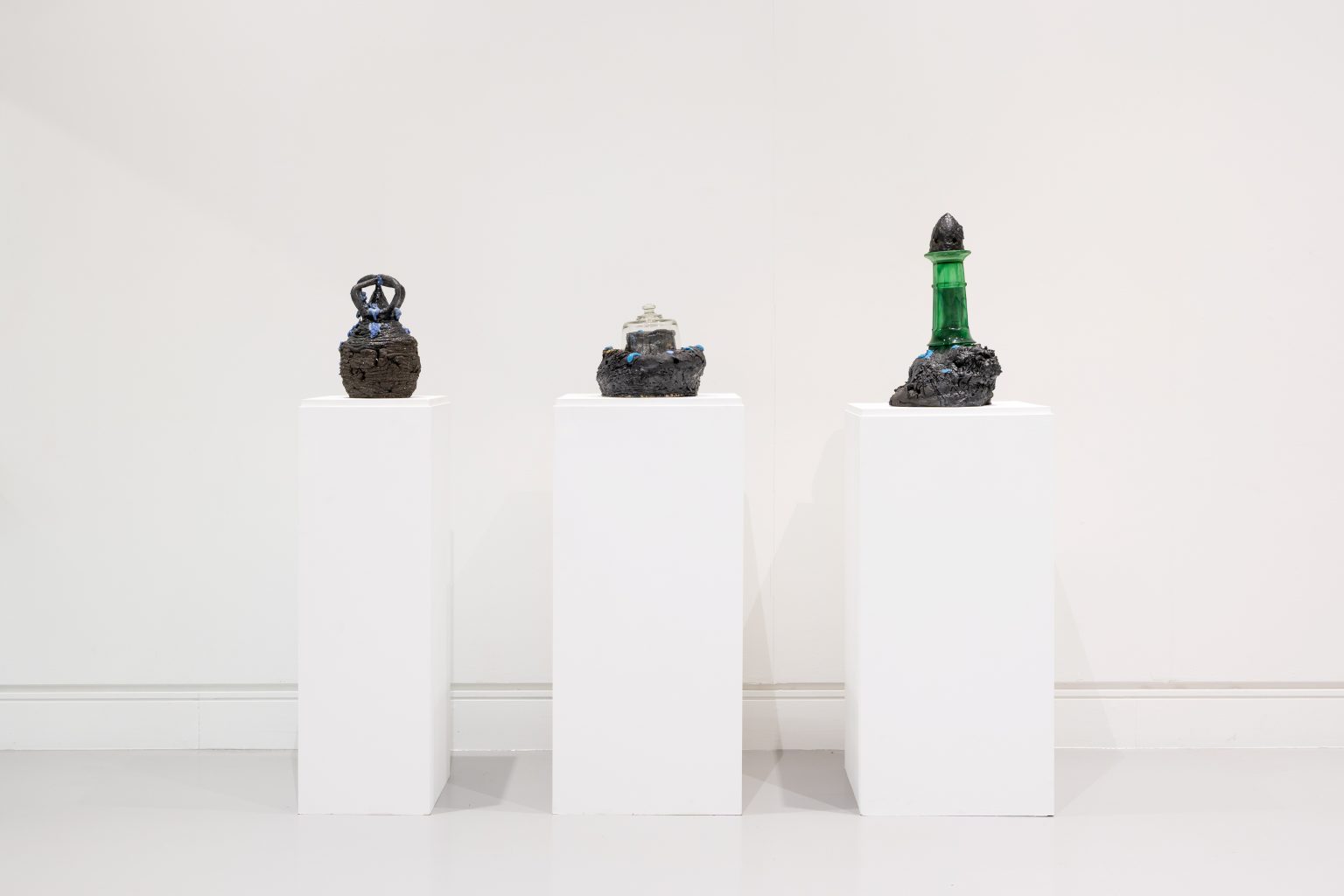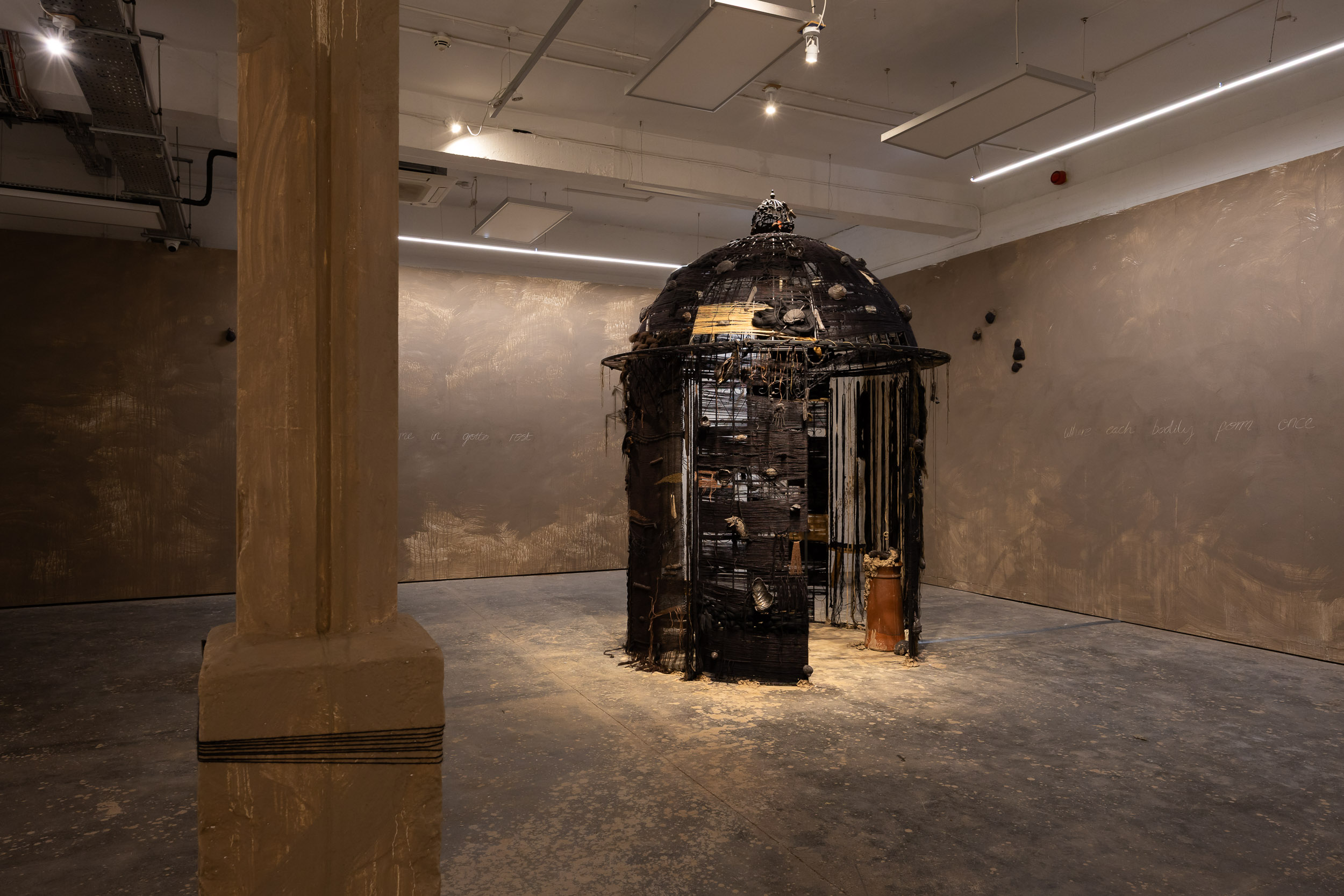
At Humber Street Gallery, brown slip stains the white walls. In one corner, a mound of clay seems to have pushed out through the join in the plaster. Dark ceramic tubes bend from it, like crinoid fossils exposed as a cliff erodes. At the centre of the room stands a wrought-iron pergola hung with ceramic shells and woven fibres. It is the sort of garden ornament that arrives with a promise of leisure already attached. Its actual product name, as artist Zivarna Murphy reveals in conversation with curator Lauren Wilson in the exhibition guide, is ‘Powder Coated Champagne Dream’. Murphy has left the frame exposed. There is no pretending that this improbable cave grew here naturally.
The shell grotto has a long history in British country houses. In the seventeenth and eighteenth centuries, wealthy landowners commissioned artificial caves decorated with shells and minerals. Visitors admired the surfaces, the result of hours of gathering, arranging and affixing each individual piece. Women were among those who undertook this work, alongside servants and craftspeople whose names were often left out of estate records. Some of the materials reached these gardens through colonial networks of collecting and trade. The finished grotto could present this labour and acquisitiveness as innocent pleasure: its owner enjoyed a cave fashioned by other people’s hands, however.
Murphy remembers visiting Blenheim Palace with her mother when she was young. In the exhibition guide she describes feeling physically small on land inherited by one family. The ticket allowed entry, but it did not make the grounds theirs. Her pergola brings that distinction into the everyday economy of garden furniture. The absurdity of the ‘Champagne Dream’ name matters. It suggests a little private paradise for purchase. Murphy takes a prefabricated structure she says she would never otherwise buy for herself and makes the dream her own, weaving her materials through its standardised ribs until the garden ornament becomes a grotto shaped by her labour and her choices.
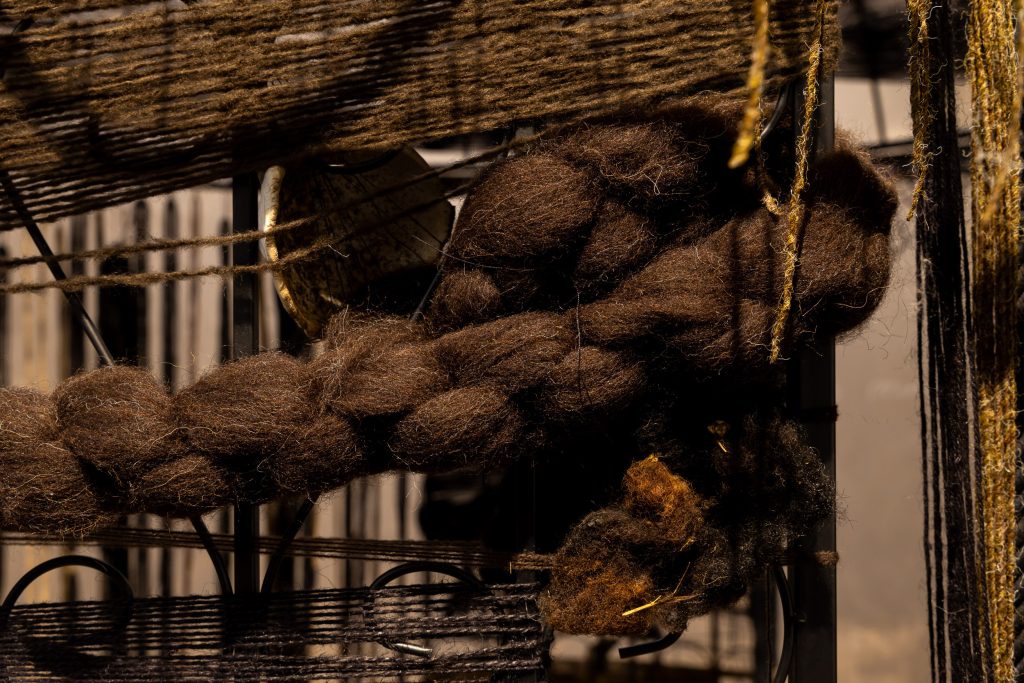
The woven fibres twist under pressure. Loose, unspun sheep’s wool catches in the ironwork; elsewhere, strands are pulled into tight braids. Ceramic shells interrupt the weaving and make it sag. Look closely and the fastening becomes harder to ignore than the ornament. Murphy relates this process to memories of braiding hair, and to her experience of growing up with textured hair that others wanted to ‘control’. In a braid, the boundary between care and discipline may be no wider than the pull of someone’s fingers. She gives that pressure a structure: the metal holds the work upright, while the weaving reveals where effort has been spent.
The exhibition borrows its title from Audre Lorde’s poem ‘Coal’. Lorde writes of words being coloured ‘by who pays what for speaking’. The poem is concerned with who can speak without being made to pay for it. Murphy does not use colour as a neat translation of identity but instead subtly rearranges the pecking order of ceramics. Porcelain normally arrives with the authority of refinement; Holderness boulder clay arrives carrying sand and the label ‘low-grade’. Inside the grotto, porcelain shells sit beside brown and black fired forms, while brown slip takes over the gallery wall. The room no longer gives us the clean white ground against which these objects are supposed to be judged.
The brown comes from the Holderness coast – Murphy gathers boulder clay exposed as the cliffs retreat into the North Sea, and in the gallery, it has dried in broad washes with sandy grains visible at the edges. A mound in the corner consists of more of the same material. Its tubular vessels recall the stems of fossil crinoids, although their bent, open ends look less like museum specimens than a colony still moving. These forms are at their best where it becomes difficult to separate the damaged cliff from the artist’s manipulation of it. The wall starts to behave like an exposed section of ground.
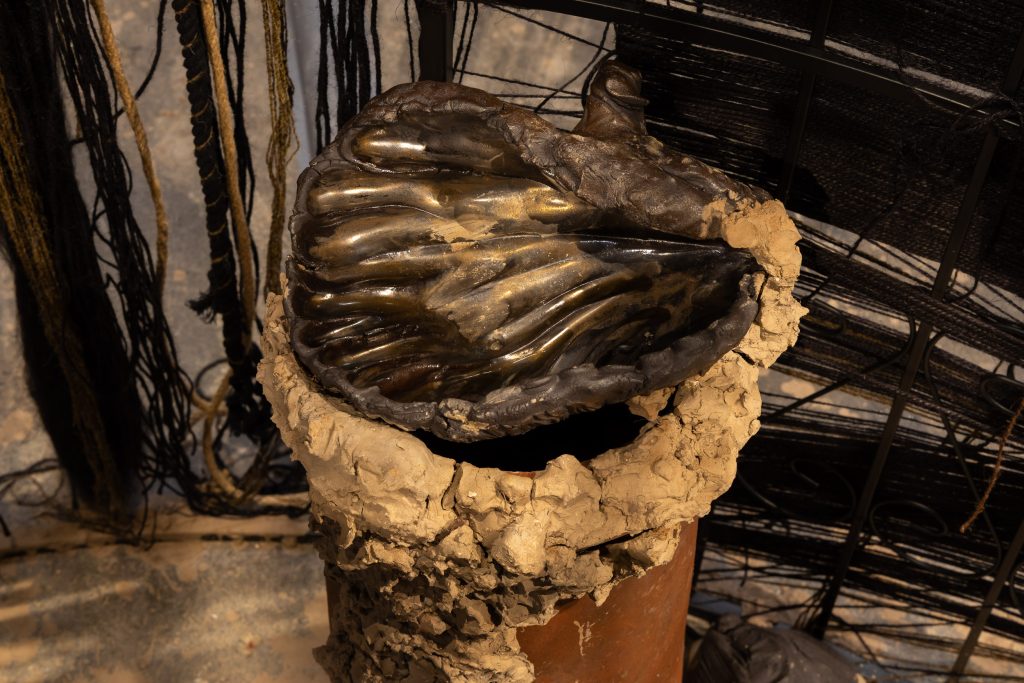
In pottery, reclaiming clay means making discarded material workable again. That word travels uneasily from the studio to Holderness, where the coast continues to lose ground. A fragment can be carried away and fired, but it cannot restore the cliff. Iranian philosopher Reza Negarestani’s Cyclonopedia (2008) treats the underground as involved in history rather than as a storehouse waiting for human use. His oil-soaked deserts are a long way from the Yorkshire shore, yet the comparison draws attention to the landscape’s own activity. This clay is exposed by erosion before Murphy gathers and fires it; the gallery objects owe their existence partly to a coastline disappearing into the sea.
Murphy has also written a way into the structure. The recorded poem ‘Grotto Rest’ calls it a ‘temple of loss and life’. The accompanying audio description says that the shells are ‘leashed to the structure’. That verb catches on the knots. To enter, you have to lower your head beneath the framework; inside, you can straighten and sit. Light filters through the weave in narrow patches. The metal never disappears, yet its rigidity supports the hanging fibres and ceramic shells that enclose the space. What looked like a garden ornament from the gallery floor becomes a room whose dimensions are measured against your own body.
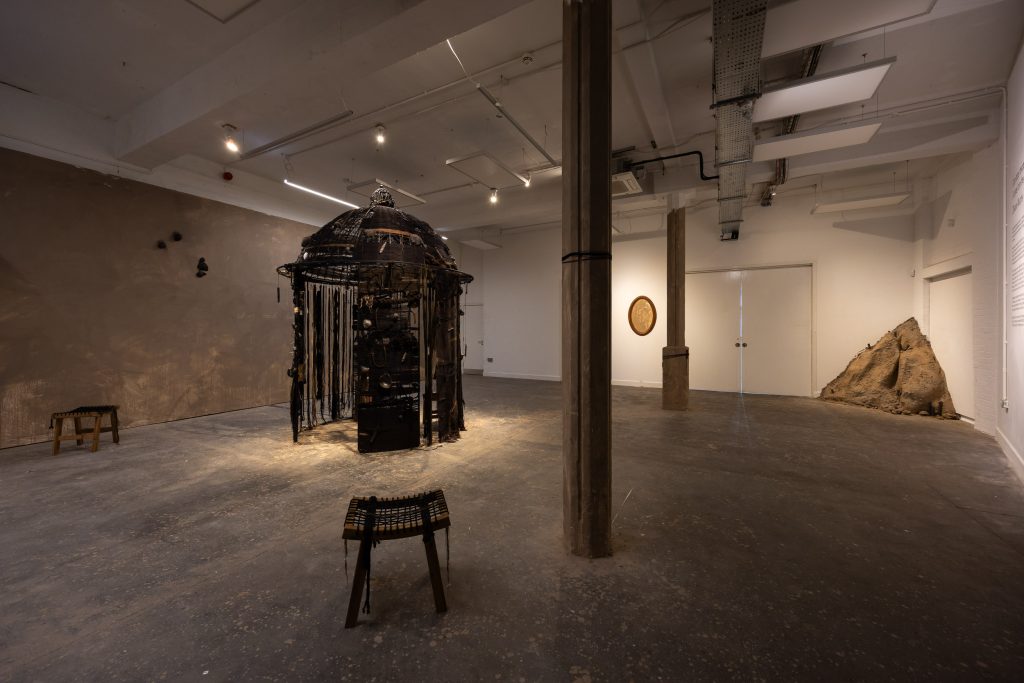
To visit a grotto on an aristocratic estate was to enter somebody else’s pleasure garden as a guest. Murphy remembers the boundaries of those visits: paying to enter, knowing the grounds belonged to someone else. Here, the structure stands in a public gallery, and visitors are invited to duck inside, touch its surfaces and sit. The invitation is felt through the body, rather than simply stated. Up close, one strand stops where the next has been fastened. The visible knots make the time and physical effort of building this grotto difficult to overlook, recalling the makers whose work disappeared behind the polished surfaces of historic ones.
When I look again at the pergola, the joke of its name has not worn off. ‘Champagne Dream’ still belongs to the vocabulary of effortless leisure. There it is, carrying a weight of wool and fired earth far removed from the manufacturer’s fantasy of an ornament ready for the garden. Murphy leaves the work of attachment in plain sight. Where an older grotto could invite admiration for its finished surface while concealing the hands that made it, this one keeps drawing the eye back to its construction. In Hull, you can see where the knots bite into the frame.
Parham Ghalamdar is an Iranian-born artist and writer based in South Yorkshire. His practice moves between painting and moving image.
Zivarna Murphy: I am black because I come from the earth’s inside is on at Humber Street Gallery, Hull, from 9 October 2026 – 7 February 2027.
This review is supported by Humber Street Gallery.
Published 17.11.2026 by Benjamin Barra in Reviews
1,198 words