Scrolling through the Iranian-British artist Parham Ghalamdar’s Instagram, I stumble across an image caption in Arabic from Surah Ar-Rahman of the Quran, which, when translated, reads: ‘Then when the sky is split open and becomes rose-red like molten oil.’ Almost instantly, it recalls for me the hellish imagery of Tehran ablaze in early March due to overnight Israeli and American bombardment of oil facilities. The skies did split open, literally raining oil and soot down on the capital’s inhabitants; the health and environmental damage wrought in one night was unfathomable. A few swipes away, I learn that Ghalamdar also burned over fifty of his paintings to protest against the livestreamed genocide of Palestinians in Gaza for his award-winning film The Sight is a Wound (2025). Only a handful of landscape paintings remain – on display here at his latest solo-exhibition Aerotheology at Blenheim Walk Gallery, Leeds – due to a tight gallery consignment contract which prohibited their destruction.
In Ghalamdar’s practice, every act of creation and image-making is meditated. In his ceramic warplanes for instance, the materiality of clay pulls the aircraft ‘back to earth’. Each sculptural object, kneaded, stretched and moulded into shape by the artist, carries the memory of touch and gesture prior to the glazing and firing process. Like these glazed ceramics, several of Ghalamdar’s landscapes are coated in a tar-like pigment derived from scorched earth collected through farms in Iraq that had been attacked by ISIS. There is metaphoric potential in this process: when applied to the surface of the canvas, the scorched earth layers a ‘landscape’ that precedes Ghalamdar’s own. It is an act that carries a built-in violence. Ghalamdar insists that we consider the ethics of representation and image-making: what does it mean to bear witness in times like these? And how, if possible, are we to represent unthinkable atrocities in images?
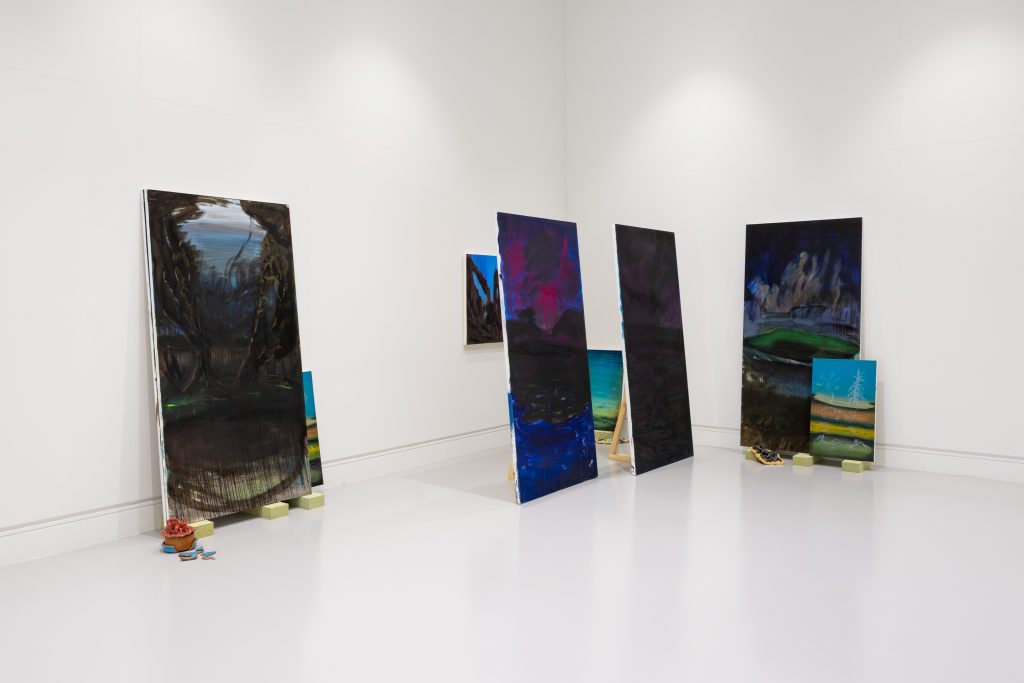
An eerie colour palette of purple and fuchsia seeps through the washes of smoky black pigment in one of Ghalamdar’s untitled landscapes: garish, almost radioactive. Here is a defiant ‘nature’ that seems barren and extreme, electric and lurid. These are liminal horizons that can only emerge after total annihilation, in the aftermath of bombardment. Looking closely at a smaller painting with botanical studies laced over in thin white brushstrokes, I am reminded of the matsutake mushroom and the red canna flowers that sprouted out of the ruins of Hiroshima, as well as the remembrance poppy in the UK. I am reminded also of the Faqqu’a Iris, the national flower of Palestine, which dies while standing tall and straight, echoing the resilience of its people. Through scorched earth tactics and the land degradation that settler colonialism entails, the destruction of plant life is mobilised here as an indication of wider violence and dispossession.
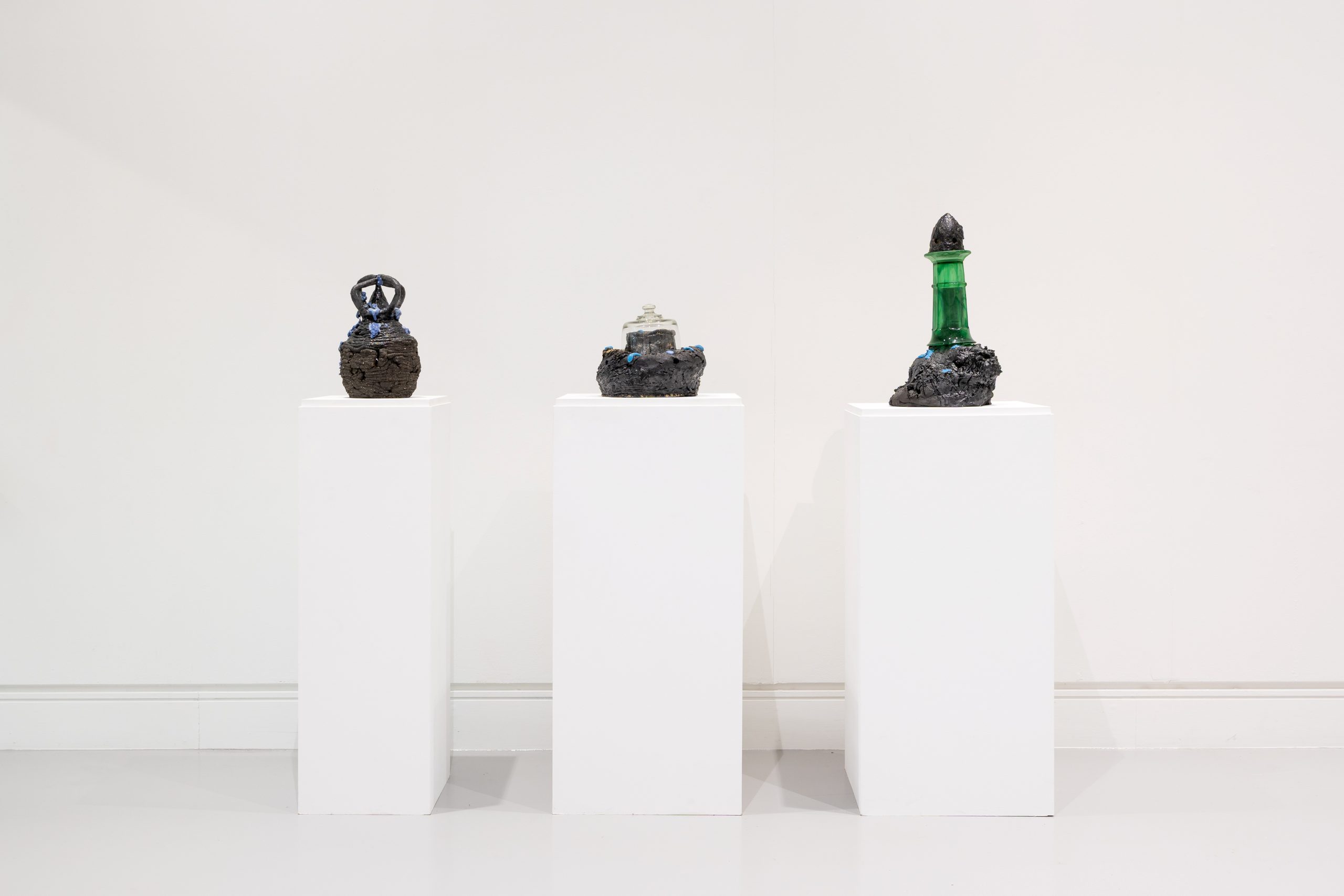
The exhibition title Aerotheology merges Ghalamdar’s focus on flight and engineering with desert folklore, Shi’i Islam and experiences of exile. AI-generated imagery of the so-called Rig-e Jenn (‘Desert of Djinn’) – legendary sand dunes near the Isfahan province of Iran, which are widely believed to be inhabited by malevolent spirits – forms a large bulk of the exhibition. A glass vitrine in the centre of the room contains some of these images printed on photo paper, next to an assortment of glazed ceramics by Leeds Arts University students Daisy Ledgard, Laura Kovacova and Mehrzad Ghasemi, produced in dialogue with the Manchester-based artist as part of an APP Creative Commission Programme (2024–25). Also dotted around the exhibition are several busts of horned divs, or demons, from Iranian mythology. In Ferdowsi’s epic poem the Shahnameh, divs are the supernatural antagonists of the hero Rustam. Through these simultaneously spooky and adorable ceramics, Ghalamdar engages the trope of the relic, a term that once referred exclusively to the sacred remains of saints and martyrs, but which now evokes the endurance of custom and attitudes throughout history. It makes sense then that the so-called Baghdad Battery – a 2,000-year-old artifact consisting of a clay pot, a copper cylinder, and an iron rod sealed with bitumen – is cited as another source material for Aerotheology, collapsing technology and antiquity into one.
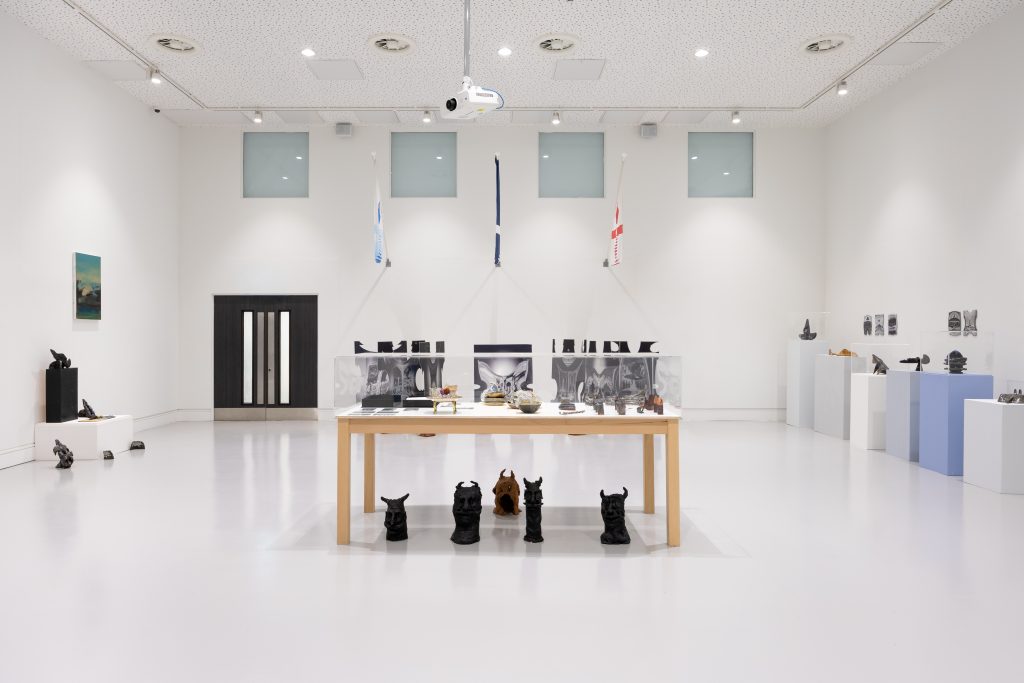
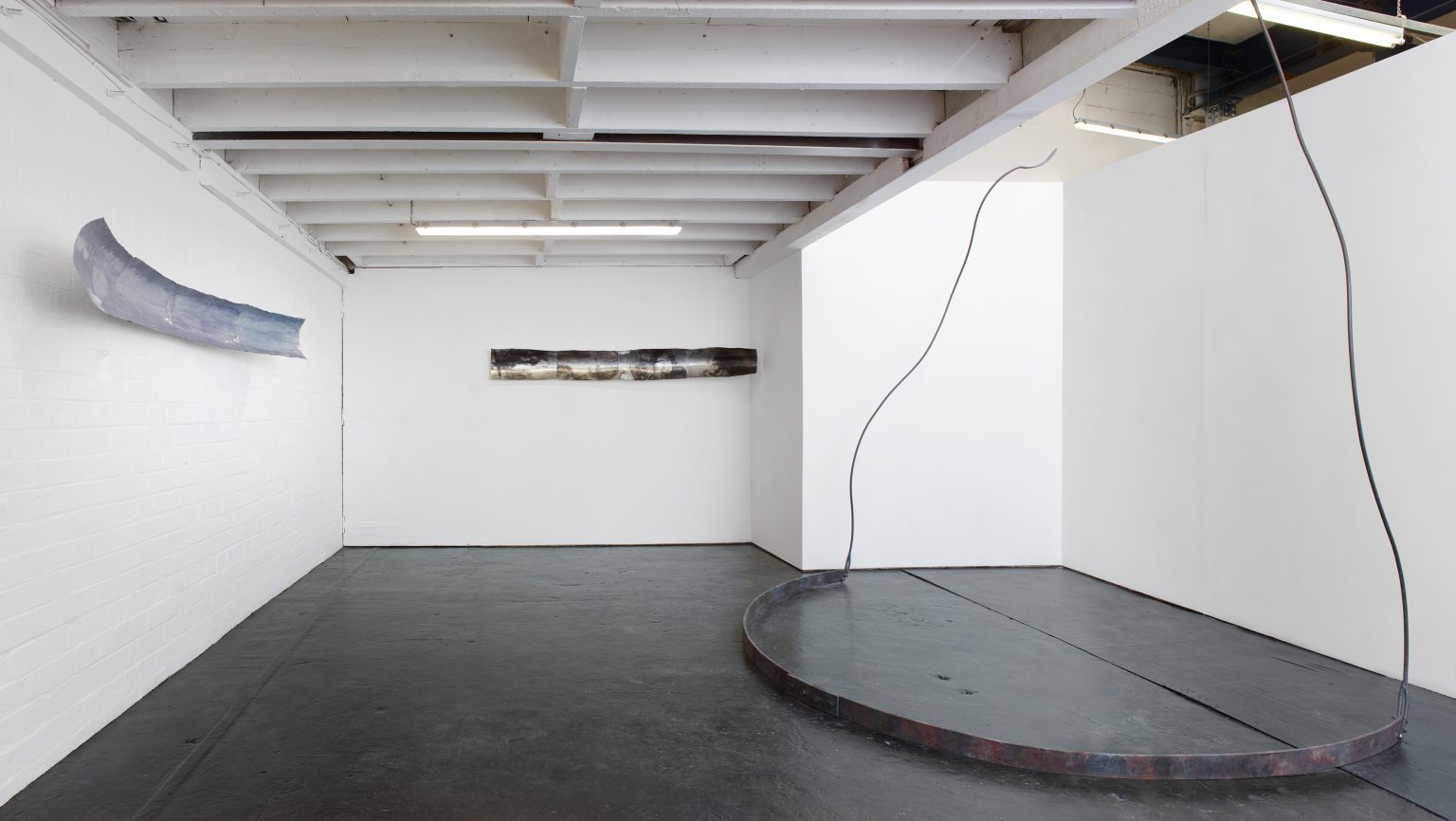
The most prominent work, however, is a series of seven aluminium and Perspex sheets imprinted with AI-generated imagery and spliced into angular geometric shapes, using sagging lumps of clay as their physical support. Laid out in an arc-shaped formation, Ghalamdar’s installation reimagines the arid desert as a site of congregation for the displaced, but also looks like it has been taken from a generic first-person shooter video game. Alien spaceships and rockets feel incongruous alongside the calligraphy, veiled figures and facets of Islamic architecture incorporated in this body of work. Although the descriptive prompts used by Ghalamdar to produce this digital hodgepodge is not presented, the juxtaposition of a Sci-Fi aesthetic with stereotypes about West Asia perhaps demonstrates how technology absorbs and reproduces (via slop) the colonial gaze and its systems of knowledge production. Given the enormous freshwater supplies consumed daily by data centres to cool and power servers, it is disheartening to consider the irony of using generative AI to depict climate-related displacement.
The oil triptych Every timeline is Ashura, & every grid is Karbala (2024) is thus a stronger highlight of my visit. Ghalamdar’s series presents two intersecting events in the histories of Christianity and Islam through the iconography of the tent – not so much as a site of sanctuary and refuge in the sweltering heat of the desert, but rather as unstable architectures where different timelines touch. Formally, we encounter three interpretations of Piero della Francesca’s Dream of Constantine (1464), a gorgeous panel from the Legend of the True Cross fresco cycle in Arezzo, Italy, depicting the slumber of the titular Roman Emperor behind the gold curtains of a well-guarded tent. When I ask the artist later about the significance of this fifteenth-century source, Ghalamdar says that what interests him is the way in which a dream has become militarised: ‘Constantine is asleep, but the vision he receives does not stay private or mystical; it becomes a sign that authorises battle, empire, and the transformation of Christianity into political infrastructure. So, the painting is not only about revelation. It is about how an image can become an order.’
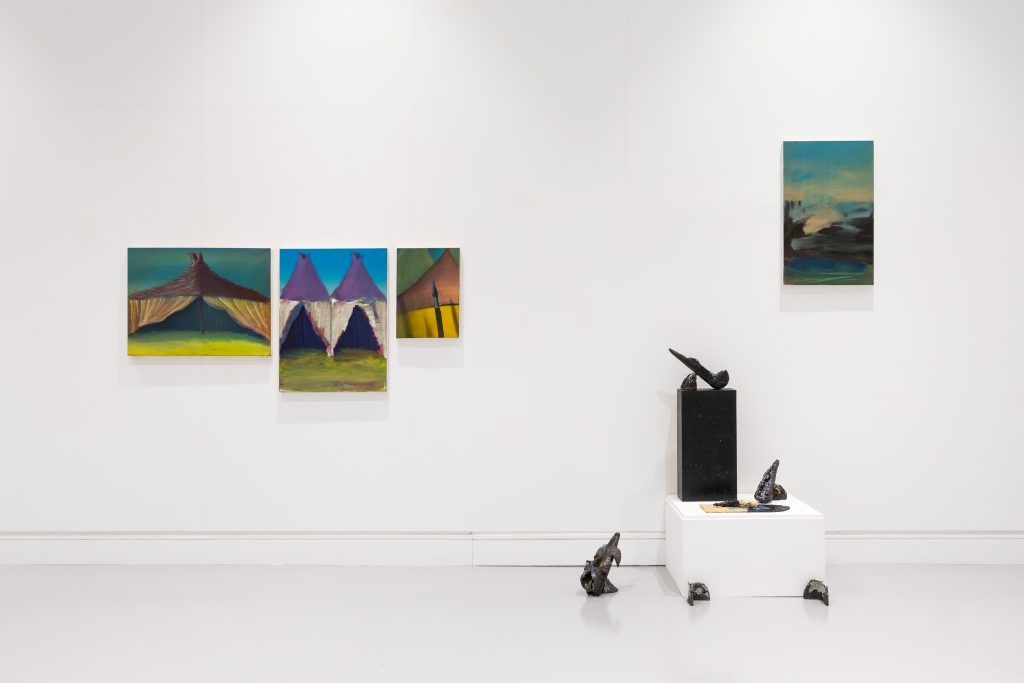
Popularised in the thirteenth century, the Legend of the True Cross appeals to Ghalamdar as a sort of non-linear narrative, wherein the sacred wood from the Garden of Eden moves through different epochs to acquire new functions: tree, bridge, relic, proof, weapon, imperial object. Once the Cross becomes totally embroiled in conquest and state power during the war between the Byzantine empire and the Persians, Ghalamdar suggests that the story feels looped into continual religious violence, with the current US-Israel axis becoming another iteration of the same. Meanwhile, the title Every timeline is Ashura, & every grid is Karbala refers to a significant tragedy in Islamic history (when Husayn ibn Ali, grandson of the Prophet Muhammed, was murdered by the army of the Umayyad Caliph Yazid I). The tents of Karbala, Iraq, might be interchangeable with Constantine’s military encampment, painted so ethereally by della Francesca, but they also relate to Ghalamdar’s reflections on asylum, dispossession and shelter – especially as an Iranian in exile.
Like the villainization of the migrant dinghy in public discourse, the tent today denotes the abjected body of the refugee, whilst the camp (the refugee camp and the concentration camp) constitutes what philosopher Giorgio Agamben defined as the biopolitical nomos (the ancient Greek concept of law or custom) of the modern era. That being said, tents have in recent years also resurfaced as architectural symbols of dissent in mainstream culture: first, during the Occupy Movement of 2011, and second, at university encampments for the Palestine BDS movement. If every grid really is the Battle of Karbala, representing cycles of violence played out endlessly over time, I venture to say that the almost saccharine colour palette employed by Ghalamdar anticipates ultimate victory against injustice and political oppression.
Simal Rafique is a writer and art history graduate based in Staffordshire.
Parham Ghalamdar: Aerotheology is on at Blenheim Walk Gallery, Leeds Arts University, from May 13 to August 1, 2026.
This review is supported by Leeds Arts University.
Published 07.07.2026 by Benjamin Barra in Reviews
1,412 words