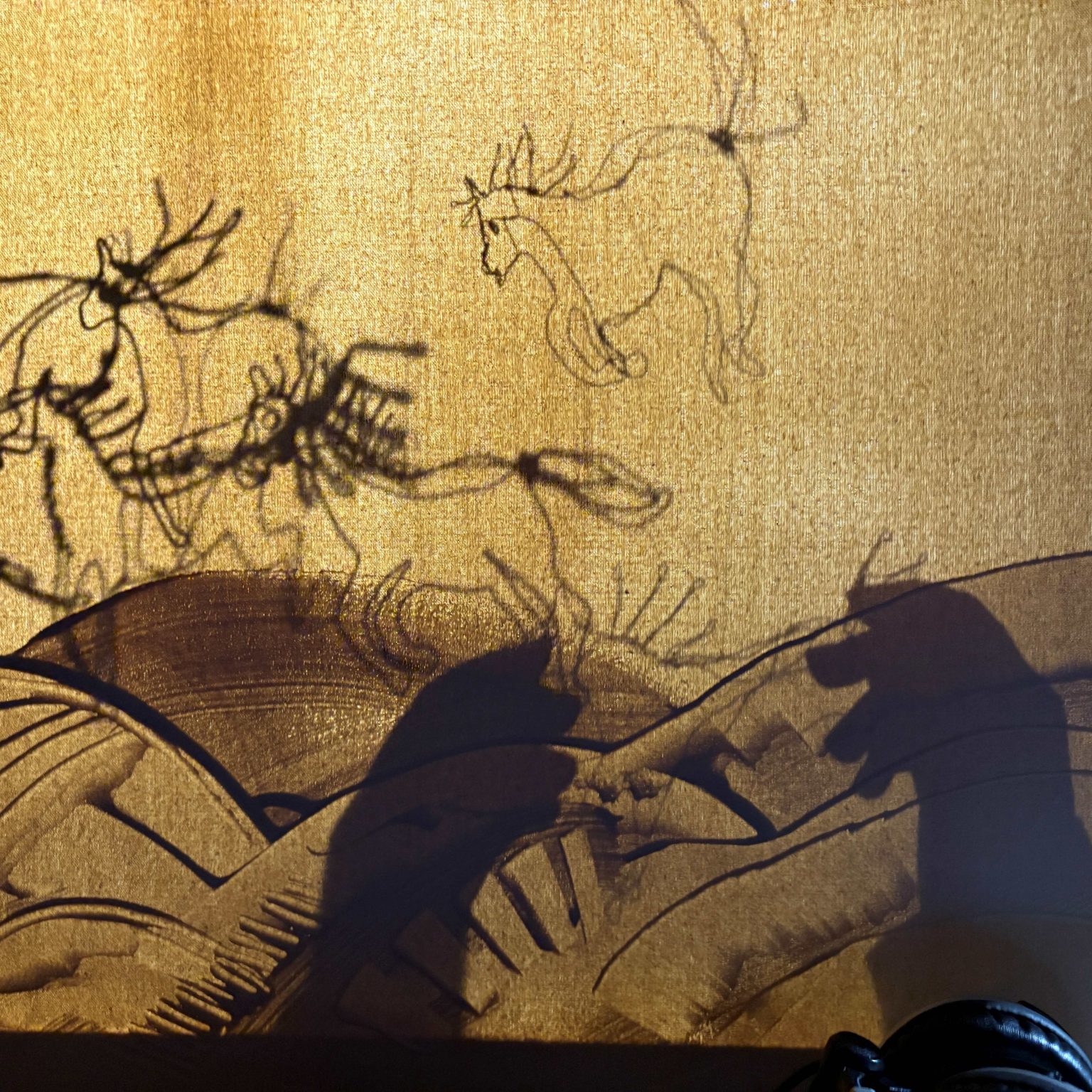
Faces and Threads is a collaborative project by artist and social science researcher Dr Lone Sorensen and artist Parham Ghalamdar. It developed out of Sorensen’s research at the University of Leeds into the role that social media platforms play in the politics of and public disagreements about climate change policy. Sorensen and Ghalamdar have worked with communities in Beeston and Hunslet in Leeds and Longsight in Manchester to facilitate discussions about climate change and create large collaborative artworks. The project aims to show that art can bring communities together and depolarise political conversations. Additionally, Sorensen and Ghalamdar have worked with Chris Bailkoski, curator and director of PROFORMA, on four exhibitions.
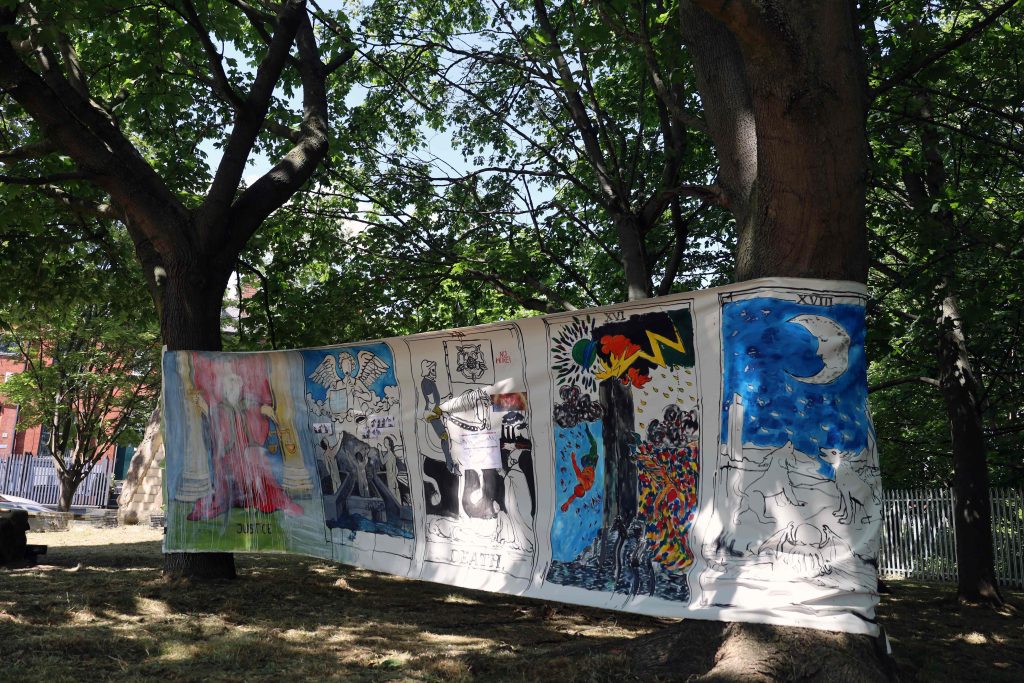
I encountered this fascinating project in its first and fourth iterations. The first presentation was a public installation of large canvas banners created by local residents wrapped around a cluster of trees on The Corner, a ‘pocket sculpture park’ in Beeston, Leeds. This small public space captures some of the tensions and complexities at the heart of Faces and Threads: a green space surrounded by congested city roads, back-to-back terraced houses and an encampment of unhoused people living in tents – nature meets environmentally damaging technologies and social inequality. Simultaneously with the banners’ installation at The Corner, other banners created by the local community in Longsight, Manchester, were exhibited at Longsight Art Space, where they were accompanied by paintings by Sorensen, ceramics by Ghalamdar, and a curated screening of artist films. The Longsight banners were later installed in The Orchard, a nearby park. This fourth iteration brings the Beeston and Longsight banners together with Sorensen and Ghalamdar’s other works in an exhibition at BasementArtsProject, Leeds.
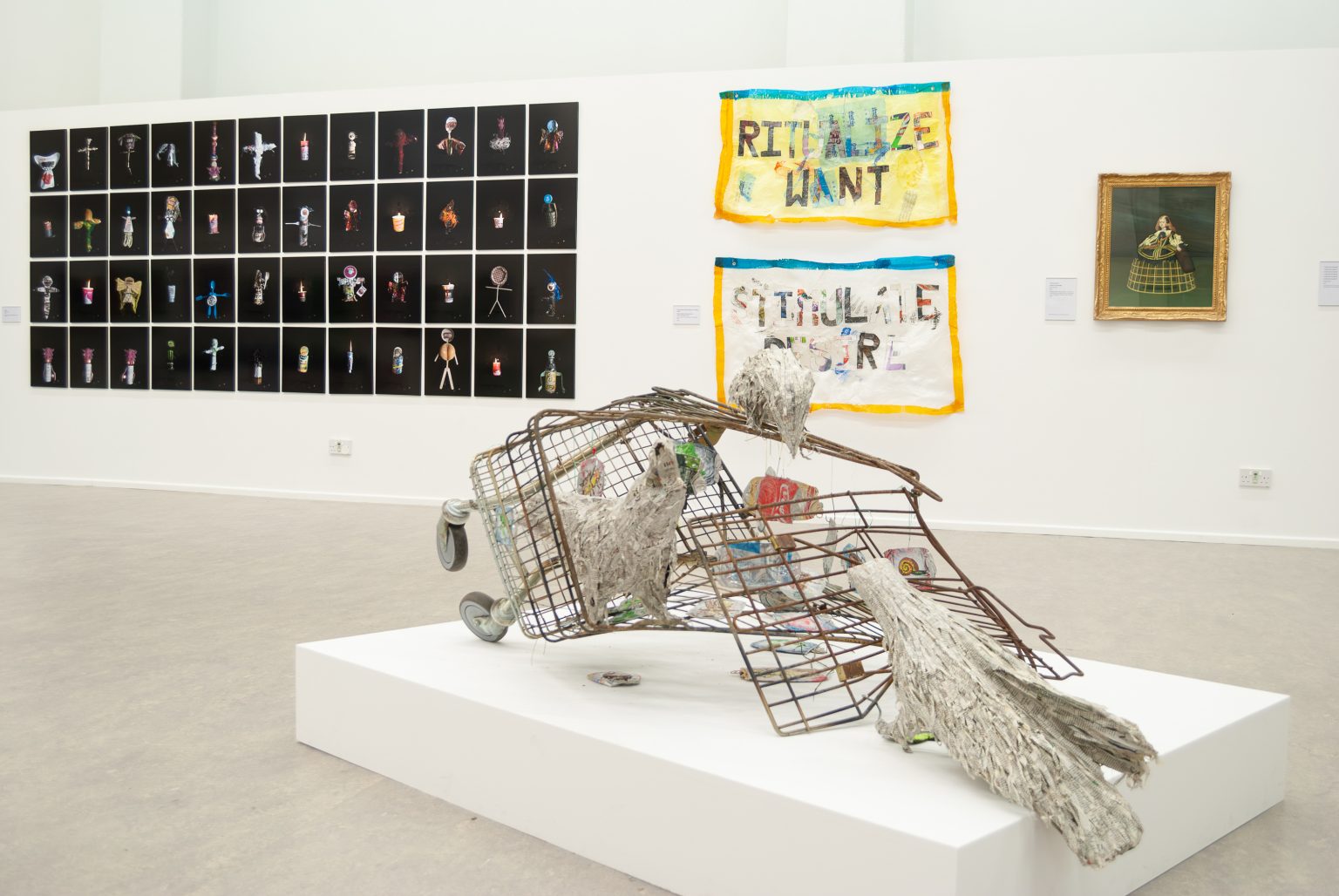
For those who haven’t visited BasementArtsProject, it is a subterranean gem of a gallery situated in the basement of an ordinary terrace house, a family home. The collaboratively made banners – ranging from muddy coloured smears and hand-prints created by children having a great time to carefully collaged and hand painted designs – line the basement-gallery walls, producing a dense visual environment. Paintings by Sorensen and ceramics by Ghalamdar sit in front or peek around the sides of the banners. Other artworks lean against the walls and stand on low plinths, giving the impression that the installation is evolving and growing as more personalities wade into the discussion.
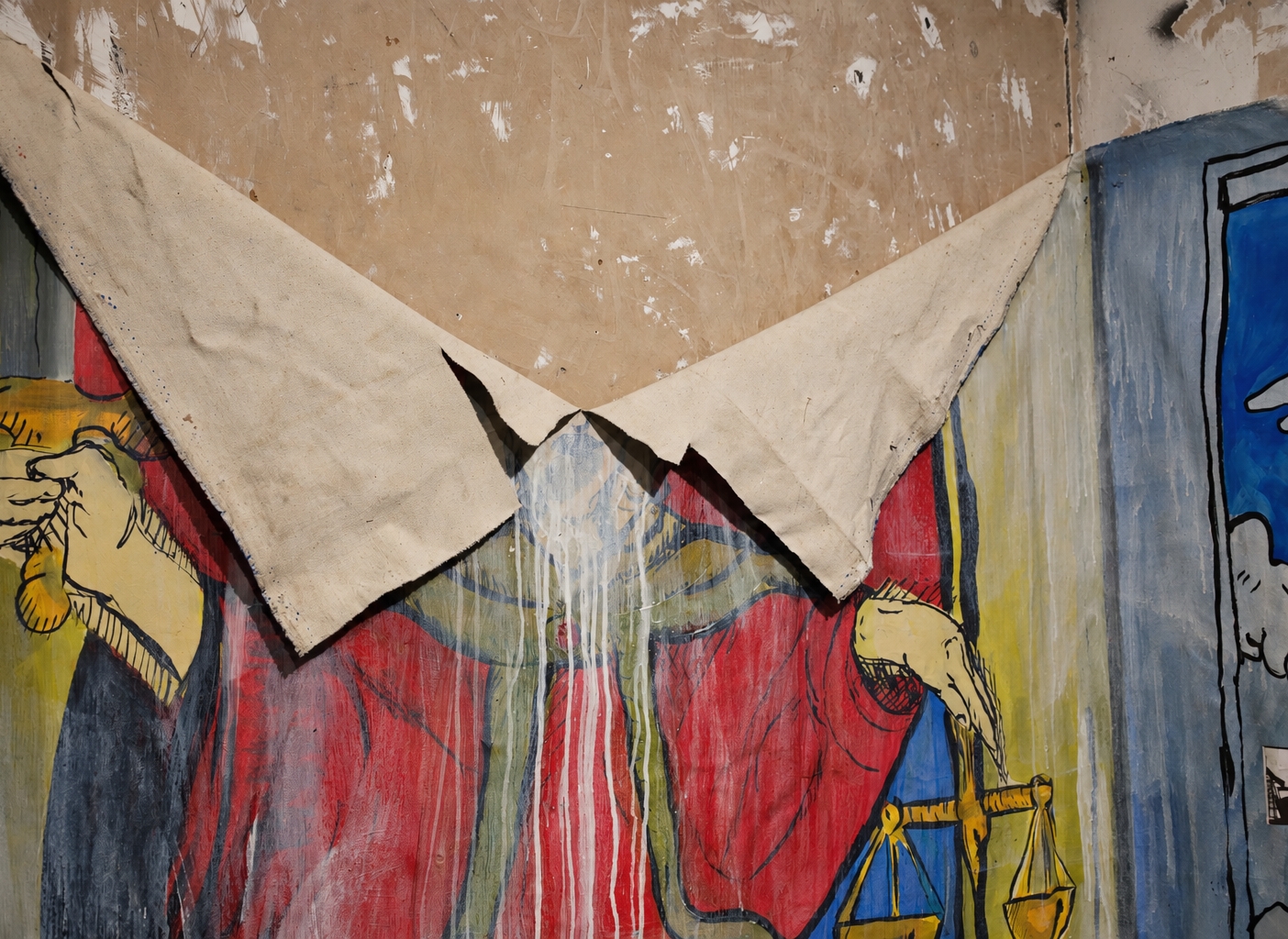
The collaboratively produced protest banners feature drawings of tarot cards and their cast of archetypes, with their various functions and attitudes that purport to offer insight into the future. During the workshops, participants used images and phrases that appeared in recent social media posts to connect the symbolic meanings of the tarot cards to climate change discourse. For example, the ‘devil’ card is said to denote that a person is trapped or stuck. Two chained people symbolising domination stand in front of the devil. Participants in Beeston added the face of Xi Jinping, the President of China, to the devil’s body, along with the words ‘China makes everything and the rest of the world purchase’, evoking the notion of humanity’s worship of consumption at the altar of China’s production line.
The joy of viewing these layered artworks is the rabbit hole of associations they lead you down. Xi Jinping may have the body and horns of a demon, but he also has the ears and nose of Winnie the Pooh, a beloved literary character and a symbol of resistance thanks to a social media meme. Winnie the Pooh was banned from Chinese social media platforms after users began to suggest that Xi Jinping resembled the loveable bear and to share posts featuring Winnie as a way of criticising the President whilst evading censorship. Alluding to this meme reinforces the artwork’s function as an act of resistance against powerful forces. When world leaders and oligarchs are cut down to the size of fictional characters, they seem less powerful and change feels possible.
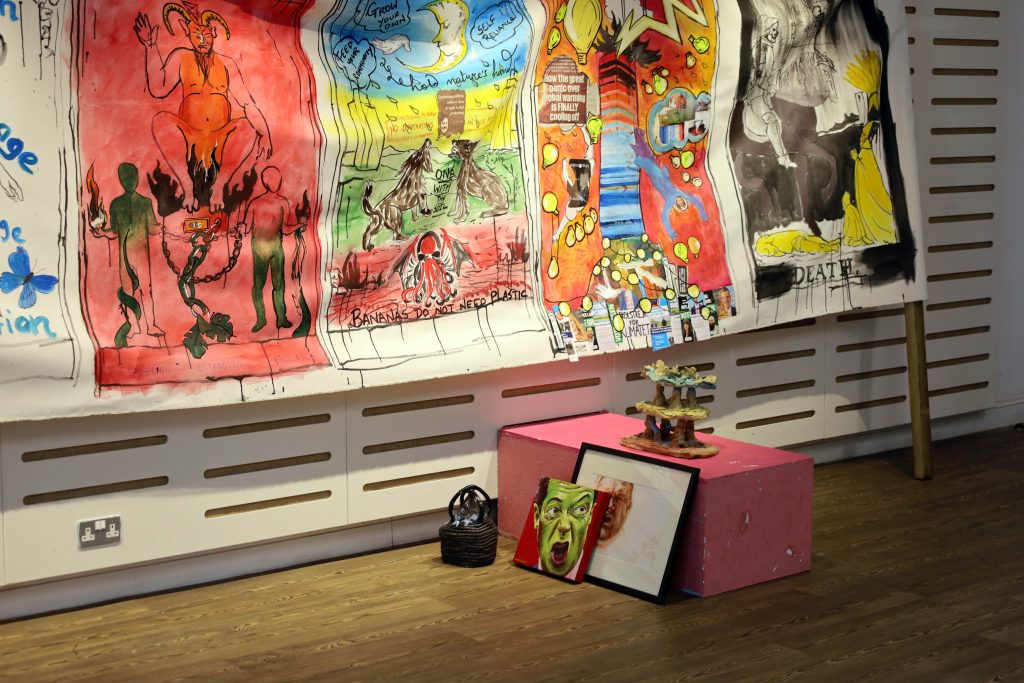
Another collage depicts Greta Thunberg falling from a tower. In tarot, the ‘tower’ card symbolises disaster, upheaval, sudden change and chaos. The participants of a workshop at Longsight used the image of the tower to show how Thunberg was dropped by media channels when she made connections between climate catastrophe, extractive capitalism and racism. The link between race and environmentalism is also expressed through the inclusion of collaged adverts for the Reform Party and material from the Gorton and Denton byelection that coincidentally took place around the same time as the Manchester workshops. Participants created a split portrait made up of the faces of Hannah Spencer (Green Party) and Matt Goodwin (Reform). Hyped by news outlets as a battle between Reform and the Green Party, for the racially diverse workshop participants it must have been a nerve-wracking experience. The election could be viewed as a choice between racism and climate denial on one hand and equality and climate action on the other. News channels may give the most airtime to divisive people, but as the election result showed, it doesn’t always change the outcome (Spencer won). In tarot, the upheaval of the tower can also represent revelations that dismantle what’s no longer sustainable – a shock or a wakeup call.
An incident that occurred midway through the project adds an additional element to the banners’ richly semiotic surfaces. Whilst hung in The Corner, the artworks were torn down and damaged, possibly by some of the unhoused inhabitants in the encampment nearby. The local creative community responded by repairing and reinstalling the artworks, but they were damaged for a second time. The damage caused to the banners is part of their narrative. For Sorensen, the ripped surfaces show how difficult it often is for marginalised and disenfranchised communities to engage in an existential crisis on a planetary level when they are experiencing personal crises in the day-to-day. How can you worry about what happens to the planet over the next decades when you don’t know where you will sleep tonight? How important is it to someone struggling to survive in the intense summer heat in these conditions that the heat is caused by climate change?
The destructive response by an element of the local community also reminds us that those who lead the conversations about climate change are often the least affected by its impacts. Those who are most affected are often given the least opportunity to join the discussion. The destruction of the banners shows the connection between climate justice and social justice, and the need for people with privilege to pick up the slack and support those who are shouldering the greatest burden. In the gallery, the tears have been restored with vibrant red thread so that the repair remains visible. The banners express violence, fragility and care within the community.
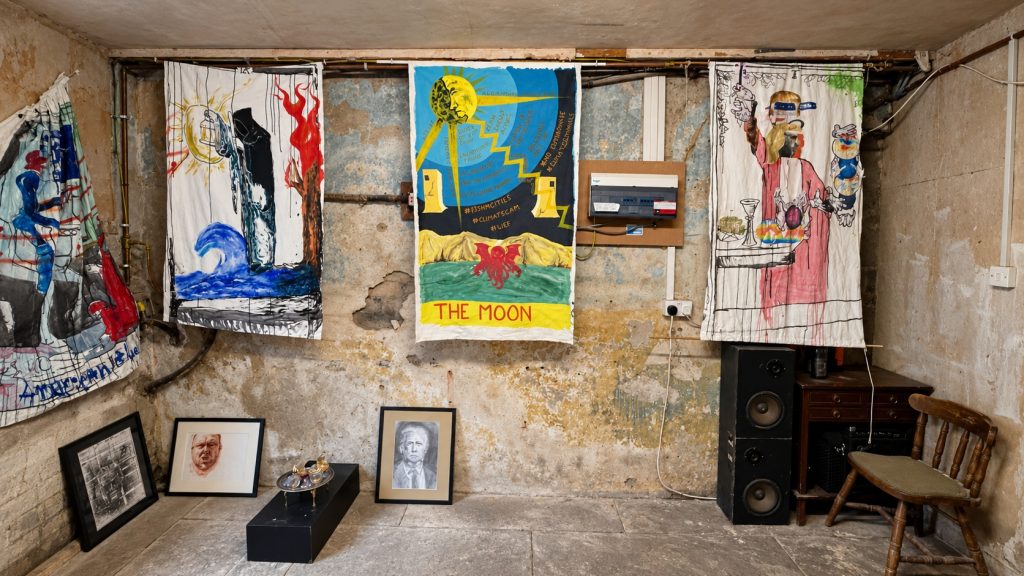
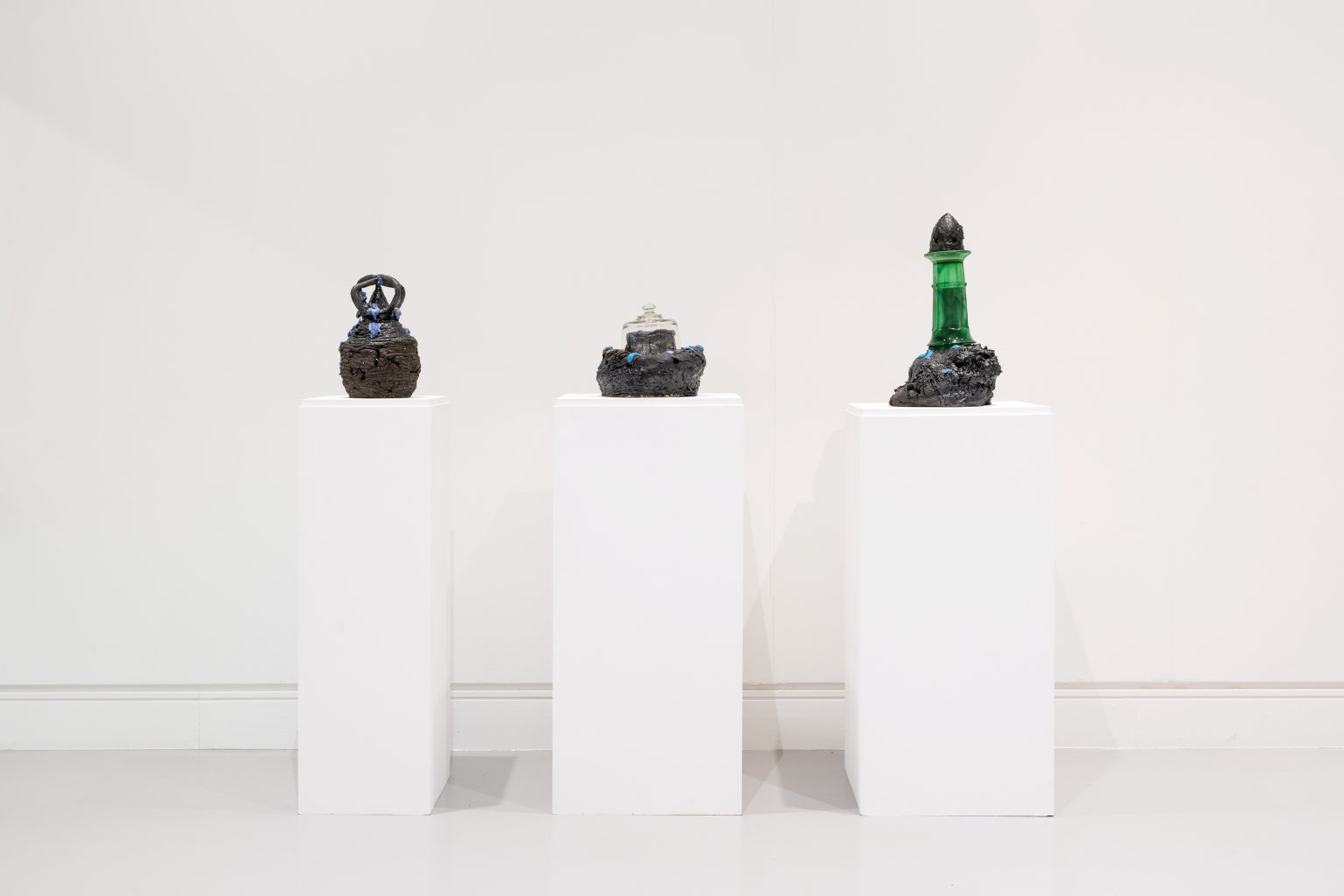
Ghalamdar’s ceramics are also marked with both destruction and care. Many of the objects are dark and heavily textured to give the appearance that they have been contaminated by tar. Ghalamdar explains that he wanted to make works that seem to have absorbed oil from a landscape contaminated by an industrial spill or the side effects of war. They look like objects that have been recovered from a traumatic event. These works and several slumped glass cups and saucers evoke a convivial family space that has been bombed out or set alight. As Ghalamdar observes, the basement space gives these artworks an archaeological feel, ‘like things dug out of a ruin’.
Ghalamdar’s ceramics, like the banner featuring the tower card, link environmentalism and colonial violence. They speak to us of the wars started due to the desire of imperialist nations to possess our diminishing natural resources, whilst the vast carbon footprints of the wars themselves accelerate us towards irreparable climate damage. This message is further reinforced by some of the artist films shown during the screening event. Reflecting the collaged elements on the banners, the films link collective cultures with surveillance, disinformation and political discourse. PalCoreCore (2023/24) by Dana Dawud organises images of Palestine circulating online into a curated sequence that raises questions about the ethics of looking and witnessing. Found footage comprising celebrating families, old advertising posters, images of soldiers and bombed out buildings produce a scrambled timeline of before, during and after the destruction of war. Referring to Walter Benjamin’s ‘angel of history’, who looks back in horror at the accumulating debris of destruction left by humans, the artist tells us that there are no angels of history today, because history doesn’t exist on social media – instead, our feeds present to us an endless flow of the present. As young men parkour and breakdance against the backdrop of ruined cities, it seems like the evidence of these acts of violence will disappear in a meaningless succession of images.
The endpoint of the deconstruction of history and truth might be what is being described in Nick Jordan’s film Thought Broadcasting (2017). The film is presented in a documentary format comprising footage of antiquated technologies, landscapes dotted with telegraph poles, antennae and receptors, and interview footage. The individuals being interviewed, perhaps by a psychologist or therapist figure, describe how their innermost thoughts are being transmitted and made public. By connecting footage of real surveillance technologies, it begs the question, why aren’t more of us ill?
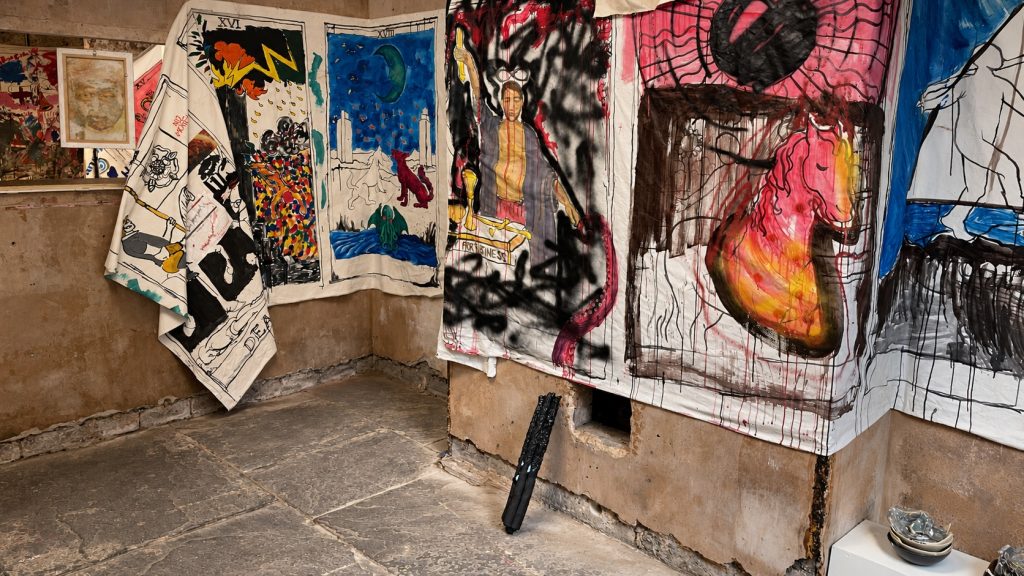
The films suggest that the pervasiveness of these technologies in our lives undermines our ability to witness, remember and cogently determine what is real. Sorensen’s paintings of divisive figures remind us of the people who are driving this technological colonisation of ‘the real’ and have the most to gain from our surrender to it. As Sorensen succinctly describes, figures such as Trump, Bannon, Orbán, Farage, Musk, Alex Jones, Jordan Peterson and Julia Hartley-Brewer have established, for her, ‘the political weather within and against which the participatory work takes place’. It is fair to say that Sorensen’s portraits are not flattering. The eyes are painted with photographic precision, in contrast to the surrounding faces, caught in snarling grimaces thickly daubed in oil paint. Akin to the tarot, these paintings can be ‘reversed’ and viewed from the back to reveal a different reading. On the front, the heavy impasto expresses the grotesque performances of power that skew debates about climate change on social media. When reversed, the politicians, oligarchs and influencers are reduced to traces and leaks – they are still recognisable, but lack weight and substance. The reversal turns power into fragility, and self-importance into an ugly smear.
Tarot readings can be used to determine how much we desire a particular outcome and to understand why we are stuck in a particular pattern of behaviour. The exhibition shows that this mode of understanding can also be used to explore feelings and behaviours in relation to climate change. Draped around the walls of the gallery, the banners invite close inspection and the slow unravelling of meaning, enabling nuanced messages to be shared and received. The collaborative and participatory processes that created them demonstrate what can be achieved when people put their creative minds together to untangle and challenge dominant narratives.
Dawn Woolley is an artist and researcher based in Leeds.
Faces and Threads is a collaborative project by artist and social science researcher Dr Lone Sorensen and artist Parham Ghalamdar, working with curator Chris Bailkoski/PROFORMA and community partners in Beeston/Hunslet and Longsight. The most recent iteration of the project was on view at BasementArtsProject from 1 September to 4 October, 2026.
Published 06.10.2026 by Benjamin Barra in Explorations
1,945 words