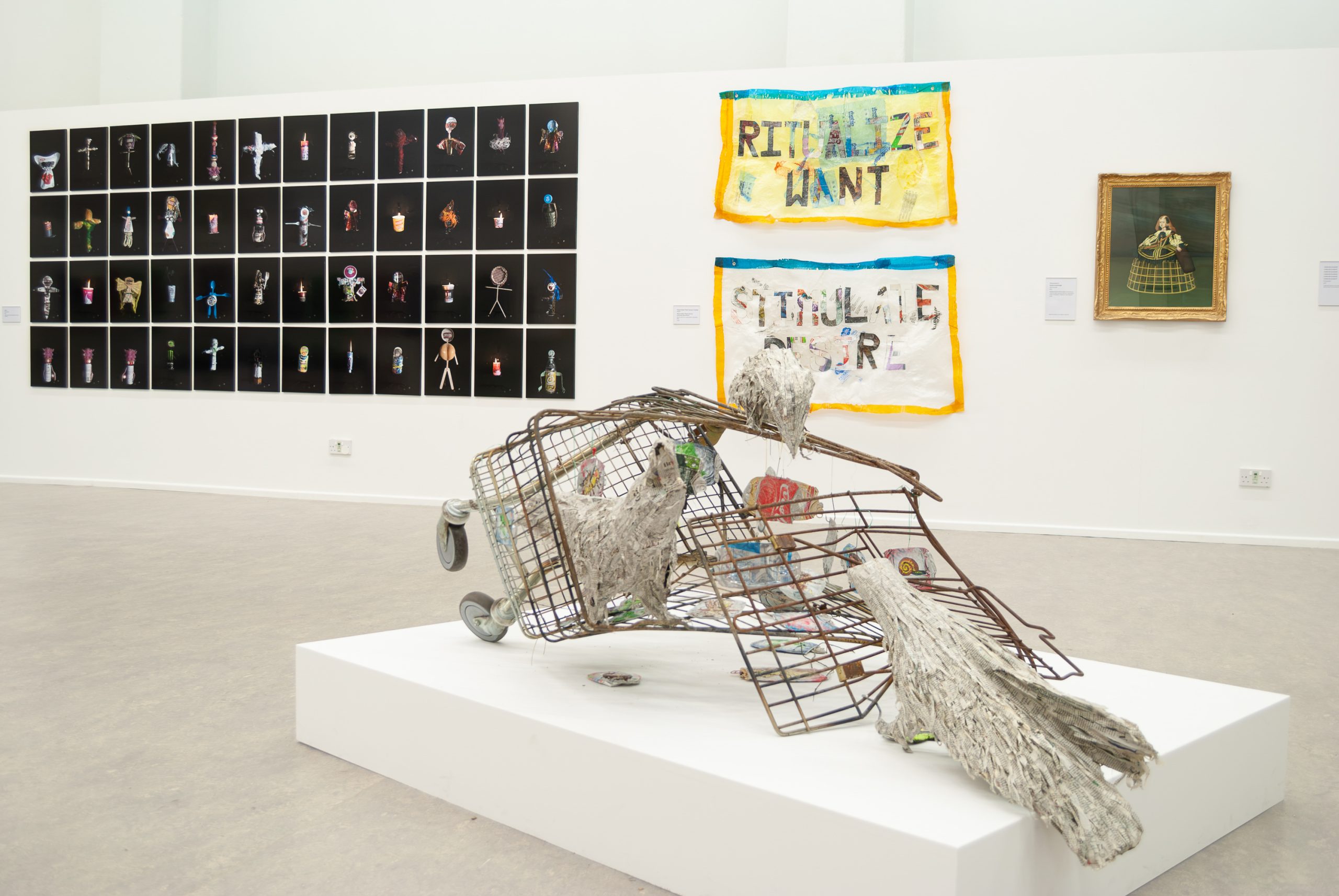
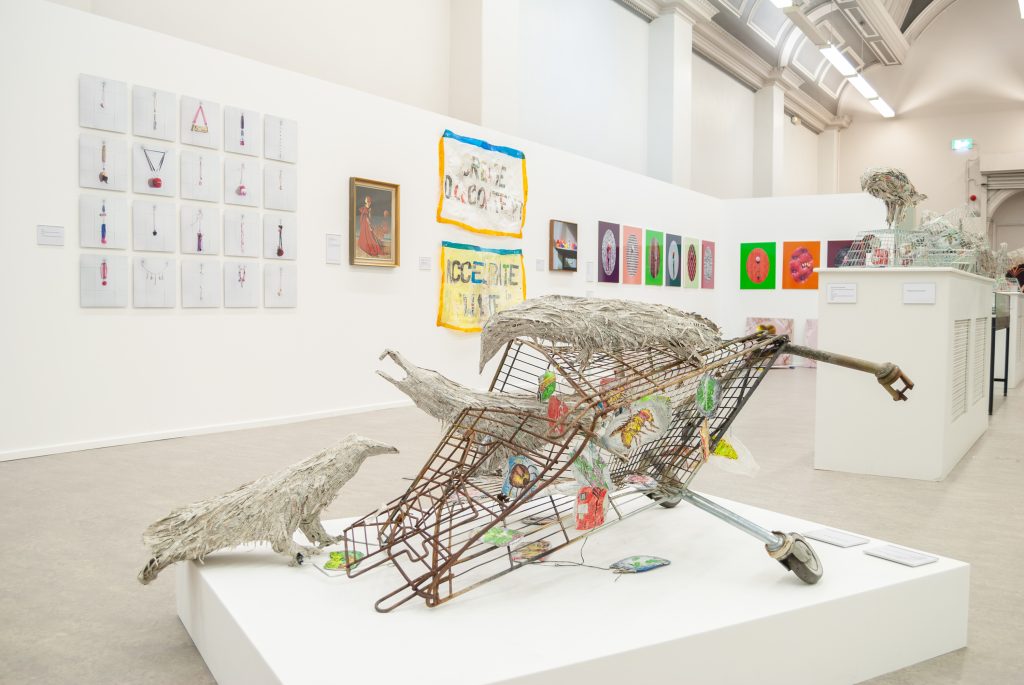
Life-sized papier maché newspaper crows, clutching upturned shopping baskets and a mangled trolley by their claws, greet visitors entering Dawn Woolley’s exhibition Relics: Objects of Devotion for Contemporary Life. Grey and eyeless, these scrap-paper scavengers are nonetheless characterful, created from the shredded pages of right-leaning newspapers such as the Metro, Financial Times and The Telegraph. The paper corvids and the supermarket receptacles on which they sit make-up Woolley’s Storm Bird and Basket (2025) series and belong to a new body of work whose rough-and-ready aesthetic contrasts with the highly controlled style of her earlier photographic works, which depict food and food packaging, arranged for allegorical effect, and are also on display here.
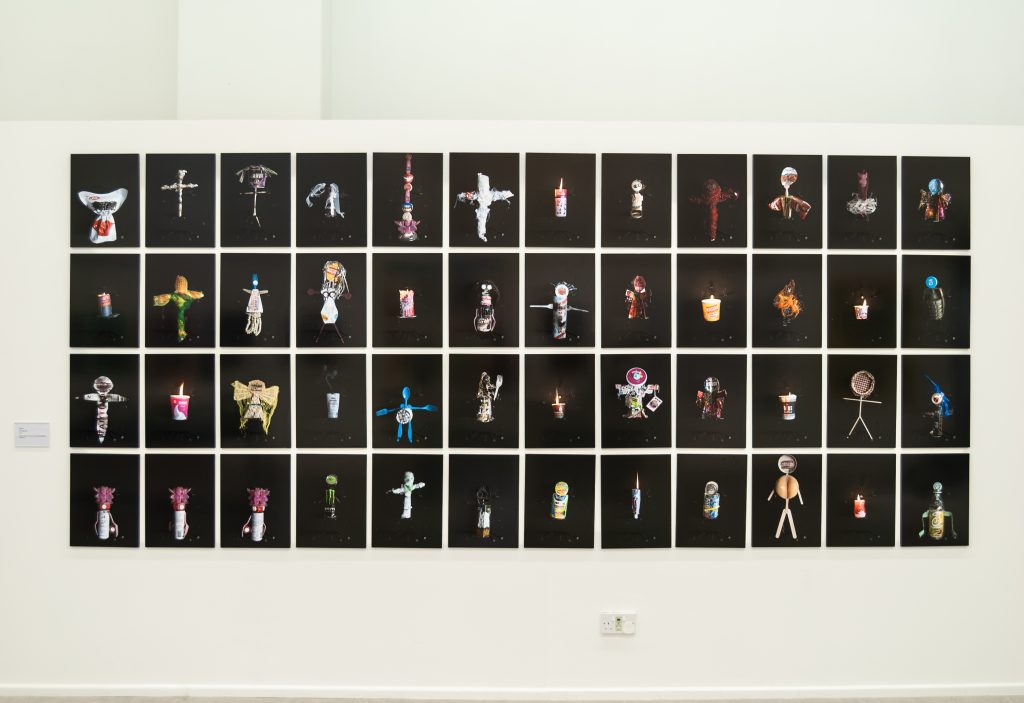
The exhibition moves between these earlier photographic works and sculptures which portray consumers via gendered messaging implicit to the design of wrappers, cartons and containers, and more recent sculptural and pictorial works which retain these waste materials in their final forms. As such, Relics: Objects of Devotion for Contemporary Life presents a kind of condensed retrospective marking a shift in Woolley’s way of working, anchored by two surrealist paintings from Salford Museum and Art Gallery’s collection. ‘Variation on Red’ (1949) by Marion Adnams and ‘Phenomenon I’ (1975) by Derek Greenhalgh were selected by Woolley as examples of artworks in which bodies are literally objectified. In these oil paintings, female-coded characters are composed of inanimate objects including bows, ribbons and a cage crinoline. Adnams and Greenhalgh’s depiction of bodies through objects provide a surrealist foundation for Woolley’s own forays into portraits of the body through the waste packaging of commodities. The most direct correlation between Woolley’s work and that of her surrealist forebears can be found in the Relics series (2017) in which we see tens of totemic anthropomorphic figures crudely made from dirtied and distressed food packaging, individually photographed against a black background. These little figurines are cobbled together from the packaging of food products such as Love Hearts, pastel-coloured sweets marketed at young girls embossed with hearts and messages such as ‘Don’t cry’ and ‘All Mine’ that could do with a post-#metoo lesson in consent. A Love Hearts wrapper has been combined with a grubby looking candy necklace and plastic cutlery splayed desperately outwards like little arms, reaching out for the approval of others following its disposal. Whilst at the other end of the spectrum we see another talismanic figure composed of a black Monster drink can, with the aggressive slime green claw mark that forms the brand’s logo reframed as a performative submission to hegemonic masculinity by the matching green pacifier that stoppers and mutes the mouth of the can from where someone once sipped.
There are also echoes between the slick black studio backdrops against which Woolley’s ‘relics’ are photographed and the nondescript muted green studio background that provides the scene for Greenhalgh’s painting. In Greenhalgh’s painting, we see a miserable looking young girl trussed-up in a lavish dress fit for the court of Versailles. Despite its finery, the dress ends in tatters below the waist to reveal nothing beneath the wide hoop skirt except an almost comic black hole in the green ground below the figure. Woolley’s black backdrops create a void of another kind, one which her ‘relics’ haunt, looming out of the darkness like arcane devotional offerings. In Woolley, Greenhalgh and Adnam’s works, familiar objects are made strange, with Woolley deploying defamiliarisation so that we might scrutinise and even decode the significance of the objects from which figures have been formed. To this end, the Relics series invites us to consider whether the planet-destroying, gender-stereotype-reinforcing packaging of food and beverage products like Love Hearts and Monster are really the cultural legacy that we wish to pass on to future generations.
Similarly, in Woolley’s Pacifier series (2014) the body is alluded to through objects, this time through sweets, sex toys and nail art practice dummies photographed together in various combinations against faux wallpaper samples. In ‘Pacifier (05)’a boiled sweet in the shape of a child’s dummy hangs from a prosthetic mouth, presumably from some sort of sex doll, the simultaneous allusions to infancy and sexuality lending the image an uneasy, almost grotesque, quality. The garish green of the dummy’s plastic ring and the matching green framing of the image contrasts with an oval of dark orange faux-bamboo effect wallpaper from which the prosthetic mouth protrudes, the harsh clash of the green and orange hues creating a jarring background to the tableaux. The series was originally shown on a billboard in Cardiff in the lead-up to Christmas, intentionally coinciding with the season in which people are encouraged to spend without thought for the impact on the environment or their personal finances. It is a series about appearances and promises, its ersatz and fetishistic components critiquing the superficiality and deceptions of consumer culture.
The Relics and Pacifier series belong to an established body of polished photographic work that provided a point of departure for a more recent body of work that takes a raw approach to painting and sculpture that Woolley herself describes as a ‘feral’ kind of practice. Such ferality is apparent in Woolley’s methods for sourcing materials, recycling the excesses of past work and relying on scavenging discarded plastics and car-flattened cans and bottles to gather what she needs. These works are now entirely removed from the domesticity and restraint of the photographic studio, the soiled appearance of the waste materials that Woolley has collected no longer distanced from audiences by the camera lens. It is this body of work to which the crows belong, and are accompanied by other recent works through which Woolley imagines the bleak future that awaits us if we are to persist with the consumerist excesses of late-stage capitalism.
Away from the gallery walls, the supermarket trolley and baskets from the Storm Bird baskets series provide structures from which Woolley has hung small paintings of undesirable species such as fleas and ticks painted in acrylic on crushed cans and bottles. These folk art-esque paintings, reminiscent of rock paintings that you might see in people’s gardens, comprise the Survivors (2026) series. Through these works Woolley imagines a world in which ‘survivor species’ such as snails and ticks thrive in the Anthropocene climate and are consequently revered in cults. I am particularly enamoured with the snails from the New Relics series, made from the distinctive brightly-coloured, bulbous BuzzBallz cocktail bottles collected by Woolley on walks between the gallery and the station in the lead-up to the exhibition. Sourcing materials by scavenging litter from the footpaths and roadsides around the gallery, Woolley’s feral sculpture-making confronts audiences with art made from their own waste, her frugality chiding us about the thoughtless jettisoning of waste food packaging. The cocktail containers now provide perfect ‘shells’ for grey clay invertebrates that slide over flattened cans painted with Woolley’s walking route, abstracted from Google maps. The species that Woolley depicts possess the survival skills we might need to emulate ourselves should our own species wish to avoid extinction. Snails seal themselves up in their own shells when the heat becomes overwhelming, whilst any species that can survive by scavenging will similarly do well as the climate continues to change. As well as providing an unedifying vision of the future, these later works take dirty, discarded packaging and create a portrait of a place according to those who use and neglect it with their littering.
It’s interesting to hear from staff that visitors are initially unsure how to ‘read’ Woolley’s work. Ironic, given that nearly all the work on display is made from the waste packaging of food and beverage products that depend on the legibility of their brand identity for commercial success. A reminder that such messaging has become so insidiously naturalised as to create an initial hurdle for visitors before they can engage with any subversive reading. So I’m reassured to hear that visitors quickly acclimatise to Woolley’s critique, embracing the opportunity to unpick accepted gendered capitalist diktats that implicitly and explicitly infer the suitability of food products according to gender through colour palettes, slogans, and names. Like, for example, the hot pink carton of a ‘Snog’ frozen yoghurt which is transformed by Woolley into a votive candle ready for the altar of twenty-first century hyper-femininity. Just as well that audiences are quick to embrace the opportunity to engage in critique since, as artist-activist, Woolley hopes that audiences will take a critical interest in the detritus of daily life and see her more recent works as having the potential to be reused in activist contexts.
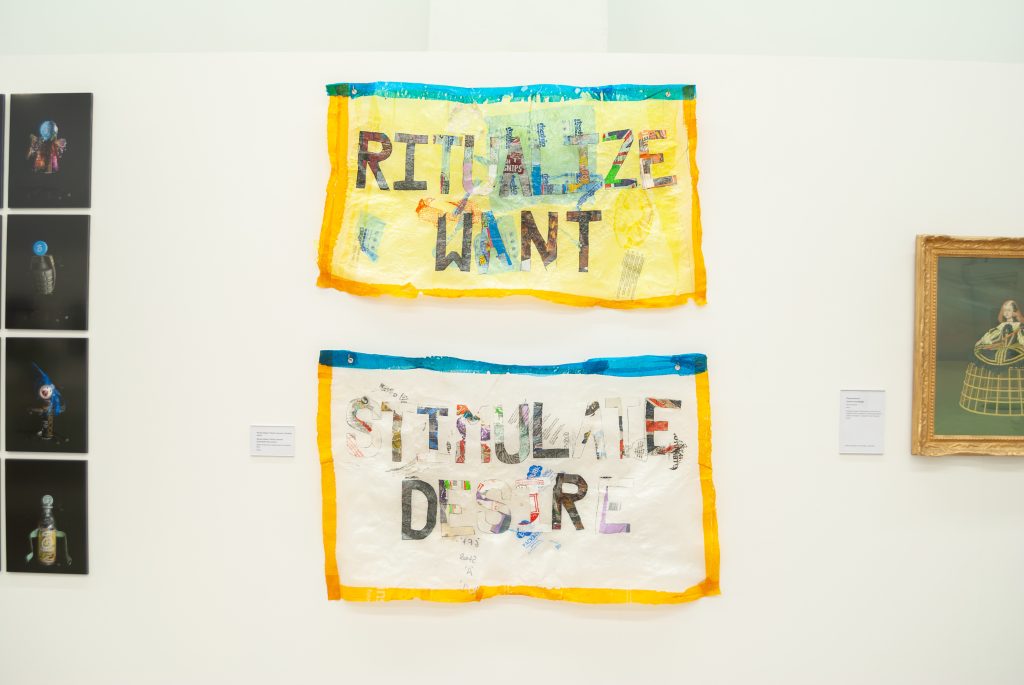
Nowhere is this more evident than in the Waste Maker Plastic banner series (2025), which takes phrases from Vance Packard’s 1960 monograph The Waste Makers and transforms them into dystopian devotional commandments for an imagined post-climate-apocalyptic future. It’s over sixty-five years since Packard tried to warn us that the introduction of built-in obsolescence and accelerated overconsumption, promoted in the post-war era as a pathway to economic recovery, was destined to result in environmental catastrophe and would fundamentally change our psychology. Such warnings have evidently fallen on cloth ears, leaving Woolley to challenge audiences with the intentional misappropriation of selected quotes from Packard’s text, so that phrases intended by Packard as warnings, like ‘ritualise want’, ‘accelerate waste’ and ‘create discontent’, become slogans for a society in denial. The banners are made from plastics that Woolley has collected from kerbsides along with the hard-to-avoid microplastic shedding nightmares that are fruit nets, laminated in the studio to create a cracked skin-like surface for Packard’s recycled words.
Relics: Objects of Devotion for Contemporary Life offers us portraits of people through their waste, and portraits of place through human waste. This is an anthropological body of work and an exhibition about being complicit. Complicit companies, complicit media outlets and complicit consumers. Complicit in the reaffirmation of hegemonic gender stereotypes through consumer choices, and complicit in the relentless death march towards environmental disaster through the shared consumer psychosis of a waste culture. Seen in this context, Woolley’s feral practices suddenly offer more than just a new way of working for the artist, but offer us all a new way of being that is feral and more free. Through the making and the theory of her practice Woolley models ways of critiquing and relating to our own waste that are needed if we are to slow the pace of climate change. Woolley’s work overflows with critical and critiqued messaging, but if there is one message to take away then it is this: we should all be more feral.
Dawn Woolley: Relics: Objects of Devotion for Contemporary Life, Salford Museum and Art Gallery, 2 May – 30 August 2026.
Zara Worth is a visual artist and researcher living and working in Durham city.
This review is supported by Salford Museum and Art Gallery.
Published 31.07.2026 by Jazmine Linklater in Reviews
1,876 words