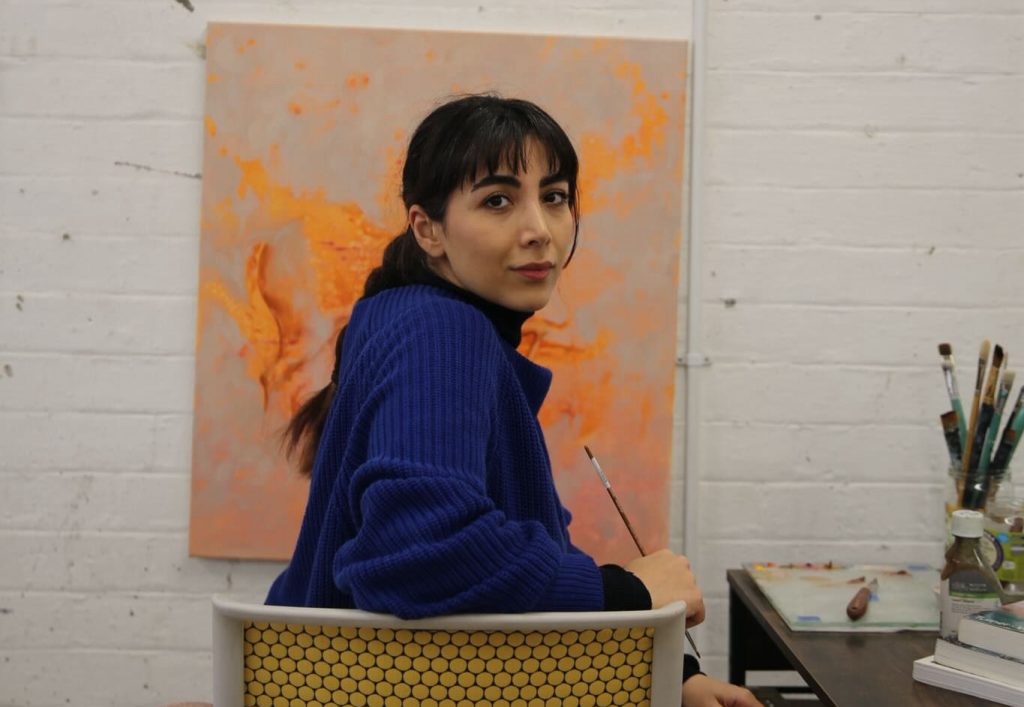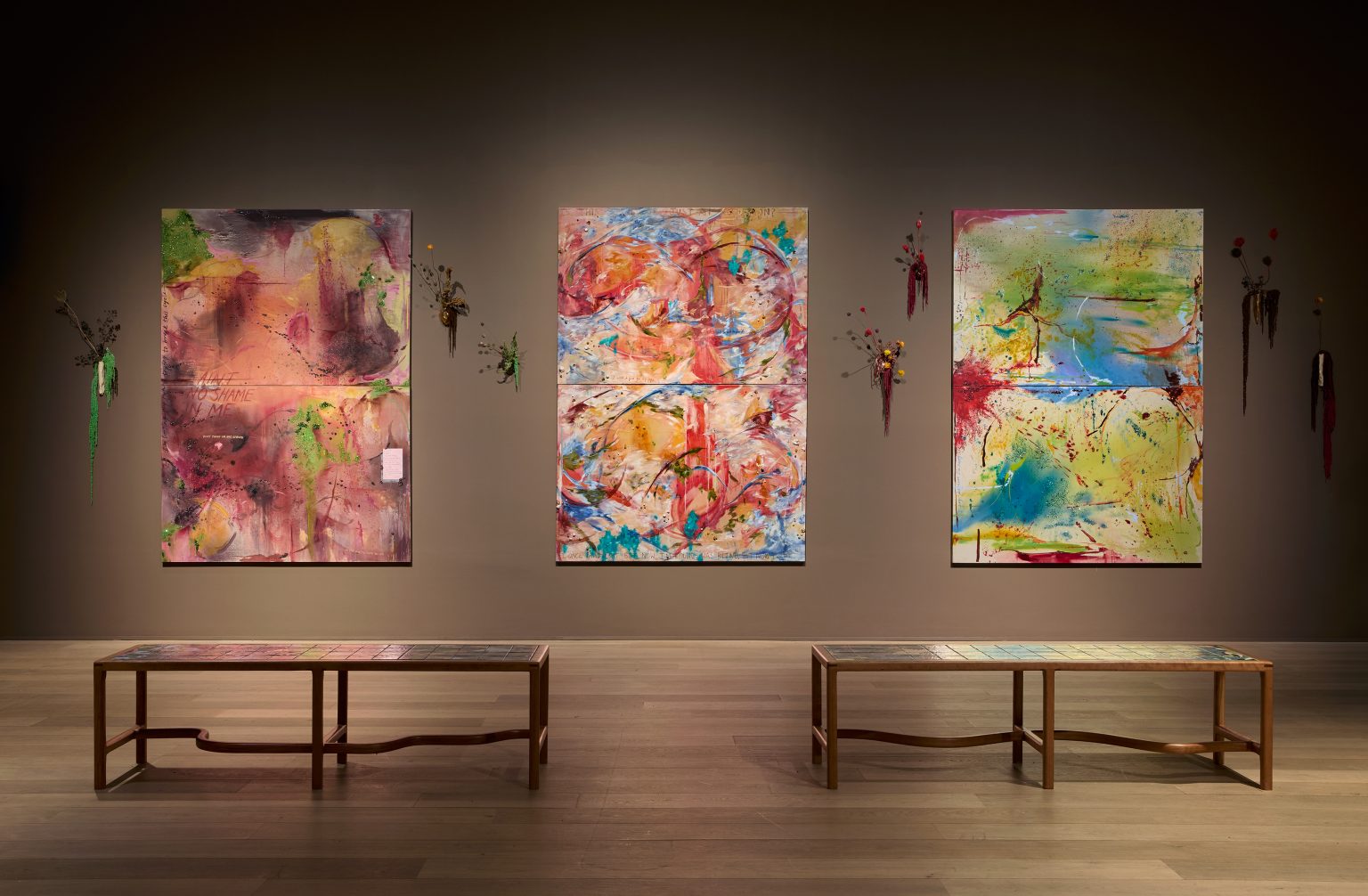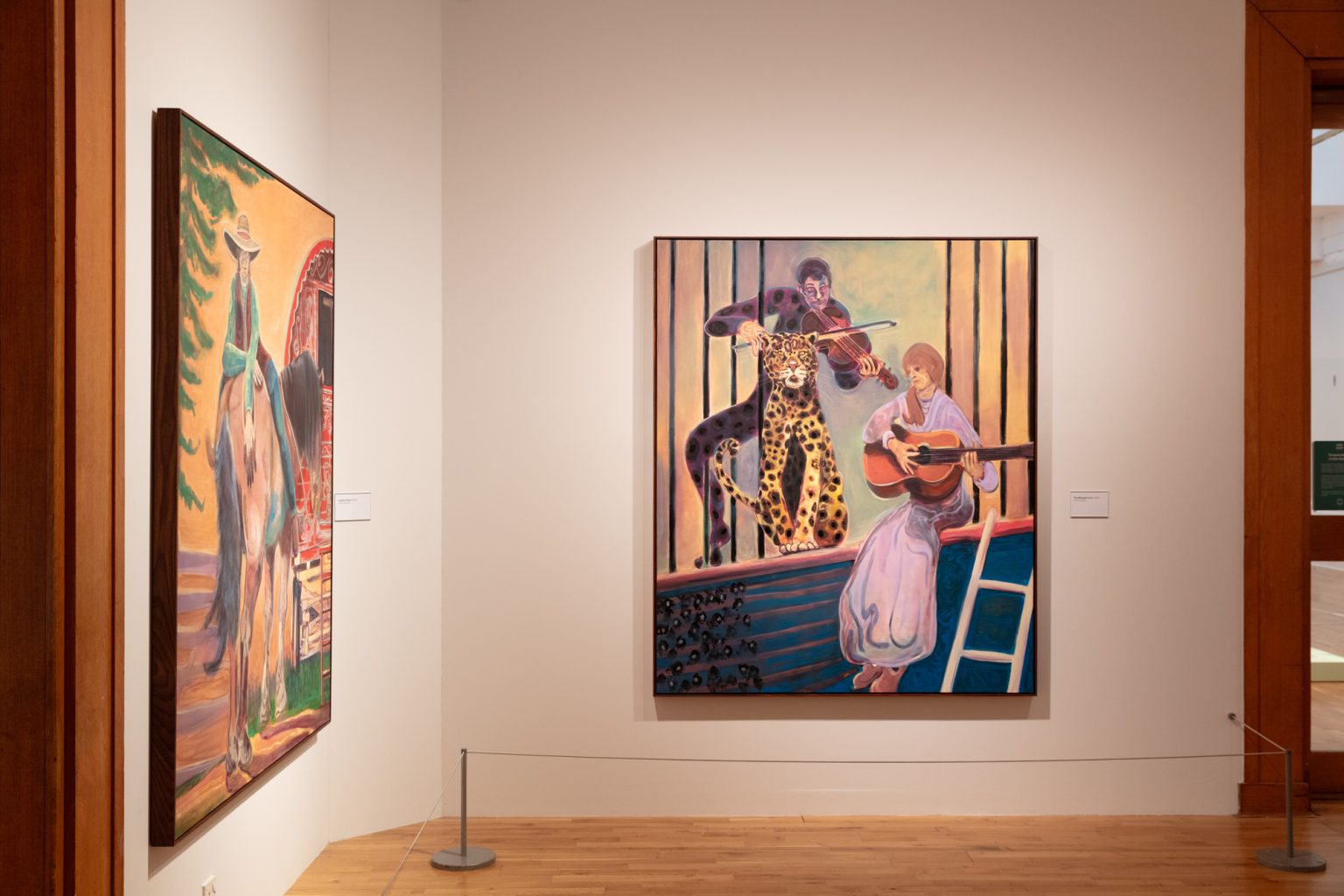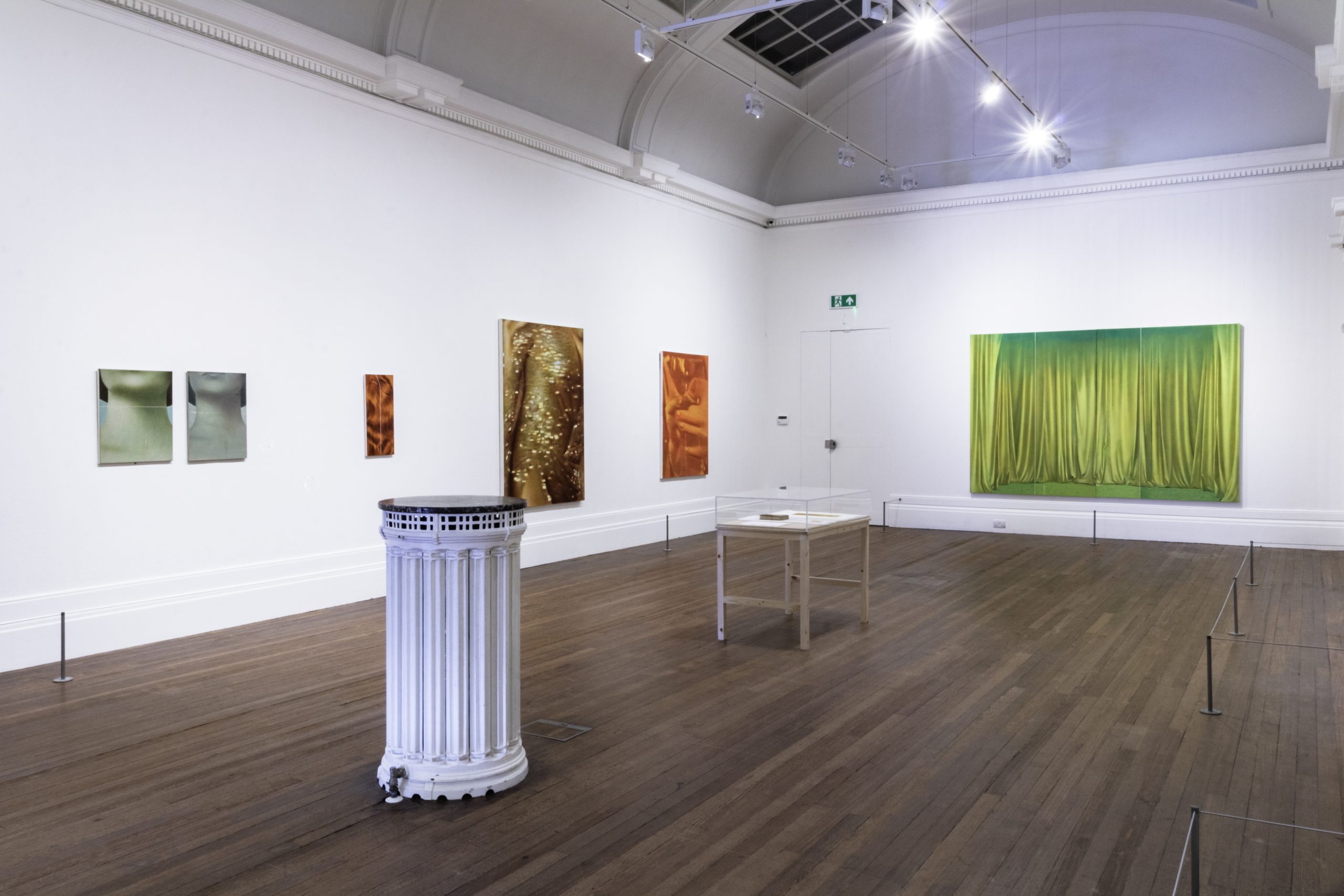
Louise Giovanelli: From Here to Here to Here, curated by Paulette Brien, is the Manchester-based painter’s second solo exhibition at Grundy Art Gallery. Containing work spanning 2014 to 2025, it charts the trajectory of her artistic practice, highlighting key moments from her career thus far. The exhibition leads visitors through three stylistically distinct white wall gallery spaces, the three ‘here’s’ of the title, charting her time studying Fine Art at Manchester School of Art, graduating in 2015, and Städelschule in Frankfurt, graduating in 2020, and ending with work featured in her 2024-25 multi-site exhibition A Song of Ascents, created in cooperation with The Hepworth Wakefield, Museum Villa Stuck, and HALLE FÜR KUNST Steiermark. Arriving a decade after her first single-room solo show, From Here to Here at the Grundy in 2016, it offers a chance to connect the dots in a way usually seen in late-career retrospectives.
Tonight’s preview evening began with impassioned speeches from the stairway about Giovanelli’s exhibition and the Apollo Painting School works displayed in the third and final space. Apollo is a non-profit art school operating in Manchester, UK, with residencies in Latina, Italy. It was founded in 2023 by Giovanelli, curator Alice Amati and artist-academic Dr Ian Hartshorne to address accessibility issues for artists, regardless of economic background or circumstances. Rising studio costs, a continued London-centric approach to artist visibility, and a lack of support outside of formal education or paid membership schemes are all issues felt keenly by artists without the financial or social means to get a foot in the door. Reduced costs and the chance to undertake an overseas residency make this intensive three-month summer programme a game-changing opportunity for emerging painters. It is a great example of how to hold the door open instead of shutting it firmly behind once personal success is established; here, works by the 2024-25 cohort are displayed in conversation with Giovanelli’s.
Entering Gallery 1: Setting the Scene, I find a high-ceilinged room, the side walls of which display a single row of paintings, and, in the centre, a vitrine housing small, delicate works on paper. Through the double doorway beyond to Gallery 2, the intoxicating pull of her ‘curtain’ paintings hastily beckons me on. My eye moves immediately to a work on my left, set apart in subject matter and tone from other Giovanellis I have seen before. ‘Swan’ (2014) is a cropped, disquieting study of the human form. A pale torso and crook of an arm lie ashen, unnaturally inverted as if standing at the head of a body and looking down from above. Art-historical references appear in my mind whilst standing in front of this painting, whether intended or not by the artist. At first, it reminds me of Dali’s ’Christ of Saint John of the Cross’ (1951) turned upside down or an afterimage of the crucifixion of Saint Peter, famously painted by Michelangelo, Caravaggio and Guido Reni, amongst others. It also reminds me of works that use cadaver studies, such as Jacques-Louis David in ‘The Death of Marat’ (1793) or Theodore Gericault in ‘The Raft of Medusa’ (1818-19). Perhaps the figure is lying on a slab, rigor mortis in full effect. Drained and lifeless, a cold light emphasises the powder-blue pallor of a stiff forearm bleeding into the bruised purples and pinks of an upper arm. Attached to a pale white, marble-esque body and rendered in chiaroscuro, it feels like a confident nod to the tenebrism of Caravaggio and, to me, one of the most striking pieces in this space.
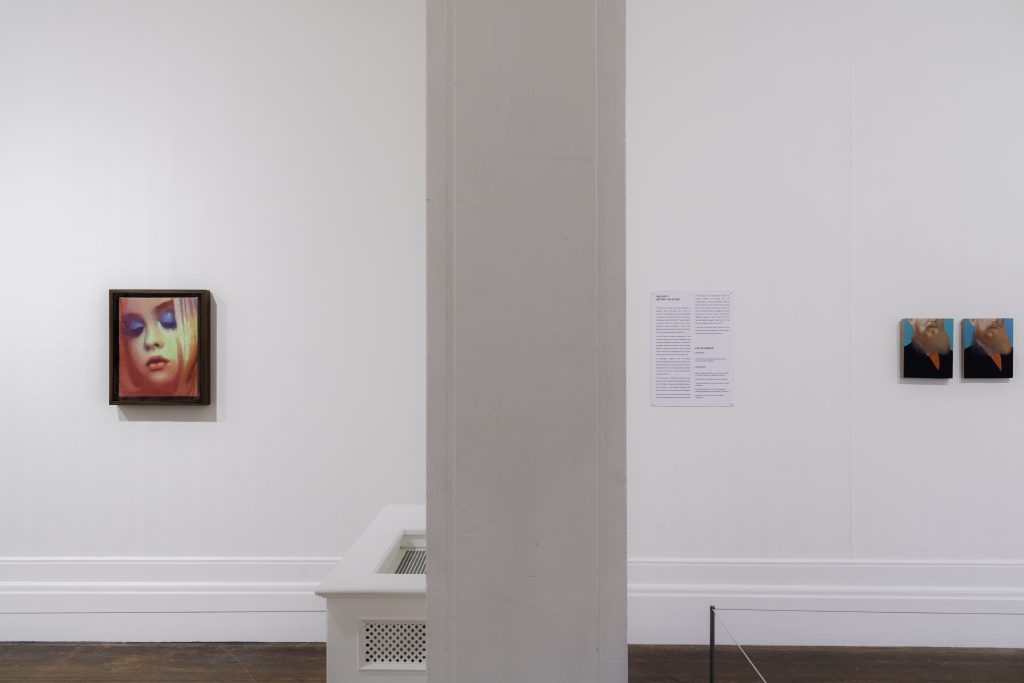
An echoing of art history continues in ‘Neckline (from the Tiergarten)’ (2016), ‘Beard III’ and ‘Beard IV’ (2016). These latter two recreate details from paintings in the Grundy collection, revealing her early interest in the archive. Throats both bare and covered make for unusual focal points. They have a danger to them, an unhealthy fixation on the jugular that one might relate to a wild animal, a vampire or a cold-blooded killer. It seems as though I am looking where I shouldn’t, and I like that kind of unsettling feeling in my art viewing. They also create a connecting thread into the next space, Gallery 2: Centre Stage, a larger room set out similarly to the first, wherethere is a definite shift in tone and artistic ability. Here on the left, Elizabeth Taylor’s tracheotomy-scarred décolletage appears in two works, ‘Marker V’ and ‘Marker VII’ (2019). A result of interventions during a bout of severe pneumonia whilst filming Cleopatra (1963), it marks an entry wound for emergency intubation. Her pale throat is cut through twice by the scar itself and a pink horizon line of paint travelling the width of the canvas. Oil paint is applied and subtracted with delicate transparency. Jawline shadow falls onto her neck, and the underlying blue tones link back to the deathliness of ‘Swan’. This is a very familiar image to me, from both spending time admiring ‘Marker V’ on display at Manchester Art Gallery and a framed copy of the direct reference to Bert Stern’s 1962 colour photograph hanging on my wall at home. Defiant in both expression and pose, the original photograph reveals more of the woman behind the character, a statement about acceptable beauty in a decade obsessed with perfect feminine charm.
‘Arena’ (2021) and ‘Lux’ (2025) also reference women in film, with the latter being more obvious than the former. ‘Arena’ is a scumbled little painting featuring the back of Tippi Hedren’s blonde head blurred as she quickly turns to the camera in the film The Birds (1963). It freezes a swift movement to demand we look. Her controlled glamour unsettled in a moment of flux, chignon coiffured and diamond earring glinting. ‘Heroine hair’ is a motif that Hitchcock returned to time and again in his films, a symbol of restraint or undoing in his characters. Giovanelli repeats this motif in ‘Tide’ (2023), an elongated canvas tumbling with coppery waves, and ‘AXIS’ (2020), an almost unbelievably shiny head of hair delicately painted on the olive green book cover of The Dragonflies of the British Isles by Cynthia Longfield. ‘Lux’ (2025) is a painting featuring the heavy-lidded young face of Christina Ricci’s character, Layla, from Buffalo ‘66 (1998). She almost sparkles in effervescent rendering, a trick of paint that Giovanelli regularly uses. Knowing the age difference and power dynamic between the film’s director/lead actor, Vincent Gallo, and Ricci makes the film a difficult watch. Centred on the abduction and coercion of a young woman to satiate the narcissistic ends of the film’s protagonist, the scene this painting is taken from shows Layla tap dancing in the middle of a bowling alley. The film is the epitome of a male-gaze dream sequence, disturbingly hallucinogenic and hypnotic in retro blues and golds. Giovanelli, however, frames Layla’s face in a close-up, forcing the viewer to consider her perspective in that moment. To me, this still makes her more relatable than the passive character she was written as, her closed eyes frozen in a defiant expression I read as tired of men like Gallo’s shit.
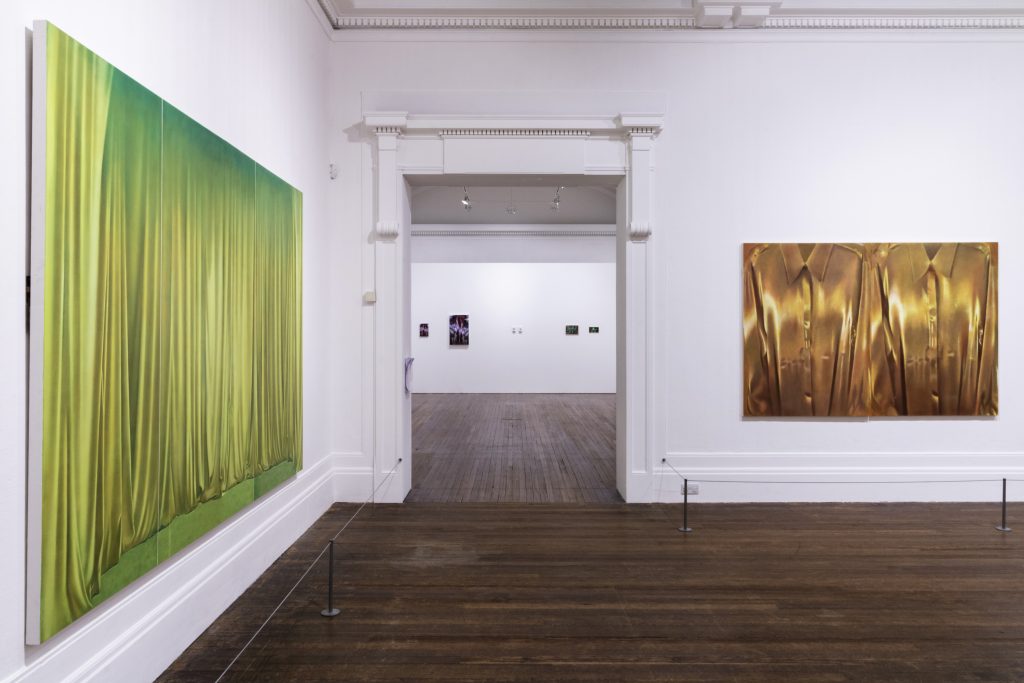
Elsewhere in Centre Stage, contemporary subjects are given almost devotional attention. Giovanelli further eulogises the everyday in a mix of low and high culture. They could be painted versions of photographs from a local social history archive. Anybody who has spent time amongst the nostalgia of this seaside town and others like it will be familiar with these motifs. For me, they stir up memories of working-class youth spent amongst the flashing lights, smoky venues and bawdy humour. The pull of the place never quite leaves you, no matter where you end up. I’ve found myself seeking out the underbelly of the cities I’ve lived in, pining for a version of Funny Girls, The Flamingo orThe Flying Handbag that never quite appears. Her pubs and clubs are Baroque and Golden Age churches and chapels. Wide, lustrous curtains that spellbound me earlier hang rippled across an empty stage in ‘Prairie’ (2022); the sgraffito across an empty wine glass clutched in a manicured shellac grip of ‘Offer’ (2022); a pair of gaudy golden lamé shirts suspended limply, waiting to be worn again in ‘Wager’ (2021). Compare these subjects to altars, receiving Holy Communion and liturgical vestments in many Renaissance works, and it is easy to see the influence Catholicism has had on the artist. She further explores this in ‘Entheogen’ (2023), in which a radioactive-green young woman stands open-mouthed to receive the Eucharist in a way not dissimilar to the titular figure in Bernini’s ‘The Ecstasy of Saint Teresa’ (1652). Spiritual pain (or pleasure) made flesh.
Perhaps this is one of the reasons Giovanelli was so keen to return to Blackpool for this exhibition; the call of its faded glamour echoing out from her work just that bit too strongly to ignore. She is adept at drawing attention to the overlooked details of social ritual, making the ordinary fantastic, the anticipation of the spectacle. Often she renders liminal spaces, her stage curtains appearing like portals in gallery walls. Early experimentation with fabrics, such as the gauzy transparency of a scarf in Gallery 1’s ‘Untitled’ (2016), makes way for the intensely worked drapery of an almost beguiling quality in Gallery 2. These ‘draperies’ are some of my favourites. Having seen different versions numerous times, I am always struck by their sensually intoxicating presence, offering a mysterious tension between stillness and movement. Loaded with the strangeness of empty performance spaces, people around me take selfies in front of them. A momentary flirtation with the spotlight before returning to the ordinary. Their five seconds of fame.
Giovanelli is a master of the extreme close-up, an artistic device that withholds the full picture to maintain cinematic mystery. This tantalising tight perspective drastically slows down immediate recognition and, in some cases, the entire process of looking. I enjoy spending time puzzling over the canvas, moving closer, then further away in silent dialogue with her mark-making, whilst drinking in the details. ‘Orbiter’ (2021) permits me to do this for the longest time. A blurry snapshot rendered in paint falls somewhere between figuration and abstraction. Sequinned and twisting, a body moves frenetically mid-performance. The cut of the glamorous golden dress is a cross between showgirl and drag queen. Featureless, the writhing figure is ambiguous, allowing the viewer to create their own narrative. Whoever they are, they look like they’re having a damn good time.
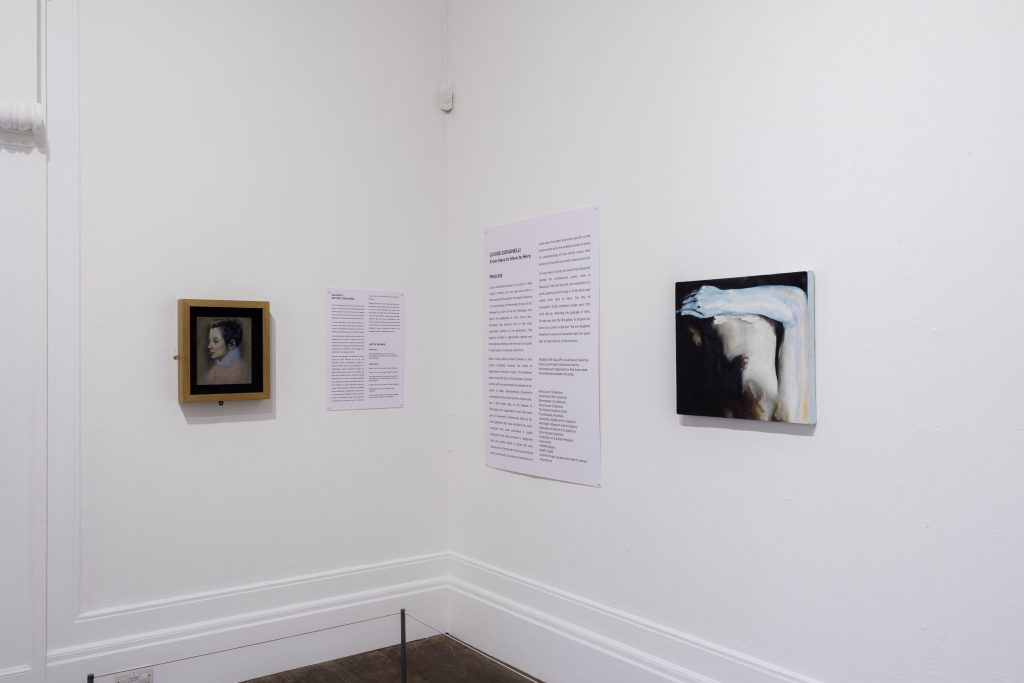
Moving into Gallery 3: Sharing the Stage, I come to one of the Grundys’ side rooms housing a collection of five final works by Giovanelli that display her appetite for returning to key themes again and again – more necks and curtains. These sit next to the works by nine emerging graduates of Apollo Painting School. It is also worth mentioning that Giovanelli’s first solo show was in this space, and now some of these artists are having their very first show in a public gallery. This fits with the cyclical themes and curatorial intentions of the artist. Interesting and varied, these works range from the tiny hand studies of Hannah-Sophia Guerriero to Nora Hreb’s acidic abstractions to Mahrokh Mofidnakhaei’s pleasingly phallic still life. There is much skill on display, each work demands to be looked at either through a diminutive scale, forced perspective or obnoxious use of colour. I enjoy ending on this note with Giovanelli passing the torch onto the next generation of painters, begging the question, which of them will be making their own return a decade from now? The overall scale of what has been achieved is fantastic. There are more than thirty lenders contributing work to the exhibition, all eager to be part of the Grundy’s second look at Giovanelli’s practice. This show of support validates her place in the art world right now. The Grundy’s commitment to talent development and raising the ambition of early-career artists comes across in the way the narrative of From Here to Here to Here is presented. I certainly felt this after leaving and can imagine how inspiring Giovanelli is and will be to the crowds of people I hope will come to see this exhibition. For a local authority gallery with a limited budget and a small team, it is of great importance to both Blackpool and the wider arts ecology of the region to show they have an eye on the past, present and future. Commanding an artist like this in their spaces is just one reason Blackpool is so deserving of being longlisted for City of Culture 2029.
Kirsty Jukes is an art historian and writer from Lancashire.
Louise Giovanelli: From Here to Here to Here, Grundy Art Gallery, Blackpool, 28 March – 28 June 2026.
This piece is supported by Grundy Art Gallery.
Published 21.06.2026 by Jazmine Linklater in Reviews
2,191 words