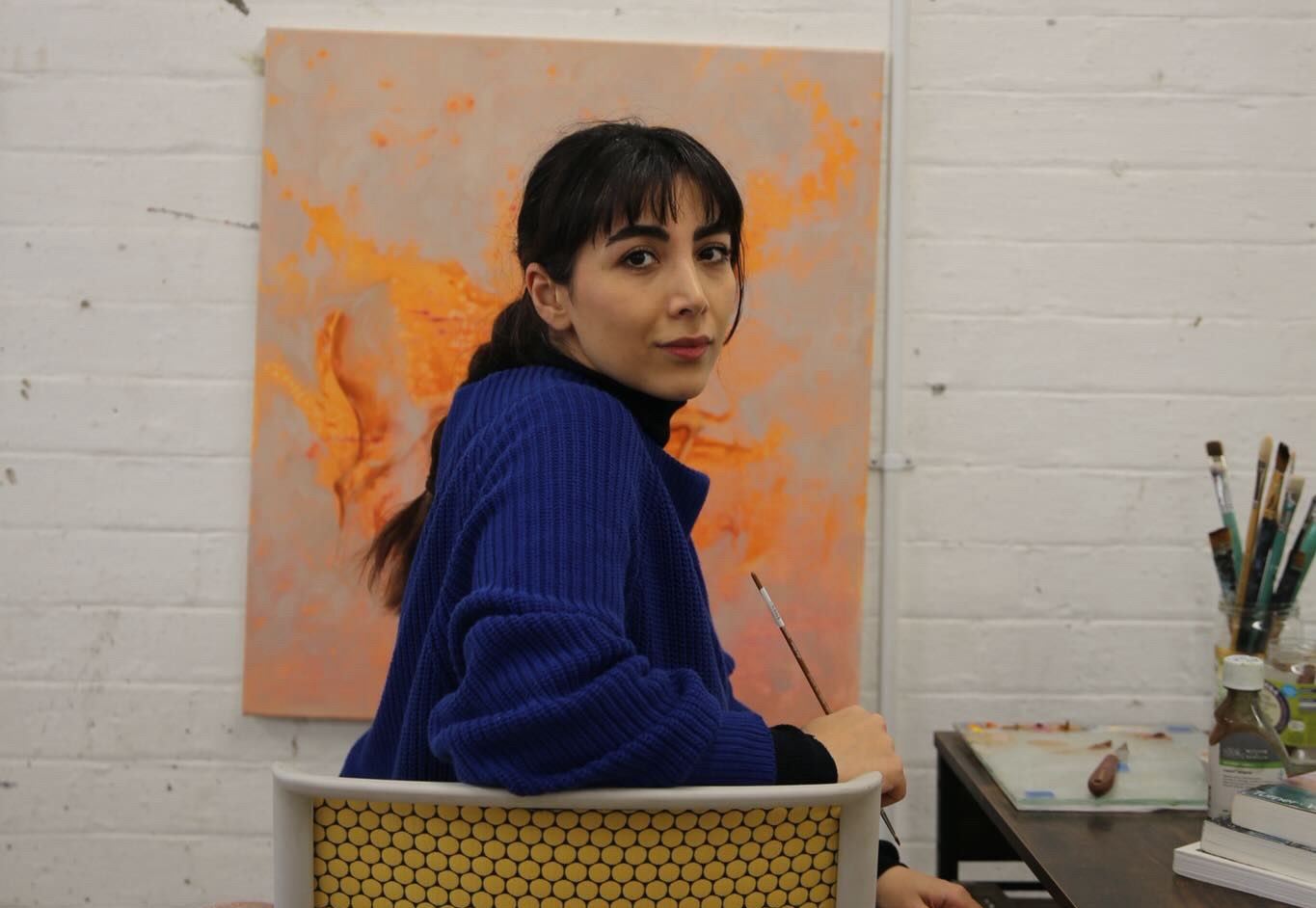
Following her contribution to Reflecting // Processing, a three-day group exhibition at Studio Sanct Manchester this April, I’m lucky enough to be able to encounter Yasaman Mollasalehi’s recent paintings more slowly in the studio. The exhibition itself was brief, almost fleeting. By the time I meet her, the works have already moved back into another kind of life: leaning against walls, propped on the floor, close to the conditions of their making.
One diptych rests upright against a white brick wall. Across its two panels, a bird and a cypress tree face one another inside narrow, rust-coloured borders. The palette is quiet but not subdued: blue-grey, soft green, brown, bruised mauve, a residue of orange at the edges. The bird occupies the left panel, its body large and low, its wing made through loose, feathered strokes that never fully sharpen into illustration. On the right, the cypress rises darkly, tapering towards the top of the canvas. Between them sits a slender vertical form, somewhere between a column, candle, trunk and vessel, its rounded base making it feel both architectural and bodily. The painting is full of separations: panel from panel, bird from tree, motion from rootedness.
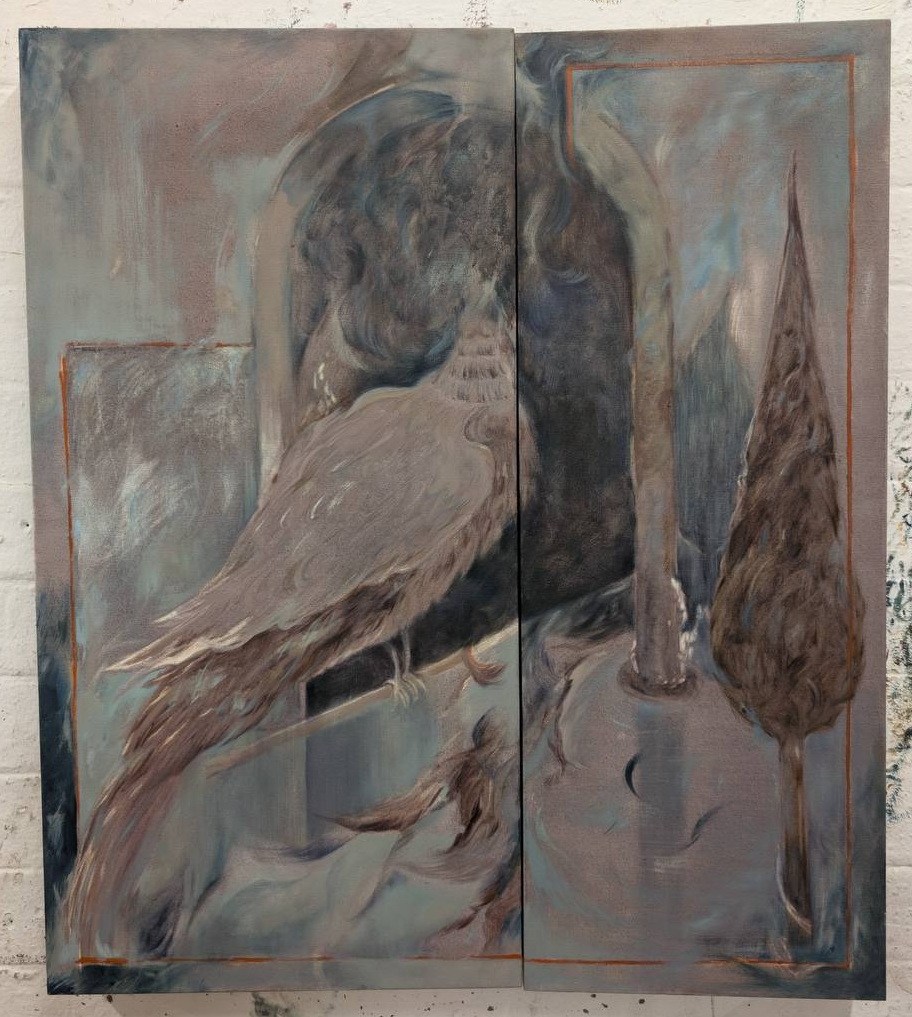
The paintings do not simply depict displacement; they behave like it, through suspended space, shifting scale, partial erasure and forms that resist full connection.
This is a useful place to begin, not because the work explains itself, but because it makes visible the central pressure in Mollasalehi’s recent practice: what it means to move while remaining attached. To be physically elsewhere and emotionally bound to another place. To seek freedom without being able to cut the root.
Mollasalehi moved from Tehran to Manchester to study for an MA in Painting at Manchester School of Art, which she completed in 2024. She is now based in Islington Mill. Her work was included in Short Supply’s MADE IT 2024, a graduate exhibition showcasing emerging artists from across the North West, and more recently in Reflecting // Processing. These details matter because her practice is not developing in isolation. It is being shaped through the demands of entering a new artistic context, building visibility, and learning how to speak about work across languages, geographies and expectations.
Before moving to the UK, Mollasalehi says painting was ‘a natural part’ of her life. Since relocating, it has become something more charged: a way to preserve identity while adapting to change. That shift helps explain why the paintings feel less like statements of arrival than records of negotiation. They are concerned not only with where an image comes from, but with what has to be kept, removed or rebuilt in order for it to survive elsewhere.
When Mollasalehi describes the move from art school in Tehran to that in Manchester, she does not frame it as a straightforward story of artistic improvement. Technique, she says, remained largely her own responsibility. What changed was more internal and more consequential: confidence. In Iran, she describes feeling that artistic legitimacy was closely tied to recognition from established professionals, galleries and institutional figures. Without that approval, it was harder to claim space. In Manchester, something shifted.’Back at home, if the professionals don’t give you that credit, you’re not very able to express yourself,’ she says. ‘Here, I feel that I’m more confident about what I’m doing.’
That confidence is not the same as certainty. In the studio, Mollasalehi speaks carefully, often circling an idea before finding the phrase she wants. She describes the experience of explaining her paintings in a second language as difficult, but also clarifying. If she can communicate the work across that distance, she says, it confirms something to her: that she does understand what is happening in her own mind.
The paintings seem to operate through a similar process. They do not begin with a fixed image and proceed obediently towards it. Mollasalehi often starts with sketches, working through compositions in notebooks over several days before moving to canvas. Once painting begins, however, the plan loosens. When she talks about decision-making, she does not begin with image or subject, but with preservation and removal. ‘Most of the decisions are about what to keep and what to remove,’ she says, describing a process of controlling colour, rebuilding layers, and deciding how much of the painting should remain visible. The surface becomes a place where adaptation is rehearsed materially: something is kept, something is erased, something is rebuilt without fully losing what came before.I think about the painting for a week,’ she says, ‘and then when I start, everything changes.’
In one large work, a dark greenish ground is interrupted by flashes of orange, red and pale blue. The orange does not sit politely on top of the painting; it appears to burn through it, emerging in patches as if from beneath the surface. Elsewhere, thin red lines cut across the image, suggesting architecture, threshold or wound. Nothing is cleanly separated. Areas of paint blur and drag, while other passages become almost bodily: a curve like a limb, a patch like exposed flesh, a form that briefly suggests an animal before dissolving again.
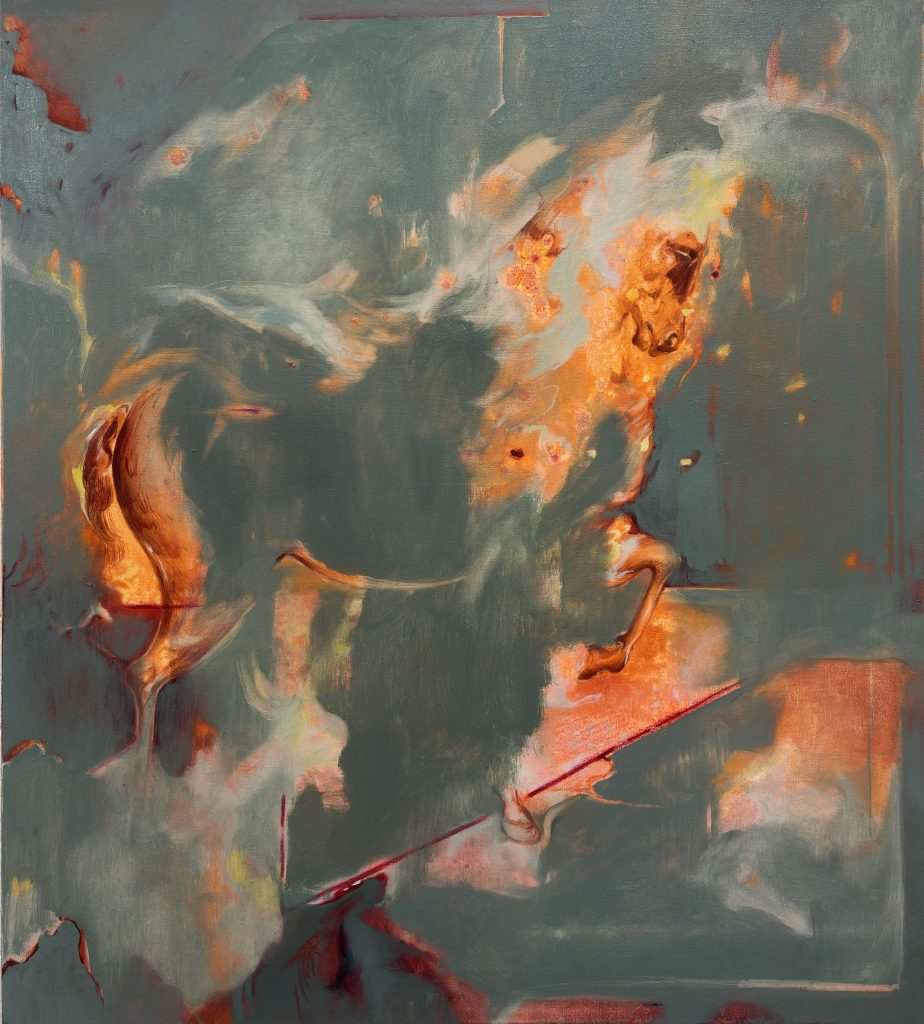
When asked what displacement looks like in the work, Mollasalehi describes ‘unstable spaces, unfinished layers, and forms that don’t fully connect.’ It also appears, she says, through suspended spaces, shifts in scale, and elements that feel detached or unanchored. This is useful because it resists the idea that displacement is only a theme within the work. It is a formal condition.
This is where the link between process and subject becomes clearest: the work’s emotional and political pressures are carried through composition, surface and scale, not simply through symbolism. Mollasalehi’s paintings are not ambiguous because they lack direction. They are layered because the conditions they are working through are layered. They are reworked because certainty is not readily available. Their surfaces hold the pressure of alteration: what can be said, what has to be softened, what returns even after being covered.
Her references to Persian miniature painting, architectural ornament and symbolic forms are central to this process, but they are not treated as decorative inheritance. From Persian miniature painting, Mollasalehi draws on composition, attention to detail, and the possibility of multiple spaces existing within a single image. She is particularly drawn to miniature painting’s ability to hold several viewpoints at once, and to the visual rhythms of Persian architectural tiles, arches and ornamental patterning. What she rejects are the more clichéd narratives and purely decorative readings that can attach themselves to the tradition. Her relationship to miniature painting is therefore neither nostalgic nor ornamental. It is structural. It gives her a way to hold simultaneous spaces, scales and perspectives without forcing them into a single coherent scene.
A motif might begin in a photograph, a memory, a family image, a fragment of architecture, or a digital or paper collage used as source material. These images are not collaged onto the canvas as objects; they are translated into paint, where they become subject to the same processes of revision, distortion and removal as everything else.
The cypress is especially important. In Persian visual and literary traditions, the cypress carries associations of endurance, life, beauty and rootedness. Mollasalehi places it beside the bird, another recurring motif in her recent work. The bird, she says, holds several meanings at once: death, hope, freedom. In the diptych, these forms create a stark but delicate contrast. The bird has the possibility of movement. ‘The tree has roots,’ she says. ‘It cannot move. The bird can move. It has a choice.’
‘I’m between these two worlds,’ she says. By ‘these two worlds’, she means the life she is building in Britain and the life, family and cultural memory that remain tied to Iran. ‘I’m free here, but actually… I’m not completely free.’
That sentence cannot be separated from the present moment. Mollasalehi is making this work while Iran is at war, and while her family remains in Tehran. That context cannot be treated as background atmosphere. It shapes the emotional conditions in which the paintings are made, even when the work itself refuses direct political illustration. To write about an Iranian painter now without acknowledging both the violence of war and the authoritarian conditions that shape public and private life in Iran would risk turning the paintings’ restraint into something falsely neutral. At the same time, the work does not ask to be read as reportage. It does not translate the Iranian state, or the current war, into a set of legible images for a British audience.
Instead, the politics enter through structure and feeling. They appear in the impossibility of full freedom. In the divided attention of diasporic life. In the knowledge that safety in one place does not cancel danger elsewhere. In the strange condition of continuing to work, speak, exhibit and plan while part of one’s life remains attached to people and places beyond reach.
This matters because Mollasalehi’s paintings resist direct explanation. ‘I don’t want to be direct,’ she says. ‘It’s not very interesting.’ She is wary of the viewer who approaches painting as a code to be cracked: what does this symbol mean, what is this object, what are you trying to say? Her paintings do contain recognisable forms, but they refuse to behave like illustrations. The bird is never only a bird. The cypress is never only a cultural sign. The surface will not let either of them settle into a single function.
In another work, five cypress-like forms stand close together against a dark, smoky ground. They vary in colour and density: one almost black, one copper-brown, one pale and translucent, another blue-black and narrow. They resemble trees, but also figures, flames, bodies in procession. Their bases seem to taper into points rather than roots, as if the forms are both planted and precarious. Behind them, the ground shifts from charcoal to blue to faint yellow, a shallow atmosphere rather than a landscape.
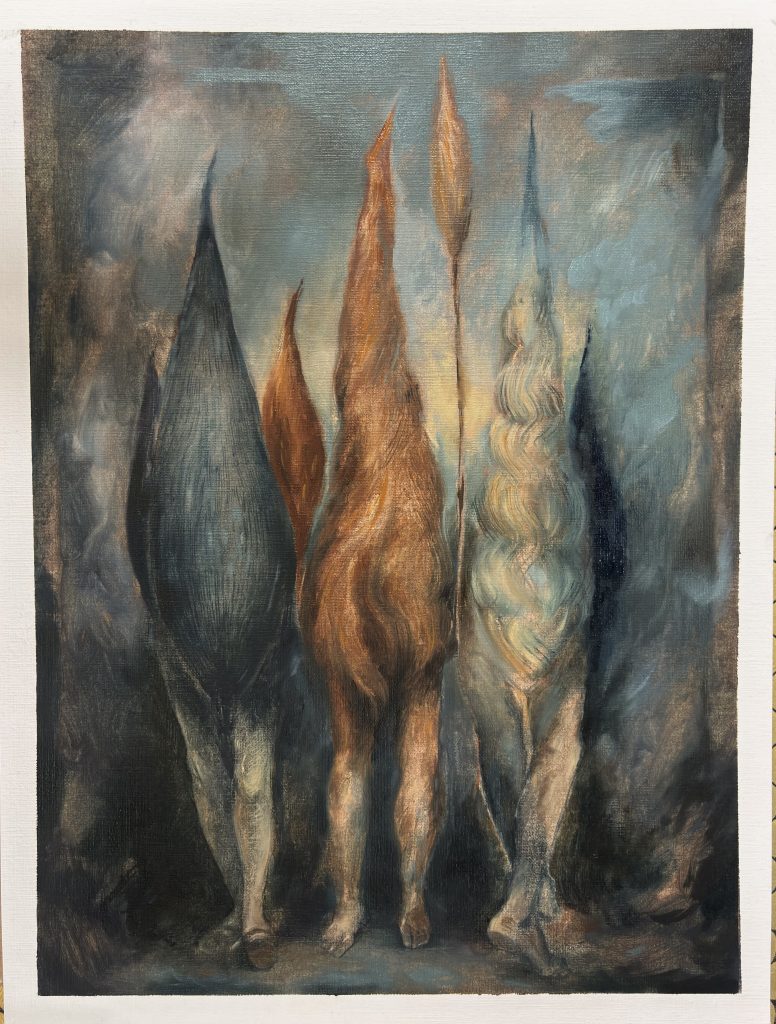
It is tempting to describe these paintings as caught between abstraction and figuration, but that binary feels too simple. Mollasalehi is not hovering uncertainly between two modes. She is using both to withhold the authority of either. Figuration gives the viewer something to recognise, while abstraction prevents recognition from becoming possession. The image offers a point of entry, then complicates the terms of access.
This may be why Mollasalehi says her work is received differently in Iran and in the UK. In Iran, viewers may immediately recognise the cypress, the colour relationships, the echoes of miniature painting and architectural ornament. Familiarity produces one kind of understanding. In the UK, where those references are less readily available, viewers often encounter the paintings through their structure, atmosphere and emotional charge before they can name the symbols.
‘In Iran, they understand the symbols immediately,’ she says. ‘Here, they understand the way I express them.’
That distinction is important. It suggests that the paintings are not only moving between cultures, but changing what legibility itself means. In one context, a symbol can be recognised too quickly. In another, it can remain open long enough to be felt.
Mollasalehi is interested in that space of delayed understanding. She wants viewers to think, but not necessarily to ask for explanation. ‘I want to create curiosity,’ she says. The paintings do not tell the viewer what to feel. They make feeling available without assigning it.
This is also true of their emotional register. People often describe her paintings as energetic, perhaps because of their movement, colour and density. Mollasalehi finds this strange. For her, the act of painting is often quiet, heavy, even painful. ‘Sometimes I’m crying while I’m painting,’ she says. ‘But people think it’s very energetic.’
The gap between those two experiences is central to the work. A painting made in sadness does not need to look sad. Grief does not always appear as darkness. Distress can be carried through soft colour, through delicacy, through forms that seem almost beautiful. ‘The final result of the painting is not exactly what is happening inside of the artist,’ she says.
This refusal of emotional literalism gives the work much of its force. During the studio visit, one painting filled with bright orange stands out against the white brick around it. The image is almost cheerful in its contrasts: orange, blue, white wall, the ordinary clutter of paint tubes and brushes nearby. But the paintings themselves complicate that brightness. Orange may appear as warmth, but also as rupture. Blue may soothe, but also cool the image into the distance. Nothing in the palette can be trusted to perform only one emotional task.
Mollasalehi is clear that she wants the work to sit within contemporary painting: to be taken seriously conceptually while still remaining open to an audience. She speaks of wanting to maintain ‘a distinct personal language’ rooted in her experiences. That ambition matters. The paintings are not only about translating one cultural context into another, but about insisting that layered identities, lived experience and formal complexity do not need to be separated.
Having first encountered Mollasalehi’s work through MADE IT 2024, Short Supply has continued to follow her practice as it moves from graduate exhibition contexts into a more sustained public life. My studio visit takes place at a point where the work feels less like a beginning than a consolidation: a painter refining the terms of her own language under unstable conditions.
Towards the end of our conversation, Mollasalehi recalls a comment from a tutor, who described her paintings as resembling a piece of piano music: melancholic, continuous, without a fixed endpoint. Something that could shift at any moment.’It’s like playing a sad piece of music,’ she says, ‘but someone can still dance to it.’
The metaphor stays with me because it captures what the paintings do best. They do not resolve contradiction. They give it form. The bird does not fully escape. The tree does not loosen its roots. The surface does not arrive at clarity, but neither does it collapse into uncertainty. Instead, it keeps moving through the terms available to it: colour, symbol, memory, pressure, revision.
After Reflecting // Processing, these works continue to ask what can be held in paint when speech feels insufficient, and when directness risks reducing what it wants to name. Mollasalehi’s paintings do not offer an account of Iran, migration, or personal grief as fixed subjects. They offer something more unstable and more demanding: a way of staying with the friction between them.
Meaning accumulates slowly here, not as message but as residue. A bird, a tree, a line of orange, a blue-grey ground, a form half-erased and still visible. Something sad enough to carry weight. Something alive enough to move.
Yasaman Mollasalehi is an Iranian painter based in Manchester. yasamanmsalehi.co.uk
Mollie Balshaw (they/them) is an artist and writer based in Warrington.
This article is supported by Short Supply.
Published 07.05.2026 by Jazmine Linklater in Explorations
2,556 words