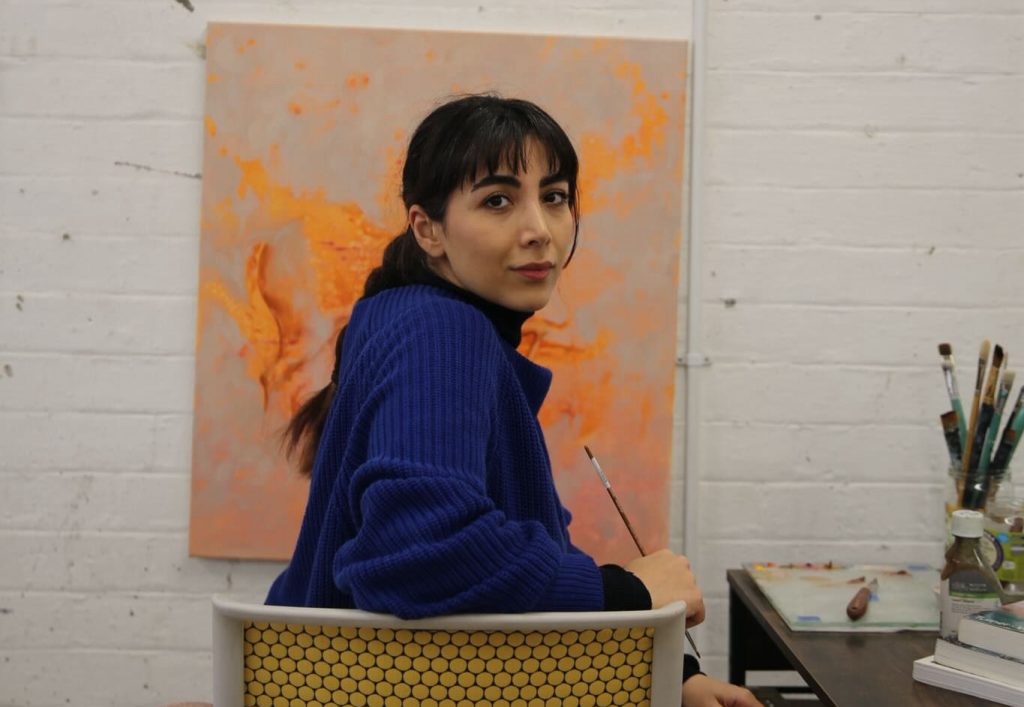
Taking its title from the work of feminist theorist bell hooks, who defined liberation not as a static endpoint but as an active, engaged practice, The Practice of Liberation comprises vibrant paintings and ceramics, tracing artist Michaela Yearwood-Dan’s unfolding self-exploration in conversation with the objects and influences around her. Born in London in 1994, Yearwood-Dan’s work is characterised by an abstract approach, combining fabric, paints, beading and ceramics to create works alive with colour and texture. Through this layered visual language, she explores and celebrates the intersecting identities she inhabits.
Painted a deep, earthen brown, the exhibition space has a distinct tenderness to it. A gently curving partition wall stands centrally, guiding visitors deeper within, facilitating investigation without a directive to approach from one side or another. The air here is cool and still. One has the impression of being within a church, or a womb, or some other sacred space. Yet far from being austere, the space is brimming with life. Flowers spring and tumble from ceramic planters protruding from the walls. Purples, pinks, blues, and greens dance across canvases draped in gently shimmering voile and smaller framed works on paper. Dotted about the space atop plinths stand six ceramic vessels, their robust, curvaceous forms marked with Yearwood-Dan’s signature swipes of vibrant colour and smatterings of gold. Inspired by Ghanaian bolga baskets, versatile containers woven from dried elephant grass that can be completely flattened, only to spring back into their original form when rehydrated, they stand as symbols of adaptability and the potential for renewal. Moving through the exhibition, it becomes clear that Yearwood-Dan’s sourcing of inspiration from her surroundings, be those objects from her home or the legacies of her upbringing, is a repeated motif.
A score by composer and long-time friend of Yearwood-Dan’s, Alex Gruz, floats between the works. Soulful humming and the sliding melody of a jazz trumpet rise gradually into a rich crescendo of choral vocals. It is the sound of praise and mourning all at once, exploring gentle, hopeful and melancholic moments along the way. Its cinematic, devotional intensity evokes feelings of love, loss and inner conflict, mirroring those traced in the works on display. Drawing on their shared experience of a Catholic upbringing, Gruz and Yearwood-Dan call on the use of music as an emotive tool in religious contexts, applying it here to produce a layered, immersive soundscape that deepens the exhibition’s emotional and contemplative charge.
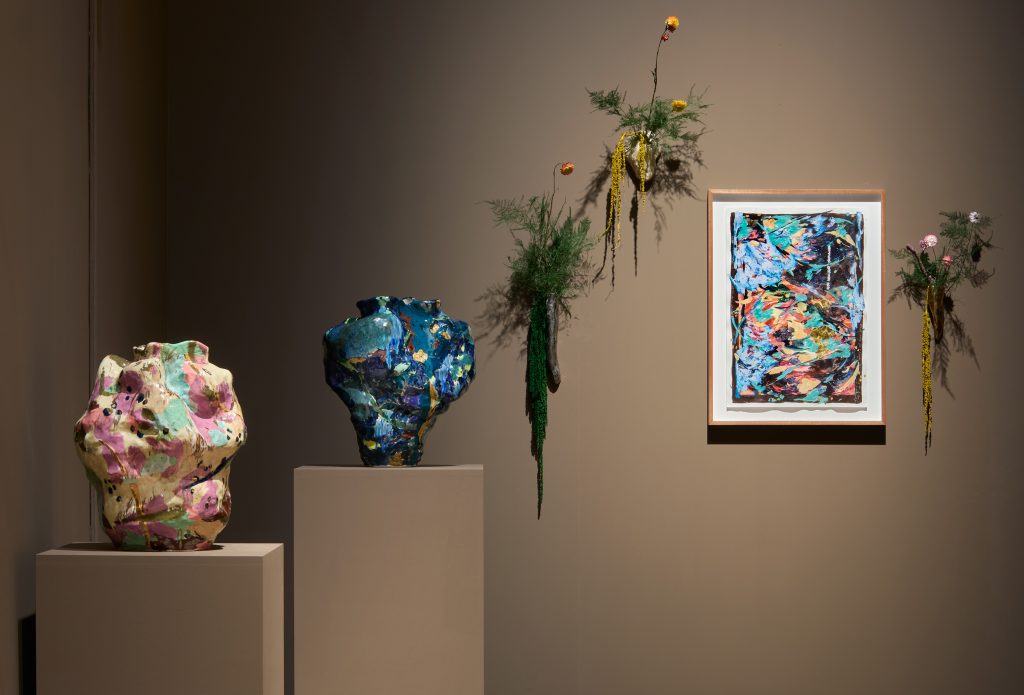
Yearwood-Dan leverages many references to the Catholic faith in this exhibition, with a focus that sees her faith become a primary site of reimagining. The six ceramic vases displayed reference the miracle at Cana, where Jesus transformed water into wine – an act symbolic of his generosity, and of the radical change his arrival promised, marked by prosperity and celebration. In their number, the fourteen paintings included reference the fourteen Stations of the Cross, mapping Christ’s journey to his death, while three backward-facing canvases displayed at floor level have the wooden crosses of their frames turned toward the viewer, recall his falling three times during these final moments. This section of the biblical story sees the Messiah at both his weakest and his most selfless, communicating until his end a message of acceptance and forgiveness.
Notably, messages of judgment and damnation are absent from the scripture referenced by Yearwood-Dan. Instead, empathy, radicalism, vulnerability and celebration are centred. Her inclusion of the jazz trumpet amongst choral music, her subversion of solemnity through bling and bright colours and her pointed selection of biblical passages all suggest a desire to reshape the faith in a way that makes space for her own identity. As a Catholic-raised queer woman, Yearwood-Dan’s simultaneous appreciation of the faith and desire to reframe it tracks a profound and prolonged negotiation.
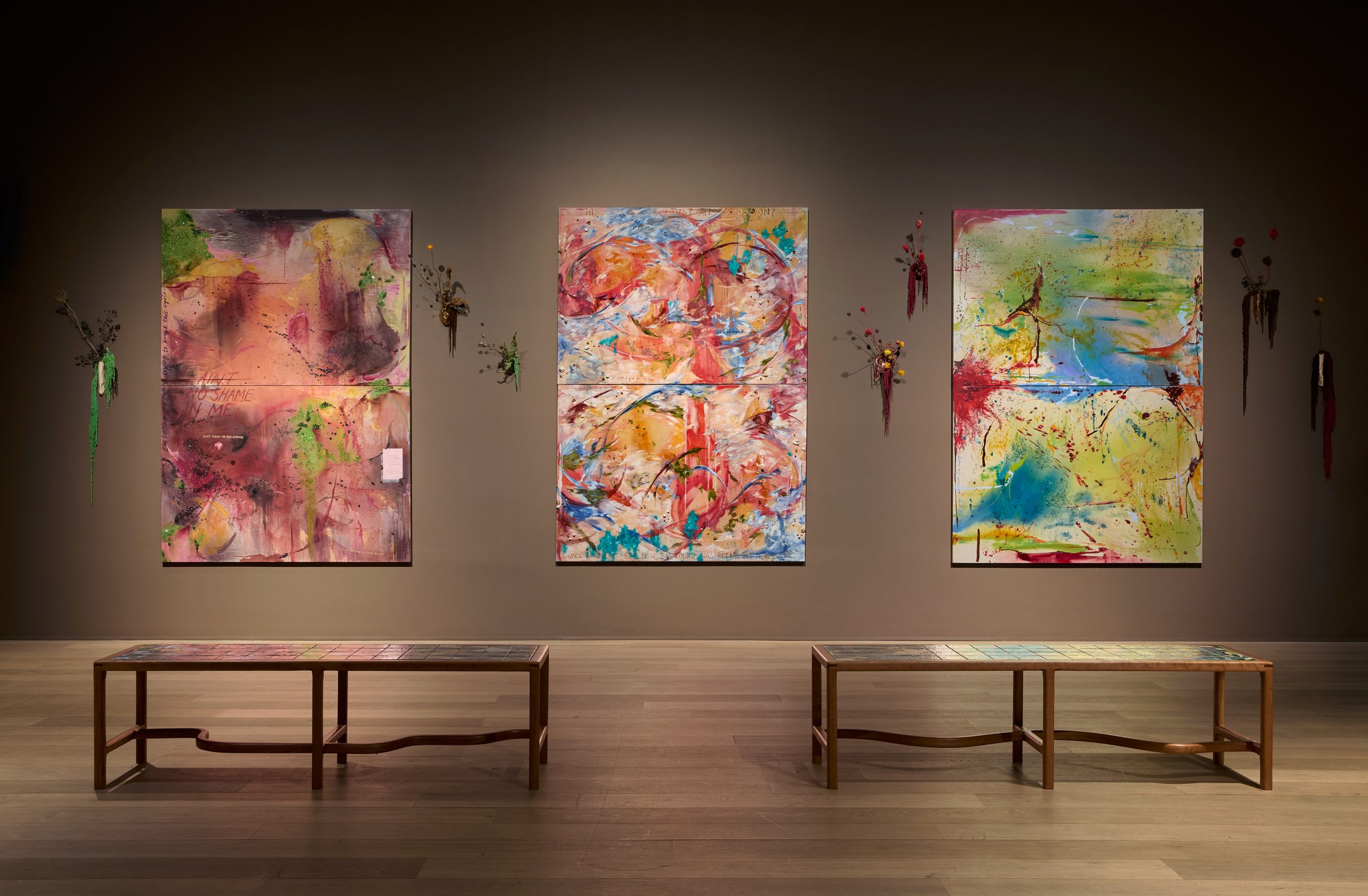
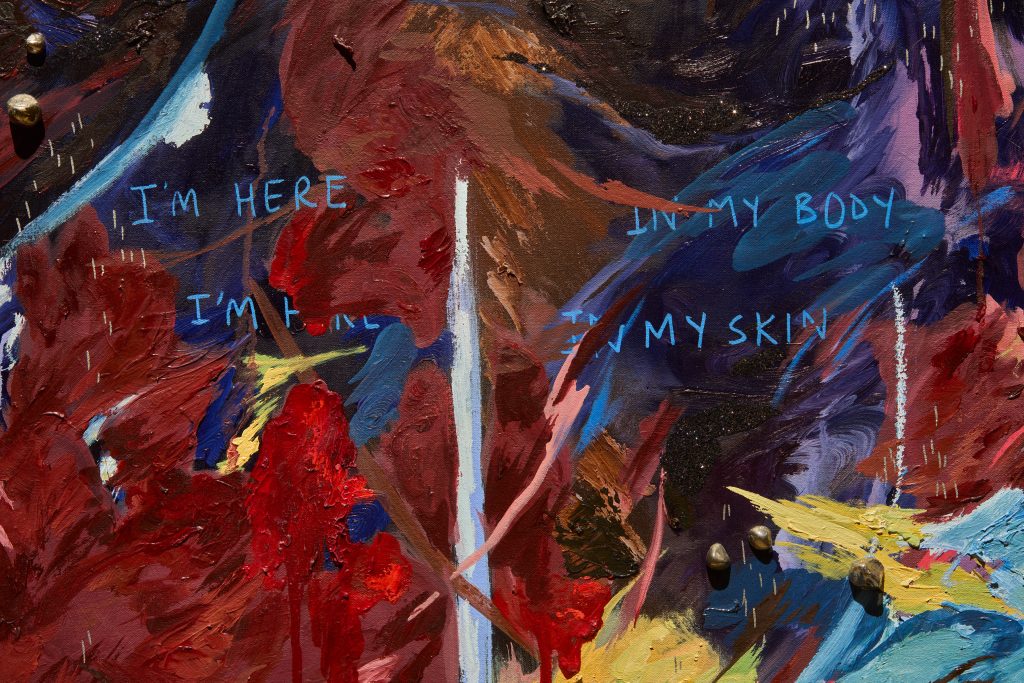
At the exhibition opening, Yearwood-Dan tells me that she doesn’t keep a personal diary, but changes in her mood – what she calls her ‘emotional seasons’ – are documented here in her art. Some works are loud and celebratory, with vibrant pinks, yellows and oranges swirling and dancing across canvases studded with golden ceramic ingots and glittering glass beads. Triumphant declarations stretch across them in bold, black marker: ‘AIN’T NO SHAME IN ME’, ‘I’M HERE IN MY BODY, I’M HERE IN MY SKIN’. Others, meanwhile, are more conflicted and vulnerable, composed of darker blue and green tones, sometimes deepening into black, with harsher, more agitated marks, where more vulnerable messages in lowercase appear as whispers, partially obscured or hidden beneath translucent sheets of tracing paper.
‘Take the Weight off my Shoulders’ (2026) is a collision of these moods. Curving from top to bottom, a distinctly scar-like seam connects two pieces of delicate voile that wrap the canvas. Painted on the fabric, ominous black shapes curve and cut through powdery purples and light blues that at points blend to grey. In the top right and bottom left corners of the piece, light pink accents push forward from beneath the muddled darkness, their hopeful vibrance fighting to be seen. Where the title calls for relief from an unspecified burden, the response appears in the bottom right of the work. Here, on a rectangular sheet of tracing paper, its translucence teasing the chaos of paints below, sits Nikki Giovanni’s poem ‘Revolutionary Dreams’. Tracing the poet’s changing views on radicalism and sociopolitical change, the text builds to a recognition that one’s existence as a woman is itself quietly revolutionary in a world that attempts so forcefully to stifle and subdue this identity. This poem’s exploration of alternative means of revolution, through an emphasis on the power of the self, grounds the painting both compositionally and conceptually. A vertical pillar of sunny yellow text on the left of the canvas declares victory in overcoming the painting’s suggestive darkness, stating in proud capitals, ‘I’M NO LONGER DOUBTFUL OF WHAT I AM LIVING FOR’. Through this layered use of colour and texture, the work becomes a dynamic negotiation of Yearwood-Dan’s conflicting feelings. By pairing references to Giovanni’s work with her own words and the title’s direct plea, she forms an active call-and-response, a live unfolding of thought and emotion and, through this negotiation, the piece ultimately reads as an act of self-liberation.
The employment of text is a recurring feature of Yearwood-Dan’s broader work. In this exhibition, textural references appearing in paint and pen are drawn from the works of Black theorists and visionaries such as bell hooks, Nikki Giovanni and James Baldwin. Incorporating their words into her pieces, Yearwood-Dan creates a powerful hybrid of continued creation and reimagining. In seeking of support from the culture, art and literature around her, the artist reveals a level of emotional fatigue felt from her existence at the intersection of multiple marginalised identities. ‘All I want to do is to wake up each morning and to not dread living. Is that too much to ask for?’, is the pained plea written along the top border of ‘I’m Nowhere but here’ (2026), a work of deep purples, greens and yellows that seem to swipe at each other – particularly heavy with frustration, vulnerability and exhaustion.
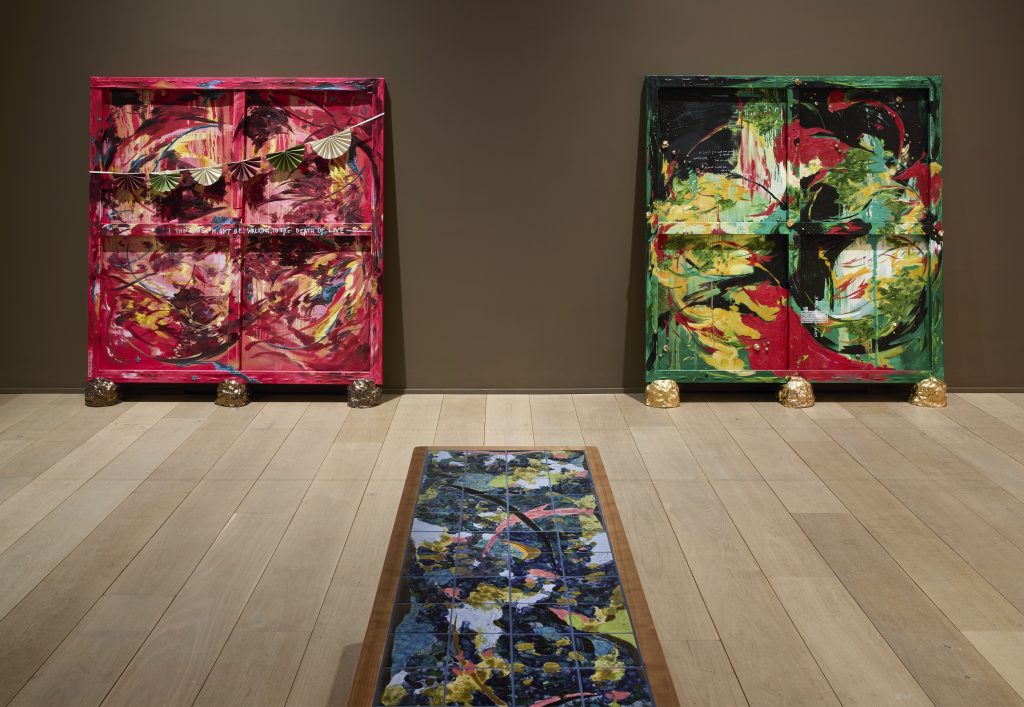
On the opposite side of the room, three towering paintings, ‘The Sparrow is Never Lost’, ‘(I guess) I’ll see you next lifetime’ and ‘Àyànfẹ́’(all 2026), hang in triptych formation on a back wall. The stained-glass effect of their gentle, bleeding hues of yellow, pink, purple and green illuminates the space in a further religious allusion. Below them, in pew-like formation, stand two cherry wood benches. Built in collaboration with artist and furniture maker Theodore Vass, another close friend of Yearwood-Dan’s, they are topped with hand-painted ceramic tiles. Inviting visitors to sit and rest, they create a welcome moment of tactile engagement and mindful pause.
Sharing a bench with Yearwood-Dan, I ask her about the titles of these two pieces. ‘Lily’ and ‘Jane’ (both 2026) are the codenames adopted by the main characters in Heated Rivalry, a hit television show with a central plot of closeted queer love between two hockey players. By the show’s conclusion, the pair openly declare their love and are met with acceptance. During the making of this emotionally involved exhibition, Yearwood-Dan tells me that this series offered respite: a love story largely free from trauma. She says this whilst wearing a T-shirt bearing the image of one of the main characters, his grinning face placed within a giant love heart. While playful in its subtlety, this nod to queer pop culture is also pointed. Where queer narratives in film and television are often framed by themes of pain and suffering, Heated Rivalry imagines something else: love without punishment. A parallel emerges with Yearwood-Dan’s own reframing of Catholicism to generate spaces where identity is explored with openness, depth and affirmation.
The Practice of Liberation is indeed Yearwood-Dan’s practice of liberation, tracing its development through the realms of sexuality, faith, race and the personal, exorcising doubts and dispensing with constrictions at each point. Leading with unflinching rawness, she exhibits the tumultuous yet transcendent practice of liberating oneself, a process that is gentle in its centring of compassion, yet still direct in its commitment to constant evolution. Her openness is inspirational. I leave with the desire to follow her into this practice and to personally realise its transformative potential.
Michaela Yearwood-Dan: The Practice of Liberation, 17 April – 18 October 2026, The Whitworth, Manchester.
Liliana Muñoz Flannery is a writer and creative based in Manchester.
This review is supported by The Whitworth.
Published 16.05.2026 by Jazmine Linklater in Reviews
1,654 words