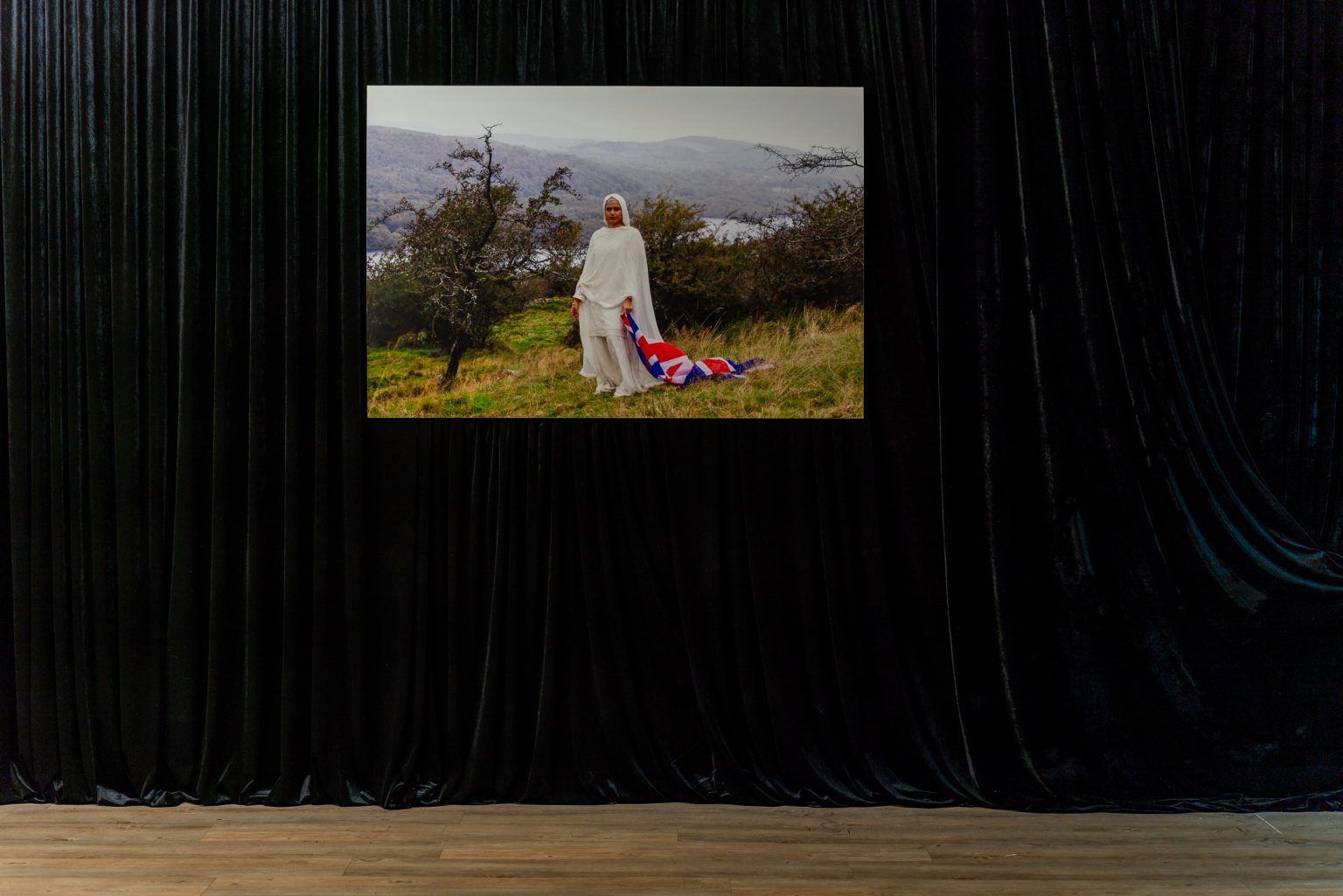
Her Extraordinary Colours is a public art project featuring twenty flags installed across Berwick-upon-Tweed. Over ten weeks, artist Beth J. Ross worked with a group of local women to research and uncover historic stories of women from Berwick and the surrounding area. Drawing on the King’s Own Scottish Borderers’ archive and Ross’ background in geometric abstraction, the group translated these stories into playful and striking flags. The flags were made in Consett, County Durham by AA Flags, a mother-daughter business run by Mandy and Ashleigh Forster. Installed on flag poles throughout Berwick, Tweedmouth and Spittal, the work culminated in a guided tour by Ross and the project’s participants.
The installation forms part of Berwick Shines, a vibrant programme which commissioned six creative projects between 2025 and 2026, delivered by The Maltings (Berwick) Trust with support from the Cultural Development Fund.

Berwick-upon-Tweed sits north of the River Tweed, with Tweedmouth and Spittal to the south. Historically a strategic border town that changed hands between England and Scotland thirteen times before becoming part of England in 1482, it remains today a place of blended identities.
The project is being undertaken at a particularly resonant moment; the widespread proliferation of Union Jacks and St George’s flags across Britain, driven by the Operation Raise the Colours campaign, has intensified these national symbols as markers of nationalism and exclusion. In contrast, Ross’ project explores the form of the flag as a tool for research, foregrounding women’s histories and contributions in the face of discrimination.
One of the most arresting flags in Her Extraordinary Colours commemorates Fraulein Schneider, a German teacher who ran a boys’ school in Berwick during World War One. During this time, she was extradited to Germany after unsubstantiated rumours claimed she had been signalling to enemy ships off the coast. Here, the black, white and red horizontal stripes of the imperial German flag are inverted, replacing the central white stripe with blue to represent the sea, enacting a visual gesture of removal.

Ross issued an open call, inviting expressions of interest from individuals or organisations willing to volunteer existing flagpoles to host Her Extraordinary Colours. ‘Flag #8, Fraulein Schneider’ (2025), occupies a physical lookout point at Berwick Coastwatch, a compact watchtower built in 1964 by HM Coastguard, which is now managed by volunteers who listen for marine distress signals and monitor coastal erosion. Ross’ work temporarily replaces the flag of St George, recontextualising the site to prompt curiosity and empathy.
It’s not difficult to draw parallels between Reform UK’s “Stop the Boats” campaign and the story of Fraulein Schneider, nor to see the role populist media plays in amplifying anti-immigrant rhetoric. In Northumberland, far-right sentiment is on the rise. In Berwick – where 55.3% voted for Brexit – this shift became tangible in the May 2025 County Council elections, when Reform UK took Berwick North from a long-standing Conservative stronghold. Newly elected Reform Councillor Nicole Brooke volunteered to host ‘Flag #9, Mabel Philipson’ (2025). Featuring a red triangle evoking a stage curtain, the flag references Philipson’s early career as a Gaiety Girl before she became Britain’s third female MP. Similarly, the flags have a performative function, as visual metaphors that echo historical modes of communication.
Her Extraordinary Colours is largely focused on Geometric Abstraction, a movement characterised by a formal departure from realism and the use of bold, flat and clearly defined shapes to convey balance and rhythm. Emerging from Cubism and Constructivism, Geometric Abstraction’s history is dominated by twentieth-century painters such as Piet Mondrian, Joseph Albers and Kazimir Malevich.
Ross’s work challenges this narrative, drawing parallels between the overlooked contributions of women within Berwick’s cultural and physical landscape. Ross foregrounds the unnamed and undocumented women whose histories and contributions were transient and collective.
‘Flag #10, Elizabeth Cocke’ (2025) depicts Berwick’s three bridges, commemorating the women who helped build the Berwick Bridge (also known as the Old Bridge) in 1624. Though little is known about Cocke herself, Ross believes she and other women likely swept sand into the cobbles – essential yet undervalued work – and were reportedly paid less than children who worked on site. The flag features four interlocking bridges in red, orange, yellow and pink. This example of seriality – patterns or marks within a series – is a key characteristic of Geometric Abstraction, and can be seen in the work of abstract artist Carmen Herrera’s interlocking forms.

‘Flag #17, Miss Kennedy and Miss Stephenson’(2025), commemorates two “unmarried female friends” who ran a tearoom in Berwick during the 1860s. Its design reimagines a three-tiered wedding cake in geometric form, rendered in pink, yellow, and white – the colours of a Battenberg cake popular in Victorian Britain. The flag was on display outside The Promenade Cafe in Spittal, honouring their enterprise and celebrating the life they built together despite the societal pressure to perform conventional gender roles.
Displayed across various sites in Berwick, the flags appear almost neighbourly as they wave to one another, reclaiming public, private, and symbolic spaces as platforms for dialogue. The project’s subversive and cyclical nature, flags designed by women, for women, brings women’s lives into contemporary focus, offering a collective means of remembering and reimagining their narratives.

‘Flag #3, The Spinners and Knitters’ (2025), draws on the design of a Gansey sweater to commemorate the seafaring communities. The flag features blue squares on a white background, framed by five black lines, referencing the steel needles used to knit these weather resistant garments. Gansey’s are traditional jumpers worn by fishermen, often knitted by their wives or female relatives. The closely knitted designs were worked in a continuous circular loop, creating a seamless garment that was both windproof and durable. Patterns varied and were often specific to particular families, often incorporating coastal designs such as fishing nets or anchors. These distinctive knitting patterns served as identification in coastal communities, allowing families to recognise individuals even after maritime disasters, such as the 1881 Eyemouth storm that killed 189 fishermen. In this sense, textiles acted as both protection and communication, transforming everyday craft into a system of coded identity. Ross abstracts this domestic knowledge into geometric design, linking inherited skills and community memory to the visual language of flags.
In discussion with Ross during the tour, she recalled a moment in her studio when, photographing the flags from above, she felt the watchful presence of the women represented and hoped their portrayal did them justice. The story captures the sensitivity of Her Extraordinary Colours – a meeting between past and present.
Her Extraordinary Colours uses flags to question, uncover, communicate and honour. Through Ross’ collaboration with local women, the project reclaims stories often hidden from history – from Fraulein Schneider’s wartime deportation to Elizabeth Cocke’s role in building the Berwick Bridge. By transforming sites across Berwick into spaces of remembrance, the work bridges personal and collective histories, turning symbols of power and division into emblems of solidarity and care. In doing so, Ross reimagines the flag not as a boundary marker, but as a starting point for curiosity, conversation, and resilience.
Anna Mud is an artist based in Newcastle Upon Tyne and is currently part of the Collective Studio at The NewBridge Project.
Her Extraordinary Colours was created by Beth J Ross, Annie Lord, Alison Gibb, Jane Munro, Trish Botten, Jen Wood, Aileen Graham and Anne Wadey. For more information visit >
This review is supported by The Collective Studio, an artist development programme at The NewBridge Project.
Published 31.10.2025 by Lesley Guy in Reviews
1,288 words