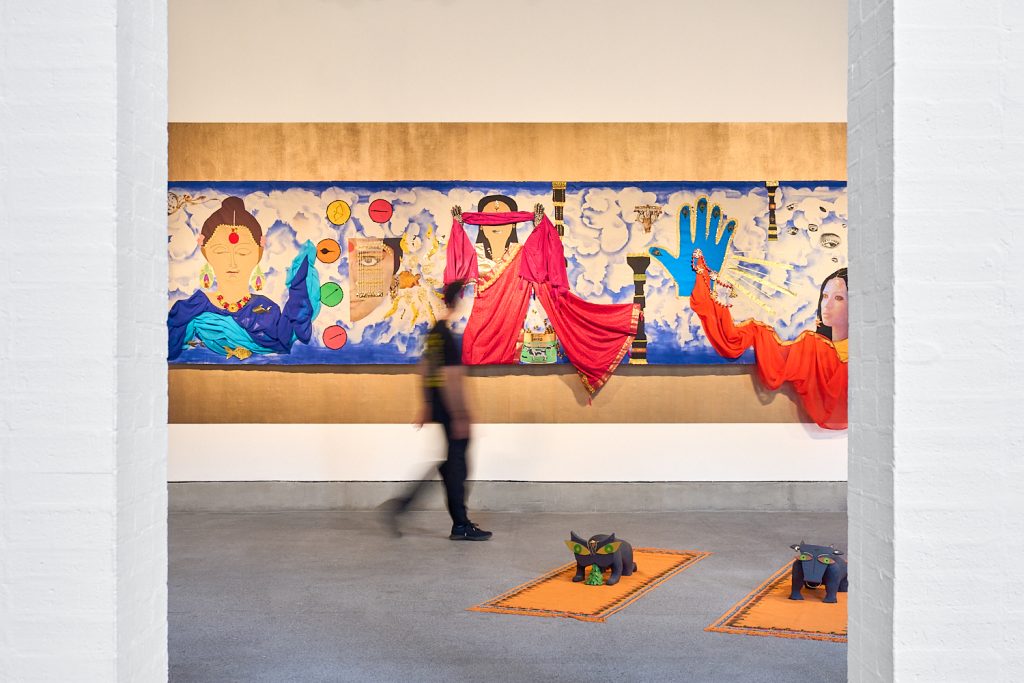
A huge textile artwork, ‘Mahabharata’ (2024), stretches twelve metres across the length of a gallery wall at Liverpool’s Bluecoat. It hangs at the centre of Jalsaghar, an exhibition by Edinburgh-based artist Debjani Banerjee. This densely appliquéd tapestry is a kaleidoscope of bright colours and kitschy imagery, and invites close looking to unravel what’s going on – and there’s a lot going on. A blue-tinted woman’s long black hair is adorned with plastic flowers, and teased by disembodied hands formed from stuffed evening gloves. Elsewhere, small collaged heads burst out of a shiny paper tin of ghee. Swathes of sari fabric in orange, red and turquoise are stitched in drapes across the work’s surface, escaping its boundaries to pool on the gallery floor. Even the painted clouds in the background are adorned with eyes, dressed with tiny gemstone tiaras for eyelashes.

The inspiration for ‘Mahabharata’ is a late 1980s television serial drama of the same name, an adaptation of an ancient Indian epic poem about warring families. Banerjee’s work focuses on the feminine characters sustaining this classically patriarchal story. The series was shown both in India and in the UK on the BBC simultaneously, and I enjoyed hearing the artist talk at the exhibition’s opening about her childhood memories of watching it on the latter with her family in Oxford, where she grew up. The motif of heads emerging from ghee, for example, refers to a bizarre birth storyline in the TV show involving incubation in clarified butter, which by some strange magic eventually resulted in one hundred and one babies. Though this did make me want to dive headfirst into the ninety-four episodes of Mahabharata, Banerjee’s artwork doesn’t require prior knowledge; it’s approached with the artist’s awe at seeing such extravagant, outlandish drama as a child, and a keenness to share her fascination. The work was created in collaboration with visitors to open studio sessions at Glasgow’s Centre for Contemporary Arts (CCA), where Banerjee was undertaking a residency, reflecting an openness of spirit.
Jalsaghar explores the complexities of Banerjee’s experiences as a British Bengali woman, navigating growing up in 1980s England, contemporary adulthood, and her Indian heritage. The exhibition comes to Liverpool in its fourth iteration since it was first shown at the CCA in 2024. Banerjee talks about returning to making art during Covid lockdowns after a lengthy break, and how she feels free to draw upon her Bengali heritage in a way that she previously didn’t, partly due to lack of visibility and encouragement for these themes when she was an art student. This sense of maturing and revisiting is felt strongly in ‘That Floats on High O’er Vales and Hills’ (2023), a large fabric quilt wall-hanging that provides a markedly quiet and tender moment in a lively and often humorous exhibition. The work’s source material is a photograph of the artist’s mother on holiday in Devon in 1977. The image has been simplified into a Pop Art style of shapes and colours: a slab of ochre sky, bright strips of receding hills, and the mother sitting in the foreground, thoughts inscrutable as she faces the landscape with a can of Pepsi in her hand. The piece is held together with lines of vertical white running stitches; Banerjee used the hours she spent painstakingly hand-stitching to reflect on what her mother might have felt as a young woman, travelling from India’s Calcutta to live in a small Welsh village.
Alongside these expansive textile works, the long gallery space is dotted with a variety of sculptures. Two small pieces mounted on pillars are sat opposite the ‘Mahabharata’ tapestry, both displayed on ornately-shaped, painted wooden shrine-like shelves. ‘Putna on Shrine’ (2023) is a roughly-worked ceramic depicting the face of a demoness featured in the Mahabharata series. Her thick, cartoonish features with heavy brow and wide grin are the stuff of childhood nightmares. ‘Cheese on Shelf’ (2024) is also a ceramic depiction of a TV character, the titular cartoon piece of cheese from the animated children’s series Boy Girl Dog Cat Mouse Cheese, a programme that Banerjee watched with her own child. Banerjee’s ‘Cheese’ reclines propped up on an elbow, cartoon eyes half-closed, with one eyebrow raised in an expression somewhere between sarcasm and boredom. Drawing a line from her childhood to her motherhood in these small sculptural tributes, Saturday mornings on the carpet in front of the television become a shared family ritual that Banerjee sustains with future generations.
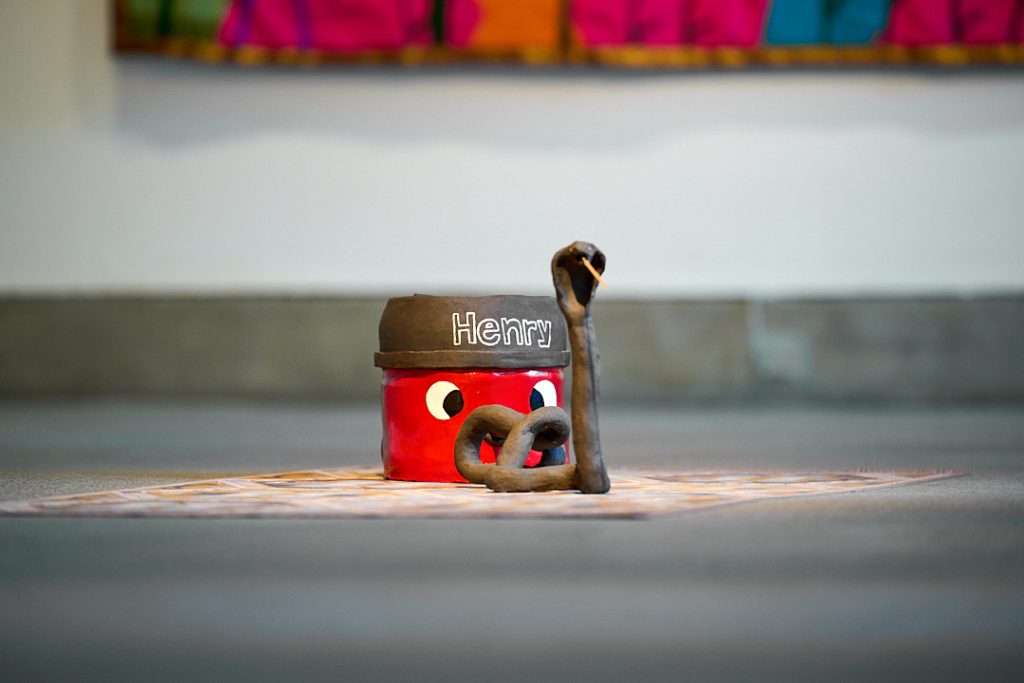
A pair of orange yoga mats are laid out side-by-side on the floor in the middle of the gallery. A squat cat sculpture, ‘Vomiting Marjaryasana on Yoga Mat’ (2024), and a similarly feline-sized cow, ‘Crying Bitilasana on Yoga Mat’ (2024), sit atop them on all fours; another pair of ceramic characters in Banerjee’s eccentric cast. They reference the popular yoga poses of their titles, but rather than evoking the ancient spirituality of the practice, they cut rather woeful characters more relatable to my own efforts at yoga; the cat ejects a pile of green vomit, and gemstone tears trail from the cow’s eye. Indian iconography merges with everyday British imagery in ‘Henry Cobra on Rug’ (2024) which shares the gallery’s floor space. The ubiquitous, anthropomorphic Henry vacuum cleaner, a mainstay of British homes and workplaces since the 1980s, has been recreated at scale in the artist’s signature slightly wobbly ceramic. Its unfurled hose rises up to culminate in a hooded cobra’s head, tiny eyes glinting, with an incense stick protruding where its tongue would emerge. It’s a funny, straightforwardly incongruous mash-up that speaks to being caught between cultures.
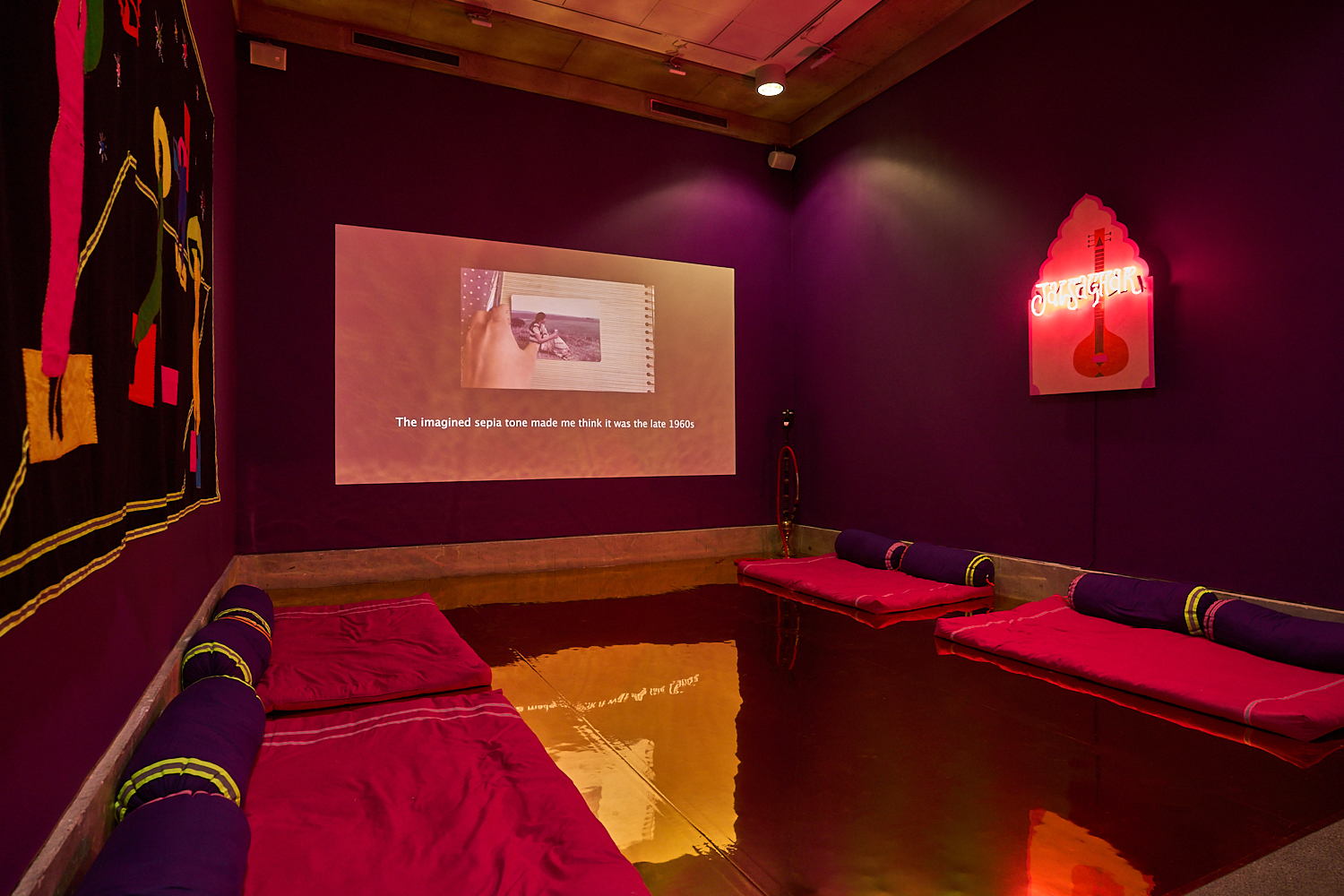
Adjacent to Bluecoat’s main gallery is a smaller space: the ‘Jalsaghar’ or ‘Music Room’ of the exhibition’s title, derived from Satyajit Ray’s acclaimed 1958 Bengali feature film of the same name. The environment manages to conjure a sensory experience within Bluecoat’s austere concrete contemporary art space, softened with dim lighting, deep purple walls and a gold mirrored floor, which visitors have to take off their shoes if they wish to step onto. A soundtrack of Bengali music is playing and cushions are laid around the perimeter, inviting visitors to lie down, relax and take it all in. Banerjee’s video work, ‘In This World My Dear’ (2025) is projected onto the wall at intervals, splicing together various source imagery that has inspired this exhibition: the Mahabharata television series, Boy Girl Dog Cat Mouse Cheese cartoon clips, the bleached-out photograph of the artist’s mother complete with Pepsi can, inside a family album. In between is footage of the artist herself dancing, carefully and studiedly, in a mirror image of the room we’re watching from. The balance of irreverence and sincerity in Banerjee’s work tips towards the latter, as she addresses the piece as a letter to the god Ganesh, to her mother, and then to her daughter. In the film, as in Jalsaghar as a whole, layers of personal histories and cultural heritage, both light and profound, are shared with a disarming mix of vulnerability and wonder.
Denise Courcoux is a writer based in New Brighton.
Debjani Banerjee: Jalsaghar run until 6 September 2026.
This review is supported by the Bluecoat
Published 07.08.2026 by Natalie Hughes in Reviews
1,228 words