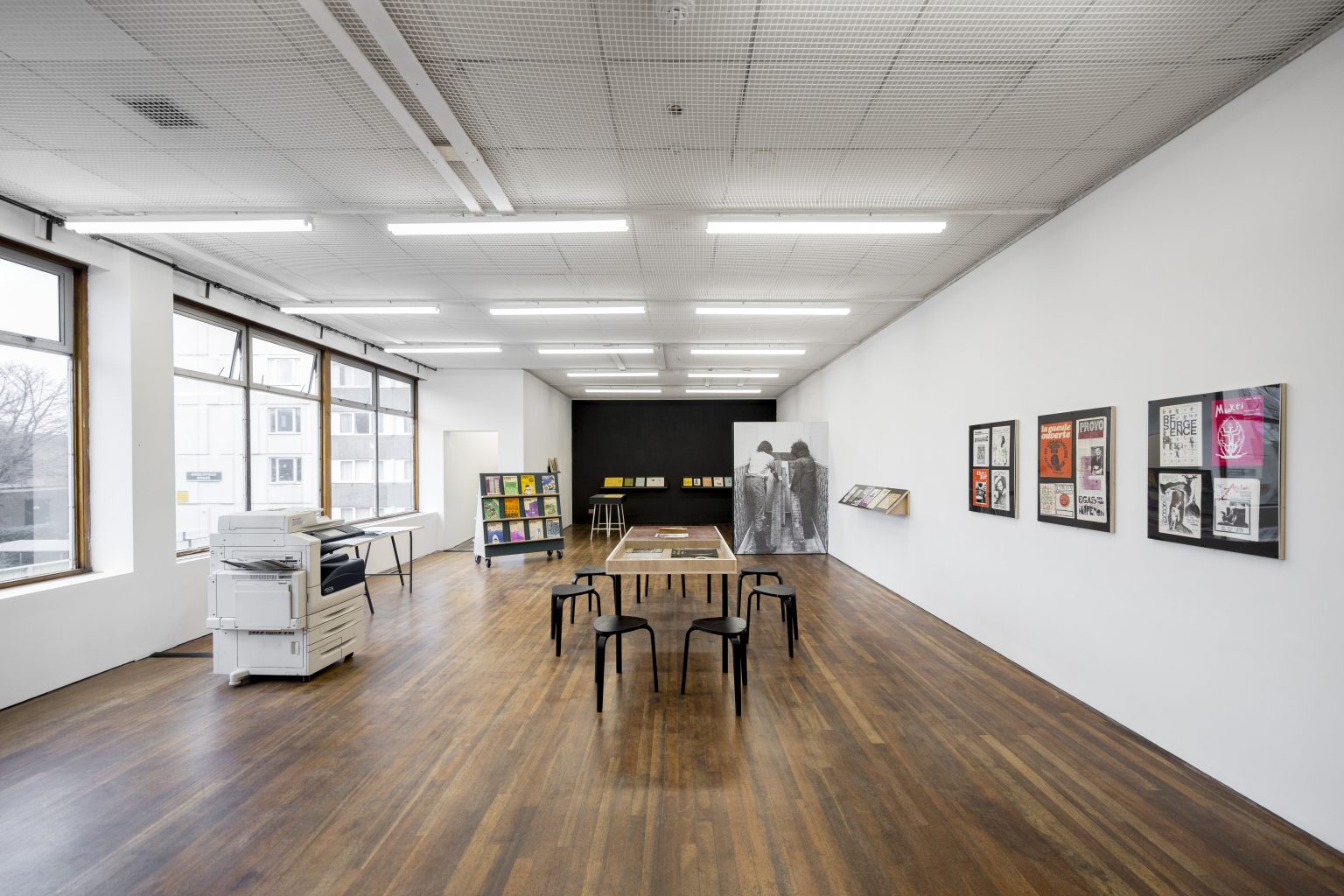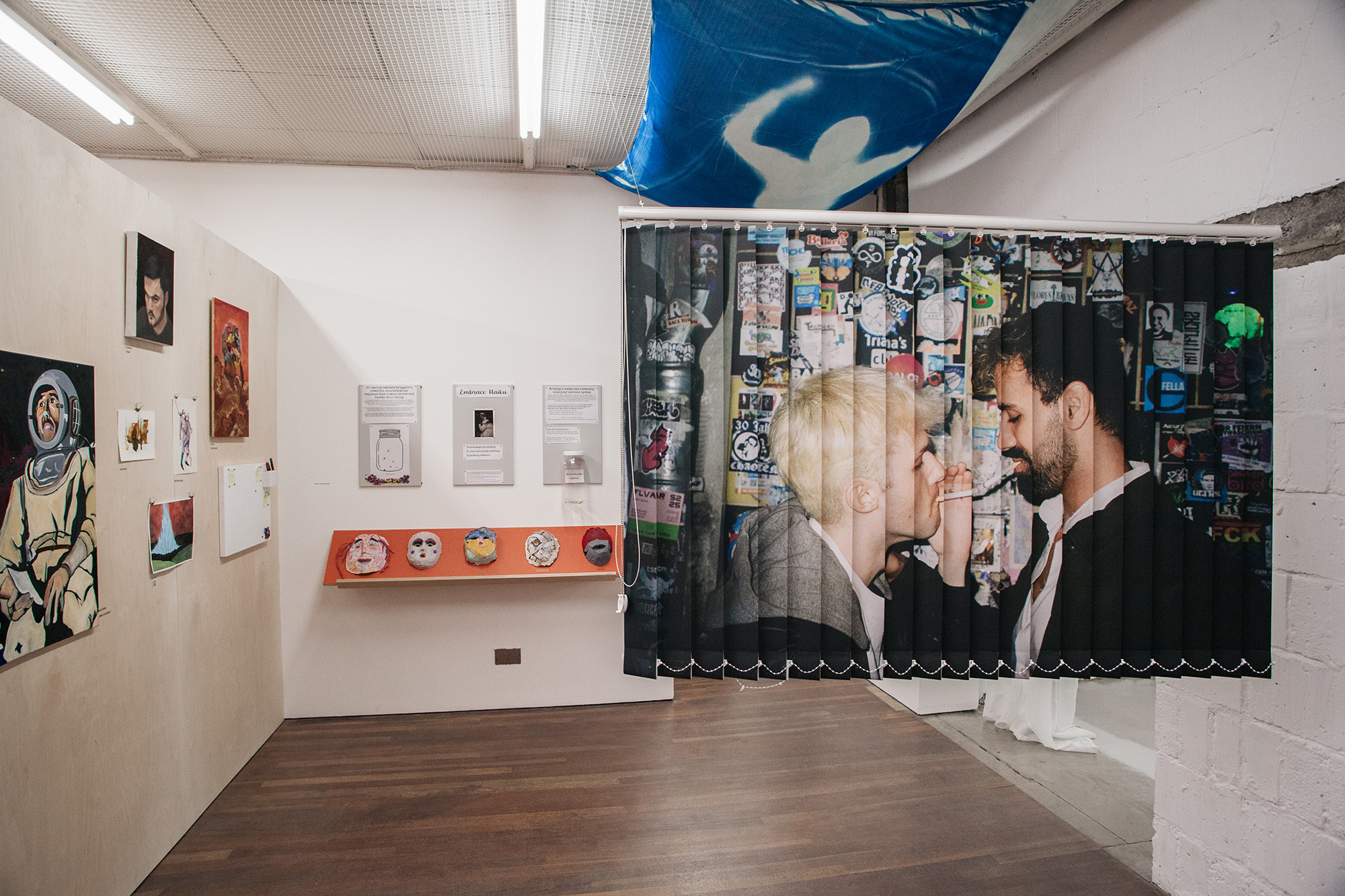
‘I like this gallery because it has got bean bags’, my five-year-old laughs as he runs and jumps around the latest group show Form and Display at The NewBridge Project. The ability to create welcoming exhibitions with softness and care has become a consistent feature of The NewBridge Project’s programme. The primary method of constructing this inclusive space began with the material design of the exhibition itself. The literal structure which artworks are hung from and around was collectively designed and built by those involved. Using timber, wire noticeboards, wooden shelves, a window blind and the occasional bollard, this apparatus creates the context for the whole show and is just as central to the exhibition as the artworks themselves.
It is a deceptively simple yet powerful move demonstrating how institutions are responsible for the structures they create and how these in turn create social relations. For example, an arts institution that chooses to have a diverse board of trustees and opportunities for community programming is going to be very different to one that lacks diversity and whose programme is geared towards the market. It is these social structures which often delineate who is invited in and who is excluded from different spaces. For me, it felt like the collective labour that made the physical and structural frame of Form and Display was a literal way of materialising a sense of inclusivity and non-hierarchical collaboration. It was a group effort of building a space for artworks to exist alongside in. This ethos is then echoed in the curation of the exhibition, simultaneously presenting artworks by studio members and those involved in other aspects of The NewBridge Project’s programme: Shieldfield’s Youth Programme, Memory Café, Saturday Socials and Coffee Mornings. There are no distinctions between so-called ‘professional’ or ‘amateur’ artists here. Here, everything is treasured as a valuable form of creative expression.
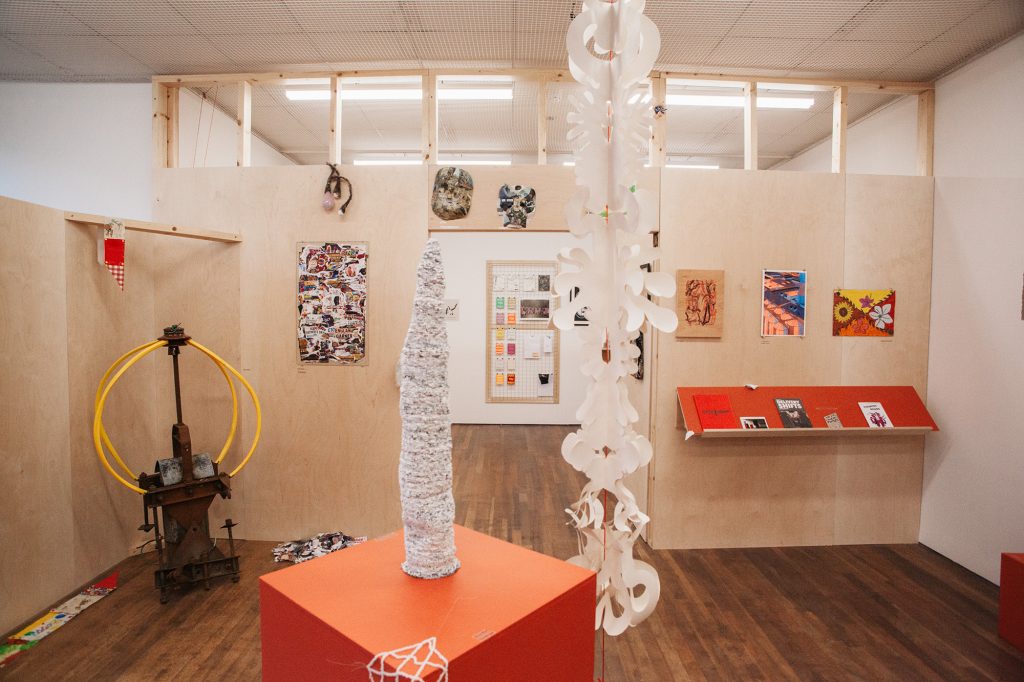
Such a front-loaded concept, focusing on the exhibition apparatus, could risk overshadowing the individual artworks themselves, and yet it doesn’t because the exhibition creates space for even the smallest artworks to breathe. With over 100 artists involved, this is undeniably impressive.
There are numerous tiny artworks on display, refreshingly confident in their refusal to compete for attention with either scale or brashness. Many of these are uncredited or discreetly credited, a choice made by the artists themselves. White-painted leaves by Ella Burgess easy-to-miss in their delicate scattering around the space; individual bus tickets by Kitty McKay repurposed as miniature canvases and placed high out of reach and almost out of sight; a single frame from a film about the gutting out of Carliol House by Jesse Howarth, NewBridge’s former residence in Newcastle city centre, mounted on the window.
This latter work echoes the material process of demolition and reconstruction, as the accompanying text describes how the actual demolition was filmed, then separated into frames, printed, scanned, then reassembled into an animated sequence. Interestingly, the finished film is absent, and we are only granted insight via a single tiny frame of this work.
Infrastructures of travel and journey appear as recurring themes, continuing with Will St’s envelope addressed to the building, and the letter inside detailing instructions to display the enclosed train ticket from London to Newcastle. The twist is that the artist was never able to, nor ever intended to, complete the journey. This time, it is the artist who is absent. In their place is a receipt of a journey only symbolically taken. Taking a different approach to absence, Kevin Parker presents a delicate stack of greaseproof paper shells, removed from baking trays but holding their shape as relics of past meals. As their edges curl up like leaves or petals, I wonder what grows in the absence of shared mealtimes.
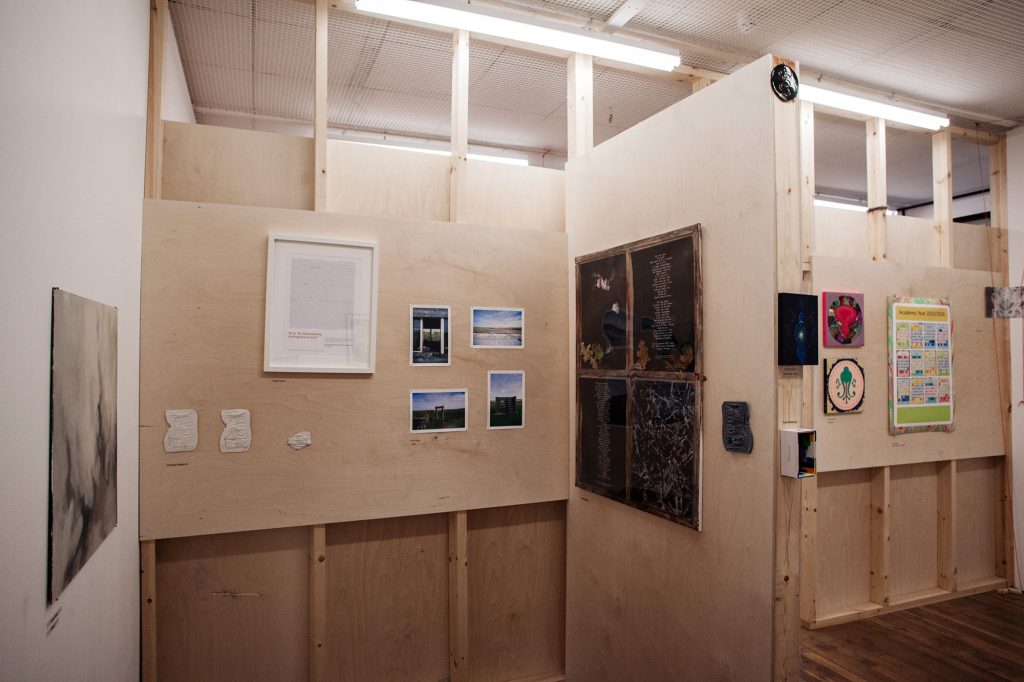
Through both the physical design of the space and materials that artists are working with, there is a sense of homeliness and domesticity at times. Read in dialogue with each other, Uzo’s two woven ‘Ankara Jackets’ hang on a wall opposite Claire White’s near-weightless fabric, its earthy tones and outlines of leaves draped like a curtain at the threshold between indoor and outdoor. Next to this, Lesley R’s painted coastal seascape appears like a window or portal in the gallery space. Another window-esque work is Claire Saaremets’ wooden frame sandwiching dying leaves and drops of blood-like fluid against a black background and poetic text from her collection Severed Brain Writings. Also riffing on the linkages between home and art practice, some shelves in the corner place crockery by Tigist Tegene alongside a delightfully impractical cardboard toaster by Liberty Hodes and a row of metallic bottles by Kaz Vranuchova.
The exhibition also challenges the ‘no touch’ rules of most contemporary art galleries. Several artworks invite visitors to interact with the materials: Millie Roberts offers the sensation of scent with a small bottle placed in a hidden corner; Maja Hajtanian Sliwinska’s ‘Emotional Labour: a study in spoons’ consists of a stack of spoons hand-etched with phrases like ‘Assertive and Relentless’ and ‘very good at working her way out of situations’. There is also an invitation from Kasha Gorowska to hug someone for twenty seconds and feel the benefits of triggering oxytocin. Set an intention for a future embrace and place a small colourful magnet inside a line-drawing of a jar. Together we can fill the container with promises of future hugs.
An environmental critique of Artificial Intelligence surfaces in Hollie Clark’s ‘AI is “An Unnecessary Ecological Luxury”’, a printed Q&A with Google’s chatbot that reveals the wealth of evidence within chatbots about AI, water-waste and climate change. Concerns about environmental damage continue with Anna Mud’s ‘Nurdle Net’, a small sculptural work woven with a handful of tiny plastic pellets. These are only a fraction of the estimated billion plastic pellets that now pollute the North East coastline following a container ship collision.
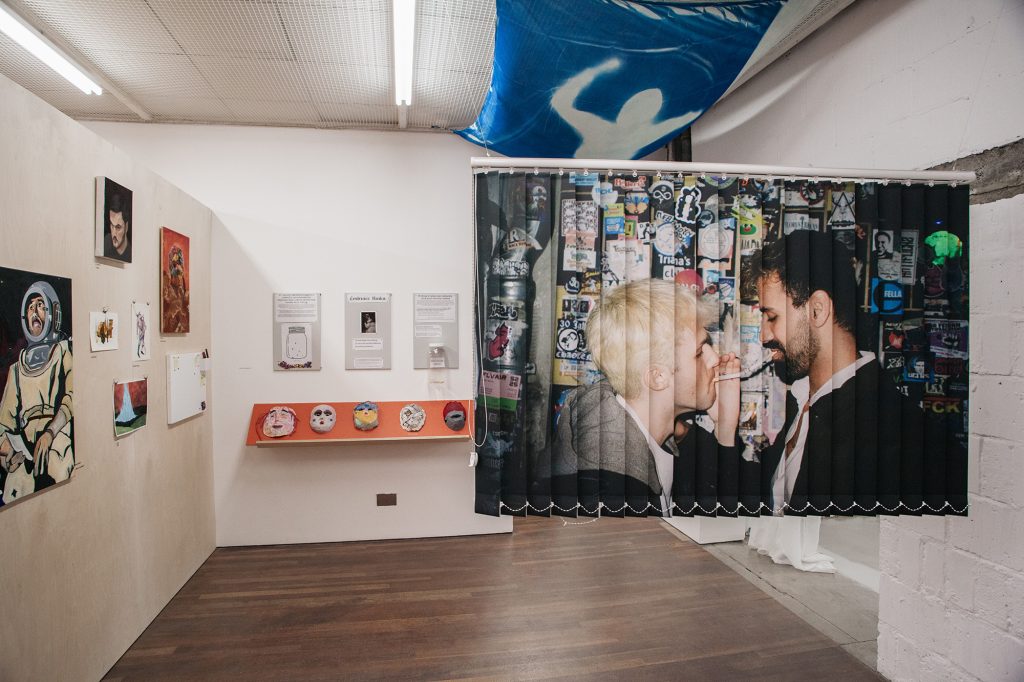
There is a beautiful simplicity and humour in the text-based works by Jennifer Quinn Huck whose columns of printed A6 paper articulate a series of wishes including ‘Don’t you wish I was selling you something?’ and ‘Don’t you wish you were on your phone?’ Helen Shaddock’s ‘Diaries Academic Year’ reminds me of the pressures of productivity and cramming as much into as little space as possible. Using the format of a calendar, each day features an unintelligible annotated sketch which makes me think about creative practice as a daily process but also about the practices of quantification and what counts as valuable (and to whom).
Perhaps the biggest success of Form and Display is how the artists have worked collectively to create a space of participation through sculpting the ontology of the gallery itself. Through treating the design of the exhibition space with equal importance as the artworks, they have united to create a ‘structure of feeling’, to riff on a phrase from the legendary working-class academic, Raymond Williams. This idea from Williams focuses on the emotional charge that can rise up through culture. It is the feelings, hopes and collective mood that can emerge from our interactions with each other in a specific time and place. Through this lens, the group show is constructed as a way to feel as a community, as a group of diverse people demonstrating what it looks like and the sensations that arise from creative practices of togetherness. And what do I feel upon leaving the space? Immense pride and gratitude for how my local community has worked together to celebrate each other as artists. In this way, the exhibition expertly articulates the value of arts institutions, such as NewBridge, that are truly rooted in a sense of place.
Kin is an artist and writer based in Newcastle.
Form and Display runs from 17 October — 18 December 2026 in the NewBridge Gallery.
Sign up to the Corridor8 Substack to read Dan Goodman’s A Reflection on the ‘Open’ Open.
This article is supported by The NewBridge Project.
Published 11.11.2026 by Lesley Guy in Reviews
1,360 words