How do we tell stories of ongoing dispossession and displacement? How do we mark beginnings and ends of colonial tragedies that are still unfolding? The artworks exhibited at the NewBridge Project in Shieldfield, Newcastle, during the month of November offer some insight into these questions. In a dark room, film footage was playing in a seventeen minute loop. I walked in and slowly sank into a comfortable beanbag positioned on the floor in front of the screen. It felt like being transported into another world, one that was familiar and estranging at once. The bright colours of the footage were the first thing that caught my eye: blankets of flowers set against the background of the Galilee and the Huleh Valley, located in what is now northern Israel, conjuring up a paradise of peace and beauty. And yet, the overly saturated colours of the footage and the sounds that accompanied such idyllic scenes created an atmosphere of anticipation, as if waiting for something to shatter a surreal tranquillity. Watching those images I could not help but imagine the flowers as heralds to the Nakba, the imminent catastrophe of 1948: the forced displacement of over 750,000 Arab Palestinians.
In the 1930s and 1940s, a Scottish missionary recorded some of the earliest known colour footage shot in the region by filming Palestine’s wildflowers. Greek-Palestinian filmmaker Theo Panagopoulos’s short film essay The Flowers Stand Silently, Witnessing (2024) makes an intervention in the original archival footage that exposes the violence of the European colonial relationship to land, nature and indigenous people. The original footage gathered images of an idyllic and timeless beauty of Palestine. Panagopoulos cuts and reassembles the colour-saturated footage of lush vegetation and peaceful hillsides as a form of testimony. When the filmmaker came across the footage in the National Library of Scotland’s Moving Image Archive in Glasgow in 2023, he found that only two minutes and thirteen seconds out of the forty-five-minute footage depicted Arab Palestinians.

Palestine’s flowers exemplify one of the many ways in which nature was made to serve a political project of land dispossession in the name of Western progress and modernity. In the name of this exclusionary and ethnonationalist project, some plants, like the European pine tree, were planted and others, like the olive tree, uprooted. European missionaries in the early 1900s left us many accounts of Palestine’s local flora and fauna with the aim of educating the local population and demonstrating true Christianity in the Holy Land. In this Orientalist genre of both European travel literature and natural science writings, nature was understood through biblical references and Arab Palestinians were often made marginal (or invisible altogether) to Western actors and interventions.
Another example of a work drawing parallels between Palestine’s flora and fauna and the land of the Bible is From Cedar to Hyssop: Study in the Folklore of Plants in Palestine (1932). Here, British archaeologist Grace M. Crowfoot and Louise Baldensperger, born into a family of German French missionaries, document local uses of wild plants and folklore in the Palestinian village of Artas, south of Bethlehem. When an Arab presence was recorded in this genre, it was often portrayed as living remnants of a primitive bucolic life soon to disappear under Western modernisation. This narrative is also clearly articulated in Pier Paolo Pasolini’s 1965 film Location Hunting in Palestine (Sopralluoghi in Palestina). Accompanied by an Italian priest, Pasolini chronicles his 1963 trip to the Holy Land to find the perfect location for his movie The Gospel according to St. Matthew, but ultimately concludes that the place, under the influence of the newly established Israeli state, is now ‘too modern’ to offer the perfect biblical landscape and the Arab faces ‘too primitive’ to incarnate its biblical characters.

I imagine accompanying Panagopoulos in the archives in Glasgow as he discovers a treasure of lost images and soon realises that the footage erases the presence of his ancestors as if they had never existed. I know that feeling. Like the filmmaker’s grandparents, my grandparents were born and raised in Palestine and witnessed the relentless destruction and displacement of their people. Like the filmmaker, I have devoted a lot of my time and work to tracing fragmented stories about Palestine, bearing witness to the violence of its erasure in everyday life. About halfway through the film, Panagopoulos writes these words, which resonated deeply with me: ‘I look at the past unable to cope with the present. But the archive can’t hold my grief. These images of flowers hid violence in beauty. These images of flowers legitimised power over others. These images of flowers led us to today’.

I watch the film once, twice, three times, and become acquainted with the main characters of this ‘floral drama’: yellow fennel, southern daisies, poppy anemones and other species. I am used to flowers being decorative elements in a photograph. Here, however, this relationship is turned on its head; it is the people who pick the flowers that become the decorative elements. People dressed in European clothing pick flowers and have picnics on the grass. More sporadically, Palestinian children, shepherds, and women in traditional dress are filmed walking barefoot. In the final part of the film, ghostly silhouettes are brought to the fore: a little girl peeking out from behind a wall and another looking at the camera from a rooftop. A boy peeks out from behind the shoulders of what appears to be a tourist with binoculars. I wondered what would become of them a few years later: will they and their loved ones survive the Nakba? In these children’s silhouettes I see those of the children in Gaza who have been murdered and still are being murdered, just like those who were murdered before them, and the ones before them.
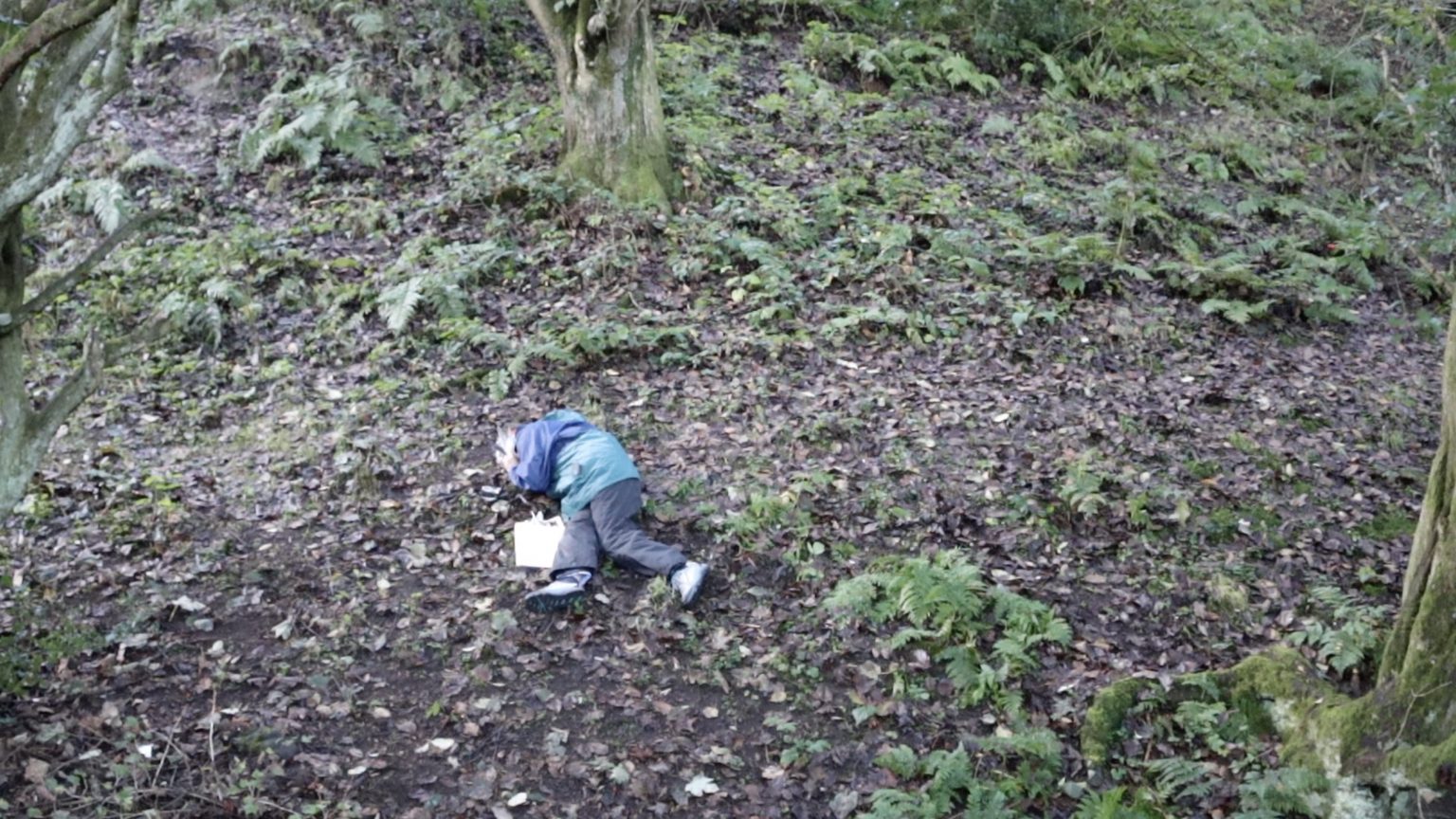
Leaving the film behind, I enter the adjacent room and walk through a soundscape set within a physical installation made of leafy ash and bamboo, bird nests and stones. It feels like a continuation of the same journey into the archives of displacement through a different sensory dimension. The sound of many voices, all speaking at the same time, echo in the room together with the sounds of music and birdsong. The installation was created by artist Henna Asikainen in collaboration with landscape architect Usue Ruiz Arana and composer Ben Ponton. The voices belong to people who were invited to contribute to the sound installation, having experienced forced displacement, and share their stories. The installation’s name, Lintukoto, is an archaic Finnish word meaning a paradise at the edge of the world, and a refuge where birds could nest, imagined as a sanctuary for those fleeing.

In this space, plants are exiles too. For example, I learn from the curatorial statement on the gallery wall that the bamboo had been removed from a local garden where it had become ‘invasive’. Many of the bird nests in the room were gathered at the end of the summer in the north east of England, once they had been abandoned by their occupants. Other nests had been woven out of plastic waste by the black-necked weaver bird, a resident breeding bird species in much of central Africa, and had been provided by the Kenya-based ornithologist Jumaa Abdillahi. Like in Panagopoulos’s film, the vegetation initially dominates the scene. However, the longer I dwell in the space, the more I experience the human voices, the birds and vegetation as deeply entangled. To really listen to what each voice is saying one needs to move closer to the bamboo leaves and the bird nests hiding in the vegetation. Many of the nests hold a speaker, broadcasting each individual voice. With my ear close to one bird nest, I listen.

Together Lintukoto and The Flowers Stand Silently, Witnessing provide an intimate account of the violence of displacement, contextualising our current political and ecological crises within entrenched forms of white supremacy and colonialism. Both works draw important connections between the violence of forced displacement and the erasure of people’s intimate and affective relationships to land, to soil, water and plants. Both works confront us with the toxicity of the ‘havens’ pursued by Western Imperialism.
The overly saturated colours of the flowers in Panagopoulos film announce the expulsion and replacement of Palestine’s indigenous population, as the Holy Land is turned into a ‘haven’ for European settlement, leading to today’s livestreamed genocide and the ecological devastation of the Gaza strip. The plastic waste weaved in the bird nests in Lintukoto evokes the current ecological crisis and the invasive bamboo is a reminder of the sinister and dehumanising rhetoric that combines Western anxieties around borders and climate change to create new racialised forms of exclusion, most visibly expressed through the figure of the ‘climate refugee’. Crucially, these artistic interventions have the power to make these connections felt and not simply understood, confronting us with the deep moral failure of humanity at this moment in history.
Silvia Hassouna is a geographer who divides her time between Durham and London. Her writing focuses on questions of land dispossession, environmental imaginaries, and resistance through art.
Lintukoto and The Flowers Stand Silently, Witnessing were on show at The NewBridge Project from 1-29 November 2025.
This exploration is supported by The NewBridge Project.
Published 15.12.2025 by Lesley Guy in Explorations
1,597 words