To say that the drawings in Surface Tension, a joint show by Kelly Chorpening and Kate Atkin, bring the outside world into the art gallery is true. The places in which they were made appear in the exhibition, both representationally and literally, in traces from rubbings and the presence of elements such as rain. However, this is an oversimplification of an exhibition which creates rich and thoughtful dialogue between two artists working in dramatically different contexts, which are exposed and extreme in different ways.
Chorpening is based in Nevada, United States, a state characterised by its desert and mountain landscapes as well as the remnants of mining industries. Atkin is a studio holder at Robinwood Mill (also home to 9a), a former cotton mill on the outskirts of Todmorden, a post-industrial town overshadowed by wild expanses of open moorland, which today houses artists’ studios and a variety of small businesses.
Situated in the steep-sided Calder Valley, Todmorden is defined both by the beauty and scale of its natural landscapes – moors, valleys, rivers and woods – and the industries that exploited these natural resources. Industry – primarily wool and cotton – has left an enduring physical, cultural and social legacy, most visible in mills, railway viaducts and other industrial buildings and structures. The town is now known for its vibrant artistic and creative communities, which exist alongside what remains of manufacturing and engineering in the area.

Surface Tension has brought the two artists’ practice into conversation, both remotely, via email and video call, and physically, during a visit by Chorpening to West Yorkshire. Joined by 9a’s curator Kelly Loughlin, Chorpening and Atkin spent time walking across the moors and making work in the landscape, using techniques such as frottage (the Surrealist term for taking rubbings of a surface) and embossing (using pressure to create relief images on paper) that enabled the artists to literally transfer elements of the environment and its surfaces onto the page.
The overall effect in the space at 9a is one of immediacy and liveness. The exhibition is dominated by a strong sense of mark-making, which captures the movement of the artists as well as their relationship to the world outside the gallery. Hanging loose, instead of being constrained by frames, the drawings seem to take on a life of their own, jumping off the walls. The viewer can see the rough edge of the paper and every mark and fold, as if these traces of places are presented directly as they were found.
The pieces that have resulted from the artists’ parallel journeys and explorations of surface are both strikingly similar and subtly different. A series of graphite drawings by Kelly Chorpening, entitled ‘Peavine Arrangements 1-4’ (2025-26), depicts assemblages of everyday objects and waste, such as tubes, cans and scrap wood. Presented in the centre of the paper, they look like cut-outs, removed from the landscape and all context. While the title Peavine refers to a mountainous area in Nevada, the objects are recognisable to anyone who has spent time in post-industrial or semi-rural environments, including the Calder Valley. Rendered in black and white, with shadows creating a strong sense of contrast, they have a documentary quality that borders on hyperreal. Close-up, they are also painterly, referencing the tactile quality of the objects on which they are based, from the scrunching of paper to the grain of wood.
If these drawings appear to be very arranged and controlled, Atkin’s work feels much more random. Presented side-by-side, two complementary pieces, ‘16th of April, Heavy Rain’ and ‘14th of April, Fine Drizzle’ (both 2026), were made by placing graphite powder onto antique paper and allowing rainwater, rather than the hand of the artist, to distribute it across the page, thereby creating a snapshot of climactic conditions on a particular day. In the earlier work, the marks are concentrated. In its follow-up, the marks accumulate, cloud and diffuse, bringing to mind the film of black pollution that is still present on many buildings in former industrial towns like Todmorden.
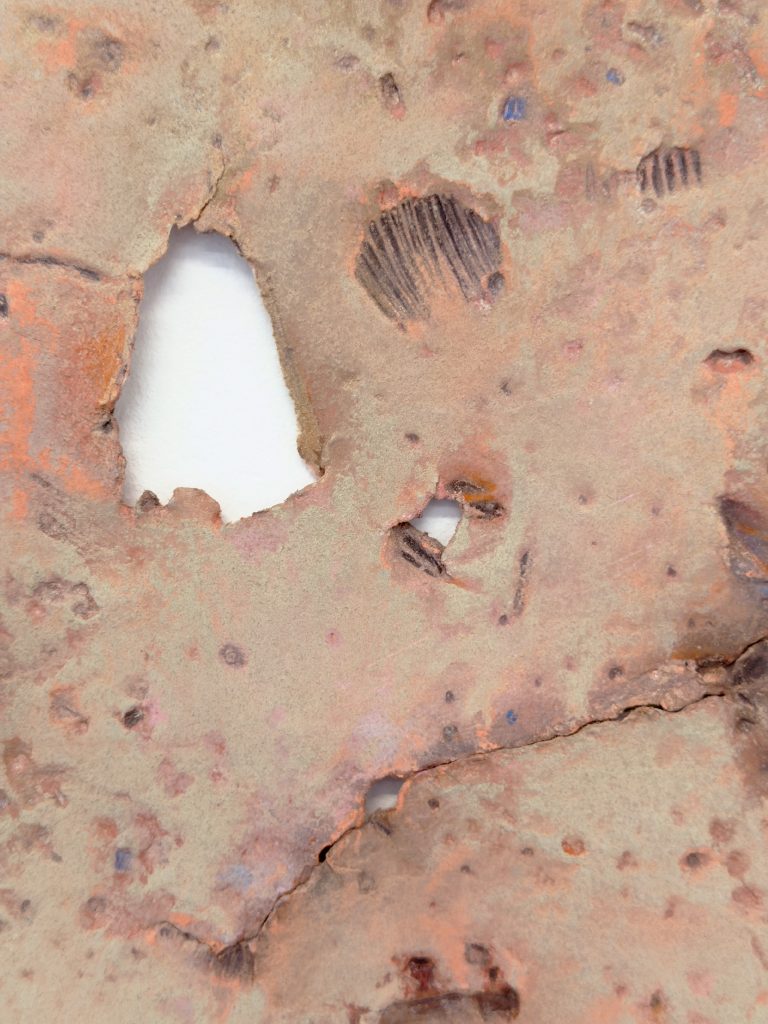
The tension between the manmade and the natural runs through Surface Tension. In other pieces by Chorpening, paper soaked in water was embossed by the artist walking over it. The resulting surfaces are rubbed, torn, imprinted, cracked and ripped, then worked with metallic paints, pastel and pencil until they resemble other materials. ‘A study in desert vitality (diptych)’ (2026), for example, has the smooth, worn appearance of a rock face, while highlighter-pen-like spots of colour add a note of discordance. ‘Resemblance as Contact’ (2026), meanwhile, could be a metal panel, corroded, worn, dimpled, nicked and scarred, and bearing marks that look like faded stamps or logos.
The surfaces of these pieces are suggestive of ageing and entropy, as if they were once home to life or activity that has now moved on. ‘Ornate and woe-begotten’ (2026) resembles a pale rock worn through use and punctuated with fossil-like traces, whereas in ‘The sun shines generously’ (2026), shapes swirl and float like luminescent plankton, frozen in time.

If Chorpening’s work suggests that the artist has arrived after the action has finished, Atkin’s work is full of vitality and movement, leaving pricks, scrubs, smears and smudges on the surface of the paper. This is most notable in ‘Carpark (2026), where a constellation of marks looks as if it’s about to buzz off the page. Atkin took a rubbing of the gravelly surface of the carpark immediately outside the building (over which all visitors pass to enter the gallery) with a graphite stick, before undertaking a painstaking process of layering further marks on top in her studio over a period of weeks. The viewer feels as if they are arriving in the aftermath of an event, to witness the seeds of a dandelion clock dispersing on the wind, or a hive of bees mid-swarm. If these moments are fleeting, time appears to pass much more slowly in other drawings by Atkin: the bubbling marks of ‘Crag’ (2026) resemble the slow flow of lava, dripping heavily down the paper.
Surface Tension foregrounds gestural expression rather than language or description: the sole word I spotted was ‘imported’, in Chorpening’s ‘Peavine Arrangement no.4’ (2025). While seemingly incidental, this small detail points to the global flows of trade and ideas that connect seemingly remote and disparate places, from West Yorkshire to the USA.
Surface Tension facilitates a series of non-verbal conversations: between the artists themselves, between the gallery and its immediate surroundings, and between a former West Yorkshire cotton town and the world outside. These dialogues take place across time, space, histories and geographies, showing the ways in which places are shaped by natural and manmade forces. These processes of change may take place over millennia, as in the formation of the landscape itself, or in the course of a generation, from deindustrialisation to gentrification and creative reinvention. As much as it exposes tensions, this is a show about dialogue and contrast, and what each artists’ work reveals about the other when you place it side by side.
Kelly Chorpening and Kate Atkin: Surface Tension was on display at 9a Project Space, Todmorden, from 27 June 2026 to 26 July 2026.
Natalie Bradbury is a writer and researcher based in Calderdale.
This review is supported by 9a Project Space.
Published 07.08.2026 by Benjamin Barra in Reviews
1,229 words