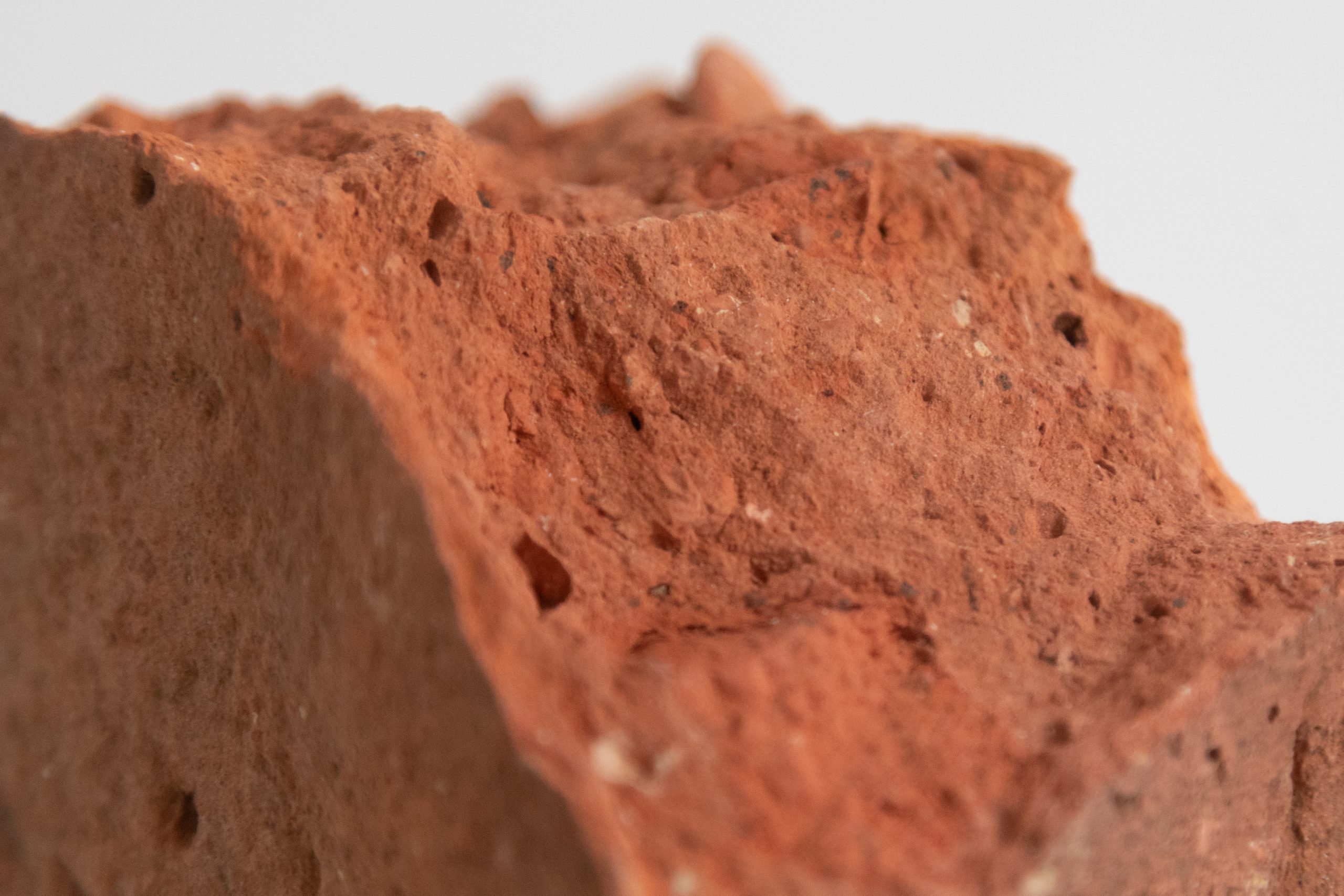
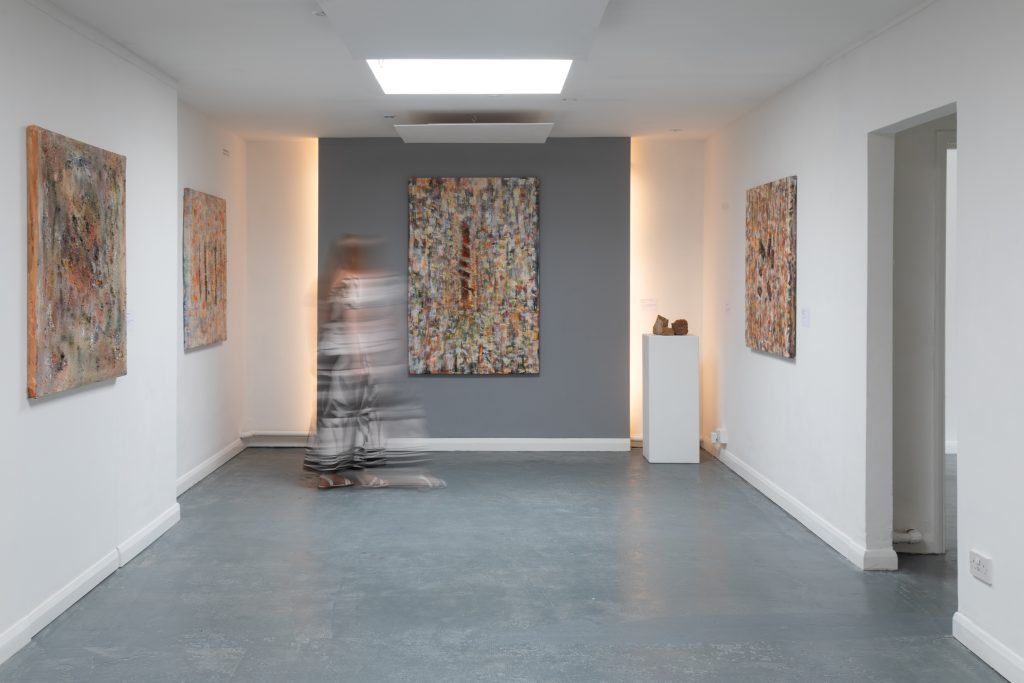
Short painted marks dash across the canvases in Oliver Benoit’s solo exhibition Roots Through Ruins, often forming around a central impression that contrasts with the surrounding colours. The surfaces are dense, textural, with grit embedded into paint and built up through repetition of wide brushstrokes. Some marks appear briskly applied over the surface, while others form concentrated blocks of saturation underneath. ‘The Return of the Ballast’ (2026), presented centrally in the gallery and occupying an entire wall, is the largest and most pronounced work. Digesting the overflow of colour coming out of the canvas, a dark red slash appears vertically down its centre, whilst the surrounding colour holds a brighter tonality in oranges, yellows, and greens. Stepping back into the room nearby there is a collection of three broken bricks displayed on a plinth that are carrying a similar palette to the paintings of burnt reds, oranges, and browns.
Roots Through Ruins, was developed by Oliver Benoit during Coreset’s inaugural International Residency Programme in Newark-on-Trent. Based in the East Midlands, Coreset brings artists and local communities together through exhibitions, residencies, and events. Benoit is based in Grenada, born in St George’s, and is an artist, academic and sociologist whose practice moves between visual art and research into national identity, heritage and colonial history. His exhibition brings together a series of abstract acrylic paintings alongside historical bricks brought by Benoit back to Britain from St George’s and which sit quietly at the centre of his work.
St George’s, Grenada’s capital on the island’s southwest coast, and its historic townscape was shaped under European colonial rule. After major fires destroyed wooden buildings in 1771 and 1775, regulations introduced under British rule directed reconstruction in brick and stone. Benoit’s research traces how bricks used in the capital were originally manufactured in Britain and circulated through colonial trade networks across the Atlantic and Caribbean. Some were used as ship ballast for otherwise empty ships that would return to the UK laden with sugar, cocoa and coffee. These bricks were used in structures built through enslaved labour and remained part of St George’s architecture for generations.
Reading from the exhibition text panel in the gallery I learn that, in 2015, Benoit witnessed the demolition of Edinburgh House, a nineteenth-century brick building in St George’s. He bought 500 discarded bricks from the site after finding out that they would otherwise be thrown away by the construction company.
Benoit uses these bricks as raw material in his work; crushed, then embedded as grit into the surfaces of the paintings by mixing them with acrylic paint. The bricks once used to construct St George’s become a literal part of the paintings. Coming to know this changed the way I understood Benoit’s work. Returning to the central marks on the canvases, they appeared to me as more structural through their dominance, like an architecture, repeated brushstrokes resembling fragments being laid, stacked, and held together. The dark lines in ‘Hidden Story of the Kiln’ (2026) look less like an isolated interruption of abstract expression and more like a symbol that carries historical meaning within the painting. That connection remains open to interpretation, however knowing that these crushed bricks are within the work makes it difficult to view the contrasting marks as colour alone.
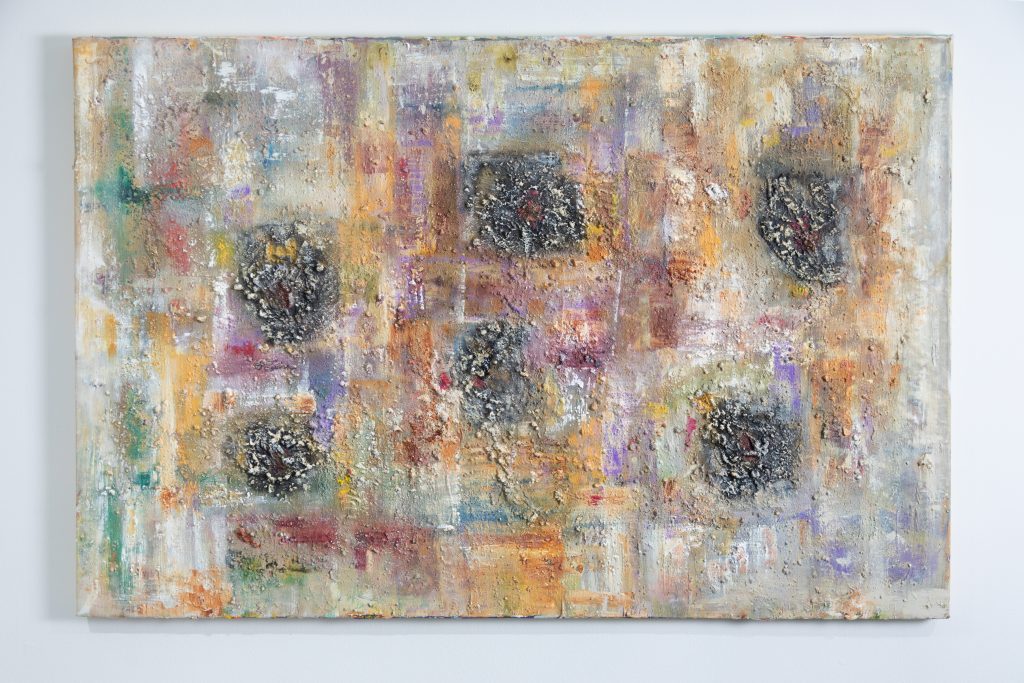
Through abstraction Benoit engages with Grenada’s history without turning it into an illustrated chronology. There are no literal depictions of ships, colonial buildings or the people whose labour was bound into their construction. Instead, history enters through the paintings’ material form and becomes intentionally preserved by Benoit. This is also consistent with Benoit’s wider practice as both an artist and a sociologist. His academic research explores how material culture can carry social memory and how visual art might generate new ways of thinking about heritage. In Roots Through Ruins, his paintings become part of that enquiry rather than a depiction of its conclusions.
Benoit’s decision to carry the bricks from Grenada to Britain adds another tension. They return to the country where they were manufactured after spending centuries within the built environment of St George’s. To me, this act reads as a deliberate reversal of their earlier movement across the Atlantic, a provocation, as if Benoit is bringing the material back because the histories it carries still need to be acknowledged by Britain. I found that act firmly affected my understanding of the work, leading me away from seeing the bricks on display as aesthetic objects alone and towards recognising their necessary role within Benoit’s practice.
Roots Through Ruins brings British and Grenadian histories together through the same material surface. The paintings might at first be perceived as purely abstract works, but the return of the bricks, Benoit’s research into their histories, and their preservation within paint, make that first reading difficult to sustain. For me, the exhibition becomes strongest at the point where the visual immediacy of the colour, grit and painterly rhythm of the work opens onto a much larger history. It is unsettling to encounter material that has travelled through those histories and to find it broken down and held inside paint. Through this act of preservation, Benoit transforms each work into an archival piece: one that physically holds fragments of the past while acknowledging the gaps that remain. He seems not to be attempting to resolve history through his paintings, instead he gives it presence, asking what it means to preserve material evidence that has been saved while so much of the human experience attached to it has been obscured.
Oliver Benoit: Roots Through Ruins, Coreset, Newark, 9 July – September 2026.
Jazz Singh Swali is a curator and writer based in Nottingham
This review is supported by Coreset.
Published 19.08.2026 by Rachel Graves in Reviews
982 words