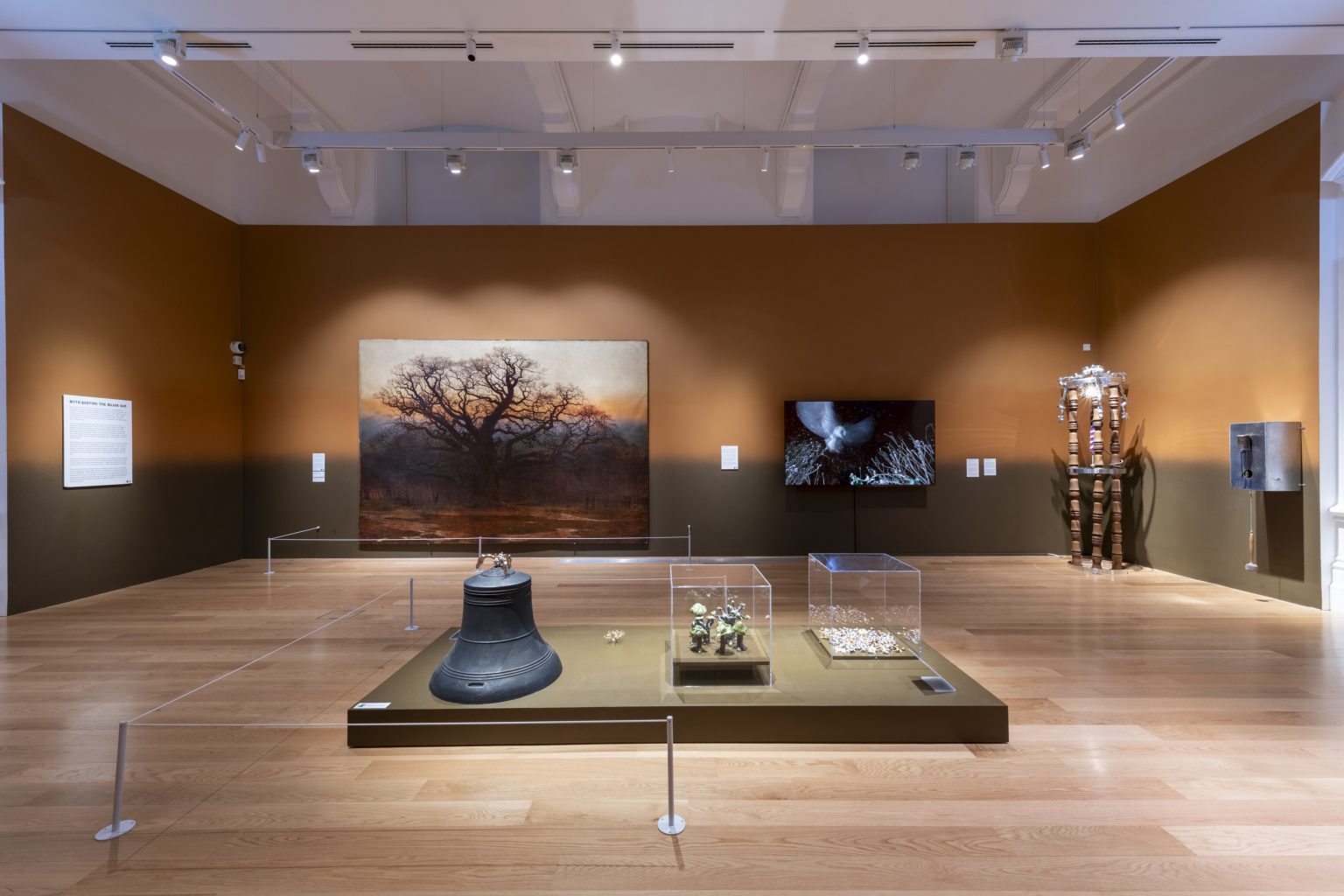
The word ‘farse’ can be defined as both an obsolete variant of the old French source word for ‘farce’, designating a form of exaggerated absurdist comedy, and a derivative from the Latin ‘farsa’, meaning to paraphrase a Catholic liturgy into a common tongue, or interweave vernacular words and phrases into a Latin liturgical service. Both of these potential meanings seem to be intended in To Farse All Things, the title given to a new publication and exhibition retrospectively sampling various individual works and collaborations by the artists William English and Sandra Cross. Not that theirs was ever a straightforward collaboration. Since starting out in the late 1970s, English and Cross have sometimes worked independently, sometimes as a duo, and often drawn on a wide range of subjects and other participants from both inside and outside the art world itself. Their unconventional working methods ensure that To Farse All Things turns out to be an appropriately curious title for a very curious kind of show.
Perhaps it’s fitting that the entrance to the gallery, and our first impression of the exhibition, is by way of a plywood corridor that partially reconstructs the labyrinthine route to the Dining Room, the restaurant that the duo collaborated on opening at a location close to London’s Borough Market in 1980 and ran as a joint art project, event space and completely functional late-opening vegetarian eatery for the following decade. A restored Dining Room sign leads us down a small set of steps where a portrait of the artists themselves greets us, subsequently directing us through various archival relics of the Dining Room itself: designs for flooring, fragments of restaurant fittings and decor, photographs of the construction of the space as well as portraits of some of its clientele. Rather than offering a comprehensive overview of the project, the aim of this archival corridor instead seems to be to convey something of the Dining Room’s atmosphere and makeshift, evolving aesthetic during its decade-long existence.

This loose reconstruction works as a functional archive, but also gives the gallery’s entrance route a portal-like quality, as though – in the long tradition of surrealist exhibition making – we are being made conscious of our passage from the world outside into an alternate kind of reality. Perhaps there’s a truth to this too, given that in today’s brutally financialised context, a makeshift, artist-led project like the Dining Room would be unlikely to manifest in the form it did, let alone succeed, without having some serious wealth and institutional backing behind it, and similar reflections carry through much of the other material here. Would an almost archetypally British character like Maurice Seddon, the eccentric inventor and manufacturer of home-made electrically-heated gloves, clothing and workwear, have appeared on major US chat shows or even have been able to make a viable cottage industry of his decidedly quirky activities, in today’s world of gamed algorithms, relentless marketing and influencer PR campaigns?
Seddon’s various TV and other appearances, as documented in William English’s film ‘Heated Gloves’ (2015), made after Seddon’s death in 2014, present us with a man who embodies a kind of low-key outlandishness with few pretences and little self-consciousness. He appears shrewd but unvarnished, in a manner that recalls characters as different, in their own ways, as the Lancashire steeplejack Fred Dibnah or the author and performer Ivor Cutler, creator of Life in a Scotch Sitting Room, a general type now almost completely eradicated from contemporary media and culture. Something similar could be noted of English’s rightly acclaimed ‘Venus With Severed Leg’ (1975), a portfolio of glamorous but unfiltered portraits of the late Vivienne Westwood in the SEX boutique she ran with Malcolm McLaren on the King’s Road during the earliest days of London punk, scrappily archived here in a small vitrine. Sandra Cross’s ‘MMs Bar’ (2011), an LP record made up entirely of the artist’s own recordings of the catering announcements on Midland Mainline trains between 2006 and 2007, during her weekly trips from London to Leicester, is another example of this kind of mundane but distinctly British oddity. ‘MMs Bar’ is one facet of Cross’s wider project to explore the realities (rather than the aspirational lifestyle advertorials and bewildering barrages of judgemental official health messaging) of our everyday relationships to food, and while the recordings consist of announcements I can clearly remember myself, they still sound spectral and remote less than two decades later, which gives them an intriguingly striking presence.

In truth, much of the archival material and work on show here has a strangely elegiac feel, inducing a kind of nostalgia for a less stratified period of time before the complete dominance of neoliberalism, when space seems to have existed, at least in pockets, for the convergence of actual rather than affected eccentricity, provincial cottage industries, and a makeshift art world bohemianism where the lives of shift workers and nurses could unselfconsciously rub shoulders with the undergrounds of music, literature and film in ways that seem less common or less viable than they once were. The late Kenneth Anger’s one time visit to the Dining Room is commemorated in a large vitrine featuring English’s substantial personal collection of material documenting now-classic underground movies like Inauguration Of The Pleasure Dome (1954) and Lucifer Rising (1972), alongside three slightly incongruous portraits of Anger in his childhood and teens, painted by his grandmother Bertha Coler between 1937 and 1944, in a display that blurs the lines between a film theorist’s archive, an artwork in itself and a more straightforward expression of fan culture. The Dining Room itself, despite its semi-hidden location and hard-to-precisely-define status, received more than a few reviews in the London and national press.
But there are continuities reflected here too. Cross’s post-Dining Room project ‘What Did You Eat Today?’, a series of filmed and recorded interviews about food begun in 1997 and continuing into the present, prefigures some of the approaches to documentary familiar on social media, while simultaneously echoing the work of the UK social history organisation Mass Observation. Mass Observation’s open submission, quasi-anthropological collections of diaries, letters and other documents exploring the peculiarities and textures of ordinary life from the 1930s onwards seem to have been a formative influence on Cross’s own project. Perhaps another surviving pocket of that older way of doing things might be Trunk Records, who released the LP version of Cross’s ‘MMs Bar’ recordings in 2011, and from memory were still operating an ordering system at the time that involved putting a £10 note into an envelope and posting it to them to obtain a copy. Even the lavishly illustrated and exceptionally well produced exhibition catalogue, also titled To Farse All Things, is self-published in a limited print run by William English Editions, another example of the duo’s cottage industry approach.

The catalogue is conceived as a kind of companion to or alternative version of the show and it offers a wealth of context for the exhibition, in terms of the artists’ own thinking and development over the five decades they have been active, and sketches in much of the political, social and geographical background to the various projects represented. The scrapbook approach taken in the catalogue is carried through into the varied works and archival materials brought together in the physical space of Bonington Gallery, and while the catalogue adds a lot of detail and context, the exhibition is perfectly capable of communicating the core ideas by itself. In both of the potential definitions of that unusual word ‘farse’, which both the catalogue and exhibition title foreground, it’s clear that the ideas the word evokes thread a common set of preoccupations through the wide and often seemingly improvised range of the artists’ featured projects and works.
There is certainly absurdist comedy here, nowhere more so than in the presence of ‘Narcissist Clown’ (2006), a kind of animatronic dummy endlessly casting his own blurry selfie projections onto the wall behind a theatrical curtain in one corner of the gallery. There is a persistent effort to introduce the vernacular of everyday life into the high liturgical context of art and the art world’s usual modes of discourse. But a third (and likely also intentional) definition of the word ‘farse’ is mooted in the catalogue’s introduction. ‘Farse’ is found written in a recipe book dated to 1597, in which context it signifies a ‘mixing together of ingredients’ in the specific scenario of making a traditional stuffing. Considering this usage alongside the others, we might say that the absurdity, the insistent vernacular and much of the edible subject matter of the work itself, all eventually blend together into something cohesive and resonant, more than the sum of its parts despite the superficially disparate approaches on show.
William English & Sandra Cross: To Farse All Things is on at Bonington Gallery, Nottingham Trent University, from 26 September – 13 December 2025.
Wayne Burrows is a writer based at Primary, Nottingham.
This review is supported by Bonington Gallery.
Published 07.11.2025 by Rachel Graves in Reviews
1,536 words