Middlesbrough, literally the middle borough between the monastic centres of Whitby and Durham, is a frontier town. In 1830, the Stockton and Darlington Railway was extended to the tiny village, creating a new port on the River Tees. This accelerated the town’s expansion, and the discovery of iron ore in Cleveland in the 1850s, along with the growth of the iron and steel industries, further transformed it. Middlesbrough’s population exploded in the mid-19th century.
Fast forward nearly 200 years and Middlesbrough’s fortunes have ebbed and flowed with industry’s fluctuating success. Yet some of that frontier spirit remains abundant, evident in the ambition of local creative communities. Over the last few years, Navigator North, Creative Factory, The Auxiliary, and Middlesbrough Institute of Modern Art (MIMA), alongside artist-led spaces such as Zoo and Pineapple Black and event promoters such as Industrial Coast, have cultivated a fertile grassroots creative scene. The recently opened Sawdust, run by artists Will Hughes, Eve Cromwell and Bobbie Bailey, provides access to equipment and fabrication, further enhancing artist opportunities in the region.
I’ve worked as a curator all over the UK, and there really is something in the water in Teesside. The reasons for this artist-led energy are myriad, but a steady supply of art students from Northern School of Art and Teesside University, coupled with lots of empty space, cheap studios and rent, and public investment, has helped. While much of this is worth celebrating, challenges remain. Like any regional art scene, paid opportunities are limited, and artists can quickly hit a glass ceiling without broader national and international networks.
Middlesbrough Art Week has played an important role, helping draw crowds and connect the local art scene with communities further afield. Now in its ninth iteration, the annual event (MAW, as it’s affectionately shortened to) draws on models such as Plymouth Art Weekender and Glasgow International. Growing year on year, MAW has now firmly established itself in the art world calendar. As in previous iterations, it has taken over empty spaces in the town centre with a mix of centrally curated group exhibitions, open calls, and commissions, plus a satellite programme highlighting the local art scene. On the day of my visit, the galleries and town centre were abuzz, with the launch coinciding with the Turner Prize opening at MIMA.
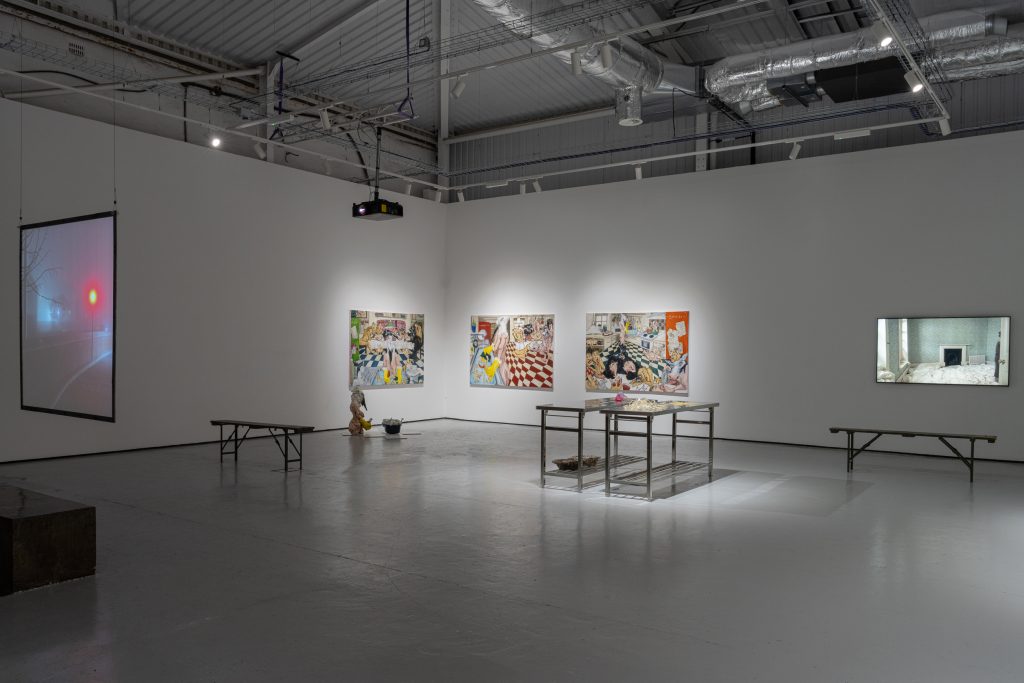
My first stop is at the newly refurbished Auxiliary for the North East Open Call, curated by Penny Payne. The exhibition has benefited by working with a small group of five selected artists, giving each plenty of room. Countering the typical clutter of open calls, the show is full of fantastic work. Izzie Beirne’s monumental painting of a burning house evokes climate strife. Recalling recent wildfires in LA, flames engulf a home, threatening the sense of familial safety. A nearby painting of a bloodied hand heightens the ominous tone. Freighted concepts of home also appear in Catherine Bertola’s ‘when feelings take on solid forms’ (2022), filmed at the stately Seaton Delaval Hall in Northumberland. The dancer Mati Torres Laborde appears in various empty rooms, framed through doorways and cropped by the grand architecture. Her solo choreography grows increasingly challenging, as she becomes entangled in bed sheets and contorts around a dining chair. In Bertola’s work, the house is haunted by a history of domestic servitude. We’re reminded that the home is a site of comfort for some, made possible by the labour of others.
Rachel Deakin’s projected moving-image work engages with tangential concepts of home through the landscape. Her films evoke an ecological reverie, merging remnants of industry with the North East coast. The work recalls Glenn Albrecht’s concept of solastalgia, an eco-anxiety wrought by a fast-changing environment, a form of homesickness for a place forever changed. Across the exhibition, the concept of home, often thought of as a space of sanctuary, becomes fraught and contested.
Alongside the 2D works, there are some standout sculptures. Susan Loughlin’s installation combines delicately coloured blown glass and tubing spread over large metal tables, recalling medical settings. Loughlin’s work derives much of its power from its multifarious metaphors. Sculptural forms evoke wombs, stomachs, lungs, intestines and water droplets, their surfaces shifting between pearlescent and mucosal.
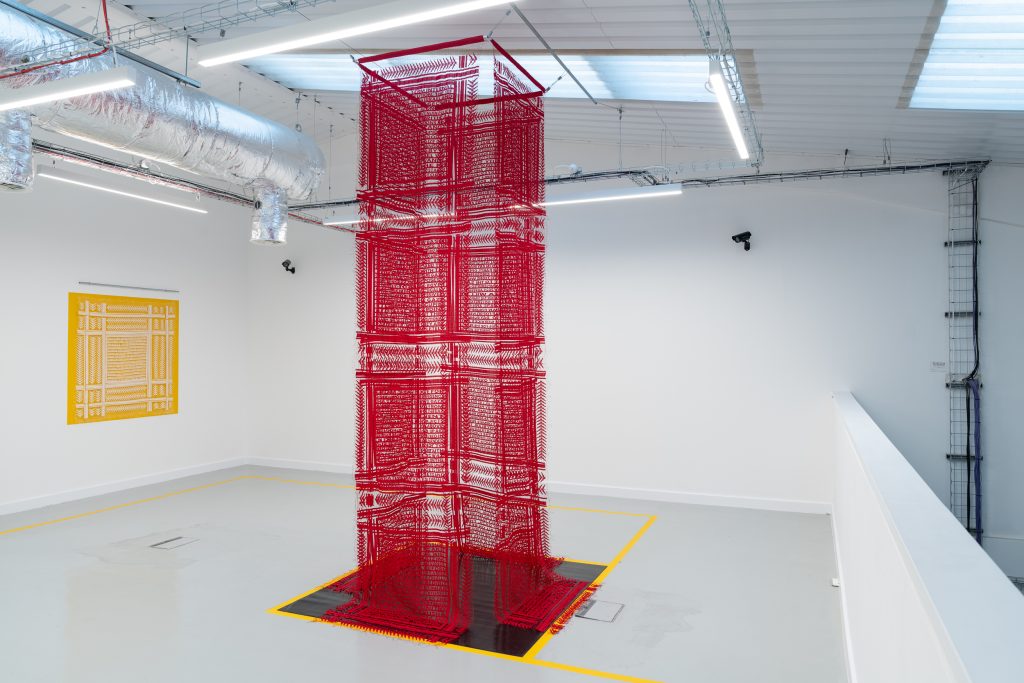
Upstairs, the artist-parent and carer supporting collective MOTHEROTHER presents Claire Ong who exhibits two intricate textiles, encompassing transcripts from Donald Trump’s speech on his twenty-point Gaza ‘peace’ plan and MEP for Dublin Lynn Boylan’s talk on the Gaza ceasefire. The heaviness of political rhetoric becomes enmeshed in the textile’s delicacy. Our attention drifts over the surface, the pictorial density burying the speech’s legibility. Ong’s textiles reflect on how rhetorical violence makes real-life aggression possible. Words are not bombs, but they do create the conditions of dehumanisation that make genocide possible.
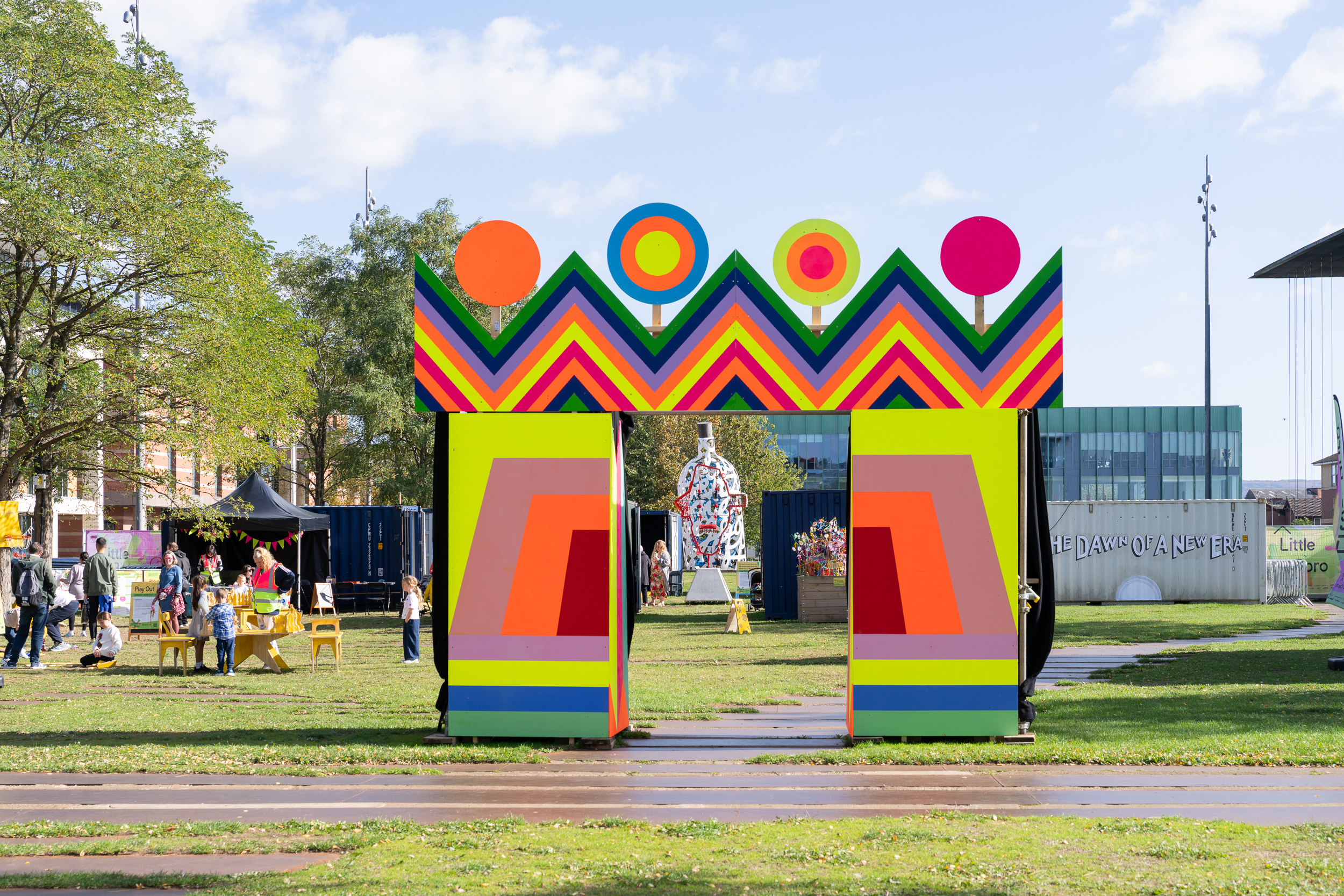
Curated by Stella Hall, Little Boro – presented in shipping containers on Centre Square – includes Liaqat Rasul’s ‘Ma, amader bhater phaen dao (Mother Give Us Rice Water)’ (2026), a memorial for the 1943 Bengal famine. Rasul’s sculpture encompasses a bold red graphic outline of a face replete with South-Asian ghungroo bells that rattle in the wind, transforming the historic tragedy into a site of remembrance and reflection. Alex Culshaw’s short film ‘Blue Lagoon’ (2026) moves from the elegiac to the ecstatic, documenting the North East coast and culminating at the Blue Lagoon nightclub in Hartlepool. As dance music engulfs the room, we’re transported amid the cathartic communality.
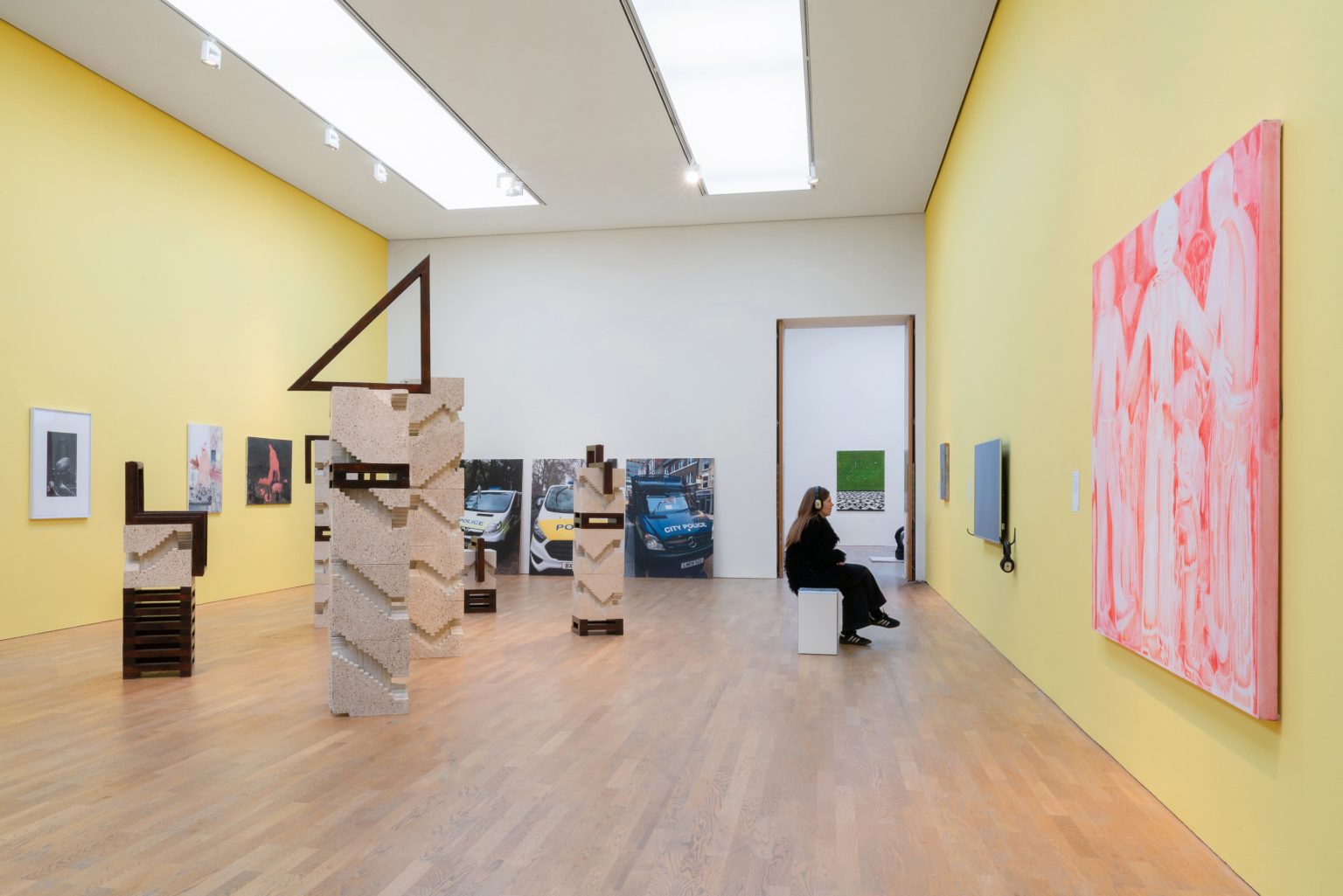
The group exhibition Lineage: Painting from Tees Valley is presented in a dilapidated Victorian house and showcases the region’s incredible diversity of painters. From Sarah Cooney’s semi-abstract still lives recalling Édouard Vuillard and Pierre Bonnard to Deb Covell’s sculptural silver painting, made by peeling and folding layers of acrylic paint, the exhibition is full of fantastic painting. Erroll Theunissen’s riotous work, ‘Police! Where?’ (2025) depicts masked youths joyriding on motorbikes through a dilapidated town centre with police in pursuit. The painting marries youthful rage with inadequate authority, summarising some of the town’s challenges. A grid of intimately scaled paintings by Gordon Dalton offers a more elegiac representation of the area. Dalton’s bejewelled renditions of the Tees Valley merge kaleidoscopic ruralism and post-industry. As in Deakin’s work, depictions of home carry a lyrical and hauntological quality.
Alongside the painting exhibition, the exhibition includes further solo presentations. Kate Stobbard’s ‘Hand Gesture Film’ (2018) encompasses a Beckettian video of disembodied hands gesturing frantically along to an off-screen conversation. I’m reminded of something I once heard about politicians: don’t listen to them, watch their hands. The body is a leaky vessel. Much of what we say, and how we say it, is unconscious as Stobbard reminds us.
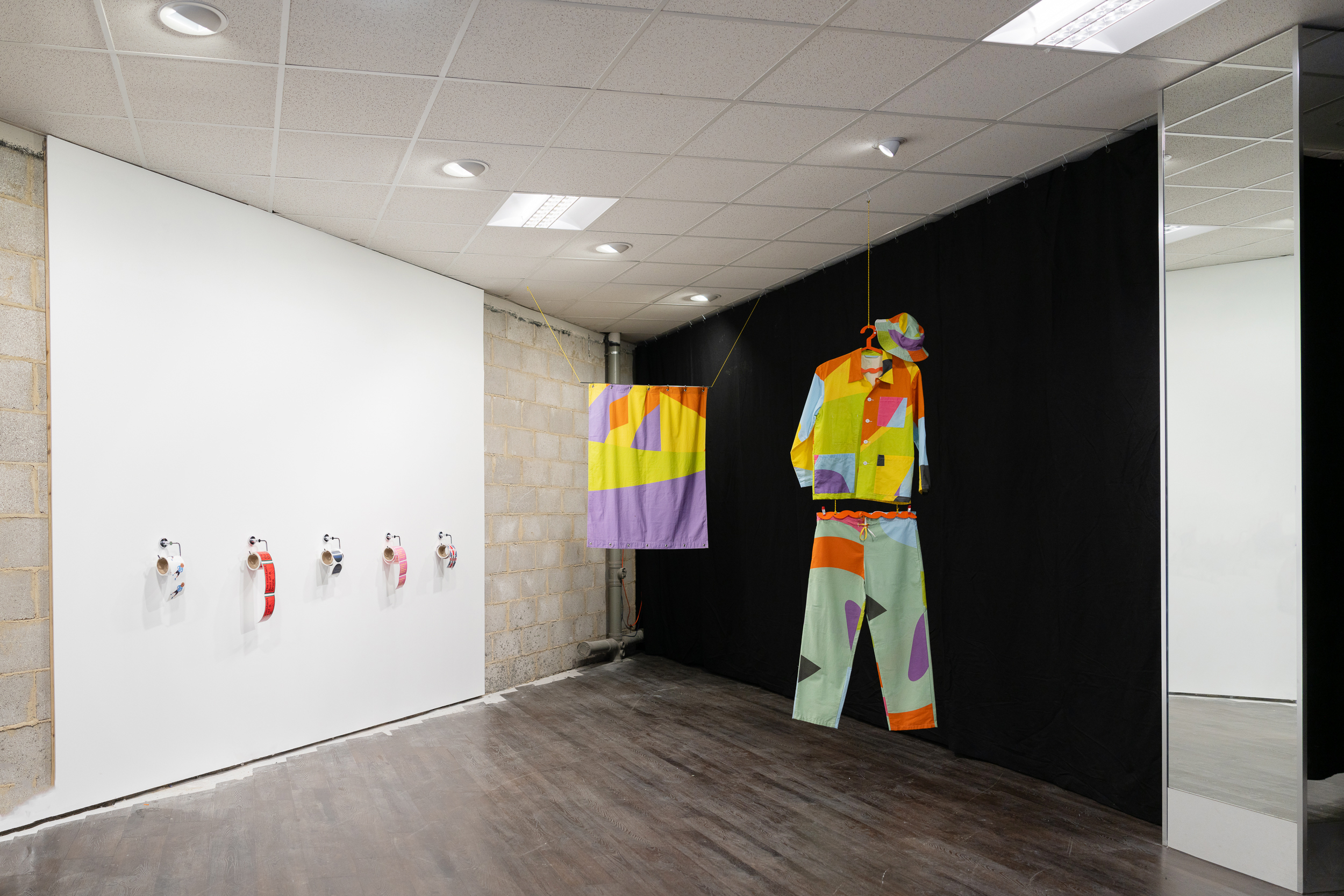
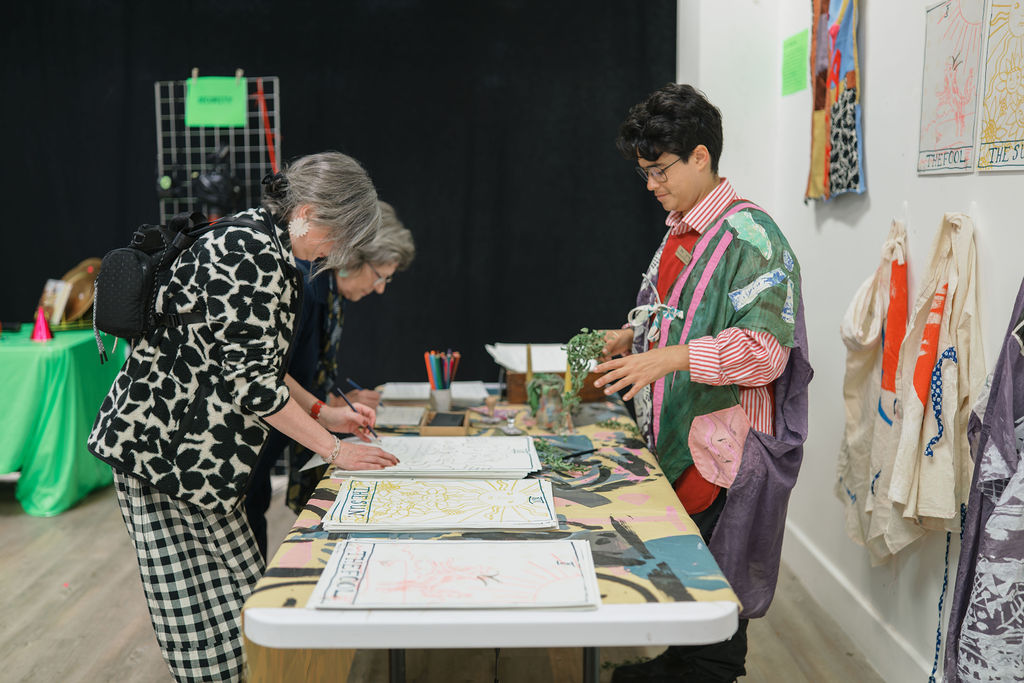
Across town, in an old TK Maxx store, Holly Willats has curated the group exhibition Threshold, bringing together artists from further afield exploring DIY culture and play. Foundation Press present a modular wallpaper and have invited visitors to contribute with stickers. On the day I visited, groups of children excitedly ignore the modular system and go free-form, creating a dynamic, colourful interplay combining pattern with something more chaotic. Elsewhere in the exhibition, Lauren Godfrey presents colourful patterned banners and recycled clothing, adapting old banners into workwear. Artwork leaches out of the space into the world. Jeremy Deller’s stickers – including statements such as ‘Welcome to the Shitshow!’ and ‘Shared Reality’ – are dispensed from the gallery and end up on lampposts and windows across town. Collectively, the exhibition presents artmaking as a space of disruptive joy and playful subversion.
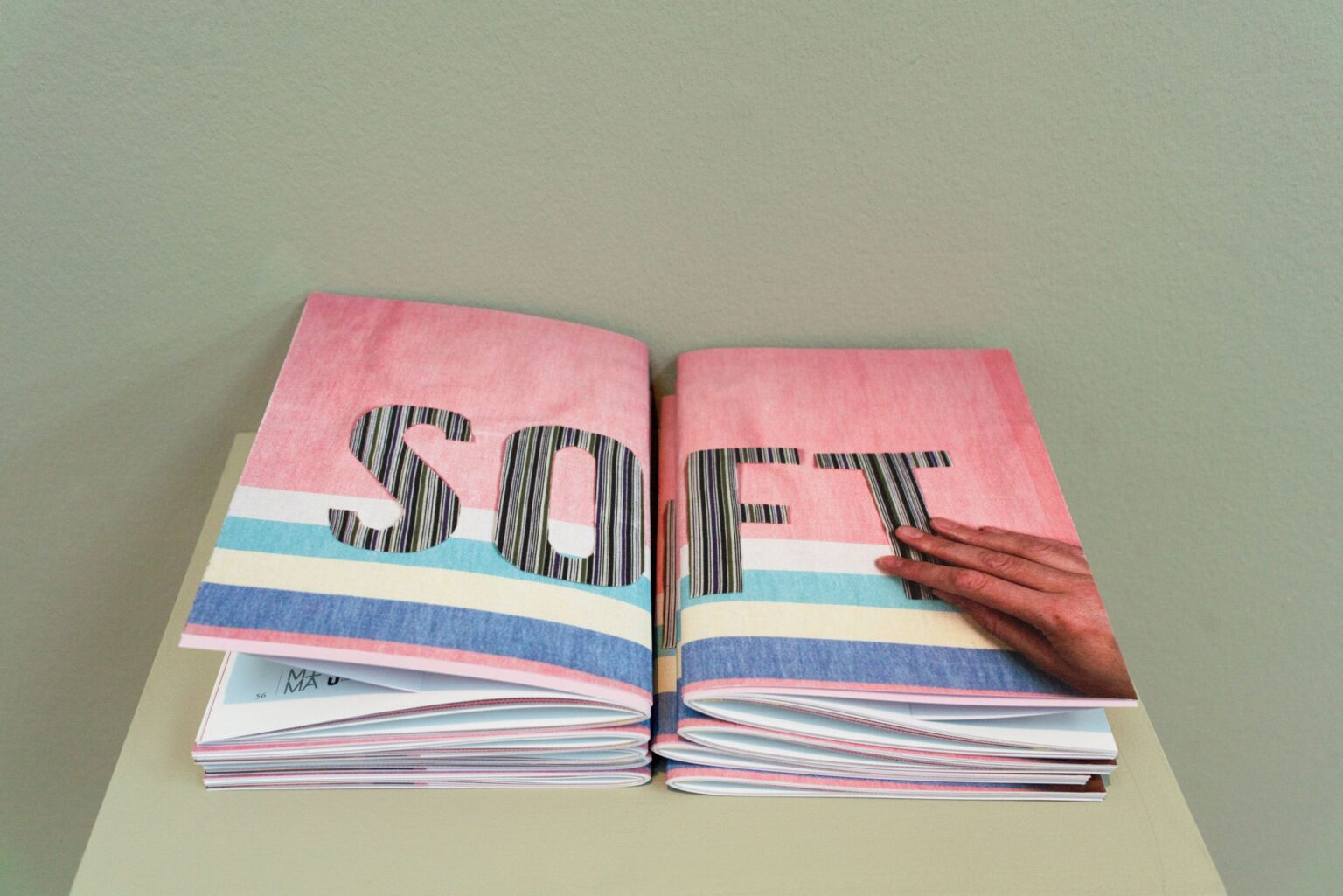
Alongside the exhibition, Andy Holden launched his new book, with a greatest-hits performance regaling us with stories about his grandma’s collection of cat figurines and the return of stolen parts of the Giza pyramid, mixing his typical absurdist wit with French critical theory. Holden’s singular practice testifies to the transformative potential of imaginative world-building.
In the Cleveland Centre, Transaction Land, by Rachael Clerke, presents an alternative shopping experience by inviting visitors to shoplift and engage in highly speculative investment opportunities with Oxo cubes. The vibe is frenetic, and I struggle to keep up with everything going on. The general vibe is Poundland meets Gary Stevenson as we desperately grasp at alternatives to an economic system that hoards wealth in the hands of the asset-owning minority. In a place like Middlesbrough, where the legacies of unemployment and austerity are brought into sharp focus, the exhibition feels particularly apposite.
On Albert Road in a disused retail unit, the New Graduate Award’s enigmatically titled exhibition Warren features up-and-coming artists from North East universities, supported by Auxiliary’s professional development programme. Daniel Carey’s spectral etchings and washed-out paintings of imagined neo-classical architecture remind me of Vicken Parsons mixed with Giorgio Di Chirico. His paintings read like empty stage sets, with windows and doors leading to dead ends and light that emanates from everywhere and nowhere. Across the exhibition, the quality of work is astoundingly high. Eleanor Jones’ ‘4a. 23:00, 4b. Vessel, 4c. Radiator’ encompasses an arrangement of bell-ringing ropes hanging from the ceiling. In theology, the ringing of bells has many connotations. From celebration to death, to the marking of time, they suggest congregation and a biblical call to arms.
Penny Payne and Will Hughes have taken over the large, ground-floor, glass-fronted office, convening a group of sculptors under the theme of the hard-to-pronounce, and even harder-to-spell, Verisimilitude. Works by Liz Wilson, Garth Gratrix, Luke Beech and Kitty McKay explore vulnerability and resilience. From McKay’s paired back deconstructions of urban space to Gratrix’s minimalist invocations of play, an economic formalist restraint belies a more emotional tenor just beneath the surface. Luke Beech’s ‘Kneeling Legs’ (2023) combines furniture legs assembled to evoke someone kneeling and speaks to concepts of forgiveness and humility or perhaps humiliation. Like many works in the exhibition, the work seems to hold competing and complex metaphors that shift depending on your own lived experience.
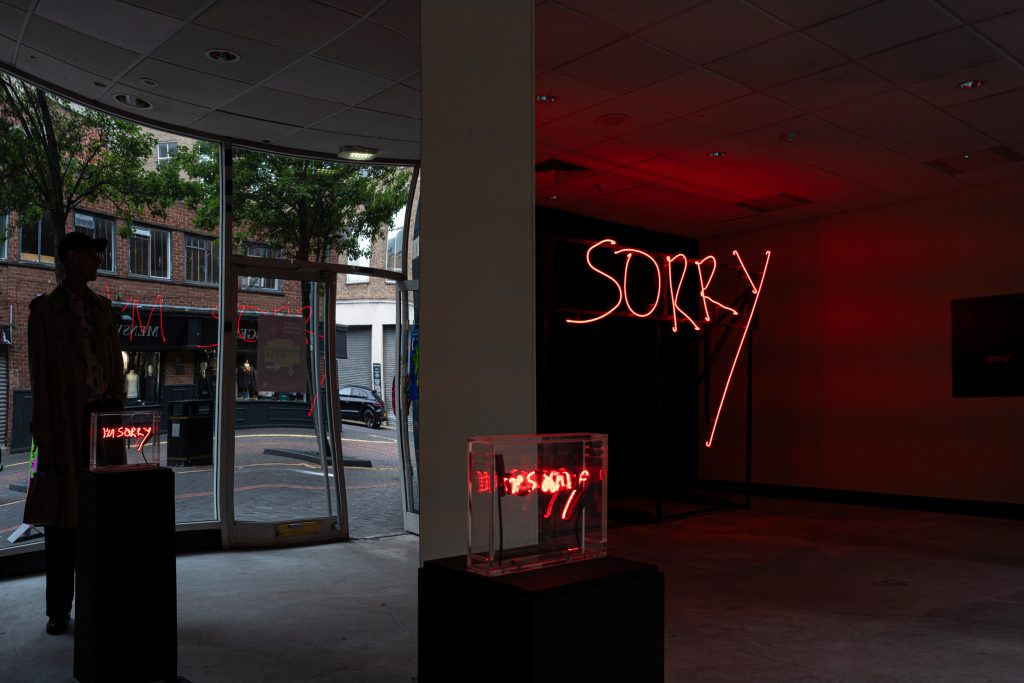
This sense of vulnerability runs through the festival. Annabel McCourt presents the exhibition I’m Sorry near Captain Cook Square encompassing a new body of work that explores apologies. Written in large neon, ‘I’m Sorry’ speaks to a humility often missing from public discourse. It’s got me thinking about my own capacity to get things wrong. For the record, I once wrote that Rihanna’s Diamonds was overrated. I was wrong. It’s a banger. Rihanna, I’m sorry.
Back to MAW 2026. I think it’s the strongest yet, thanks to the programme collaborators’ sensitively curated exhibitions, which anchor a diverse range of activities across town. The title, An Island of Neighbours, less a theme than a tone, riffs on Keir Starmer’s controversial speech about an ‘island of strangers’ and captures the conversations and friendships emerging and strengthening in the town and further afield. In a world as divided as ours, it’s a joy to see the artistic community in the region flourishing. Let’s keep drinking that Teesside water.
George Vasey is a Curator and Writer.
Middlesbrough Art Week is delivered by The Auxiliary. It ran 24 September to 3 October 2026.
This review is supported by The Auxiliary.
Published 04.11.2026 by Lesley Guy in Reviews
1,916 words