Desire Lines: Art, Place & Possibilities is a multi-installation presentation over four rooms that draws together contemporary artworks produced by artists with a relationship to the Tees Valley, works from the Middlesbrough Collection and a series of works created during artist residencies at Middlesbrough Institute of Modern Art (MIMA) and the former Cleveland Craft Centre and Middlesbrough Art Gallery. Along with elements from regional cultural contributors such as Navigator North, the exhibition is an abundant survey curated over the four cavernous gallery rooms of the ground floor, it invites the visitor to consider how artists have imagined and might shape the future of a place.
The curation shows a commitment to and development of MIMA’s long term project examining a particular conception of Localism, introduced in the form of an exhibition by the same name in 2015/16 and now set out on their website as ‘a radical approach to exhibition making, inviting the public to help write the narrative that grows with the show, adding to it as we go, thus creating an encyclopaedic family tree of creativity on Teesside’.
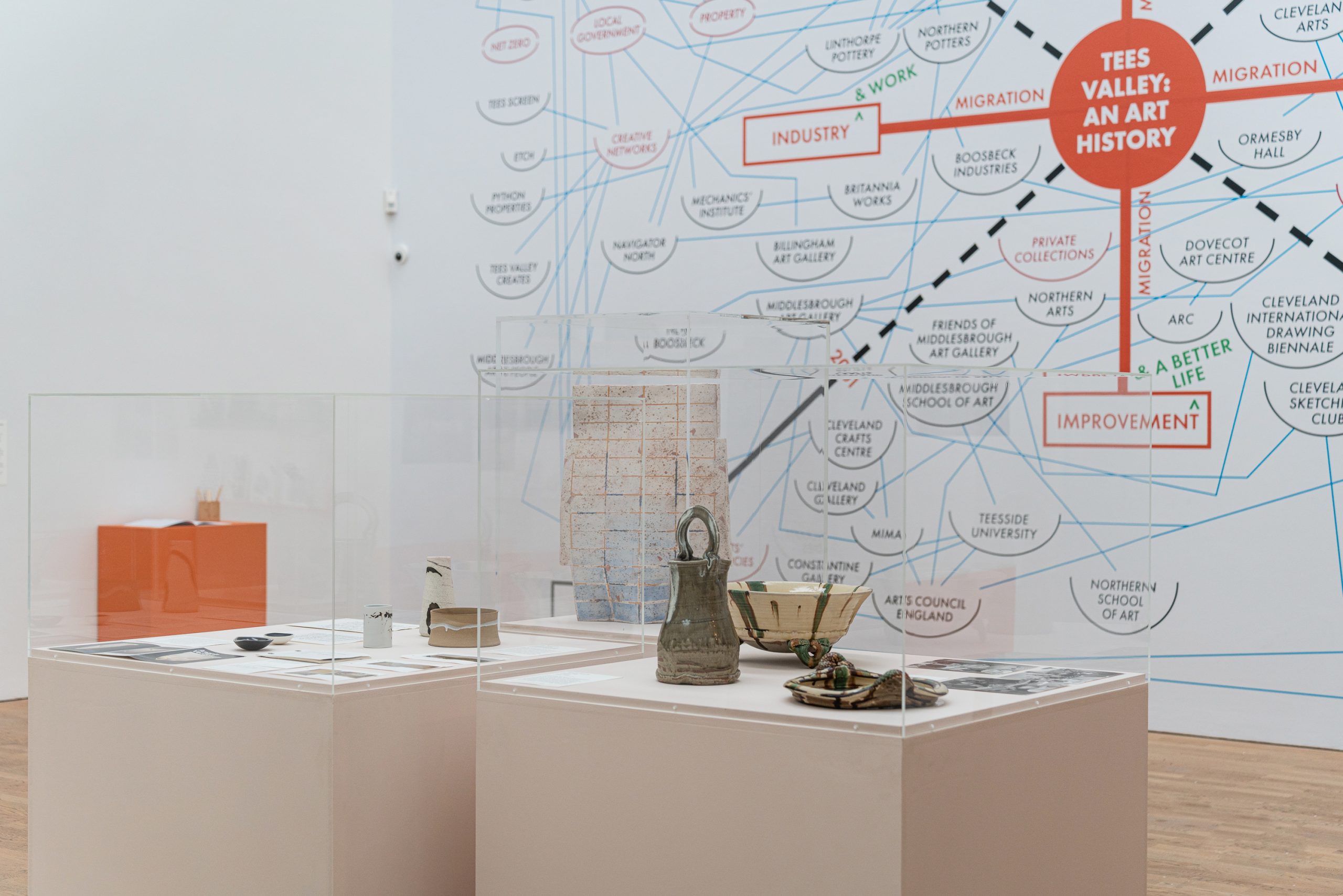
This commitment is illustrated in the first room of the exhibition by a massive spidery map, covering most of a wall, tracing histories of creativity in the Tees Valley. Developed by James Beighton with MIMA and designed by Jo Deans, ‘Tees Valley: An Art History’ (2025) revisits and updates the wall map ‘A History of Teesside Art’ (2015) from the original Localism exhibition. As well as adding many more venues and events, Beighton has made simple yet effective addendums in green to the original map’s four topics, Industry, Rail, Moors & Coast and Improvement that now branch from the map’s central title.
In the centre of the room is a huddle of vitrines displaying works from the Middlesbrough Collection. They include a beautiful chimney-stack shaped porcelain bowl titled ‘Cylinder’, made by Sue Paraskeva whilst artist in residence at the Cleveland Craft Centre in 2000. A liquid and undulating outline of the Cleveland Hills is mapped all the way around the bowl’s waist. Drawn with a stick that Paraskeva found on the nearby Redcar shoreline, it offers a contrasting representation of the region’s landscape to the straight lines of the map looming behind it.
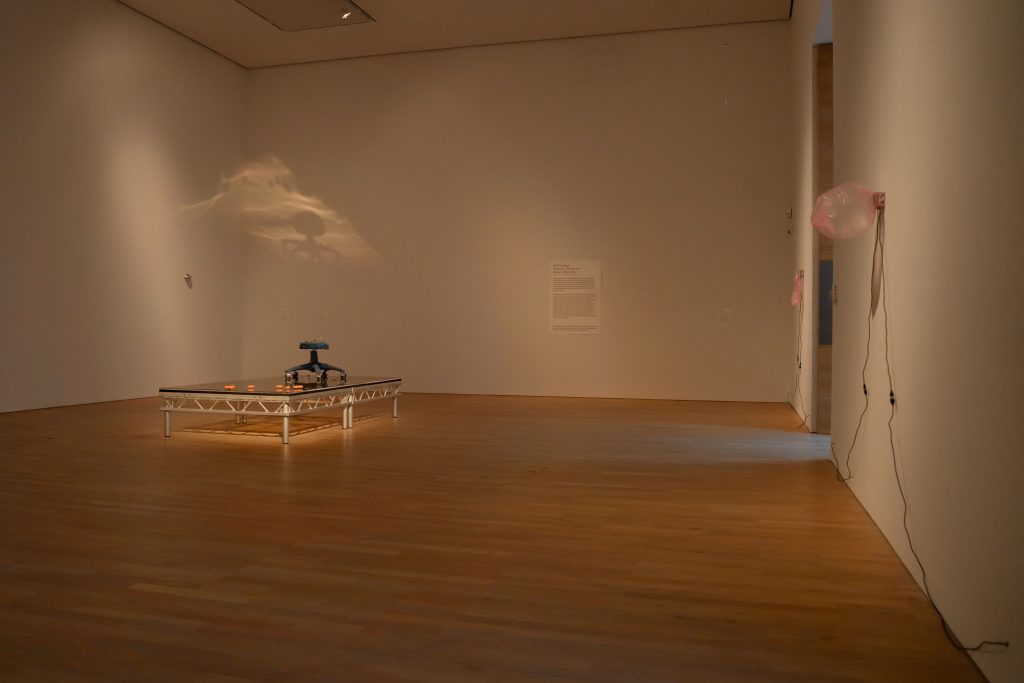
Moving anticlockwise through the exhibition, room two has Tees Valley Artist of the Year 2025 Will Hughes’s solo presentation, Glamour, Desire and Queer Materiality. The installation of works includes ‘The air that I’m breathing, Forever’s not enough’ (2025). Two pink plastic bags, powered by USB fans, inflate and then deflate, buoyant then flaccid, over and over, on either side of the gallery room’s doorway. These days, plastic bags are a pervasive feature of any landscape. Finding joy – glamour even – in something typically viewed as a degrading eyesore is a queer thing to do. It is also something akin to philosopher and eco-feminist Donna Haraway’s plea, made in her seminal 2016 book Staying with the Trouble: to acknowledge the state of environment and life on earth as it is, in order to be able to think clearly and move forward; to lean into our collective ‘response-ability’ and work with the realities of the changing and changed world.
The valleys of trees, rock piles and riverbeds that weave through the Cleveland Hills down to the North Yorkshire coastline, will nowadays inevitably have a bag or two hooked, shredded and caught up within them. In the third and largest room of the exhibition, Diane Watson’s wallpaper installation ‘Game On’ (2024) has been created with pupils at St Mary’s Catholic Primary School in Grangetown. The children have pulled objects off the shore and out of the sea and done lovely drawings of them; fishing netting and food wrappers, as well as birds and shells and plants. These drawings have been digitally edited to create a dizzying design that repeats and mirrors itself in a way reminiscent of the socialist designer William Morris’s Victorian wallpapers, evoking his belief that beauty could be a rallying cry against the ugly injustices of capitalism. It includes the refrain, ‘reuse, reduce, recycle’ that is repeated over the wallpaper. It is hard to know whether this is a plea or just a detail copied from a discarded piece of rubbish. The phrase, so often printed on single use packaging, has become easy to ignore. It is just a part of the entangled mesh of the natural world and a surfeit of man-made detritus. The Saturday Club, a group of young people aged 13-16 who meet weekly at MIMA, present their solution to utilising discarded materials in a series of prints produced using natural inks made from plants and food waste. They have been inspired by artist Cassie Quinn, producing delicate artworks that are a practical way to process and repurpose our excess.
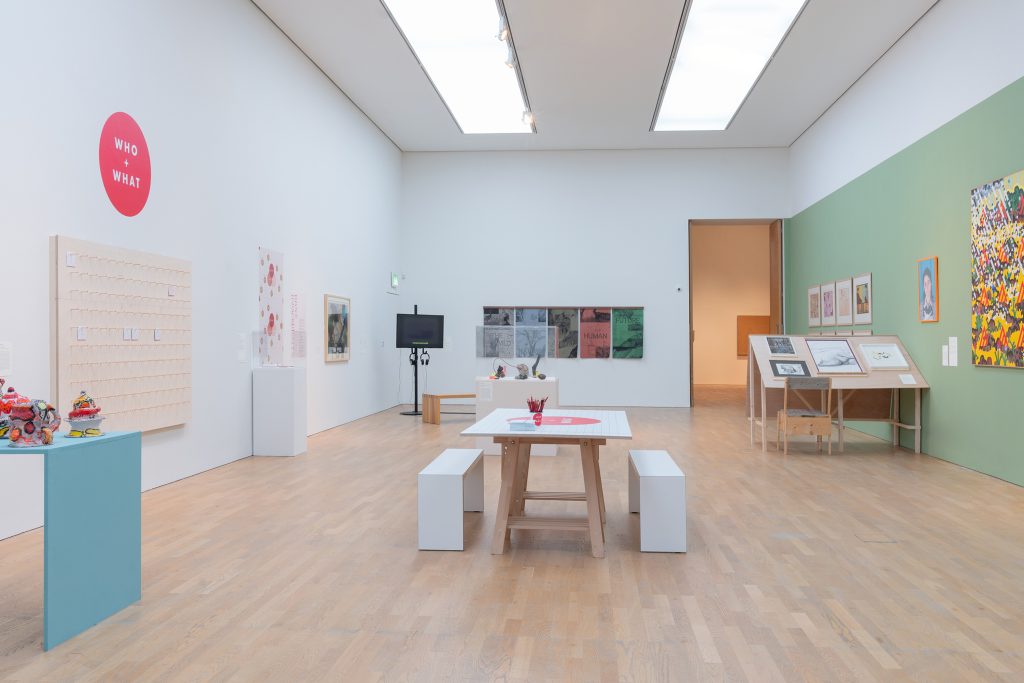
There is a lot of work in Desire Lines and it is a lot to soak up. Nic Golightly’s interactive work, ‘WHO + WHAT’ is a chance to take stock of what has been absorbed so far, and invites the viewer to jot down their own opinions and answers to a question asking who and what makes the Tees Valley a creative place. A sizeable number of notes written in red pencil on small white rectangles of paper are hooked onto a grid on the gallery wall. The red pencil mirrors the colour of the text in Beighton and Dean’s map that opens the exhibition and is an effective aesthetic that unifies the amount and variety of responses that people have offered. A call to remember ‘THE VANDALS, THE TAGGERS, THE ANONYMOUS SCRIBBLERS’ is pegged up above a quick sketch of the instantly recognisable Transporter Bridge. and just next to the glitzy name of a long-gone drag night.
‘Geofictions’ (2016) by Helen Hunter and Mark Peter Wright is a vitrine of small ‘rocks’ that are a fusion of iron ore, tar, sediment, cement, discarded electronics and plastic. They each have handwritten labels in the first person. ‘I will shrink’, ‘things fastened onto me’ and ‘future fossil’ are predictive little text messages to future generations who will potentially look back to this period of time, increasingly referred to as the Anthropocene, when human activities became the dominant force shaping the planet’s geology.
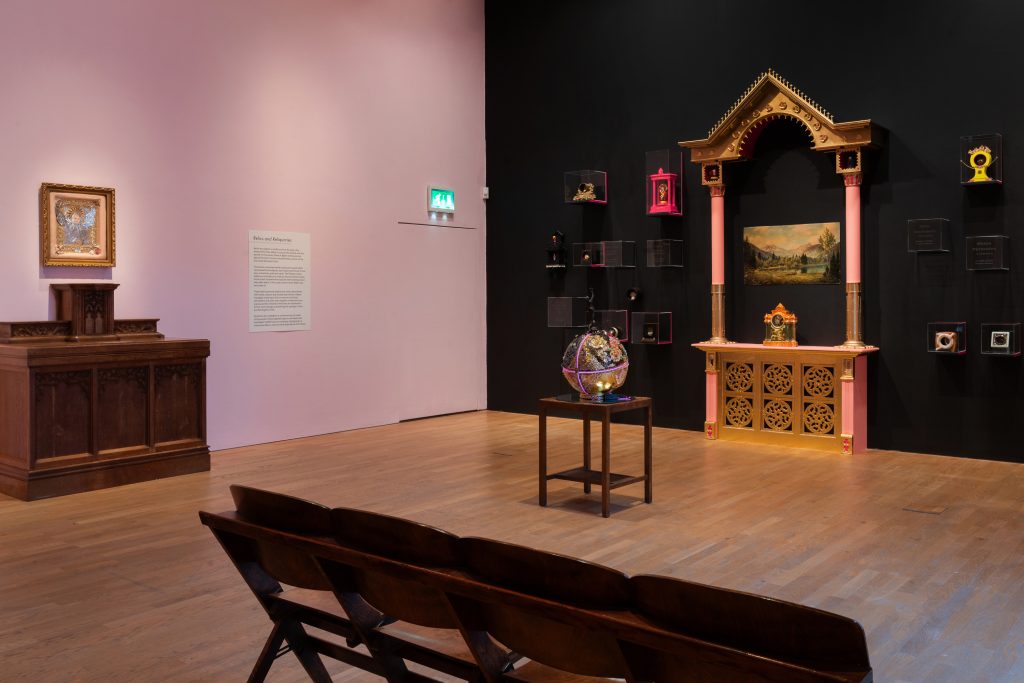
In the fourth room of the exhibition, Claire Baker’s Relics and Reliquaries installation has borrowed furniture from St Thomas Aquinas Church in Darlington, including wooden chairs that smell of well-handled varnish and a wooden altars that provides a platform and backdrop for her overwhelmingly detailed hand-embroidered textiles and artefacts. These are dazzling orbs and statues of pink and green sequins, amber-headed pins and exquisite multi-coloured thread highly reminiscent of Orthodox religious iconography. Baker produces these works as remembrances to honour her relationships of many years with the self-settler women of the Chornobyl exclusion zone. She spent time in the homes and lives of these women researching regional embroidery traditions and skills, and describes the pieces produced in response to these relationships as her life’s work. The current war in Ukraine means that she hasn’t seen them for a long time. The installation manages to be a sincere meditation upon loss at the same time as being resoundingly, defiantly, bold and bright. The work is a testament to the act of sitting with and really listening to someone in order to connect with, learn from and share with them.
‘Dialogic’ may be one of the most overused adjectives in writing about contemporary art and exhibitions, especially ones that bring together work by many artists. It is, however, the careful attention to the methodology of Localism – which involves encouraging and highlighting the dialogic nature of imagining, creating and experiencing art and culture – that is most apparent and impressive about Desire Lines. This thoughtfulness shapes a contemplative, materials-oriented exhibition. It outlines a gallery-based approach to working with, through and beyond what we have at our disposal, in order to create the conditions to begin to reimagine ways to build better lives.
Time has proved MIMA’s Localism to be a robust and stimulating methodology that emphasises the cyclical and symbiotic relationship between communities and culture. Since that first exhibition ten years ago, the cultural landscape of the Tees Valley has flourished. As Helen Welford, Head of Programme at MIMA says, ‘Ten years ago, we would have been amazed at how that landscape looks today’. However, it would be remiss to not acknowledge that the decade has been marked by overwhelming global unease and distress at the direction the world seems to be moving in. Reimagining involves rethinking, and a rethink is both a concession and an opportunity to acknowledge that the things that shape a place and its future – money, people and language – regularly shift, or are shunted around. Walking around Desire Lines, one holds and releases these conflicting feelings in the chest, like air inhaled and exhaled into one of Will Hughes’ membrane-pink plastic bags, as if to mitigate a panic attack.
Kate Sweeney is an artist based in Newcastle upon Tyne.
Desire Lines is at Middlesbrough Institute of Modern Art, 28 November 2025 to 12 April 2026.
This review is supported by MIMA.
Published 16.02.2026 by Lesley Guy in Reviews
1,604 words