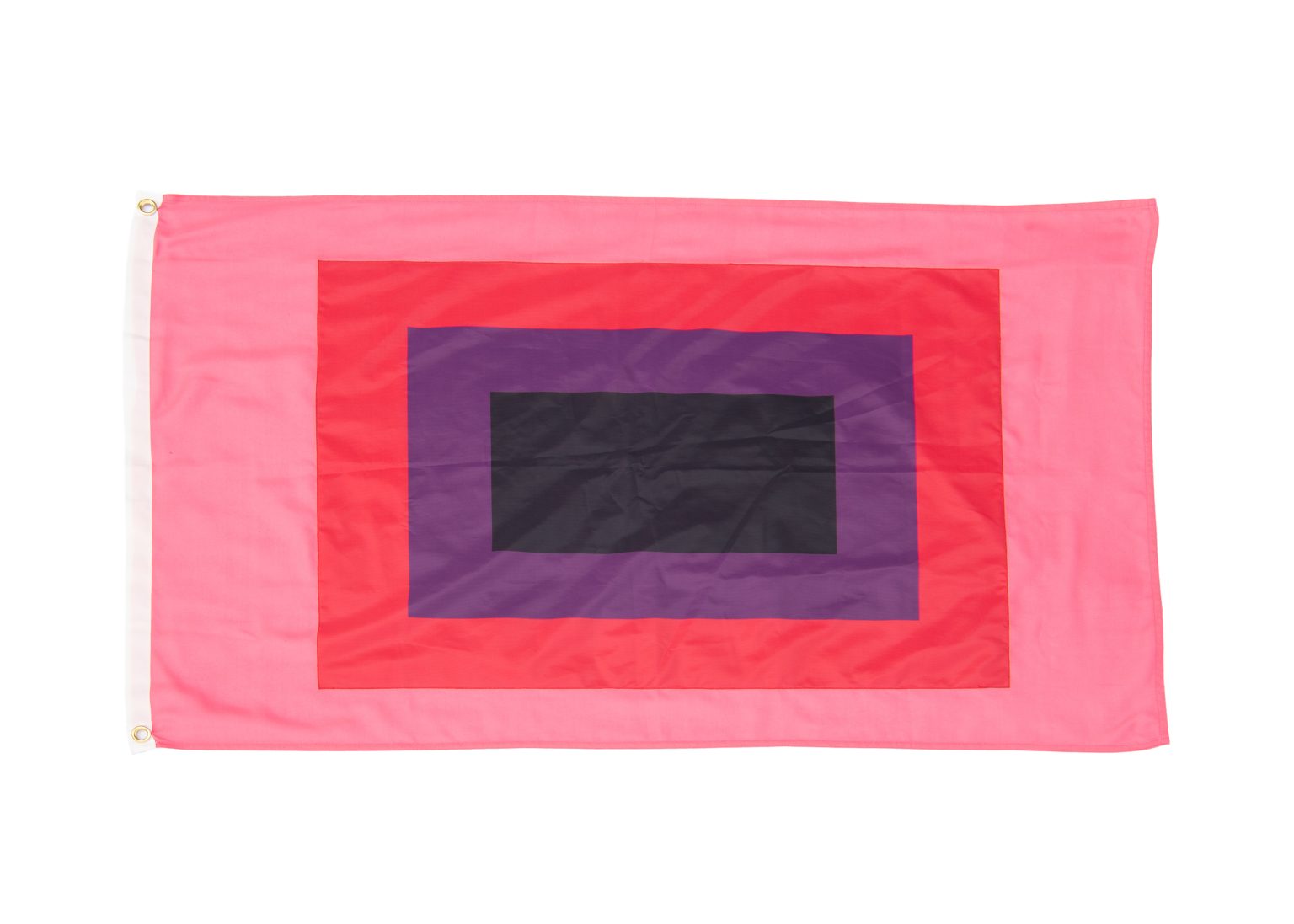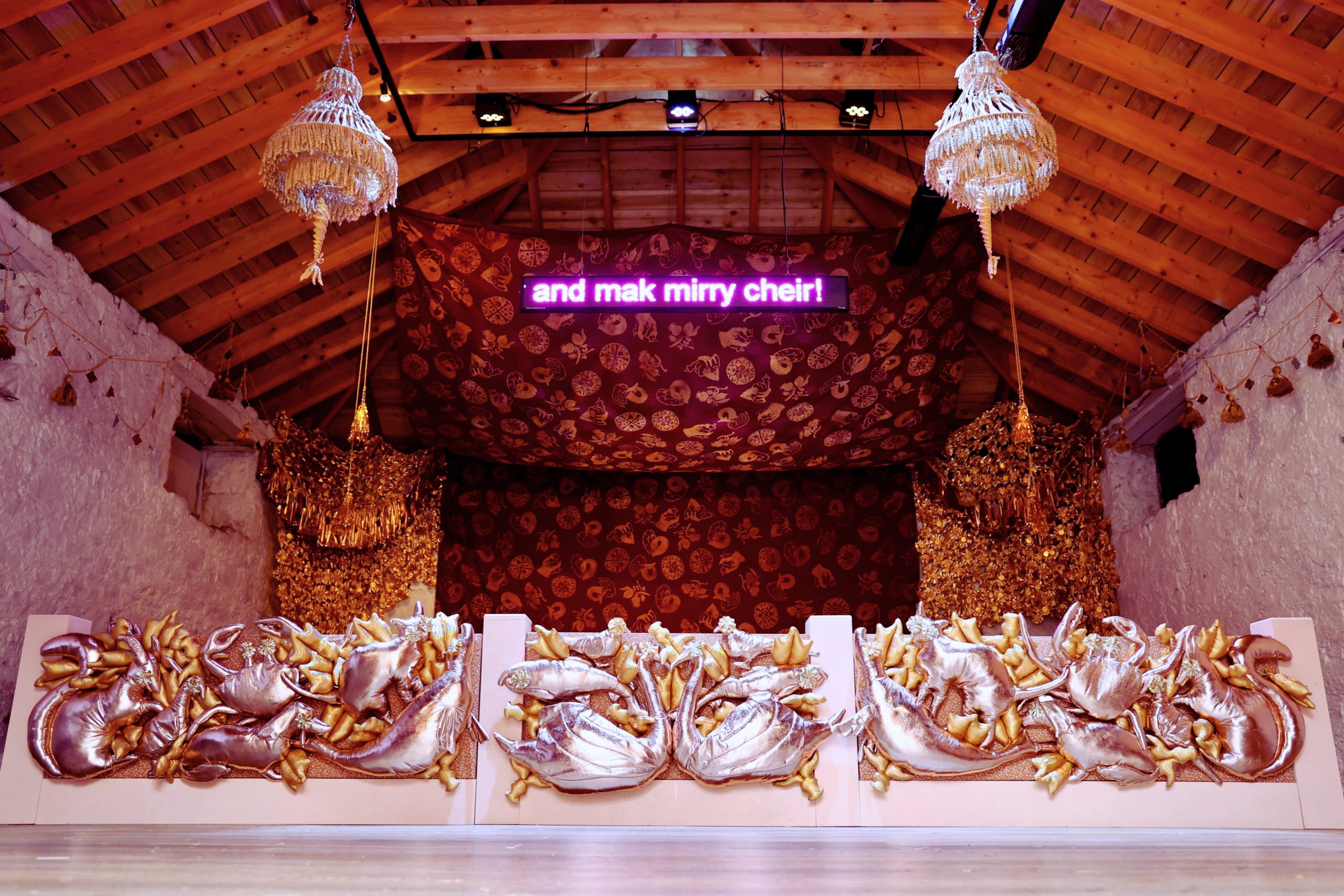
I enter The Straw Yard’s small barn-like space via a gold foil tassel curtain. Inside, plush platinum creatures – swans, fish, crabs, cats, seals and pigeons – adorn a low border marking the throne room’s boundary. I have an 11am appointment to be crowned queen as part of artist Lucy Wright’s Our Wic project with Create Berwick. Twists of gold-lamé with fake (chocolate?) coins in the middle flank the main backdrop. Maroon fabric hangs behind a gold circular stage covered with lino printed motifs. Above this a scrolling LED screen displays fragments of text. I catch ‘Refuse to be their commodity…’ Two corn-dolly style chandeliers hang on either side. An ambient soundtrack plays – Michael Nyman, I think. Here, whether in booked slots or dropping in unawares, Lucy welcomes new monarchs, photographing their card crown coronation and inviting them to name their new kingdoms. Next to a hay bale, a bronze crown is displayed on a cushion. On its surface are the forms of shells, ears of wheat, a bit of bike chain and a ring pull.
Before Lucy and I go to a café to talk about the project, I visit the other part of the installation. Around the corner, at Holy Trinity Church, photographs are shown of six ‘kings and queens’ nominated by the people of the town, each wearing a bespoke crown made by a Berwick craftsperson. The crowns are displayed here next to the prints, which are mounted on corrugated cardboard with the sides exposed.
Kate Liston: How did you find being here for short bursts across the last year? Did you get a sense of how the town ticks?
Lucy Wright: I must confess, I felt a little bit uncomfortable at the start, being that I’m not from this area. The brief was very much focused on creating something that speaks directly to Berwick and the people who live here. And I thought, ‘Am I the right person for this task?’ I’m really aware of that pitfall of artists being parachuted into places and seeking to speak for the local people when it’s really not their place to do so.
It felt important to me from the outset that I found as many ways as possible to invite people in so that it wasn’t just my voice, my interpretation of this place. I wanted it to be a shared thing as far as possible.
It’s a project of two parts. The first part was very much focused on getting to know people, getting nominations for who they felt were the contemporary royalty of Berwick.
KL: How did the nominations work?
LW: When we first came for the Salmon Queen festivities last July, I wanted to see how they did it and use that as inspiration for what I wanted to do. The thing that struck me from the outset was that the Salmon Queen celebrates the historical salmon fishing industry in Berwick, which for centuries was the main employment for local people. So it was kind of like, well, what are the contemporary industries and communities that make Berwick what it is today?
We had a stand at last year’s Salmon Queen Festival where we asked people to post their nominations and tell us who they thought ought to be crowned. We had lots of great suggestions and found that certain names and businesses got mentioned a lot of times. That made it easier to highlight a few people that we wanted to work with.
KL: So, you had these warm starting points for people…
LW: Absolutely. I also knew that I wanted to commission some local artists to be part of the project. I commissioned six local artists and craftspeople to make six bespoke crowns. In certain cases, the makers themselves had suggestions of who they might like to make a crown for. My favourite example was Dave Purvis who made the stained glass crown. He maintains the stained-glass windows at the Free Trade pub, and said, ‘I want to give my crown to Brenda, who’s the landlady’. That was one of those little moments of serendipity.
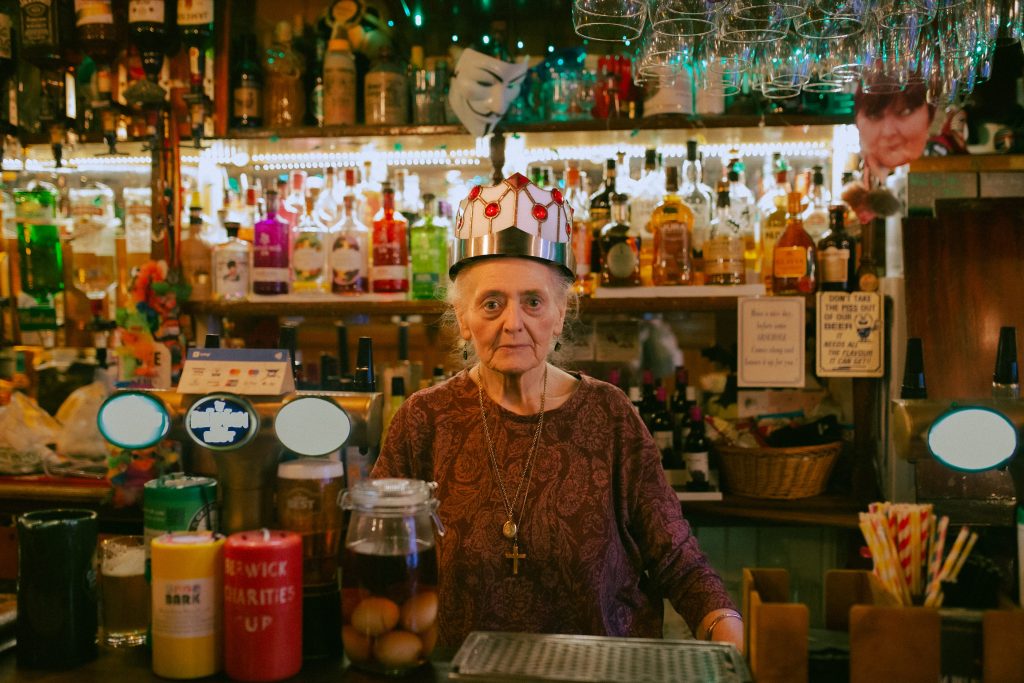
KL: I’m curious to know about the throne room, which I was very happy to have seen. I was crowned queen!
LW: Rightly so!
KL: What struck me about the installation is the visual exuberance, which runs through a lot of your work, and within that, very specific material choices and details.
LW: The Our Wic exhibition really came together on the day of the install. I was preparing materials over the last year and building bits of this at home, but I have a tiny working space. Making a work for such a large space – I’ve never done that before.
KL: Within that exuberance there are languages that relate, let’s say, to nostalgic ideas people might hold about what folk traditions look like. But alongside the straw we have gold chains and lamé. Materially, it feels like you are pushing at things.
LW: That’s pretty much the goal of my work in its broadest sense – to challenge and undermine, or expand, people’s stereotypes about what folklore is, what it looks like.
I define myself as an artist, but I’m also a folklore researcher, and I’ve spent the last fifteen years exploring, researching and documenting lesser-known community practices. The canon of materials that we understand as English or British folklore today is quite a limited collection in contrast to what is out there or what has been out there historically. Folklore is happening now and we’re all involved in it. The way we decorate our houses, the way we dress, the kinds of things we make online to send to our friends; you know, there’s so much folklore happening all the time, but we tend to view it in this quite narrow way, especially aesthetically.
I’m always looking to challenge the idea that folklore should be rustic and rural and polite and, you know, floral. I mean, it might be floral, but there is an edge to it that is quite political. But the actual throne room was inspired by the Palazzo Royal in Turin. I always wanted to make a throne room, but I wanted to make the Palazzo Royale throne room as if it was made on a budget by your local amateur dramatic society. I wanted to have that kind of handmade look to it, because I think there’s something really interesting about how people – especially working-class people – create opulence, glamour and luxury for themselves. There’s a whole lot of resourcefulness to create things that feel special when you don’t have access to a lot of resources.

KL: Photography is a huge part of this project. It made me think about whether social media – in the way that the Carnival Morris teams you’ve worked with probably share their performances on TikTok – offers hope for folklore. Can it allow people to capture these things as they are and not as one person documents it?
LW: I really like that. And it’s absolutely true that, in its kind of DIY sense, online culture is an incredibly fertile site for folklore. It’s a kind of new oral tradition that we’re getting digitally, which I think is really fascinating. There’s absolutely no contradiction for me between folklore and the Internet as a space or as a context for it.
KL: It’s been a long project, but a short run of the exhibition. Do you think Instagram can extend that timespan?
LW: I would love that. Social media has ended up being quite an important part of what I do. I see it as quite a folk space in its purest sense. I’m not a big fan of Meta, but as an idea, the fact that anyone can post their work and be sharing it with and growing an audience is quite beautiful to me and exciting.
Other projects that I’ve done in later years have ended up using the affordances of social media as part of the work. Things like Dusking, which functions as an online folk tradition. Every October 31st people share performances wherever they happen to be in the world, but they share it all at sundown, and it becomes this virtual folk tradition. It has grown organically and has this potential to be as big, or as small, as it needs to be every year.
KL: You had the crowns made by artists and craftspeople of Berwick, but could you speak more about your overall making processes?
LW: My dream scenario is to have a little atelier. At the moment, it’s just me and my partner and my mum. The lino printed curtains took ten hours, but there were three of us doing it well. I feel like the art world sometimes obscures the actual process that artists go through. We’re supposed to be magicians; you just generate this thing and no one asks where it came from. My whole life, my whole house has been taken over by this project. I’m not complaining. I’ve loved it.
KL: Part of the project has been highly involved with people. But you’ve had another interaction with the town, choosing textures for the bronze crown. I was picturing you spending time on your own, quietly gathering. Could you talk about how you did this?
LW: I really wanted to make a bronze piece. As a sculptor, it’s a rite of passage, isn’t it? I think for this project I was wondering, ‘What is the difference between the official narrative of Berwick and the unofficial everyday lived narrative of Berwick?’ We’re always creating our own kind of experiences and interpretations of place, depending on who we are and the body we inhabit and the communities that we’re part of. And so, I wanted to capture the unofficial Berwick and maybe the less celebrated things and to put that onto an object that’s going to last longer than I’ll be alive.

KL: How did the blackout poem come about?
LW: I’m not a poet, but a friend of mine, Kyveli Lignou-Tsamantani, has been doing a project about blackout poetry, which is something I’d not come across before. I took two important texts from Berwick’s history. One is the 1604 charter, which I think is one of the key documents that sets out that Berwick belongs to England once and for all. Then there’s an older text, a comic poem written in Middle Scots dialect from the time when Berwick was a Scottish town. I picked out different words to create a new charter for Berwick, speaking to what I hope are the kind of values of Berwick today.
I thought that was a fun process – not to use my words from my own head, but to actually be kind of excavating words out of existing texts to create something else.
KL: An assemblage of writing, like the way you work with sculpture and installation. Is there anything that we’ve not spoken about that you’d like to add?
LW: There are so many people who’ve been a part of this project that I probably won’t be able to list them all, but they’re all in the exhibition book. It has been very much a communal effort. I’m really grateful to all the people who were up for being crowned. And I’m grateful to the makers who I just think did such a beautiful job with the crowns. They’re all so different. That was a real pleasure to get to know some of the artistic community here as well.
And then obviously I’m really grateful to Create Berwick, who’ve been brilliant to work with. It’s my first go at a properly funded, biggish commission. I have loved it.
Kate Liston is an artist and writer based in Gateshead.
Our Wic was on at The Straw Yard, Berwick-upon-Tweed from 11 – 16 July 2026.
This interview was supported by Create Berwick.
Published 07.08.2026 by Lesley Guy in Interviews
2,065 words