The title of Holly Kilner’s exhibition, Excavation of a Traitorous Body, conjures feelings of unearthing parts unknown or setting out on a dangerous but noble quest. Indeed, Abingdon studios sits at the very top of the building which houses Abingdon Market in central Blackpool. It celebrates ten years of operation and provision of artist studios within the town. The only means of access is a series of stairs which, in the sweltering heatwave, made the ascent feel like a pilgrimage. Eager to discover what beauteous relics I was set to see I ascended the stairs.
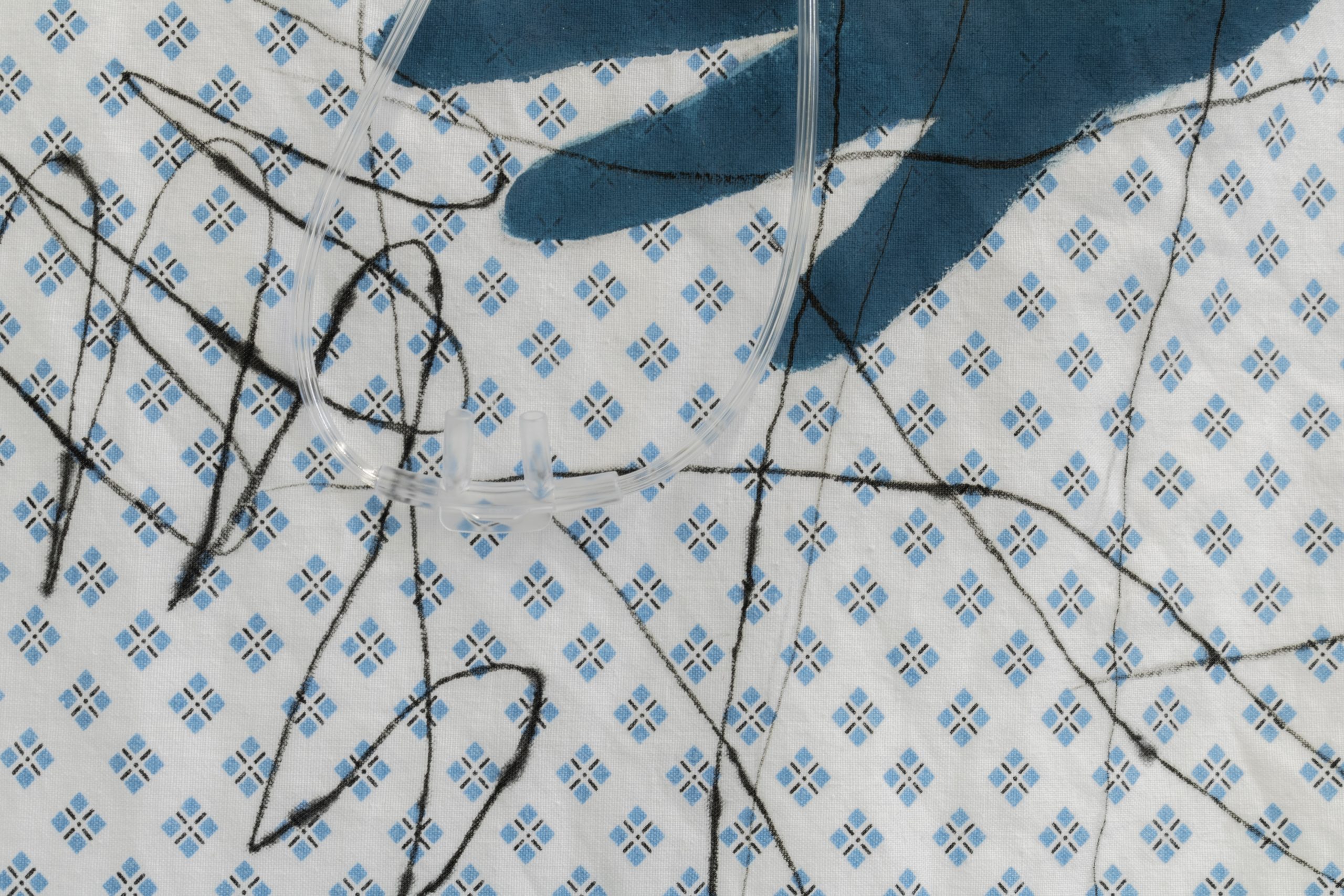
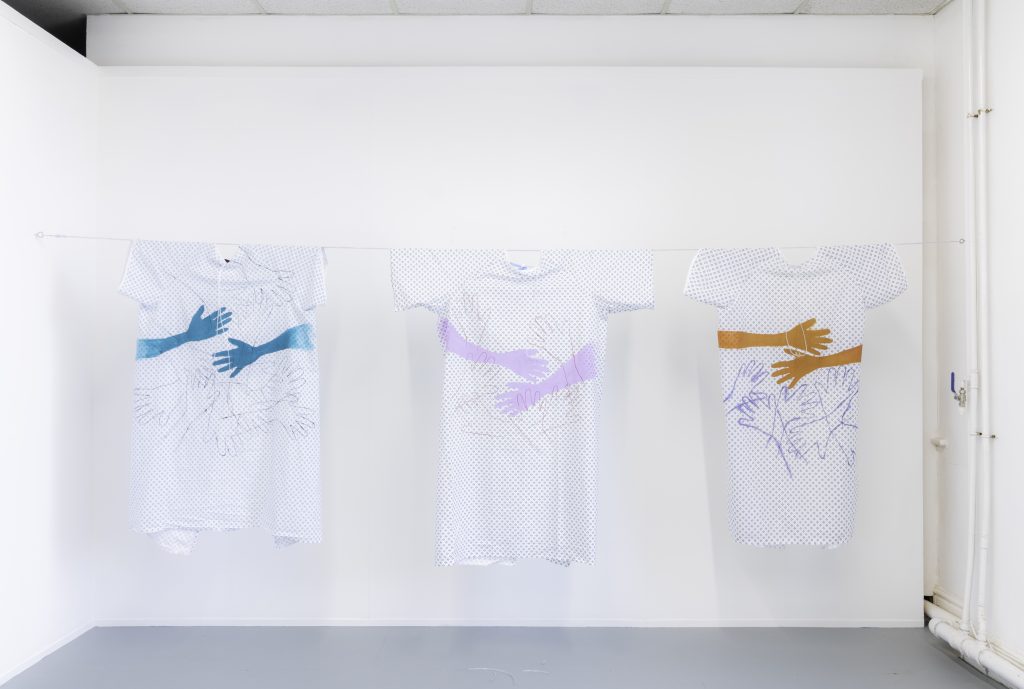
I meet Kilner and follow her up to a room of white, fresh walls, where we are immediately met with the image of three hospital gowns, an initially arresting and clinical image. This serves as a reminder of the room Kilner spent most of her time in during COVID, making various works for her dissertation and, in the time between hospital visits and subsequent surgeries, the germ of an idea for this show.
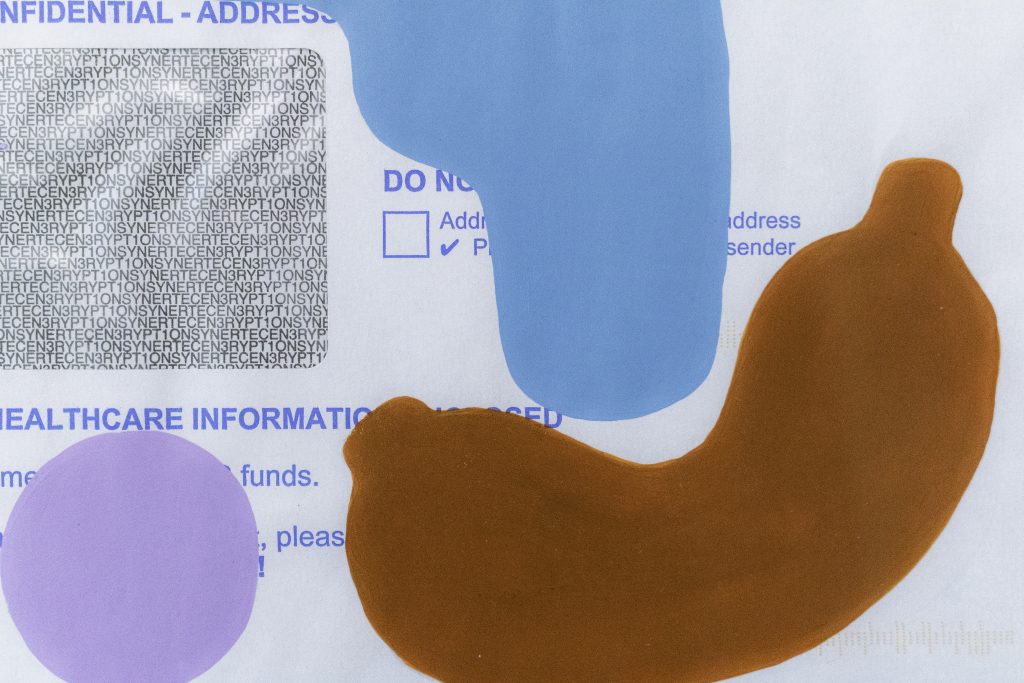
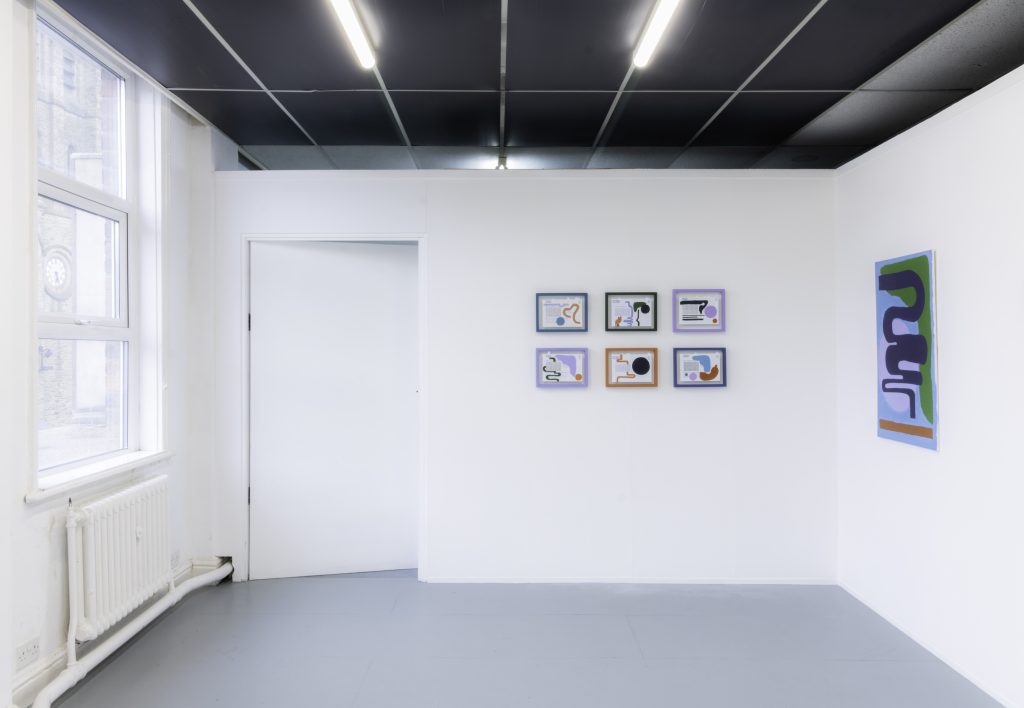
Kilner’s work is both intervention and obfuscation. Split into three distinct areas, we follow an autobiographical journey from diagnosis to intervention. On the left-hand wall can be seen what originally began as random doodles on confidential envelopes. Kilner’s ‘Self Portraits 1-6’ (2025) reflect the enforced anonymity bestowed upon her by an NHS number and bar code. Abstracted forms of stomach, bowel and liver distort the paper, playing with the space and filling it with a naive, bright wonder. Large black dots censor and obstruct. There is a whimsy to the shapes that juxtaposes the harsh nature of their contents. Appointments for consultations. Dates for surgery. Blood tests. It memorialises the loss of personhood felt by Kilner and the shift towards thinking of her body as an ongoing audit of malfunctioning flesh. These works reflect the very real need to separate the everyday reality of her pain with the realities of moving on and existing as someone with needs outside of the norm. Kilner refers to these envelopes as ‘violence through stationary’, stating that absent mindedly doodling upon the envelopes gradually became an intrinsic part of her meditative, therapeutic practice. Through these interventions, Kilner is attempting to take us outside time and into the liminal retreat of absent minded thoughtlessness, rather than painful reality.
Kilner has familial adenomatous polyposis (FAP), a genetic disorder which causes cancerous polyps to grow in the stomach, bowel, bones, skin and eyes. After years of feeling pain in her abdomen which was brushed off as period cramps and, at one stage, an accusation of alcohol misuse, a diagnostic endoscopy revealed a tennis ball sized tumour was blocking her stomach and duodenum. Subsequent genetic testing of the tumour and other polyps revealed the source of the pain. She became jaundiced due to complications with the liver and kidneys. Her stomach was removed. Her vision became obscured by harmless black dots caused by another side effect of the diagnosis, CHRPE (congenital hypertrophic retinal pigment epithelium).
The colours and abstract shapes move into a more formalised representation on the centre wall, the largest display space. The portrait oriented canvases ‘Dissection of the Human Condition’, ‘What if? Dark Blue’ and ‘What If? Periwinkle’ (all 2026) depict stylised images of the stomach. The white form on a dark blue background conveys a feeling of sadness. The darker form on a periwinkle background is reminiscent of a grecian urn. All three of these images are reminiscent of Georgia O’Keeffe or Joan Miró, the sumptuousness of the curved forms in stark contrast with the flat uniformity of the background. They have a pictographic resonance while also conforming to the seventeenth century Dutch vanitas, a reflection on emptiness and formlessness. Information is imparted through gesture, suggestion and the use of colour. Periwinkle for stomach cancer, emerald green for liver cancer, and kidney cancer is a deep ochre orange. Here, Kilner transitions from deliberate obfuscation to a more holistic view of the self. A body cannot and should not be defined by what has been lost from it, but accepting the grief of its passing shows strength. It is clear to me that excavation of her body has not been viewed as a desecration; while peeling back the layers of malformed tissue to excise and purify, Kilner venerates that which has been lost.
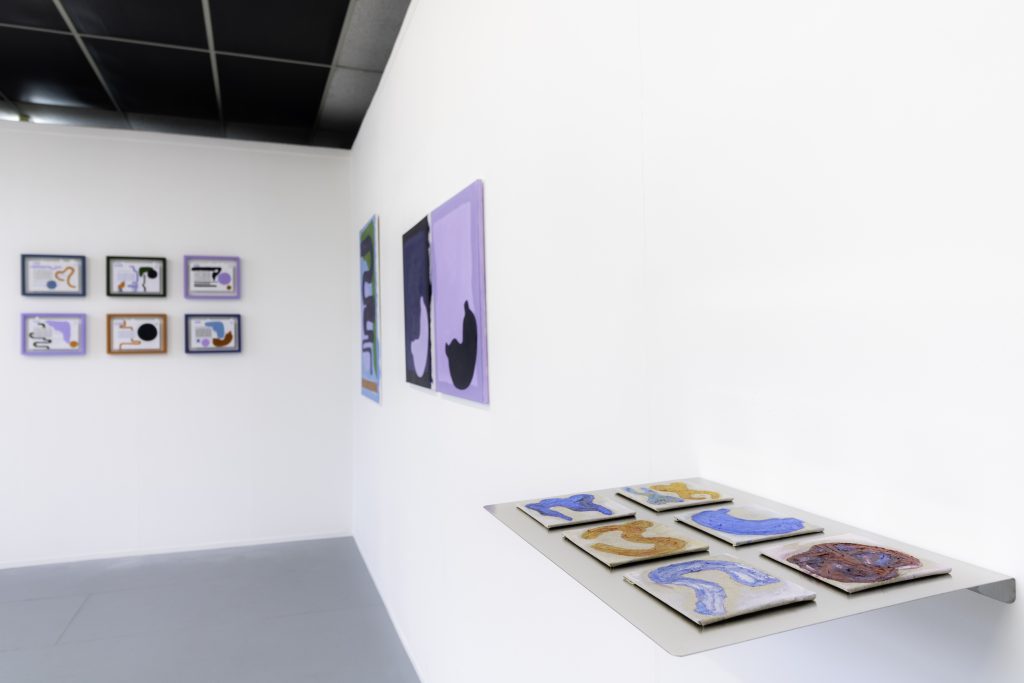
The accompanying piece to this set of portraits, ‘Necessary Loss’ (2026), features a shelf at Kilner’s abdomen height. A series of six small canvasses all containing brightly coloured blobby representations of organs. The paint is applied as thick, smeary and frenzied. The limited palette of emerald green, periwinkle green and ochre persist. These small depictions of body parts seem much more intimate and angry in tone. When asked about her influences Kilner mentions the post cancer works of Tracey Emin, and the way her work shows how anger is not the end of feeling but the beginning of a journey towards acceptance and joyfulness. Painful reality can be transubstantiated into visions of honesty and unapologetic, affirming depictions of that pain.
The last series in this collection, ‘Scar Memory I-III’, (2026) is on the wall the farthest on the right. These three hospital gowns hung upon the wall were the first thing I saw upon successfully ascending the stairs, but the clinical nature of the garments has changed through understanding the context and how they sit among the other works in the gallery. Here Kilner moves away from works on canvas and paper and becomes more sculptural in nature. Three hospital gowns are daubed in the same flat motifs, depicting interlocking hands. Some are in the same palette of ochre, emerald green and periwinkle as that which permeates all of the works but there are also outlines of other such forms. Kilner goes on to explain that these ‘ghost hands’ refer back to her mode of self-soothing at a time when human contact was impossible during COVID. These wispy interlocked hands also act as a visual metaphor of the pain Kilner was holding, and continues to do so now. A trinity of apparitions, like those of the fates or a coven of witches. There is power here along with the touch of the beyond. Kilner tells me that while in recovery, she had a near death experience. There was no pain, just blissful transience and warmth. In what could have been Kilner’s last garment, we see the hope of a new life on borrowed time, a reflection upon her time during COVID when Kilner could only be supported and comforted in spirit. The work shows that art made in isolation is just as deserving of an audience and a community.
Kilner’s work is at once a doorway to a sacred space of dissociation and a celebration of bodies as more than mere collections of cells. Thought, memory and spirit are not held in body parts. These works are not icons or idols, but a jubilant record of a person’s will to move their consciousness outside of time. Pain is a constant companion along the road of life and Kilner has dealt with a great deal of it, but rather than dwell on what has been lost we are invited to celebrate what is here. These works will the viewer to enter into Kilner’s much more joyous space, which is outside of time and grasps at life, clear in the knowledge of its hardships. Kilner is seeking to free the body from materiality.
Excavation is a discovery through unearthing and removing layers of history to reach a new understanding and truth. I broach the subject of legacy with Kilner and that these works may also be interpreted as a kind of memorial. They have the potential to outlast her. There is a moment of stillness which shocks me given the animated, zesty exuberance Kilner has shown me up until now. But her work and demeanour are the opposite of maudlin. It can be a tired and overused notion that process becomes therapy, one I fear is perpetuated by the commercialisation and capitalist notions of normality. If you are not productive or fit for work you are thought less of. It seems that work is deemed the only means of improving self-esteem and anxiety by those in power, and therefore by society as a whole. Kilner’s work seeks an alternative vision of what normal is; inclusive, accessible and free of the confines of what it is to be a ‘normal’ body. This level of basic humanity shouldn’t need to be explained.
Our final chat over coffee and a chocolate cookie turns to the notion of destiny. Is this traitorous body set to offer up the ultimate betrayal? ‘Death is just admin, life is to be lived’, says Kilner. Her work is a process of embracing hardships and seeing them as unexpected surprises. At first, I thought that the cheerfulness of the work might be hiding a deeper truth, which needed to be excavated through studying the pieces. What I actually came to realise, is that it is the empowered choice of someone meeting her health with honesty, acceptance and joy.
Holly Kilner: Excavation of a Traitorous Body, Abingdon Studios, Blackpool, 24 Jul – 17 Oct 2026.
Even Allen (AKA That Looks Queer) is an art writer and critic based in Sheffield.
This review is supported by Abingdon Studios.
Published 15.09.2026 by Jazmine Linklater in Reviews
1,621 words


