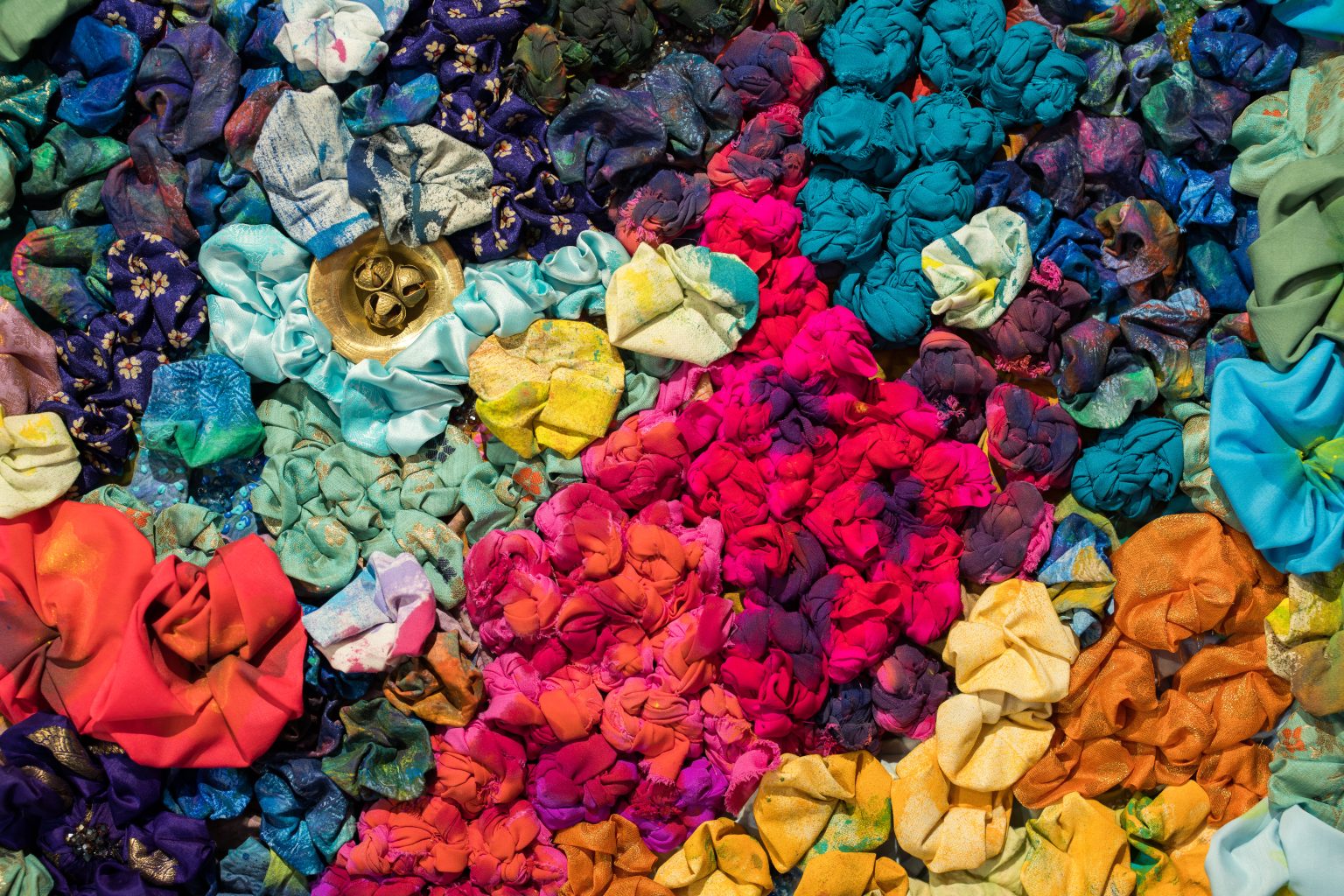
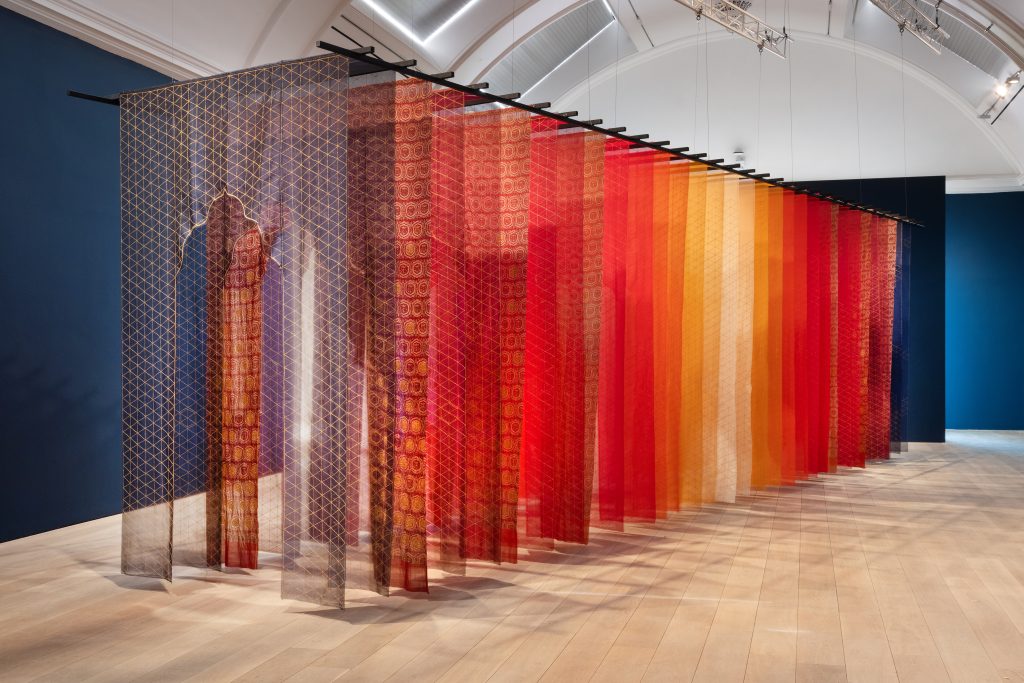
The first installation I encounter in the Hyundai Translocal Series: Entangled and Woven at the Whitworth is Jounghye Yoo’s ‘Gilded Veil_A Mysterious Curtain Lightly Draped in Gold’(2025). I walk through a tunnel of cotton and silk panels with golden embroidery, its archway inspired by the gate of the Vishwanath Temple in Varanasi, Northwest India. The organic shapes and floral patterns of the cotton were made in Gujarat with the Ajrakh technique, an ancient form of block-printing using natural blue and red dyes, while the translucent traditional silk originates from Gyeongju. Yoo’s pairing of textiles from India and South Korea, resulting from her collaboration with Ajrakh printer Dr Ismail Mohammad Khatri, unites locally situated artisanship across national boundaries. A passageway of cloth glimmering in the gallery, ‘Gilded Veil’ is a portal into the exhibition’s world of traces and threads.
Entangled and Woven has travelled from the Cheongju Craft Biennale 2025 to the National Crafts Museum and Hastkala Gallery in New Delhi, before coming to Manchester. It is the first show of the Hyundai Translocal Series partnership initiative, which funds cultural institutions to work together on a specific thematic inquiry to forge connections between Korea and other parts of the world. Cheongju Biennale and the Whitworth, The University of Manchester, commissioned eight Korean and Indian artists and collectives to respond to the theme of Craft and Community, celebrating the two countries’ heritage of diverse artisanal traditions and vibrant textile production.
The Whitworth’s involvement stems from its internationally significant collection of over 20,000 textiles, and historic examples from South Asia and Korea are interspersed with the eight contemporary installations. They act as a reminder of Manchester’s own textile industries and involvement in global trade systems shaped by British imperial exploitation. Expressing a commitment to transparency about the collecting of museums and a decolonial desire to restore information about their provenance and unique cultural significance, the display of these textiles also underscores the Hyundai Translocal Series’ efforts to cultivate more equitable and non-extractive relationships between textile-makers, artists and public institutions across the world.
Upon arrival, I can smell smoke in the air outside from the moorland fires and the entrance to the show is flanked by two floor fans to cool the space during the heatwave. Gallery assistants carry handheld fans to pair with their lanyards. A continuous whirring is the soundscape of my experience of this motor company-sponsored exhibition, and such reminders of the accelerating climate crisis add an edge to its core theme of interconnectedness. Yet this is also a reminder of the importance of the collaborative methods and community empowerment showcased across the three exhibition galleries, with artists enacting a deep appreciation for local craft and prioritising sustainability in recognition of our global interdependencies.
The participating artists undertook field studies and research trips to Korea and India to learn more about craft processes and textiles that they might integrate into their own ways of making and thinking. Amy George, Senior Curator of Collections, Textiles and Wallpaper at the Whitworth and Jeeyoung Lee, Senior Curator for the Cheongju Craft Biennale, advocate for a perspective of craft that moves away from viewing its practitioners as living repositories of endangered traditions. Instead, they characterise craft as evolving and potentially experimental, fostering critical inquiry beyond the preservation of heritage to advance conversations about how textile art can celebrate localism in globalised contexts, challenge imperial frameworks of knowledge-production and commodification, and deconstruct a reductive opposition of tradition and innovation.
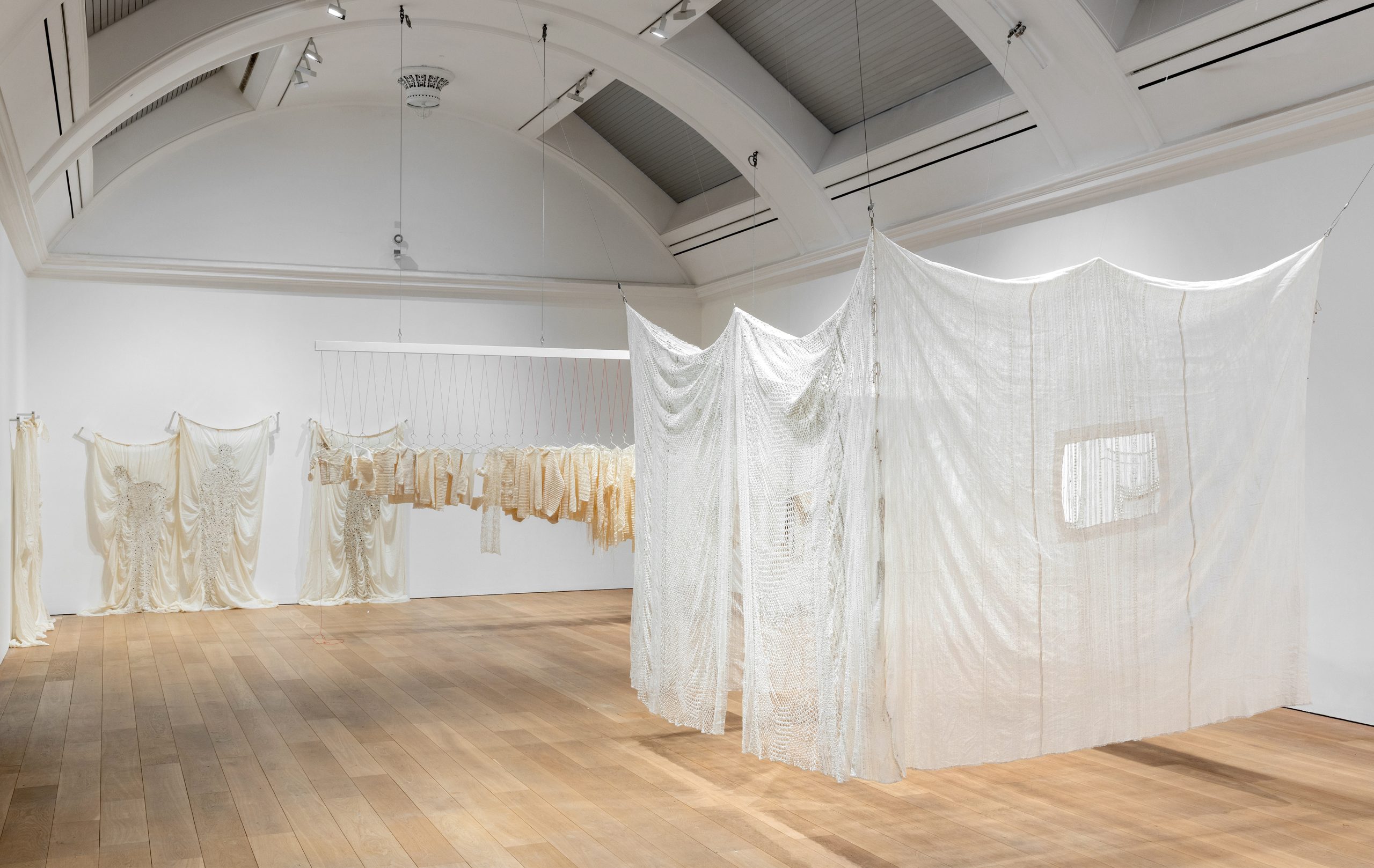
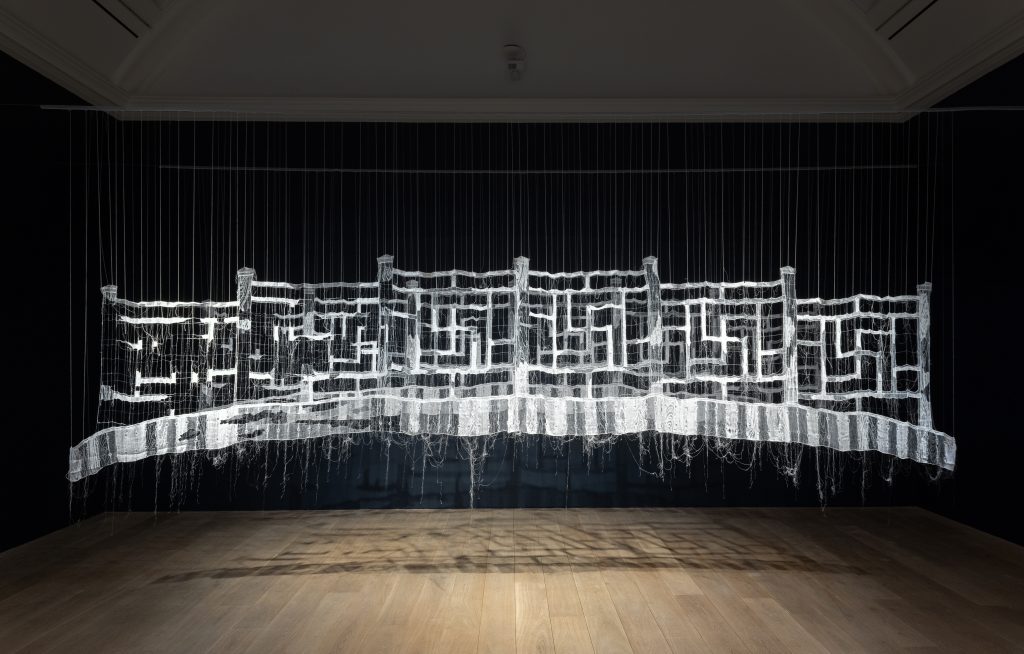
Collectively the installations interlace cultural reciprocity, extending across shared techniques, conceptual approaches, and material inspirations. Architectural motifs are rendered ethereal through their translation into cloth and thread. In the gallery to the right of ‘Gilded Veil’hangs PÉRO fashion collective’s ‘Entangled Memories, Interwoven Stories’ (2025). A multi-seamed white tent, it evokes royal enclosures and jalis, a Hindi word for the latticed screens and windows found in Indian and Islamic architecture. It was assembled by stitching into fabric and water-soluble paper that was later dissolved to reveal a delicate structure. Sumakshi Singh has also used soluble backing to create a ghostly embroidered bridge suspended along gossamer strands in the gallery on the opposite side, which the artist describes as an ‘almost cobweb-like registration in the air’. Turning material form into this apparition, Singh’s ‘Spanning the Void’(2025) conveys the visionary potential and resilience of ‘intercultural bridges’ but also a poignant sense of their vulnerability.
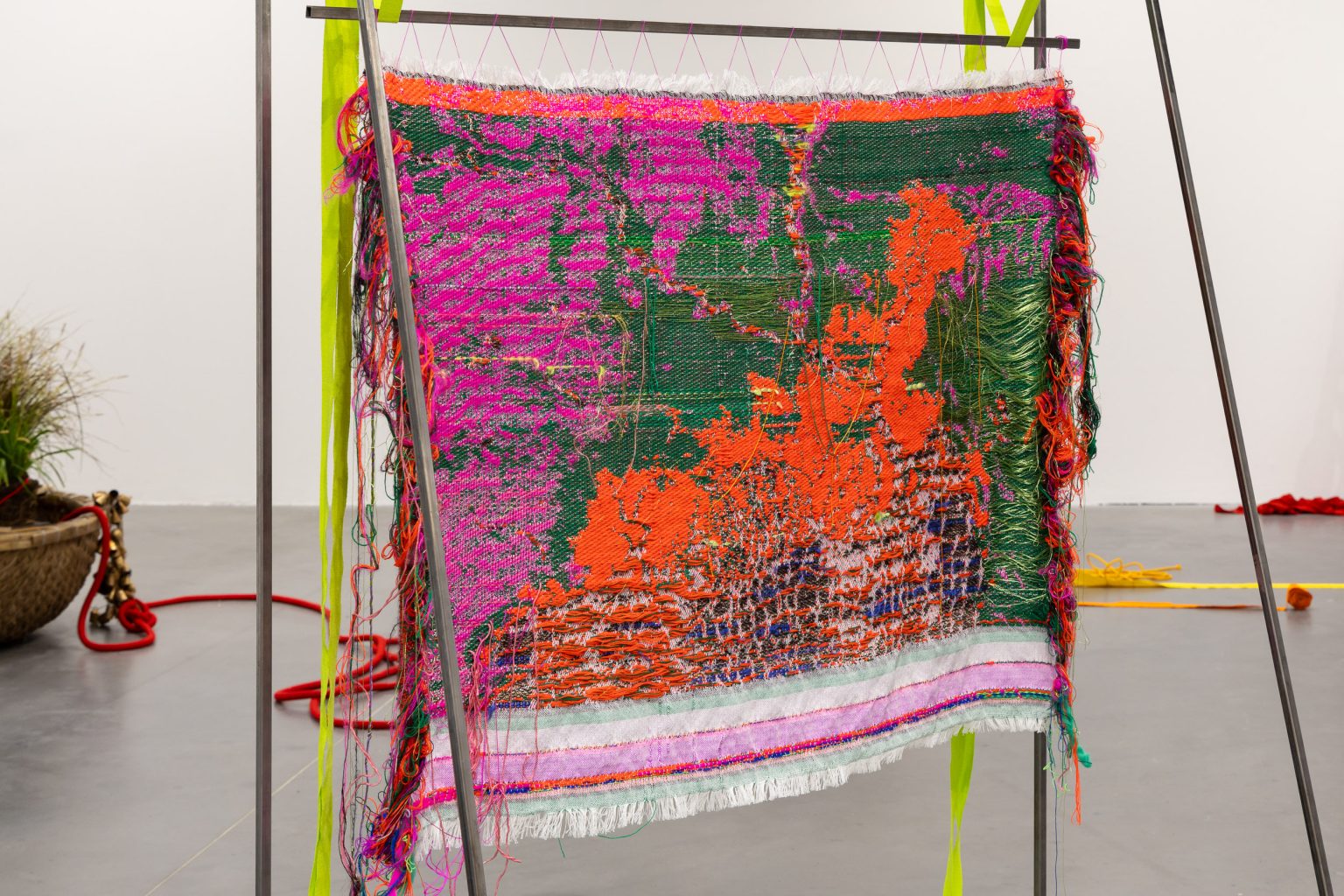
Yeonsoon Chang and Kaimurai’s artworks are appropriately placed next to each other nearby Singh’s bridge. Both artists view their artistic processes as meditative and spiritual rituals and employ indigo as a deep-tinted dye or pigment. Kaimurai has also used water in the creation of ‘The Answer to All My Prayers Are in the Questions I Never Asked’ (2025). Radiating and pierced spherical forms are drawn with indigo-based paint onto wet cotton khadi, a handwoven natural textile that is strongly associated with India’s independence movement, derived from the Hindi for coarse cloth. A smooth round stone over which a bronze bell hangs by a string is positioned on a plinth, leading the eye to the textiles which are arranged like a succession of banners in an ascending order, held up by wire. The artist likens this progressive elevation to a set of steps that lead into a deeper sense of calm. Just beyond Kaimurai’s piece, Yeonsoon Chang’s geometric sculptures from her Woringcheongang series are indigo-ridged planes and slender pillars made from dyed and stiffened fabric woven from abacá plant fibres, a species of banana, and applied with gold leaf. Worincheongang is a philosophical concept from Buddhism that means ‘the moon reflected on a thousand rivers’, expressing ‘unity beyond boundaries’ in the moonlight strewn across the world from one source.
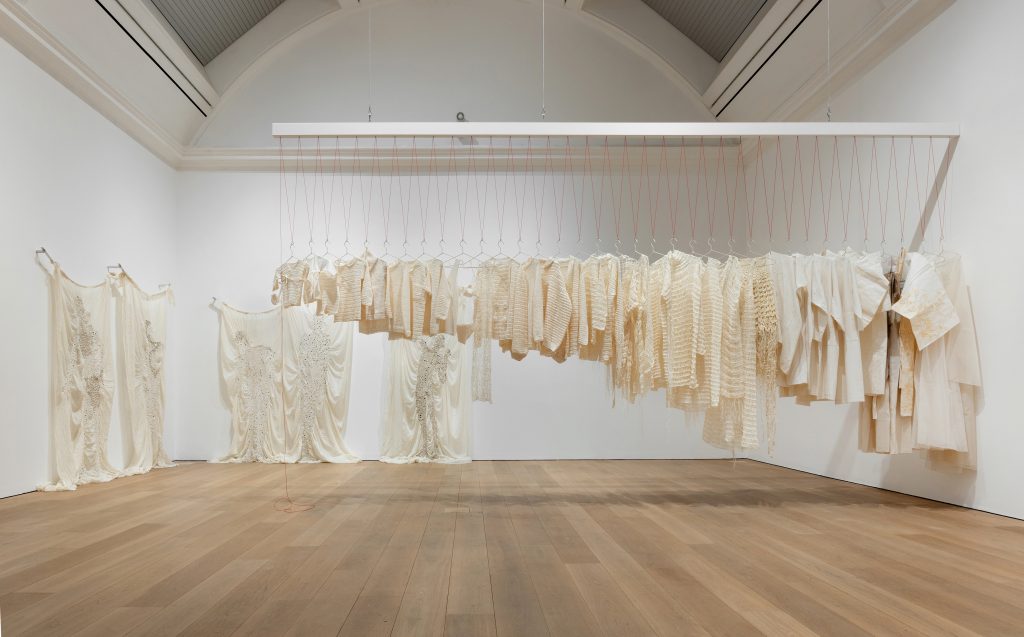
Somi Ko’s installation in the third gallery captures what she describes as ‘the quiet traces of individual being’ in the exhibition’s accompanying artist film. ‘People of One, Continuum’(2025) is a rail of thirty-five white garments on hangers hooked into a red cord, from baby-clothes to dresses, jumpers and long robes. The shifting sizes and shapes of these items are an intimate record of an individual’s body and identity as they change over a lifetime. Each piece is woven from hanji, traditional Korean paper that Ko experimented with to develop her own kind of woven textile. In ‘People of One, Moment’(2025), Ko has used Indian mirror embroidery for the first time, which possesses a protective and spiritual function of warding off evil spirits. Contrasting with the contemplation of the trajectory of one life, this piece seems to conjure collective movements. It consists of large white sheets pinned up on the wall, each with a human form in different poses made up of the tiny round mirrors sewn into the fabric. The figures appear to dance as I approach, and my own physical presence is incorporated into the artwork through my fragmented reflection.
On the other side of the gallery, Young In Hong’s two artworks both foreground animals to probe the boundaries between the human and the more-than-human, and their different inhabitation of place. ‘Sacred Empires’(2025) presents five patchworked flags together, each representing five animal nations, also featuring mirrorwork, appliqué and embroidery. Such a range of techniques and materials brings attention to the creative agency of the women artisans Hong worked with from Kala Raksha, a grassroots collective in Kutch, India. Each chosen animal – elephant, crane, penguin, butterfly and owl – has numerous different species that find their homes across multiple continents. I wonder whether these flags, objects that project national symbols and attend embassies, armies, or political negotiations, are intended to express humanity’s kinship with animals or suggest the arbitrary nature of states and their borders, boundaries that are meaningless from a non-human perspective.
Nearby, ‘White Cranes and Snowfall’(2024) appears to support both interpretations. Collaborating with straw-weaving master Choong Kyung Lee, Hong has created eight pairs of triple-taloned boots woven from sedge for the migratory cranes that she observed during a research trip to the demilitarised zone between North and South Korea in 2023. Perched on a pool of white sand, each shoe’s special design details and angled position creates the impression of unique shapes, sizes, and even strides for each of these absent cranes, from flat-footed sturdiness to tip-toed elegance. Within the ability of a human-imposed zone of violence to act as a peaceful site for rare birds and nature-spotting, Hong’s piece represents a ‘hybrid territory’ where humans might learn from the perception of animals, detached from fixed and contested territories and ecologically destructive conflicts over them.
Moving from real animals to mythical beings, on returning to the first gallery I come across the sculpture of a legendary creature from Boito, a heritage textile company founded by Richa Maheshwari in 2022, based in the Indian state of Odisha. The ‘Asareeri,’ part of the Navagunjara series (2025), is a composite of nine animals, with each limb made by local craft communities across the region. A being originating from a fifteenth-century poetic version of the epic Mahabharata from Odisha, each part of the Navagunjara embodies a unique local heritage and craft. One hind elephant leg, for example, is fashioned from dhokra, a method of metal-casting from Dhenkanal. A rooster head and a human arm presenting a lotus, as if to the gallery visitor, are made from papier-mâché and decorated with the intricate fauna and mythological motifs of pattachitra from Raghurajpur, a distinctive form of painting on cloth. Although a highly localised celebration of craft rooted in Odisha, the Navagunjara’s multiple fragments fuse into one entity, communicating the same sense of underlying unity that Yeonsoon Chang seeks to uncover with her moon sculptures.
On the wall nearby is a video depicting the similarities Boito discerned between the laborious tasks of handmaking two kinds of textiles, kerang or bark cloth in Koraput District, Odisha, and ramie cloth, also made from plant fibre, in Seocheon-Gun, South Korea. Encouraging my attention to shuttle back and forth between each place and pick out their parallels, the film visualises the textile-makers’ cycles of labour inside the gallery space, from harvesting the plants to preparing the yarn and weaving on handlooms.
The historic textiles from the Whitworth’s collection play a supporting role, with most of my attention captured by the contemporary installations. They provide insights into continuities of making as examples of the techniques shown throughout the exhibition, such as mirror embroidery, indigo dyeing, block-printing, or offcuts of ramie cloth patchworked together for thrift. Object labels aim to reveal the impact of empire and global trade on textile production and the collecting practices of museums. A sample of eighteenth-century chintz cloth points to the increased demand for Indian cotton across Europe as the East India Company extended its control over the subcontinent. A celebratory Gujarati door hanging from a Diwali festival was once owned by a British silk dyer and included in the Manchester Royal Jubilee Exhibition of 1887, and the old cursive label of a skirt fragment records its provenance as ‘Lahore, India’ rather than Pakistan, indicating that it was acquired before partition in 1947. Embedding material records of these complex histories amongst contemporary art frames the exhibition as a contemplation of the legacies of industry and empire, and expresses the curators’ description of textiles as tactile interwoven narratives.
Before I leave the exhibition, I keep coming back to Sumakshi Singh’s poised bridge, and its poetic ambiguity regarding points of connection. I try to decide whether it seems to be disappearing or appearing. Is it on the verge of disintegrating or in the process of materialising? Acknowledging the tensions and power disparities of cross-cultural interactions across time and space, Hyundai Translocal Series: Entangled and Woven is inflected by this metaphorical uncertainty. Nevertheless, a tentative optimism accumulates through my awe of the sheer diversity and beauty of the Indian and Korean textiles I have seen, and the trust demonstrated between the commissioned artists and their collaborators. With this solidarity on display, the show proposes flexible and generative iterations of local and global community, enacted through textile art and the dexterous hands and embodied expertise of their makers.
Hyundai Translocal Series: Entangled and Woven, the Whitworth, Manchester, 10 July 2026 – 3 January 2027
Iona Glen is a writer and researcher currently based in Cardiff. Her mother’s family has lived in West Cumbria since the 1970s.
This review is supported by the Whitworth.
Published 05.09.2026 by Jazmine Linklater in Reviews
2,127 words