Jason Wilsher-Mills describes his work as “Think I, Daniel Blake meets The Beano”. I’m so glad he didn’t say The Dandy. I was never a fan of the Texan Desperate Dan and his cow pies. I much preferred The Beano’s mischievous Dennis the Menace and the other misfits that looked as though they’d been pulled directly from my primary school class photo. Perhaps I recognised myself in Dennis’ world of water balloons, catapults, practical jokes and a feeling that adulthood was something to be resisted rather than respected. Not because I inhabited Beanotown, but because I grew up with my own cast of accomplices and there may have been an incident involving eggs and a neighbour called Eileen.
Recognition, I suspect, is where empathy begins. We rarely encounter ourselves exactly in art. Instead, we find fragments: a shared joke, a class sensibility, a remembered feeling. Dennis the Menace was not me, but he was sufficiently adjacent to my own experience for me to enter his world. Standing in Wilsher-Mills’ exhibition at Attenborough Arts Centre, I find myself wondering whether the same principle applies when the apparent distance between artist and audience is much greater.
Wilsher-Mills is an artist from Wakefield, West Yorkshire, whose work openly explores his lived experience of disability and the life-changing effects of childhood illness. On paper, there would seem to be little common ground between us. I arrive at the gallery in training for an ultramarathon with a body that has generally been privileged by health, mobility and athleticism, but which is also beginning to experience decline. Through age, injury and a post-Covid loss of form, I find myself increasingly negotiating with a body that no longer shares my ambitions. Yet even this feels a long way from the world Wilsher-Mills reconstructs.
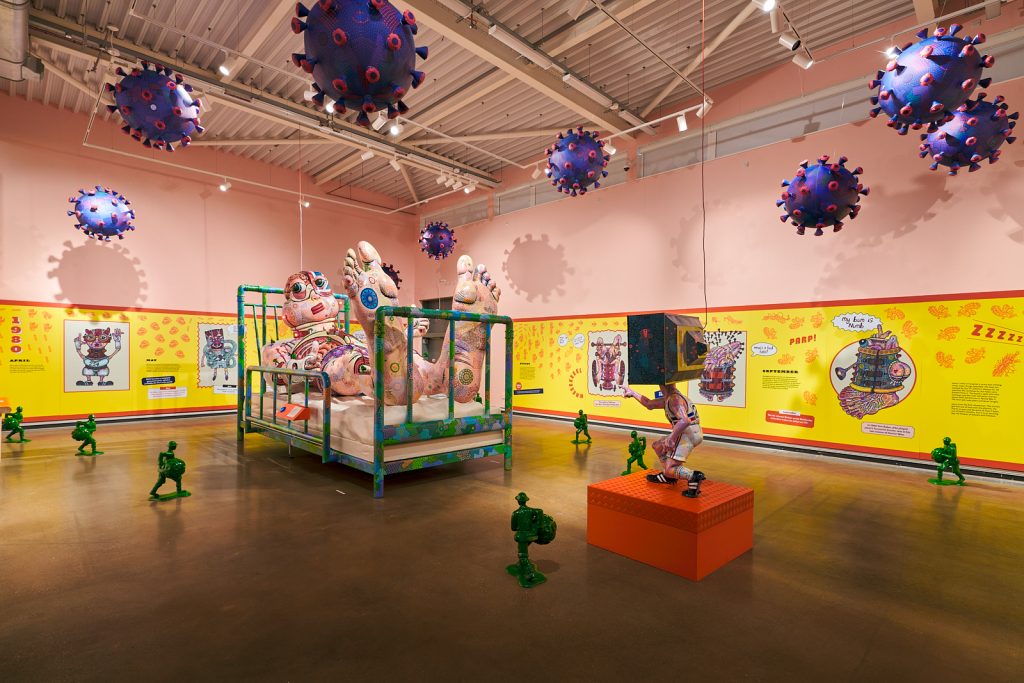
Entering Attenborough Art Centre’s main gallery space, visitors are greeted by an oversized sculpture of a bed-bound figure. Traced across its surface are illuminated neural pathways, fairground bulbs mapping routes from head to toe. Most striking are the enormous feet. Their exaggerated scale recalls prehistoric fertility figures such as the Venus of Willendorf, where bodily proportions are distorted to emphasise significance rather than anatomical accuracy. Here, they reference the artist’s childhood memories of sensory pulses travelling through his body and concentrating in his feet, which he remembers “felt huge”.
Across the gallery floor, enlarged toy soldiers advance, carrying with them virus cells. They appear to be marching towards the body rather than defending it. Something is going wrong. In 1980, aged eleven, Wilsher-Mills contracted chickenpox. The virus attacked his central nervous system, leaving him permanently disabled and reliant on a wheelchair.
The gallery walls are painted the sickly pink of a children’s hospital ward. We are transported into this formative moment; invited not simply to witness it, but, in some strange way, to experience it through the peculiar logic of memory. For Wilsher-Mills, the exhibition is perhaps an attempt to process these experiences. “I didn’t realise I had PTSD,” he explained at the exhibition opening, adding that it was only through counselling undertaken during the development of the work that he recognised its lasting effects. “It’s not maudlin, it’s created with humour,” he says, before qualifying the remark: “My Dad would have said ‘it’s too daft to laugh at’.”
Sculptural virus cells float from the ceiling above us and reappear in the gallery shop as fluffy keyrings with googly eyes. Throughout the exhibition there is an absurd tension between the gravity of the subject matter and the joy with which it is approached. Catastrophe is never allowed to settle into tragedy. Humour repeatedly interrupts. Returning to the body, we find a fusion of comic-book graphics and anatomical cutaways inspired by medical illustrations from the Wellcome Collection, who commissioned Wilsher-Mills to develop the exhibition. It is as though the child-Jason is trying to understand what is happening to him through the visual languages that are available to him: comics, toys, hospital diagrams. Childish Y-fronts compete for attention with cumbersome medical corsetry, creating a collision between adolescent imagination and clinical intervention.
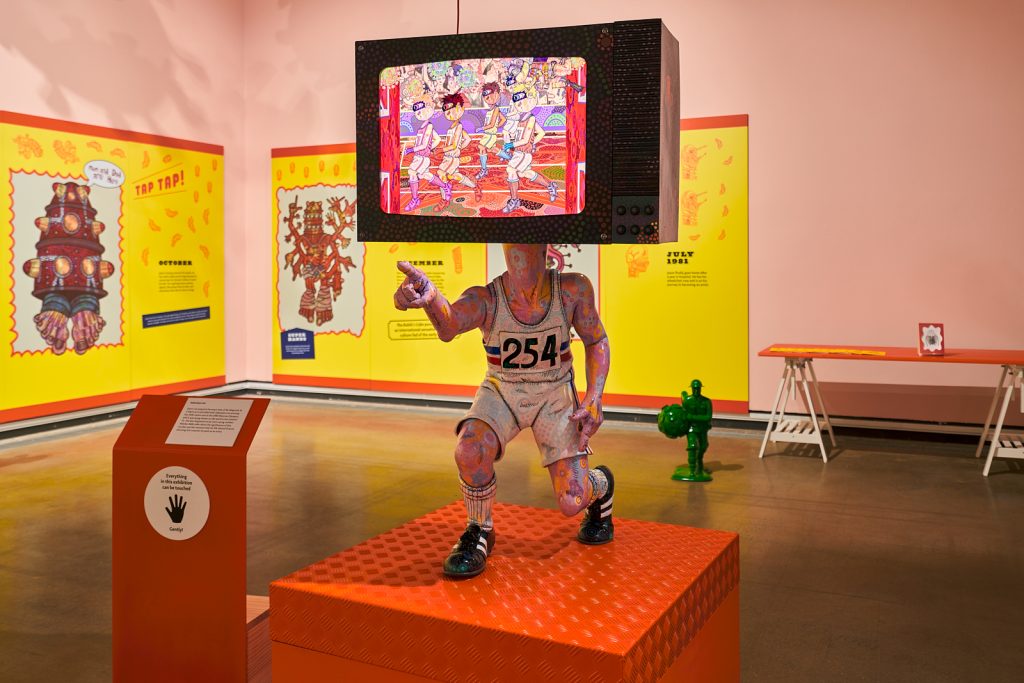
A colourful patina covers the humungous body. I find it difficult to look at, provoking a faintly trypophobic, skin-crawling sensation that perhaps mirrors the irritation of chickenpox itself. The arms are raised in a double-handed pointing gesture reminiscent of The Fonz from Happy Days, a television fixture of the period. Returning the gesture, like an echo of Michelangelo’s ‘Creation of Adam’, is the figure of an athlete with a bulky television set for a head. We learn from the interpretation material that television was one of the main ways that Jason marked the passage of time during his long stays in hospital.
The figure is British athlete Sebastian Coe.
This is what I have come for.
The exhibition’s title alludes to a precise moment: 2.54pm at Pinderfields Hospital in Wakefield on 1 August 1980. Lying in bed, Jason overheard his parents being told of his diagnosis. At the same moment, on a television at the end of the ward, Sebastian Coe was winning the gold medal in the 1500m at the 1980 Summer Olympics, wearing race number 254. The chickenpox patina spreads across both the television and the athlete. Coe once referred to his backward glances down the final straight as being driven by running in fear. Here he appears caught between aspiration and threat, as though he might outrun the virus itself.
As a runner, I find this moment unexpectedly affecting. My own relationship with physical decline has been slow and negotiated through injury and diminishing expectations as I age. Wilsher-Mills presents something very different. The athlete and the diagnosis occupy the same instant. A body capable of almost anything flickers across a television screen just as another life begins to take an unforeseen direction. Much of the exhibition can be understood as an attempt to revisit and digest a specific year: 1980. Emblazoned around the gallery walls, the ‘254 Wall of Facts’ charts the progression of Wilsher-Mills’ illness alongside events from the wider world. Inspired by the bumper annual editions of The Beano, personal memories sit alongside national headlines and fragments of popular culture: the threat of an iron lung, Tom Baker’s final season in Doctor Who, UK unemployment reaching a 44-year high.
Time in the exhibition is measured less by calendars than by the television. Confined to a hospital bed, Wilsher-Mills experiences the outside world through broadcasts, headlines and children’s comics. TV becomes both clock and companion, marking the passage of days while offering a temporary escape from them. The exhibition adopts the same logic, reconstructing memory via a collage of images, stories and cultural touchstones through which a child might attempt to understand the trauma of what was happening to them. Wilsher-Mills adds, “The work is like a form of time travel, where you can still experience something you felt or thought as a child.”
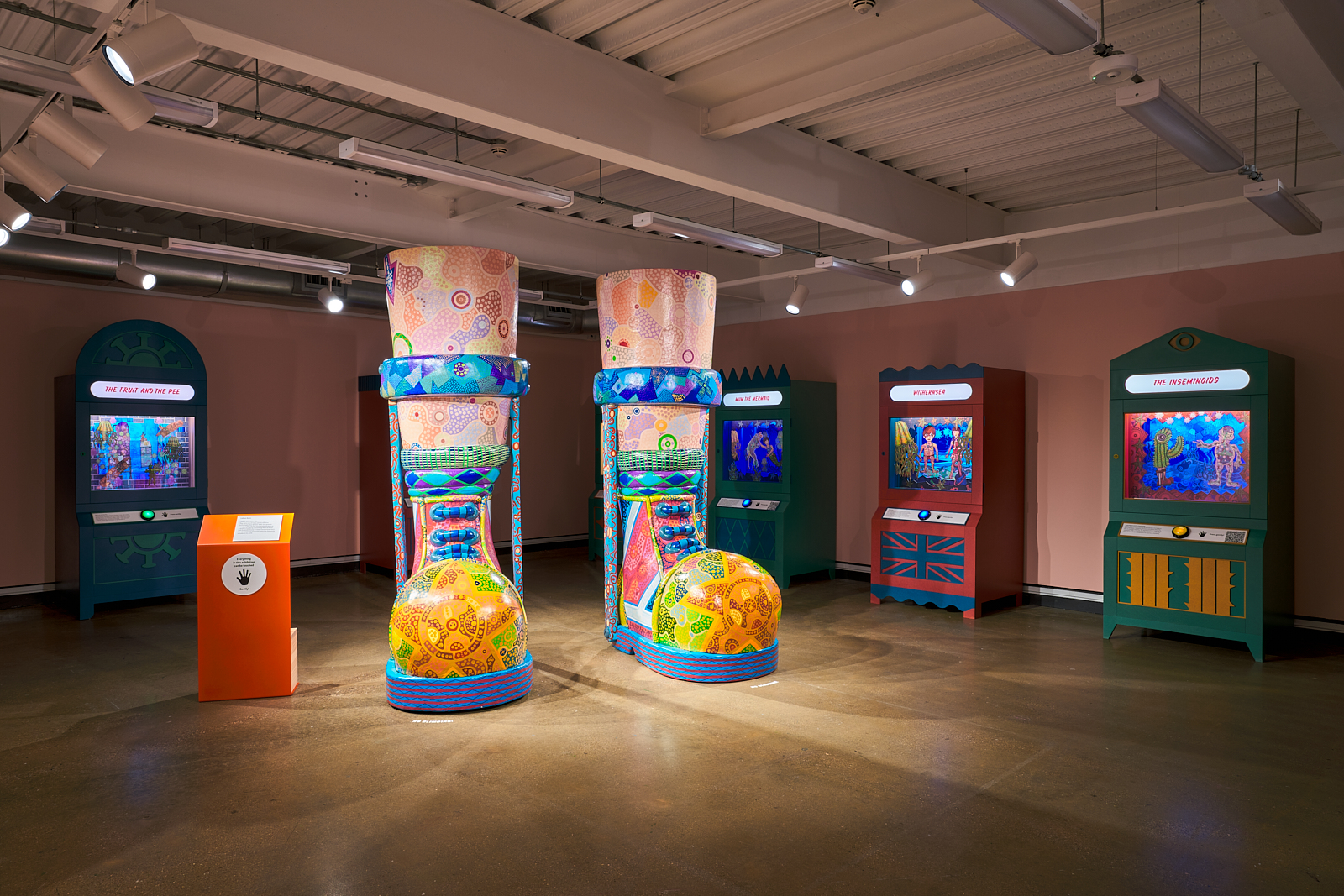
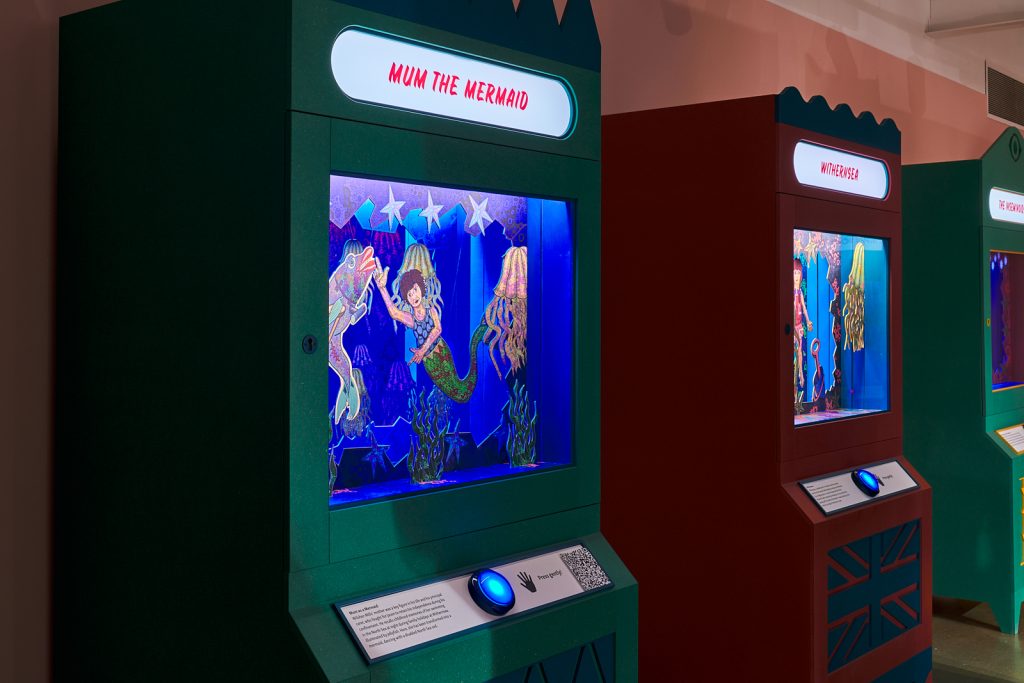
In the smaller adjacent gallery, nine illuminated dioramas surround a monumental pair of calliper boots, a recurring motif in Wilsher-Mills’ work. Housed within arcade-style cabinets and activated by push-button controls, the dioramas recall the amusement machines of childhood seaside holidays, found in places like Withernsea for Jason or the “Honky Tonk” arcade in Hunstanton for myself. Visitors are invited to “Press the buttons to activate Jason’s inner life”, perhaps the clearest expression of the exhibition’s ability to transform memory into something tangible, playful and shared.
These dioramas possess a delicacy that feels distinct from the larger sculptural works. There is something of the draftsperson here; a quality that seems closer to the anatomical illustrations and watercolours many will be familiar with at the Wellcome Collection, than to the bold graphic language of the comic strip, even though many of the stories themselves remain gloriously mischievous.
In ‘Withernsea’ (2024), the child Jason plays on the beach with a bucket and spade alongside his sister while virus cells loom ominously on the horizon. In ‘Trinity’ (2024) , we learn that before his illness, Jason was a talented rugby league player and captain of his team. Here, Wilsher-Mills imagines a parallel universe, exploring what his life might have become had illness not intervened. It is one of the few moments in the exhibition where humour gives way to something more wistful. The mood quickly shifts in ‘The Fruit and the Pee’ (2024), which recounts the tale of a brother-in-law who habitually helped himself to the fruit left by Jason’s hospital bed. One day, he unknowingly ate an apple that had earlier been covered in urine—a pure Beano moment.
Addressing the audience at the exhibition launch, Wilsher-Mills explains that he had eventually met Sebastian Coe and that “he was a lovely man”. Afterwards we shared a laugh about the moment many households across the country discovered that their childhood sporting hero was, in the words of my Mum, a “Tory bastard”. “I just didn’t know about the politics of athletes when I was eleven,” he explained, later describing Coe as “Tory-lite, like Ken Clarke—or the modern-day Labour Party.”
It is easy to forget how powerfully Coe occupied the public imagination at the time. Articulate, composed, and media-friendly, he was often presented as the establishment favourite. His great rival, Steve Ovett, was cast in the opposite role: working-class, taciturn and suspicious of the press. The newspapers loved the contrast. One was the golden boy, the other the rebel. Watching from a hospital bed in 1980, it is easy to see why Jason would have been drawn to the hero. Looking around the exhibition today, however, I am not entirely convinced it was Coe.
For all the affection Wilsher-Mills clearly retains for the athlete bearing number 254, the spirit of the exhibition feels closer to that of Ovett. Its sympathies lie with outsiders, misfits and those written out of official or established narratives. The work repeatedly resists tidy explanations, authority and respectability. It is populated by comic book rebels, television heroes, impossible coincidences and a child refusing to surrender his imagination to medical institutions. The artist makes their position explicit in perhaps the closest thing the evening had to a political speech. “Working-class people are portrayed in such a negative way at the moment,” he told the audience. “I will use my work to challenge those buggers. We will win.” A remark that landed somewhere between a rallying cry and a Dennis the Menace prank. Explaining that his ambition for the exhibition was simple. He wanted “children to go wow! And parents to remember how it feels to be a child.” I suspect this is why the exhibition succeeds. Its achievement is not that it explains disability to a non-disabled audience, nor that it transforms personal trauma into public testimony. Rather, it reconstructs the peculiar logic through which children make sense of the world.
Recognition, I suspect, remains where empathy begins. By the end of the exhibition, however, I was less interested in the distance between Wilsher-Mills’ experience and my own than in the strange territories we appeared to share: childhood, imagination and mischief.
In writer and philosopher Mark Rowlands’ book: The Philosopher and the Wolf, Rowlands writes of running: “On the long run, I can hear the whispers of a childhood I can never reclaim … in the rumours and mutterings of the long run, there are moments when I understand again what it was I once knew.” Wilsher-Mills’ exhibition achieves something similar. The work creates a form of time travel. Not a return to childhood itself, but to a way of seeing the world that adulthood rarely permits. For a few moments, wandering amongst giant feet, toy soldiers and Sebastian Coe wearing number 254, I thought I heard those whispers too.
Jason and the Adventure of 254, Attenborough Arts Centre, Leicester, 5th June – 30th August 2026.
James Steventon is an artist, writer and runner, based in Northamptonshire and Director of Fermynwoods Contemporary Art.
This review is supported by Attenborough Arts Centre.
Published 26.06.2026 by Rachel Graves in Reviews
2,038 words