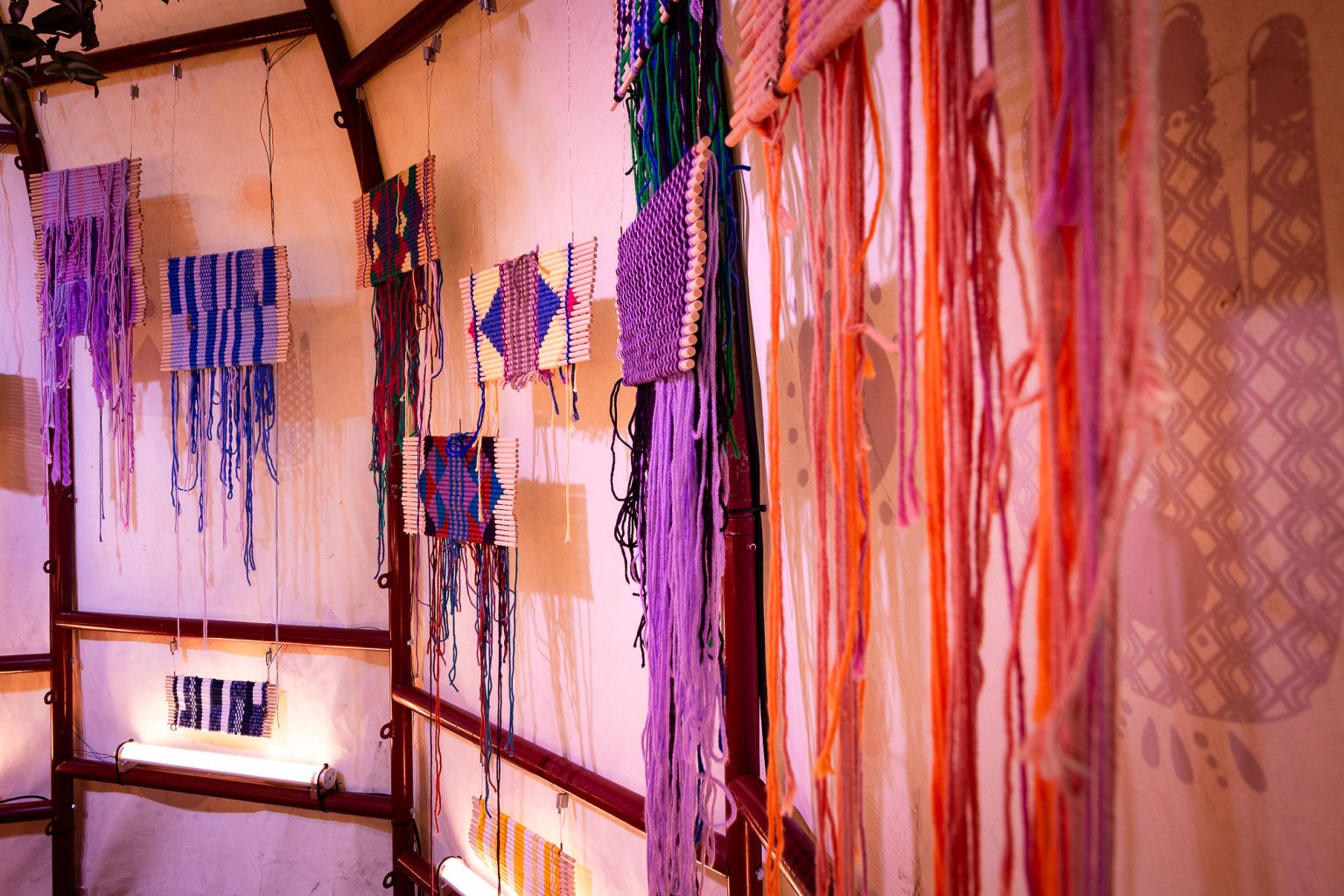
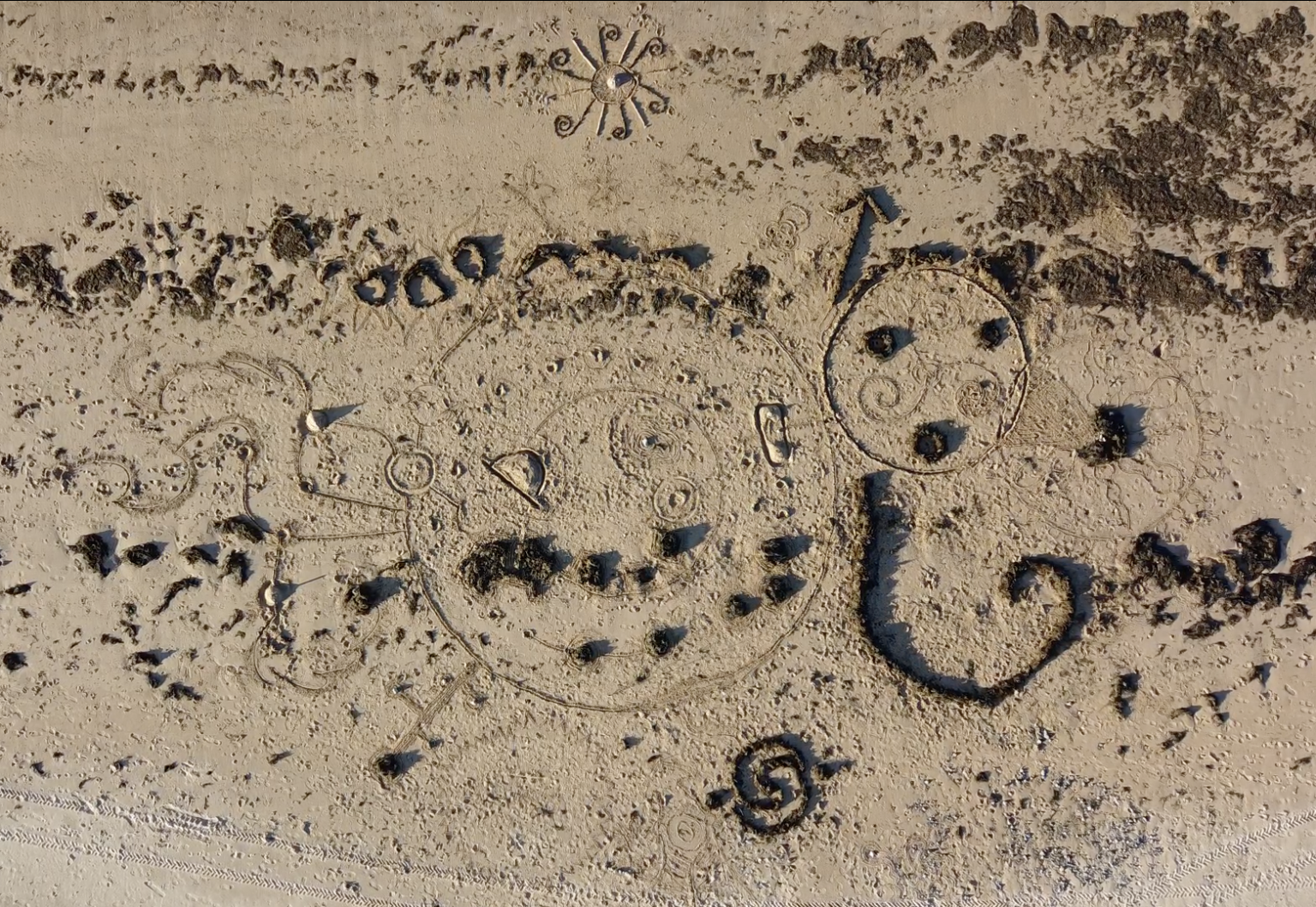
The Guardians of Living Matter, the ambitious new exhibition by John-Paul Brown and Sophy King, offers a refreshingly distinct utopian story. Opening at Lowry, it asks us to step sideways out of the anxieties of January 2026 and into a speculative 2076 — a future in which the climate crisis has not been ‘solved’ through human dominance, but eased through collaboration between mycelium and artificial intelligence. The exhibition was developed over eighteen months as part of Lowry’s Developed With programme, which supports creating ambitious, high-quality work and developing artists’ practices. This immersive collection of installations marks a significant progression of scale and scope for both artists. They first connected through a shared environmental focus while working at Rogue Studios, Manchester. What they have built feels less like a conventional exhibition and more like a fully realised set from a positivity-tinged retro sci-fi film. Low-carbon prototyping meets high-concept futurism, producing something immersive, playful and quietly radical.
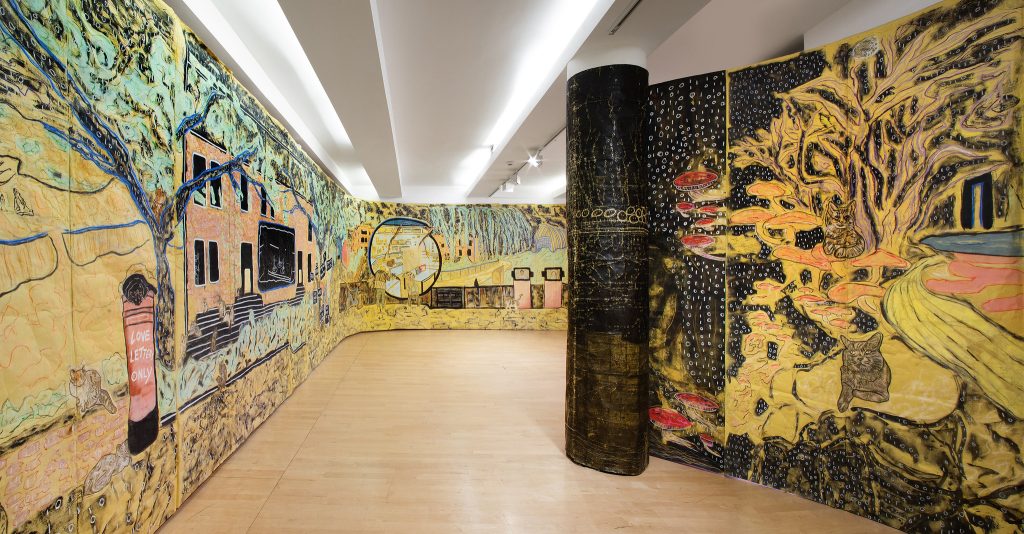
The exhibition is lavishly labelled in the style of a museum from the future and divided into zones: G01- Reception, G02 – Brown’s ‘The Tapestry of Future Past’, G03 – ‘The Oracle’, G04 – The Laboratory of Affirmations, G05 – Museum of Artefacts and G06 – King’s ‘Bureau of Entanglement’. The reception and laboratory areas lean unapologetically into a Doctor Who-esque aesthetic: theatrical, retro-futurist and built from reused materials. A repurposed stage floor becomes wall cladding, spaces are divided by a window into a viewing area. The artists’ commitment to reuse is not just practical but conceptual. Brown’s pseudo-protective clothing on display is made from the same post-industrial plastic paper used in his monumental drawing also on display, ‘The Tapestry of Future Past’ (2025), collapsing distinctions between artwork, costume and evidence.
The exhibition is a mixture of the installation and framework itself alongside two major new pieces by the artists. At the philosophical centre of the exhibition is ‘The Oracle’, a piece described as a bio-computer entity that reimagines the evolution of communication itself. Taking the form of a ceiling-based, web-like installation constructed from rope impregnated with live mycelium and illuminated by colourful lights, it is both infrastructure and organism. During a tour of the exhibition the artists explained that it was important that these lights are controlled by ‘low carbon’ AI, being mindful of the 2026 reality of the environmental impact of massive AI data centers. In the exhibition’s narrative, ‘The Oracle’ emerges when humanity finally accepts that traditional human leadership has failed the planet. In 2076 AI still calculates, but now through the logic of mycelium — exchanging nutrients, redistributing resources and responding collectively rather than hierarchically. ‘The Oracle’ translates unseen forces — weather systems, tidal patterns, air quality, even solar flares — into an ongoing feedback loop of planetary care. This metaphor creates a productive tension in the gallery: Brown and King sidestep tired binaries of human versus machine or human versus nature. Instead, the protagonist here is the more-than-human: a worldview that recognises humans as part of a wider, interconnected system. By 2076, the exhibition suggests, we have learned to act as custodians rather than owners, guided by a system that combines AI’s problem-solving capacity with the regenerative intelligence of the mycelium network to mitigate the climate crisis.
By pairing mycelium networks with AI, Brown and King challenge the familiar paralysis of post-climate grief. Their imagined future begins with a clear admission: governments, billionaires, and human developed algorithms failed the environment. In their place emerges a more-than-human alliance, reframing intelligence as something distributed, cooperative and rooted in ecological systems we have historically ignored. It is a bold assertion, but also a hopeful one: that the future begins now, with learning how to listen differently.

Materially and visually, the exhibition is a confident exercise in low-carbon thinking. Post-industrial waste and scavenged materials are repurposed into an environment that feels both alien and strangely familiar. The Andrew Law Galleries are transformed into a space that oscillates between research lab and ritual site, a place where the boundary between worlds feels thin.
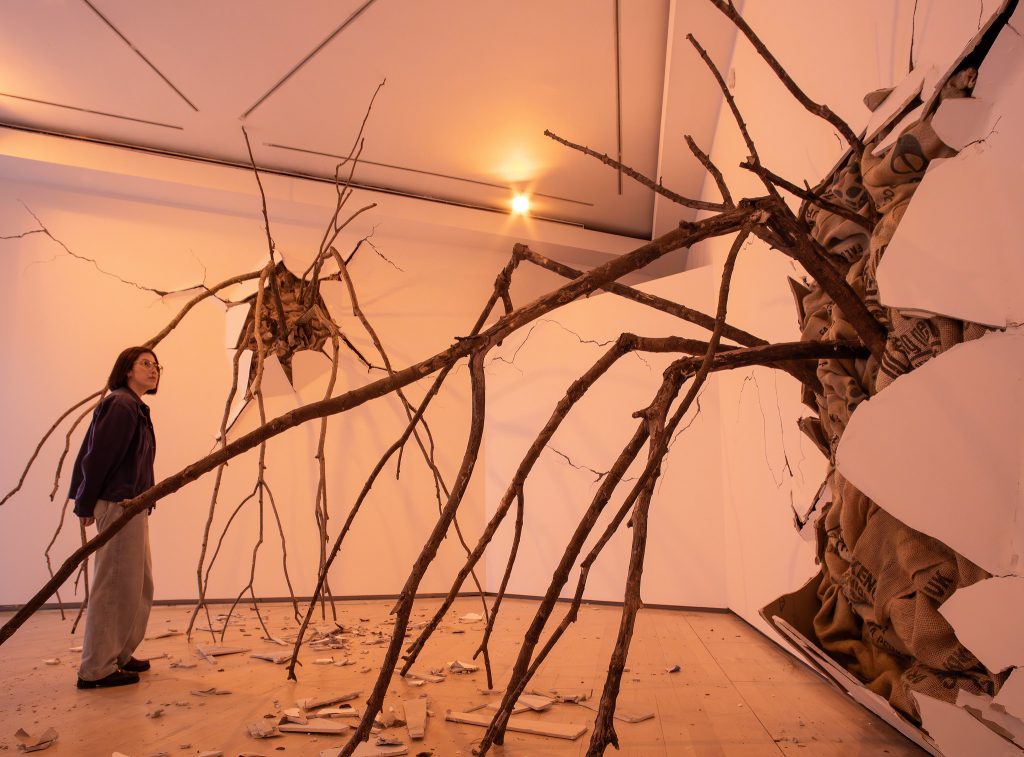
Nature intrudes here not as metaphor but as action. In ‘Bureau of Entanglement’ (2026), King forces the gallery to yield, as storm-felled cherry and willow branches rupture the white cube, scattering plaster across the floor like shed skin. The work stages a moment of breach: nature no longer framed or represented, but physically reclaiming space, agency, and consequence. This blunt collision mirrors the exhibition’s wider narrative, in which mycelium and more-than-human systems cease to be passive resources and instead act as collaborators in shaping future worlds. Part ruin, part portal, the installation evokes those liminal sites—found across cultures and belief systems—where boundaries thin and other modes of knowledge emerge. Visitors are left standing at the edge of a threshold, warned not to cross, yet acutely aware that the old divisions between culture and nature, inside and outside, control and coexistence, have already begun to fracture.
Orbiting this collaborative core are the artists’ individual works, each scaled to match the ambition of the world they have collectively imagined. The Developed With programme and curator Zoe Watson have given both Brown and King the space to extend their practices into new territories of scale, materiality and technical complexity—allowing ideas that might once have remained speculative to become fully realised environments. Brown’s monumental drawing, ‘The Tapestry of Future-Past’, is installed as an all-encompassing curved sculptural wall, unfolding like a visual manifesto for this future ecology. Dense with imagery of positive action over time, it operates simultaneously as narrative, map and proposition. In dialogue with this, King’s large-scale installation consumes the gallery space, immersing the viewer in texture, density and material presence. Together, these works extend the exhibition’s central proposition beyond collaboration as a theme, embedding it physically and spatially into the experience of the gallery itself.
Ultimately, The Guardians of Living Matter succeeds because it frames hope as active rather than passive. It acknowledges the climate grief that defines the present moment, but refuses to remain there. Instead, visitors are invited to become travellers, moving across a timeline of recovery. Performative warning signage about safety, dimensions and crossing lines pull the viewer into the narrative. We are not simply looking at artworks, we are stepping into a parallel world where different choices were made. By entangling artificial and fungal intelligence, Brown and King offer a response to the climate crisis that feels genuinely fresh. ‘The Oracle’ gives voice to the silent networks that sustain life, translating roots, tides and spores into something humans can begin to understand. As we step back out of 2076 and into 2026, the exhibition leaves behind a quiet but persistent sense of possibility.
John-Paul Brown and Sophy King: The Guardians of Living Matter, Lowry, Salford, 31 January – 29 March 2026.
Andee Collard is an artist, educator and co-founder of Bolton Contemporary, a non-profit organisation dedicated to providing inclusive contemporary visual art to the people of Bolton.
This exhibition is supported by Lowry.
Published 06.02.2026 by Jazmine Linklater in Reviews
1,199 words