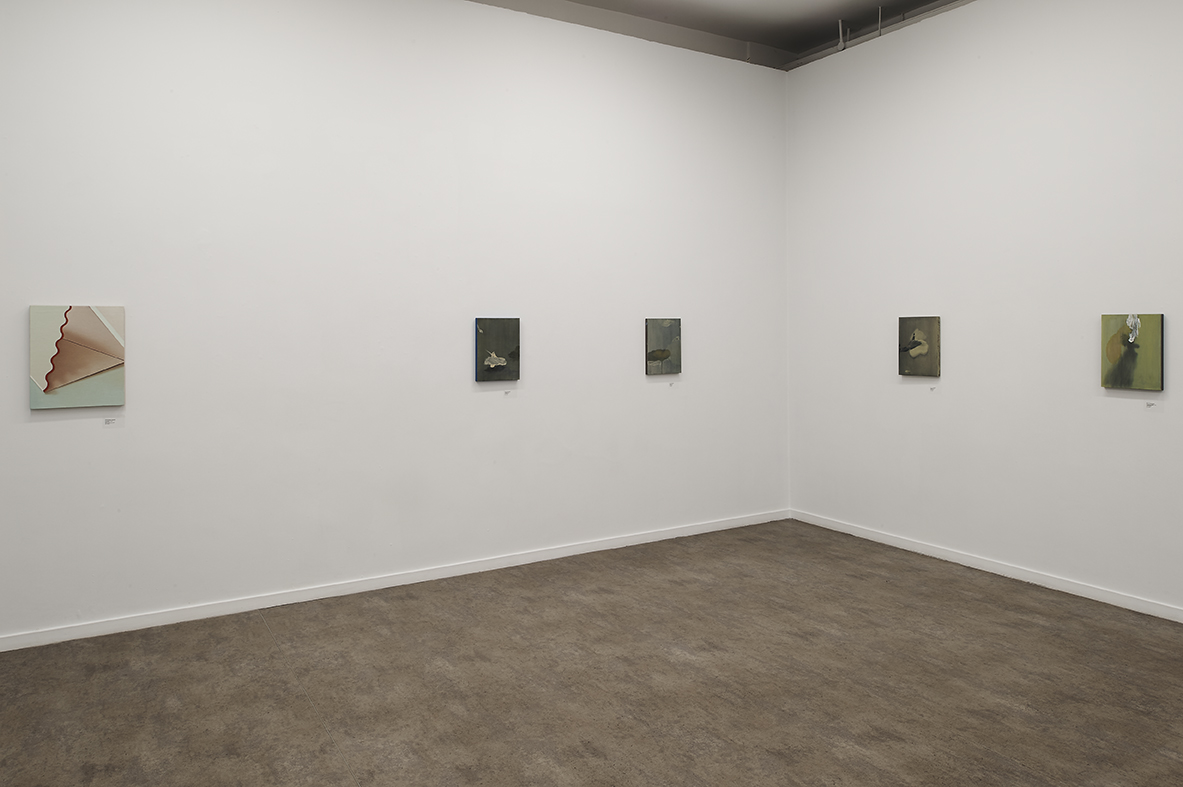
In summer 2025, a group painting exhibition, On Waking, showed at Limerick City Gallery of Art, curated by Jenny Eden and Rebecca Sitar, with Gillian Lawler assisting Eden who was lead curator. It featured the work of seven painters from Ireland and the UK: Eden, Lawler and Sitar alongside Christopher Hanlon, Harminder Judge, Damien Meade and Karen Roulstone. This conversation with North-West-based Eden took place a year after the first exhibition and ahead of a second iteration due for February 2028 at West Cork Arts Centre, Skibbereen, Ireland.
Jazmine Linklater: On Waking is a group painting show that responds to the transition between sleep and wakefulness. How did you settle on this theme and know you wanted to explore it with these painters?
Jenny Eden: The idea for the show came about five years ago when Rebecca Sitar got in touch after reading my essay ‘Opening the Receptors’. She was interested in my language around paintings’ distinctive and elusive behaviour and felt a resonance with the work. In the essay I ruminated; ‘In its willingness to be seen, [a painting] opens its receptors and makes itself visible. But in doing so, it also withholds and controls, drawing a veil over itself. Two conditions, therefore, are simultaneously present’.
We soon recognised a combined interest in painting’s capacity to depict a kind of ‘coming into being’ of form and content – a subtle painterly figuration ‘in and on’ the surface which simultaneously resists classification.
Then, as co-artist-curators, we acknowledged this sensibility’s relation to the time of waking, arising from slumber, becoming conscious; a universal experience but also highly individualised.
I can’t help thinking it’s such a radical idea. The slow, sensitive and common – quite beautiful – practice of waking up, has the potential to conceal a range of intense, significant, even instant experiences. Waking up from what, where, with whom, with which thoughts? Things come to mind in the act of waking, realisations, epiphanies – think about the phrases ‘sleep on it’, and ‘see how you feel in the morning’. Here, a longed-for clarity can be quickly altered when conscience, memory or expectations take effect.
To this end, acknowledging a ‘way of being’ in our combined works helped us find the compositional and representational transitions in other painters’ paintings, not in the sense of depicting the period of waking up, but alluding to it through gesture, structure and subject.
JL: Why painting? What is it as a medium that keeps you enticed by it, keeps you practising it today?
JE: Painting is a unique medium. It can carry complex and fluctuating relationships with time and memory within its formation; time-based histories, experiences, perceptions and realities are folded into the decisions that make up a painting.
It offers a middle space between inner and outer experiences of living and being, and leans into uncertain, uncomfortable, awkward and evolving states of mind. For me, and I suspect the other painters in the show, painting is the only medium that appropriately translates our relationship with this world, the surface, body and process of painting holding the texture of what it means to exist, reflect and continue. And it is always there, in front of you, near you, ready (or not!) to accept your offerings towards it, as you wrestle with the technical, psychological and perceptual elements woven into each sitting.
This approach to communication has been provided by painting for millennia, and it prevails as a dominant medium despite (and because of) recent expansion, critique, the market and systemic underfunding in education and the arts more broadly. If anything, this exhibition awakens us to the limitless value of painting, as we look back and forward for clues as to how the medium might develop further.
JL: The show ran at Limerick City Gallery of Art last summer and I understand it will go to West Cork in 2028. Why Ireland? You mentioned that most of the painters included have some connection with Ireland, can you expand on this?
JE: We first approached suitable galleries in the UK, but various external factors (Covid et al) prevented them from hosting the show at the time, despite interest in the concept. So, the project lay quiet for a time – akin to the theme – until Gillian Lawler, based in Ireland, rekindled a dialogue with us and suggested we approach galleries there.
Specifically, Gillian knew Limerick City Gallery of Art (LCGA) would suit the exhibition, due to its airy, contemplative spaces, especially the large South Gallery, a stunning room with natural light. In fact, each of the five galleries at LCGA invited a different approach to looking, proffering the kind of interiorities we’d hoped for the paintings (the conditions they needed to thrive). So, we approached Una McCarthy, the Director, who showed great enthusiasm for the project and the energy to bring it to life. (Una has since retired, On Waking her final exhibition; a poignant time and theme, on reflection.)
Contemplating an Irish show prompted us to acknowledge various connections with Ireland that hadn’t come to light before. We were reminded that Damien Meade was born in Limerick (with family living locally, it turns out). Christopher Hanlon lives in Belfast and works at Belfast School of Art. Karen Roulstone had Irish heritage, and Rebecca Sitar is an Irish descendant from her maternal great-grandmother.
Coupled with the atmospheric nature of the space itself, and previous thoughtful shows (George Shaw’s solo stands out), hosting the exhibition in Ireland felt entirely appropriate. So much so, we plan to continue an Irish tradition for On Waking, with a second iteration at West Cork Arts Centre, Skibbereen, in 2028. In the interim, I am working on a long-form article, emerging from LCGA, a meditation on the exhibition’s relationship with slowness, spectrality, death and immanence.
It’s apt that things are taking so long, and I don’t mind that. The show itself and the work within it are a slow burn. These paintings take time to unfold as ideas and bodies of work. My future article and this Q&A are also slowly waking.
JL: On Waking is a big show, with many small paintings – some rooms containing only small paintings at eye level, other rooms alternating larger and smaller paintings. Is the curation based more on the dialogue between the paintings themselves, or on an idea of the human body in the room, crafting a narrative through their shifting proximity to the works?
JE: We really enjoyed the difference in sizes across the five rooms, but it was paintings themselves that mattered the most in the selection. I’m speaking about a set of decisions coming from inside our a posteriori knowledge of making. Obviously, each artist always has their own relationship with scale, based on various factors (personal, practice-related, intentional, commercial).
As painters or artist-curators – remember, we are not curators, per se – we considered each painting’s attitude, attention to surface, the appropriateness and handling of colour, gesture, motif. Of course, the size of the painting formed part of our conversations. But the overall communicable presence of each work was perhaps more important to us. We knew we would find the best arrangement once we had the paintings in the space.
It’s worth saying here, I’m a strong advocate for the artist operating across wider roles within the field; artist-curator, artist-lecturer, artist-writer (painter-writer). For example, I co-direct a contemporary painting gallery in Salford called Oceans Apart with my partner Keith Ashcroft (also a painter). Everything we do there happens through the lens of making paintings. Gillian, too, is studio manager at Pallas Projects in Dublin, working with her husband / director Mark Cullen and co-director Gavin Murphy – they have a similar outlook.
On Waking is an opportunity to take practitioner perspectives beyond our self-made worlds, much like Terry Smith’s ‘third artworld current’ (after re-modernisation and globalisation) involving DIY projects coming into line with (being welcomed by) big gallery outfits. I am grateful to Una for allowing us to show this is possible, and fruitful, in a municipal gallery, echoing an earlier time before the rise of the curator.
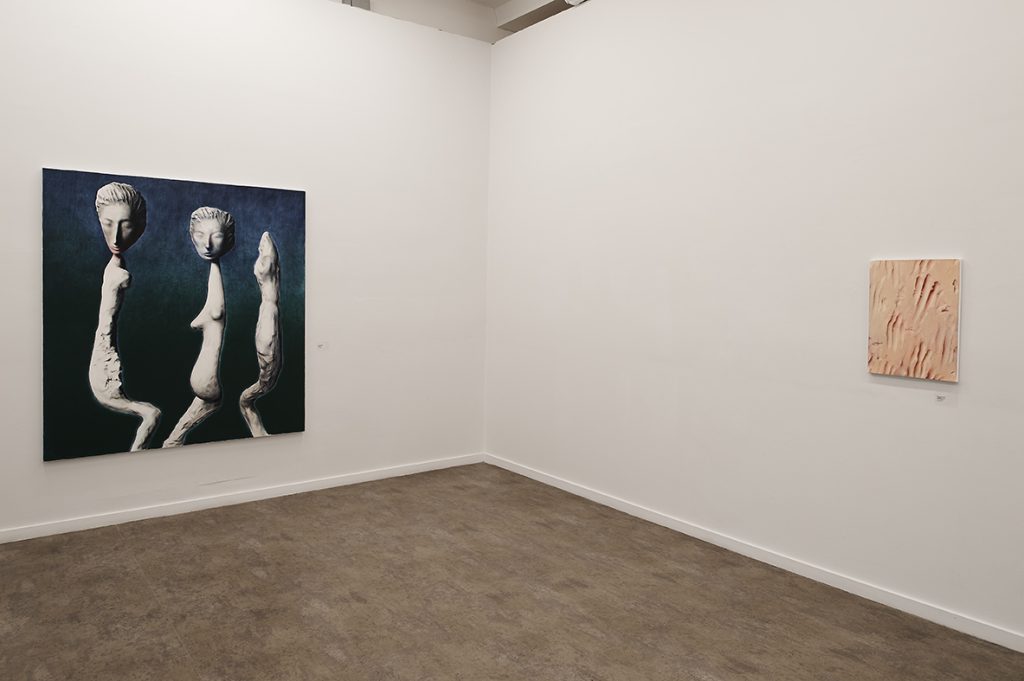
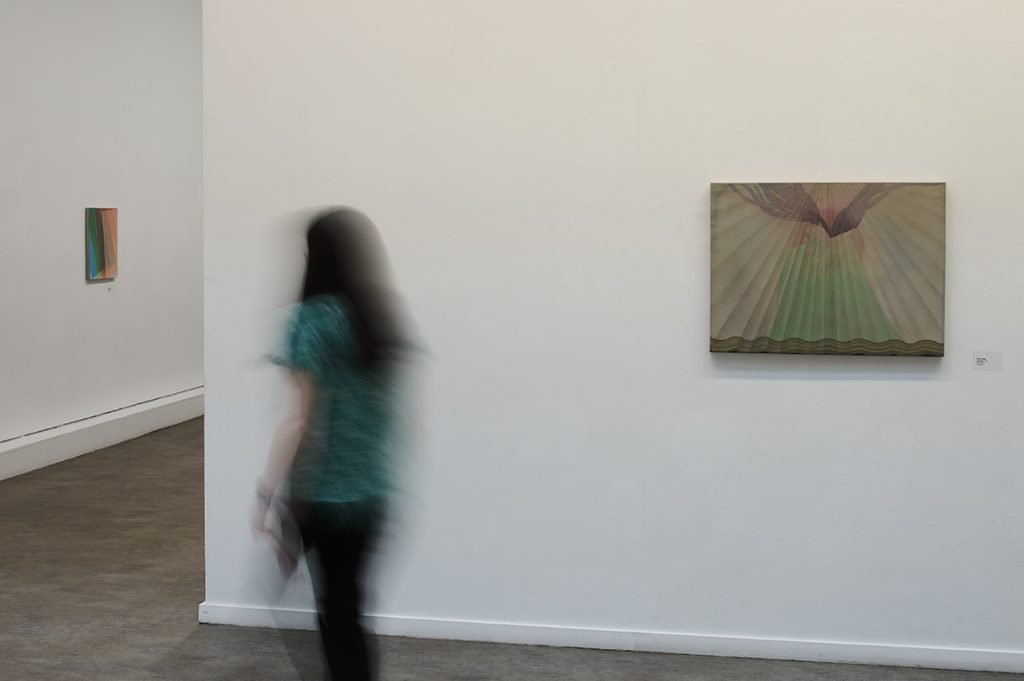
But I think you wanted me to say more about dialogue, which is something we intended but couldn’t predict until the work was in the space. We found the paintings spoke as people, between works and the space. Meade’s striking ‘Untitled’ (2022) ‘detected’ you as you entered the foyer, inviting you right, left or diagonal, with Lawler’s stunning ‘Transition’ (2025) imitating rays from the skylight and a thread piece installed in the eaves (part of another exhibition at the time) – we could have never predicted this relationship. Going right, Meade’s three-figure works occupied most of the quiet ‘anteroom’ (waiting room), larger paintings looking after smaller ones, who fidgeted unable to wait.
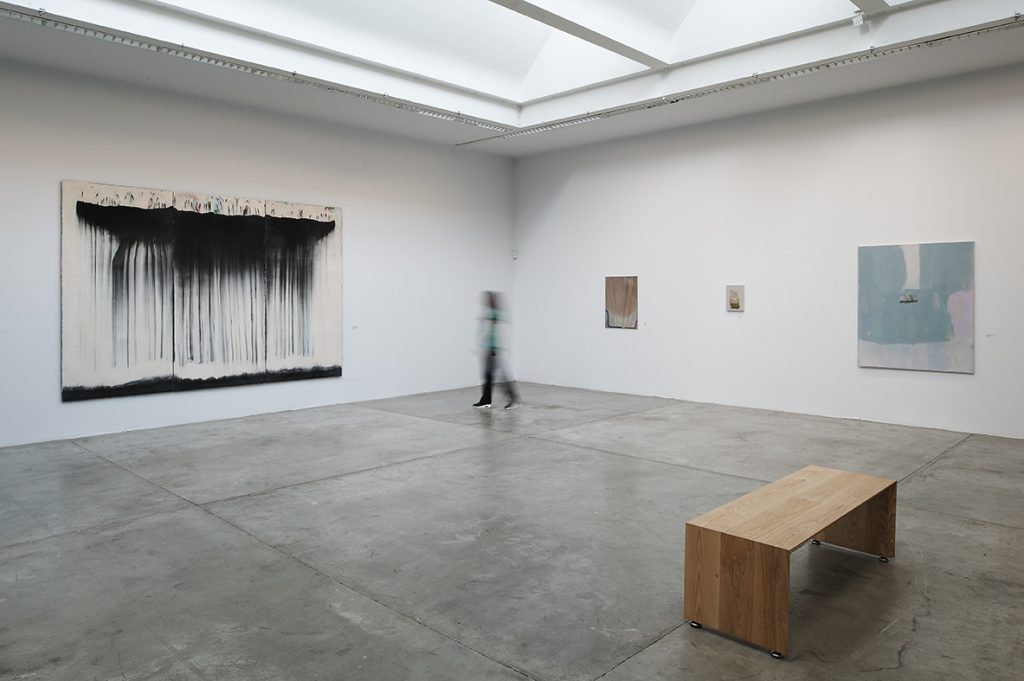
The South Gallery, the largest space, presented a community of works by Judge, Lawler, Sitar and me, with Judge’s monumental ‘Untitled (upper and lower skin rising)’ (2023) – the outcome of an experimental process of sanding, oiling and polishing pigments pooled into wet plaster – stationed at the far end like an altar or curtain. In this reverie space, naturally lit and opening upwards, the works nestled together (and apart), whispering in a manner made even stiller by the expansive concrete floor.
Diagonally and to the left were two further rooms hosting Hanlon, Roulstone and the rest of Sitar’s paintings. These were slightly busier spaces witnessing the chatter of people navigating other parts of the building. Significantly, two facing U-shaped spaces enabled conversations between Sitar’s miniature emblematic forms, excavated and cherished, and Roulstone’s fleeting encounters, organised around gestures. But the most unexpected element of all was how Roulstone’s presence permeated the show through her five beautiful paintings – Karen sadly passed away in 2019 – which grounded the exhibition and guided us through the whole experience.
JL: Across the exhibition is a sense of light and haze, something ethereal and otherworldly. This is sometimes expressed through the ambiguous forms the paintings depict which, short of entirely eschewing mimesis, do seem to represent things. Certainly, these paintings are images, but there are often slippages of focal points that keep the works shy of total abstraction. Is this intended as a refusal of representation or something murkier?
JE: I don’t think it’s a ‘refusal’ since most works establish a sense of thing-ness, albeit hazy in some cases, as you say. I guess ‘something murkier’ could be appropriate, but it’s not necessarily ‘darker’ (in mood), but a mysterious intellectual complexity involving subject – however transient – and materiality (including the way the painting is constructed).
For example, Hanlon’s paintings deal with ‘minor’ or ‘trivial’ subjects – found photographic sources he refers to as ‘disinterested’ – reawakened through the act of painting. These images are elevated, they gain life, not least through a consistent attention to colour, and the clarity and proximity of edges and shadows, but in the way his resulting paintings occupy a space in our visual thinking beyond the humble origins of the image.
‘Figuration’ is possibly the kind of representation we’re talking about in painting terms, a condition I always remember Richard Wollheim referring to as a specific form representation which identifies objects, people and places. However, by extension, I feel the paintings in this show relate to what I have referred to my own practice as ‘loose-’ or ‘post-figuration’, a ‘transportation in situ’ (to quote the fabulous writer John Kelsey), where figurative information is ‘returned differently’ through the vehicle of static form.
Absolutely, I see these paintings as operating in relation to the physical, figurative world, coming from what we might call ‘memory-images’, to use Freudian terminology. By this I mean experiences, histories, different times or cultures, consciously or less than consciously ‘taken in’ and used, compromised and re-presented. In my own thinking, the paintings formed a parallel life-world together, occurring ‘with’ and ‘after’ the figure. They were abstractions from actual imagery, in the case of Hanlon and Meade’s paintings (Meade uses clay sculpture, photography and digital production as layers in the studio process). They depicted various thoughts-in-action – gestures, wipes, glazes – which ideas coalesced around, in the case of Sitar, Roulstone and my paintings. And they were spatial abstractions which alluded to compositional structures but remained pictorially illusive, in the case of Lawler and Judge’s works.
Our collective abstraction could be thought of as a paired, two-fold or secondary abstraction, whereby painting itself acts as a distanced activity from an already abstract beginning (image, gesture, composition).
JL: In the accompanying text you talk about a pre-conscious state in the period of time spent emerging from sleep – that hypnogogic diversion from the daily grind of linear time. How did these ideas influence the curatorial decisions? I’m thinking of almost the opposite state, the vast number of artists who have grappled with insomnia and even induced sleep deprivation to produce their works. Were any of these paintings produced whilst actually waking up?
JE: I wouldn’t know if the artists grappled with insomnia or at what time of their daily routine the paintings were made, unless they have alluded to this in their statements or conversations, which I don’t think they have. But I guess all of this is possible.
In the press release we were interpreting a temporal coexistence in the period of waking, where divisions between past, present and future dissipate in favour of expansive and fluid time. Our reference to the preconscious referred to another Freudian concept between consciousness and the unconscious, a midway ‘surface’ that ‘receives’ external stimuli and stores it for future use.
I’m deeply drawn to this part in the mind, especially within the context of painting, because it acts as a never-ending ‘repository’ for life’s encounters, artistic or otherwise. In some ways this is overwhelming, but of course, not everything I’ve seen, felt or thought appears in a painting; some stuff is triggered in the making, or encouraged from the outset, where other things (must) lie dormant for eternity.
There is a significant parallel in the moment of waking, when memories, images and thoughts arise in the mind unexpectedly, brought on by / in sleep (dreaming, worrying, longing, picturing), or when the sleeping / resting mind touches the day. Both conjure a wealth of material imaginaries we have tried to present in this show.
And yes, a few people have mentioned the scientific state of hypnopompia, rather than hypnogogia, which is interesting in relation to Freud’s early neuroscientific musings and his later ‘mystic writing pad’ (a metaphorical device he used to articulate the preconscious). Hypnogogia is an antithesis, referring to sensory phenomena experienced when ‘going into sleep’ rather than ‘waking’, as I understand it. Hypnopompia would be our near equivalent. Although I appreciate there are similarities, our paintings spoke to the liveliness of ‘coming into being’, the first breath, rather than the hallucinogenic or paralytic drift into slumber.
JL: Reflecting on the title, ‘on waking’ signifies the moments when wakefulness seeps into consciousness, but without quite arriving at ‘waking up’, and leads me towards the political idea of ‘wokeness’. Your accompanying text discusses slippages between reality and imagination across memory and projection, which calls to mind the political right’s weaponisation of nostalgia and romantic portrayals of a mythical past. How consciously does the exhibition engage with this political context, especially through the practice of painting under the rise of the authoritarian right? And, relatedly, I’m interested in your use of Heidegger’s philosophy—how are you able to navigate the politics of his thinking?
JE: The works aren’t overtly political – I mean, no one mentioned this as a driving force – and yet I have a deep feeling that all painting is political. It has to be, right? Because it’s made in relation to, despite, amid, a mood, an ethos, a generalised or specific ‘current’ flowing through our time.
Paintings like those in the show are slow, nuanced, too. They’ve taken time to make, and they demand care in the act of looking. This position is also political because it counters today’s propensity for speed. Embodying the transition from sleep to wake, the paintings ask us to ‘stay awake’, aligning with the medium’s left-ist past; collegiality, social awareness and opportunity for all. Any trace of painting’s questionable traditions within the canon are placeless in this curation.
Which brings me to your mention of Martin Heidegger, a difficult pill to swallow in the mix. I am naturally in conflict over Heidegger, his political legacy sitting unwell with me. However, aspects of his philosophy had already infiltrated my early writing and thinking – his considerations of beingness, and his rhythmic organisation of words – before I knew of his background. As such, I’ve had to reconcile with the fact he represents one of the many contradictions in my own practice, and thus my understanding of painting’s agential qualities, already permeated with Heidegger’s cues. I have little option but to accept this difficult situation and take care when referring to his writings. The same is true of Freud and other infamous male theorists I’m now indebted to. But they have provided me with the foundation to scaffold my own painting-writing voice, cushioned with a contemporary perspective, and I feel strength in that.
JL: There’s something ritualistic about the paintings’ depictions, processes of creation, and invited mode of engagement. Does the inducement of an actively-passive, or passively-active, mode of looking, not quite asking the viewer to fathom out what exactly they can see but gaze into an unfolding experience of time across a painted surface, come out of thinking into ritual?
JE: I’m interested in the way paintings can draw you in and push you out, as a simultaneous experience. This is a ritual of seeing that rewards patterns of perception.
I’m reminded of a quote by Philippe de Montebello in Arden Reed’s 2017 book Slow Art: ‘most works of art yield their secrets slowly and … since most don’t beckon, they must be approached and given time.’
First, you engage with a painting’s dimensions, in the room, on the wall, through the body, heart, mind. The image strikes you, a sensitive amalgam of painting’s elements (from a distance); colour, shape, composition, light, texture, form, aura. A motion to a subject. In time, you step into the painting’s chamber to encounter its materiality and application. The image breaks down and you’re against the surface, the layers, gaps, dabs, edges, degrees of flatness, up and down, side to side. You stay there, head-to-head, contemplating the difference between near and far. Before being released into the gallery to start the process again. The painting stays with you, but you aren’t with it anymore. Your attention is now elsewhere in the zigzag of slow looking.
With thanks to Rebecca Sitar and Gillian Lawler with whom I discussed my answers ahead of publishing.
We are grateful to Una MaCarthy, along with Siobhan O’Reilly and the team at LCGA, for helping us realise this project.
On Waking, Limerick City Gallery of Art, 20th June – 10th August 2025.
Jazmine Linklater is a poet and writer based in Manchester where she is Corridor8’s Greater Manchester, Lancashire & Cumbria regional editor. Her new poetry pamphlet is Snagged on red thread with Monitor Books.
Jenny Eden is a painter, writer and lecturer based in the North-West. She lectures in Fine Art Painting at Manchester School of Art and co-directs Oceans Apart, in Salford, a gallery dedicated to contemporary painting.
This is a volunteer article for Corridor8. Please consider donating to support our work.
Published 13.09.2026 by Jazmine Linklater in Interviews
3,322 words