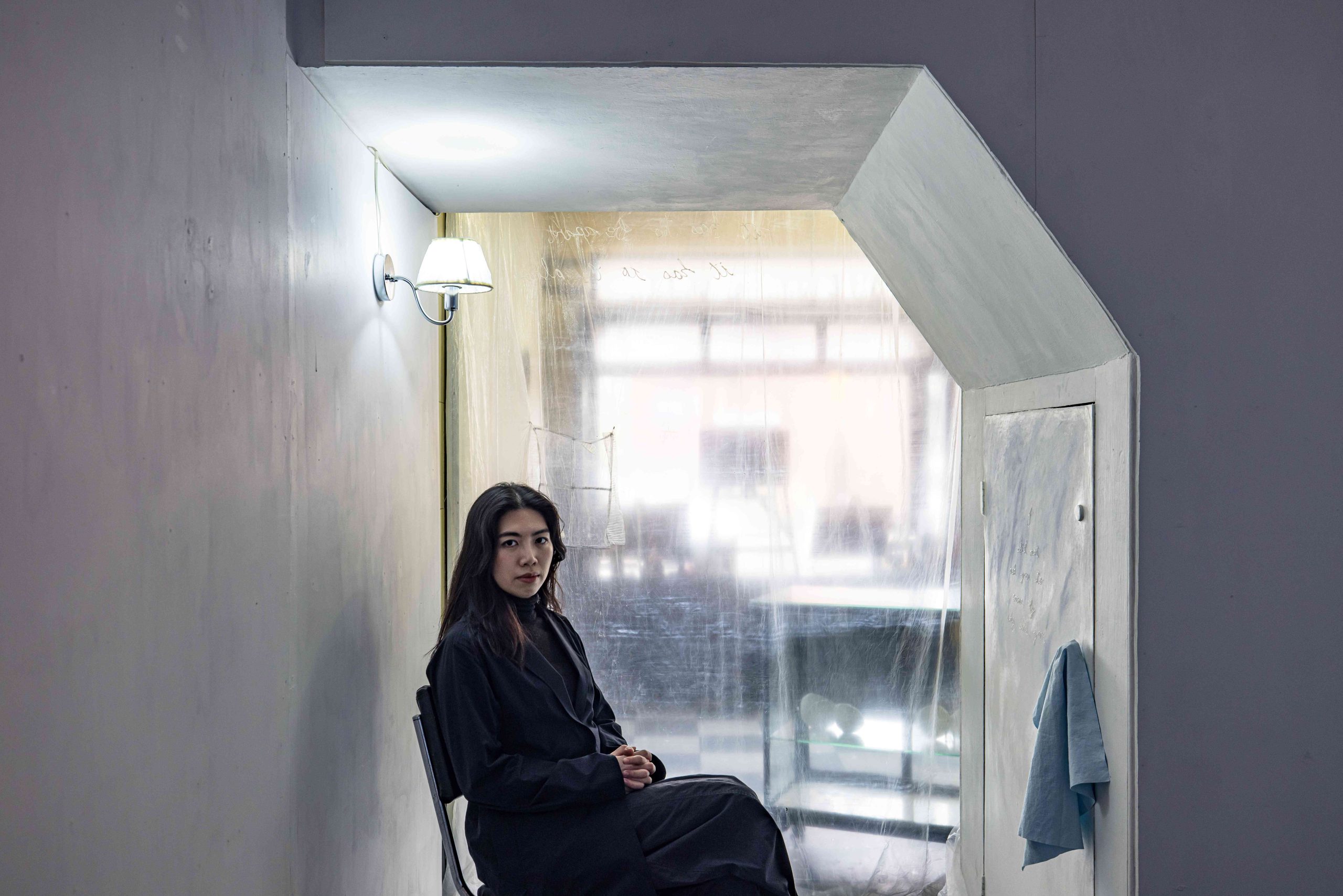
I love visiting an artist’s studio for the first time and feeling a rush of recognition. Jessie Tam’s window at PINK in Stockport is covered in various sheets of semi-transparent white: a loose curtain with almost imperceptible embroidered lettering; a long sheet hand painted with swirling brushstrokes; the vertical slats of a pulled-back blind. On the desk is a clear plastic file organiser and, hung along the wall, a collection of artworks that also play with levels of transparency through tracing paper, plastic sheeting and clingfilm.
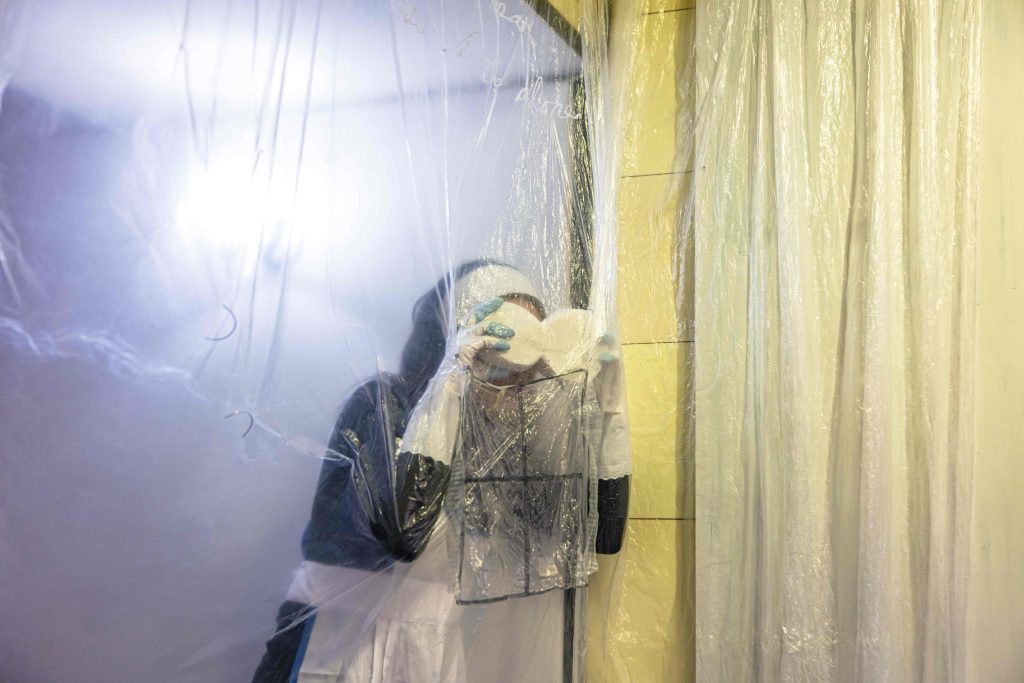
I’m visiting Tam in the final days of her exhibition, It Has to Be Apart It Has to Be Alone, at C&G Artpartment in Sheffield, where visitors are greeted by a pair of plaster eyeballs inside a glass-fronted, mirrored cabinet, and a sheet of semi-translucent plastic sheeting billowing in the breeze from the front door. The installation is an accumulation of traces, invitations to peer through and glimpse images – stars and moons and paper coins – and stories. Centred on Tam’s invented character Eyeball Maniac, the narrative of the exhibition explores ideas and experiences of home, displacement, memory, visibility and care. It Has to Be Apart It Has to Be Alone is the third iteration of this project, following exhibitions in the Netherlands, Seoul and Tam’s home city of Hong Kong. In Sheffield, the installation incorporates film and voiceover with performance, drawings and found objects, to create an environment of welcome, loss and remembering.
Jazmine Linklater: We’re going to talk about your recent exhibition at C&G Artpartment in Sheffield, It Has to Be Apart It Has to Be Alone. Could you tell me a bit about what that phrase means to you?
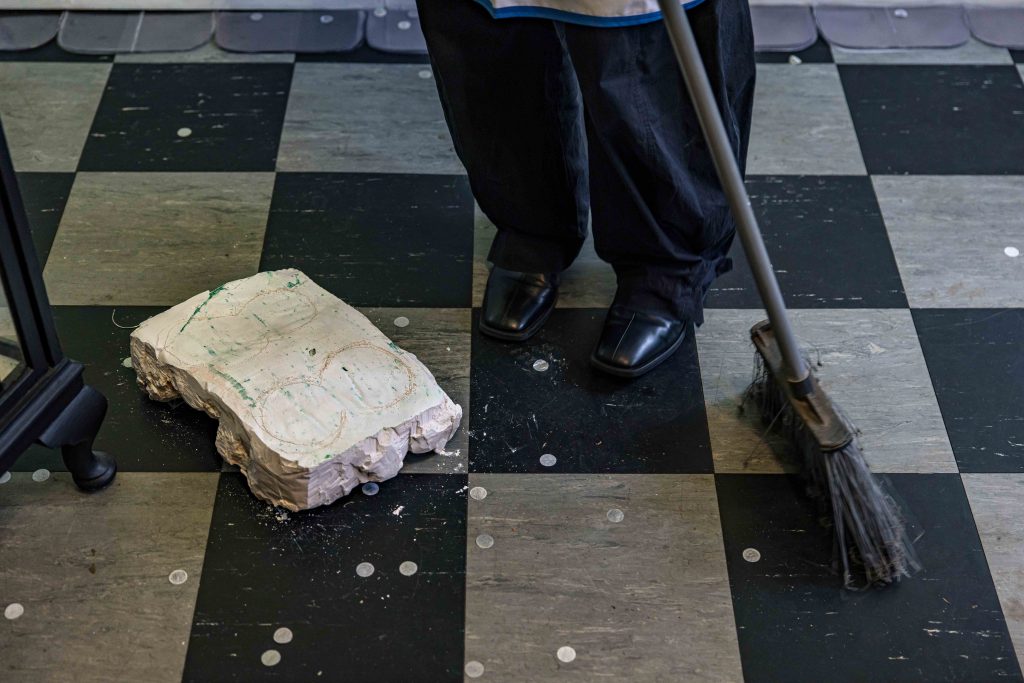
Jessie Tam: When I was studying in the Netherlands in 2019 and 2020, I was inspired by one of my tutors. She always said, ‘it has to be, it has to be’. It was during that time that I encountered the plaster fragment which started the project. I was wandering around one evening when I came across a house, a renovation site, with a lot of trash bags out in front. Out of curiosity, I put my hand into one and took out a block of plaster. I took it back and didn’t think much about it, but later saw these blue droplets on its surface. So, I made some assumptions. I thought, if crying is from the inside of eyeballs, perhaps I was seeing the inside of eyeballs already. I made up a story that this was an eyeball visiting its home, but when it couldn’t recognise the place, it cut itself in half. Then I sculpted it into a pair of eyeballs, because while it was meant to be apart now, it was meant to be together with its home. I started to gather other materials to form the story and the objects the eyeball encountered on the way home.
JL: It seems that your storytelling builds out of a sort of surreal, dream logic. Is it a conscious decision how you move from one idea to the next?
JT: I saw the blue droplets and associated them with tears and crying, but probably I’m also linking this to the political context of where I’m from. I think we always have to cut ourselves in half to settle down, between what we want to pursue in the future and the past that we have lost. That’s why we have to be apart. At the same time, we are alone. But it is also about places we used to be but are forced to leave – certain places or spaces where we leave memories.
I am conscious of ‘little moments’ happening around me, in my everyday life. I describe it as encountering them, capturing and chasing these moments I am going to lose. It is very much dreamlike in nature because these ideas always appear quietly and secretly. They are here but we may not notice, but they are the ideas I always move onto next.
JL: There’s an interesting phrase in the film about the ideal home being transparent. How did you want the space in Sheffield to feel to visitors, was this part of that ideal home you’re imagining?
JT: This work has been showcased quite a few times. First in Seoul as part of an exhibition, when it was more object-based, with the objects relying on each other to tell the story. At that time, it was only a mirror, some paper coins, the frame asking the eyeball not to come back, and the dust protection film. A later version in Hong Kong introduced performance and also an artist book set. I wanted to expand the narration a little bit. But this time in Sheffield, I wanted to create an immersive installation. The space and objects become characters in the story. I wanted the space to feel like a container that holds memories, but it’s also welcoming – we’re welcomed into it at the same time, and it’s intriguing. In the video, I ask the audience what an ideal home is, and that’s partly personal – I like transparency, so if I had an ideal home, I’d want a lot of transparent things. That’s just because I like it. That’s why I included that little bit at the end of the story where I ask about an ideal home. It’s mainly my question too – as an artist, sometimes I feel like I’m heading to a future that I or we want to attain but aren’t able to. Like, I’ve got a full-time job but still, for me, having my own home with my own furniture, things like that, is something it seems I cannot achieve. It’s something that I want to pursue, so I’m going towards it in the story.
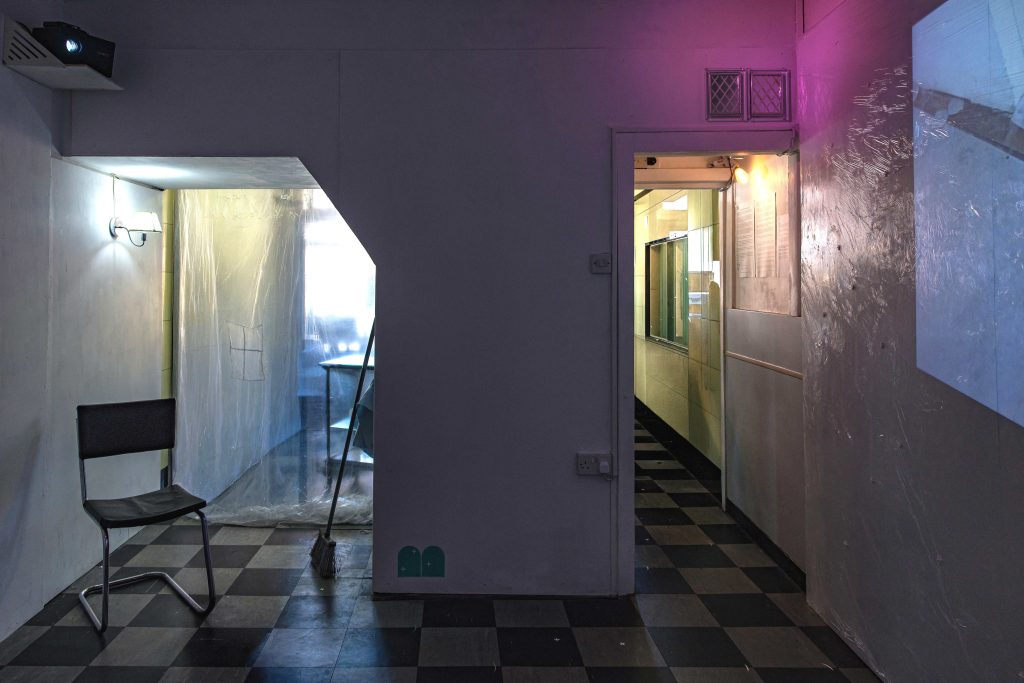
JL: There’s so much engagement with the domestic in your work, but also these handcrafted items with drawing, stickers, embroidery and stencilling. There’s a playful, childlike quality. Could you talk about that?
JT: Before studying art, I actually studied Legal Studies for one year, an associate degree, and then I studied History in university for another two years before I decided to study Fine Art. I didn’t have traditional early art training, and I think this encouraged experimentation rather than fixed technical skills. At art school, my tutor encouraged me to use pencil, and it actually opened me up – I think quite a lot.
I grew up in a quite small space. Which probably gave me an ability to be flexible. So, most of my materials are very light. I can carry them along, because I’m moving from place to place and I can pop them in a storage box; but at the same time, let’s say like the dust protective sheet, I can also enlarge it instead of building a wooden wall. Instead of forcing myself to do things I cannot handle – I’m not used to heavy workspaces, like going to a wood workshop or metal workshop to do things that are very huge – I try to make things very handy and light.
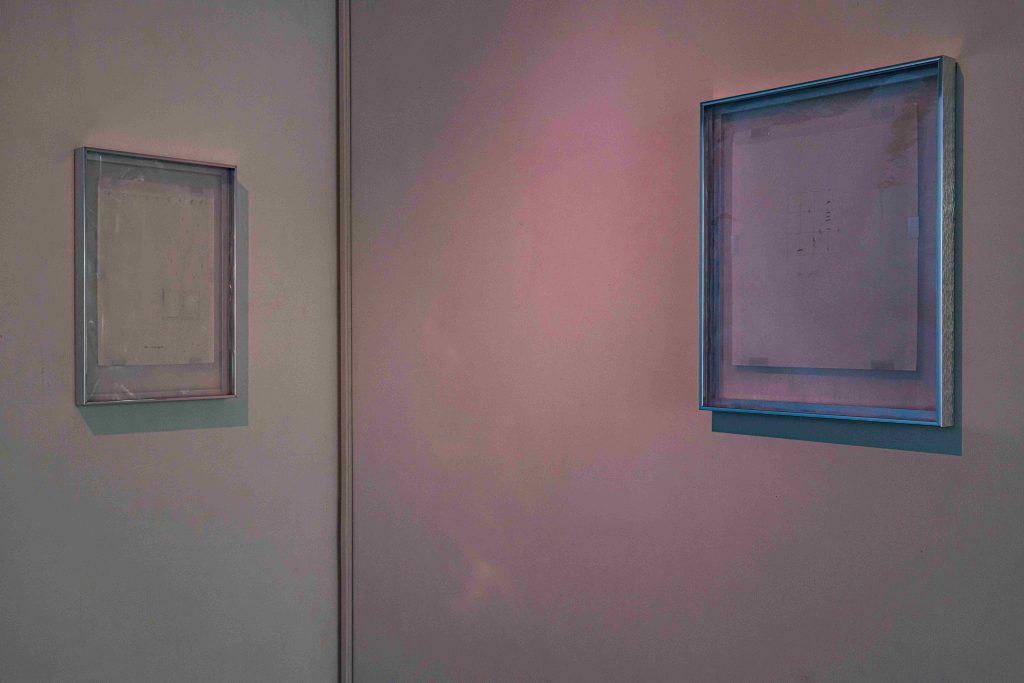
JL: I understand that in Hong Kong you did the performance every day, but in Sheffield only a couple of times. How do these different activations of the installation work for you? For example, in Sheffield when I visited, the active labour itself was absent from the space.
JT: In Hong Kong, I performed whenever the audience came in. But I was seeing it more like a role play, to show the memory of the home and the space itself. So, when the audience goes into the space, they can see what the space witnessed. It’s not a performance, but more like a memory trigger, like a ghost. But because I was doing that every day and the markings I was making were getting deeper and deeper, when I had to dismantle the exhibition I missed the place. I felt like I was making plans for the eyeball, but somehow it’s like I’m trapping myself by leaving all these traces and repeating them every day in the space, I’m becoming the eyeball and making a trap for myself as the maniac.
So, when it came to the Sheffield version, I intended not to be there every day, just to keep some distance between me and the work and to avoid this kind of remembering. That’s also the reason why I’m using English. Normally, I use my voiceover, I tell my personal story, I create a character, but this time I wanted to erase some of my existence in the work.
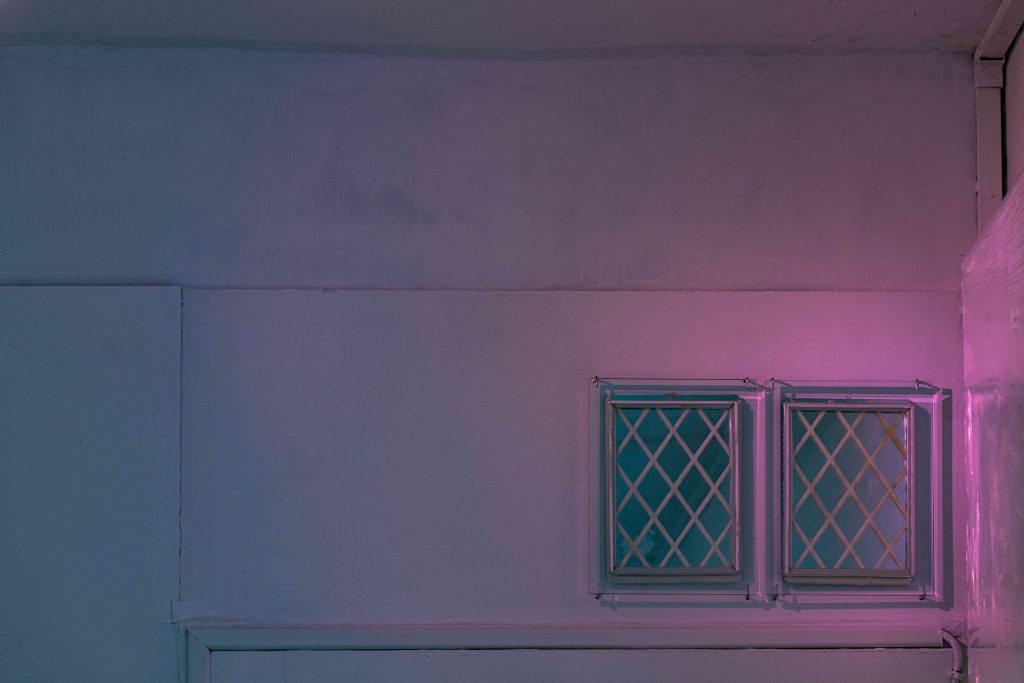
JL: You’ve mentioned that the story you’re always telling is the one of your home place, so I wonder how your sense of identity in relation to Hong Kong and China and the political situation in Hong Kong influences your work? I know that C&G Artpartment started there but reopened in Sheffield in 2024. Given the crackdown on free speech, the trauma of your home changing dramatically while you navigate the international art world – did this make the performance work in Hong Kong more difficult?
JT: I guess what is difficult is growing up in a place where we often have to say goodbye to things and places involuntarily. Like places we’ve lost. And I wondered where my memory was going to go. Or whether what we pursue and wish for always goes wrong.
When it came to 2019, I left Hong Kong and went abroad to study in the midst of political turmoil. I started to ask myself, ‘What can I do as an artist?’ I believe the best thing I can do is to make work – not a ‘provocative’ exhibition, as it is not the form of art I am good at, but I myself as an artist from Hong Kong, making work and exhibiting somewhere not in Hong Kong, telling stories not just about myself, my home place, but also about ‘home’ itself in general, which everyone can relate to.
During the performance, I intend to do simple acts like cleaning, sweeping, spraying water, or simply holding a pair of plaster eyeballs. I am aware of others seeing me, so I decided to do an act of everyday life – you can’t really tell if I’m performing or just cleaning. After all, it is just a ‘flashback’ of a space. In Sheffield, I wanted to create a feeling of waiting for the character to activate the space.
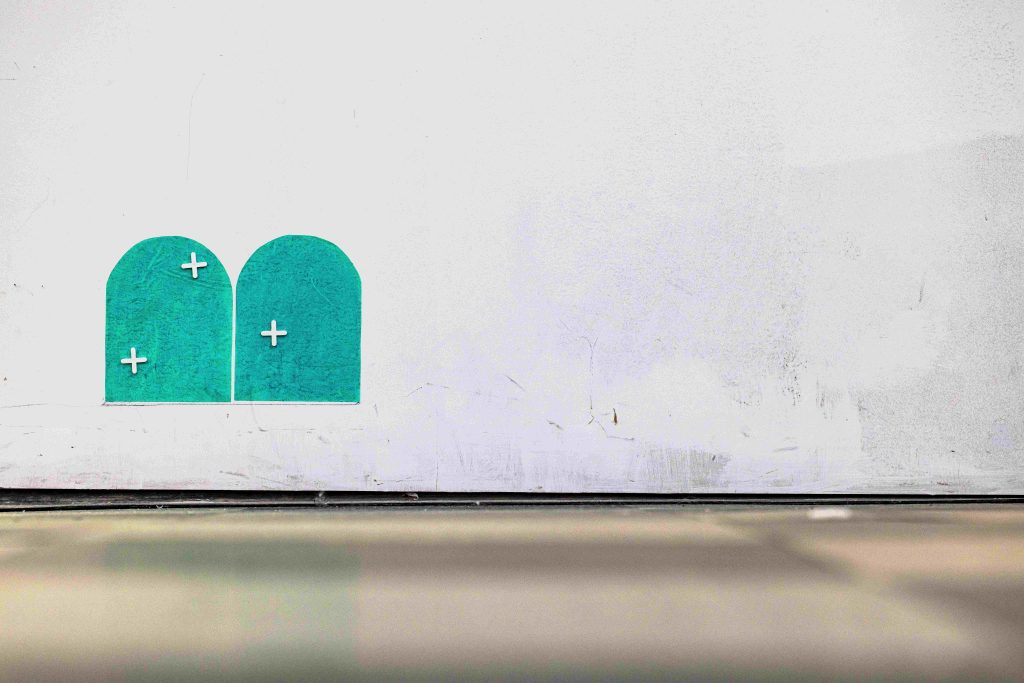
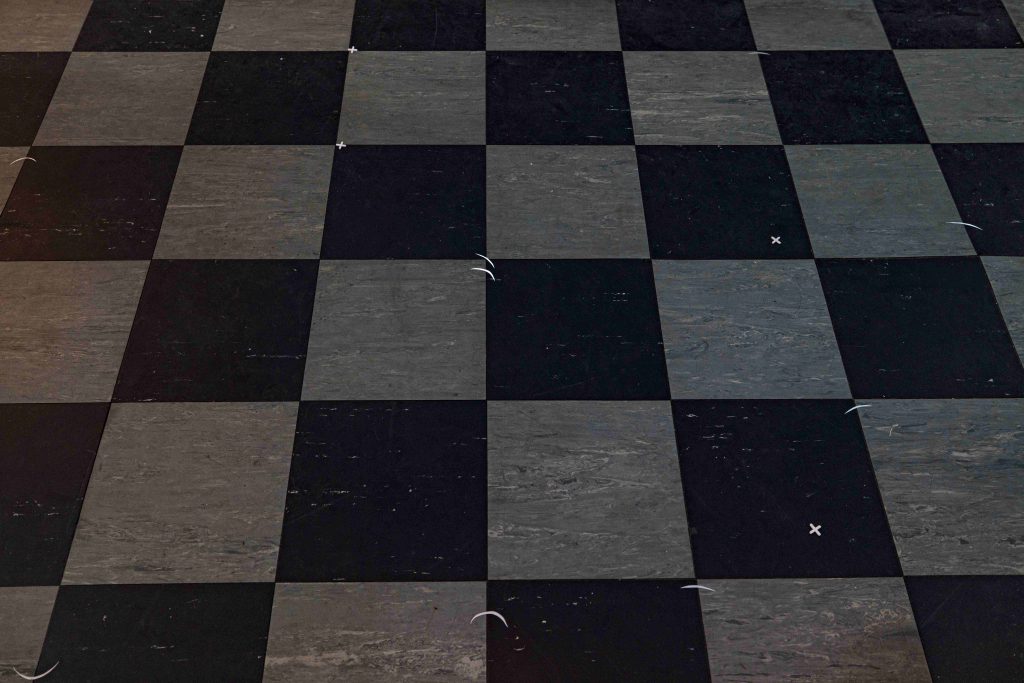
JL: There were multiple layers of time and materials – translucent layers, layers of narrative, performative repetitions, moon slivers, plastic crosses and confetti, which somewhere you call paper coins. Can you talk about these layers and repetitions?
JT: The paper coins were inspired by a British Hong Kong dollar coin I found in my pocket after leaving Hong Kong in 2019. I felt it was following me, linking to colonial history – something we didn’t ask for. I took it out and I was asking it, ‘I didn’t ask you to come by, why did you?’ I connected it back to Hong Kong’s ghost festival traditions where people burn fake paper money for deceased loved ones. I wanted the paper coins to flip and move like ghosts in the wind when my sweeping character comes, making the memory and history fly up and down together.
I imagine these paper coins each carry their inner voice and so does every object in the installation. They are so light and small; in order to be noticed they need to speak louder, but because of their scale they can only speak softly. These layers and repetitions are like small voices coming together. Individually quiet but collectively loud enough for us to finally notice them. In a practical sense, it comes from the way I collected these materials. The confetti always came in multiples and so did the tile spacers (the small plastic crosses), which naturally become the language of the installation.
JL: How much do you want the audience to understand about these stories, which despite the voiceover and gallery text, are not really available to them in the space?
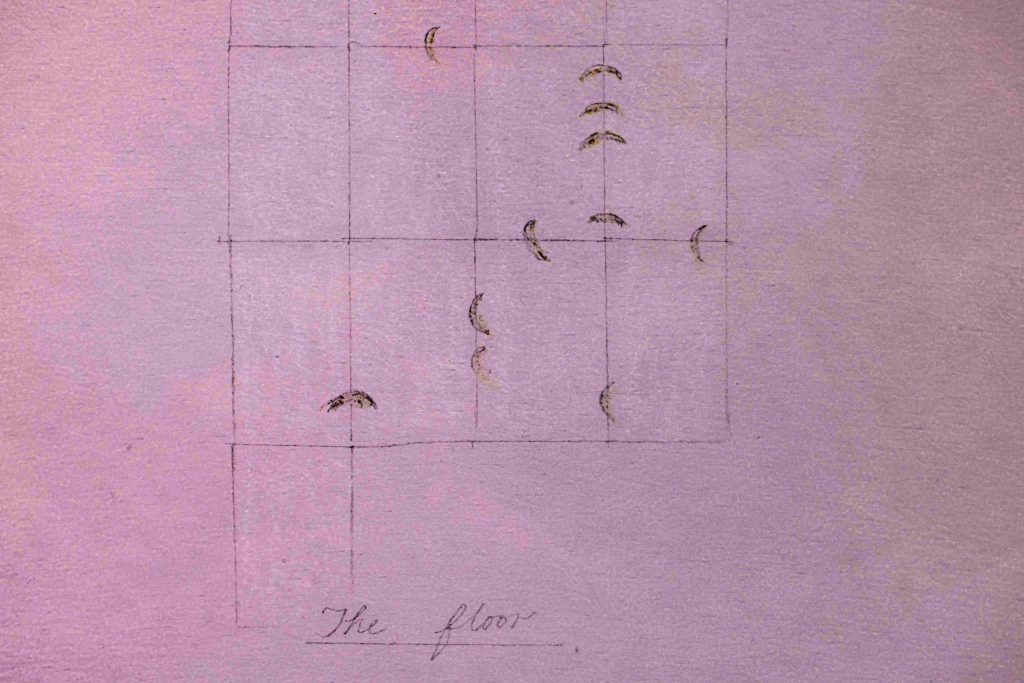
JT: They don’t need 100% understanding. Some people didn’t recognise the pencil drawings of Hong Kong dollars, while others did. The floor elements look untidy when I’m not there, because they are stars and moons falling out of the sky in chaos; but if I was there, I would arrange them precisely between tiles, trying to fix the order, trying to fix everything. The performance tries to make order but at the end it returns to chaos.
It is mostly from personal memory, not in the show. A childhood memory of my aunt’s place in the summertime, a place that we lost. And a time at Venice Biennale, when I saw the moon on the water and thought we would move into the moonlight, but we did not. And there is group memory, like a very tragic accident that happened in Hong Kong last year, a big fire, affecting quite a lot of people. Many people died and many were forced to leave the area and were not able to get back. Or they got only a few hours to grab their belongings.
The gesture of activating the objects through the performance and close-up shown in the video work is like, ‘Look! I’m doing something here!’ I’m sweeping the floor and I’m sweeping some paper on the floor. It’s actually paper coins, and no matter how hard I clean they are still messy and flying around. And if you look closer, you may find a transfer image of the British-Hong Kong dollar on the paper coin.
JL: Did that incident with the fire influence or change the narrative of the Eyeball Maniac for you?
JT: Yes, I realised it’s very much about people who lost their homes, spaces they can’t return to. Even if they go back, they find change. I wish we didn’t have to experience that loss.
JL: We often associate translucency with clarity and legibility, but in your work, it is more complex, often obfuscating our view. You give us these semi-transparent frames or curtains or objects, which should be easy to see, to see through, but often they pose a real challenge and create quite a difficult viewing experience. I wondered if this was about ghosts and memory, or maybe about not being seen for who you are?
JT: Every material has its physicality, cultural meanings and spirituality, but I don’t always start with its hidden meaning. One of the transparent materials I use often is a dust protective sheet. I first found one in a second-hand shop in the Netherlands. Rather than thinking about its function, I was drawn to its half-shimmering, half-sealed feelings. I was holding it in its original package and trying to imagine what it looks and feels like once opened.
Peter Fischli and David Weiss have a series of sausage photography I really like. When I first saw them, I was like, ‘How did they find this material to work with?’ I imagine they walked into a supermarket and took into consideration basically everything they encountered and opened up the possibility of using anything for art making. Taking this mindset, I try to stay open to everything I see in my everyday life. If that’s the case, it could be a pack of plastic dust protective sheets I saw in a second-hand shop.
I’m particularly drawn to the half-sealed, half-seen and half-visible texture of materials, and I’ve started applying this quality to the way I frame my drawings. I wanted to make the drawings feel ‘important’, but in a less traditional way, not with a cardboard mount, but with a material language that suits the work itself: PVC and gesso painted on acrylic sheet. It’s something new I’m experimenting with, and I’m very excited about it.
I’m drawn to the physical sensation of these materials when the plastic sheet moves, or when the gesso on acrylic seems to shift slightly. There’s a kind of unstable, floating but poetic feeling that is difficult to describe but feels very close to my visual language, and those memories of home and places we have lost.
It Has to Be Apart It Has to Be Alone was on at C&G Artpartment, Sheffield from 11 April – 2 May 2026.
Jazmine Linklater is a writer based in Manchester, where she is a regional editor for Corridor8. Her new poetry publication is Snagged on red thread (Monitor, 2025).
Published 24.06.2026 by Benjamin Barra in Interviews
2,960 words