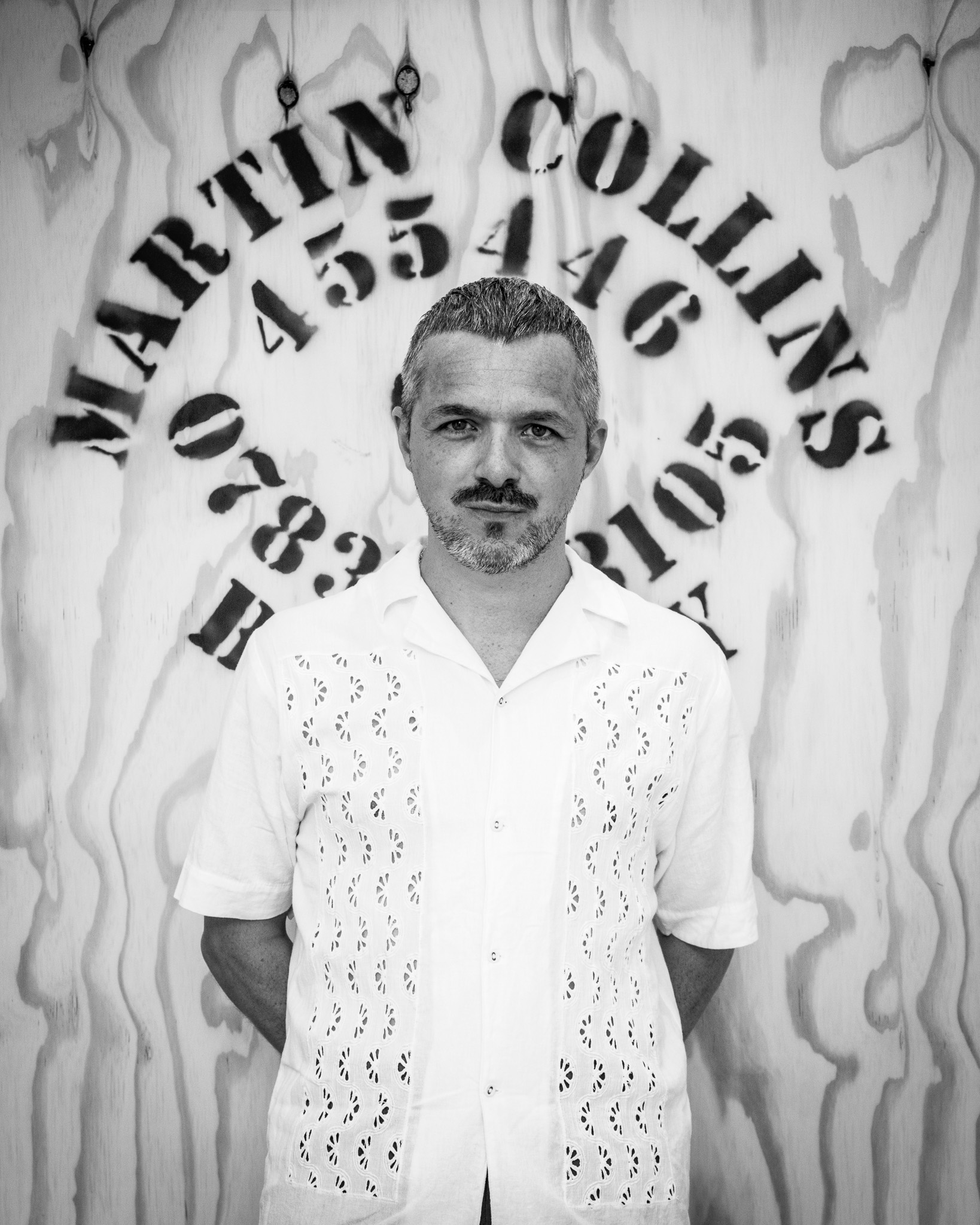
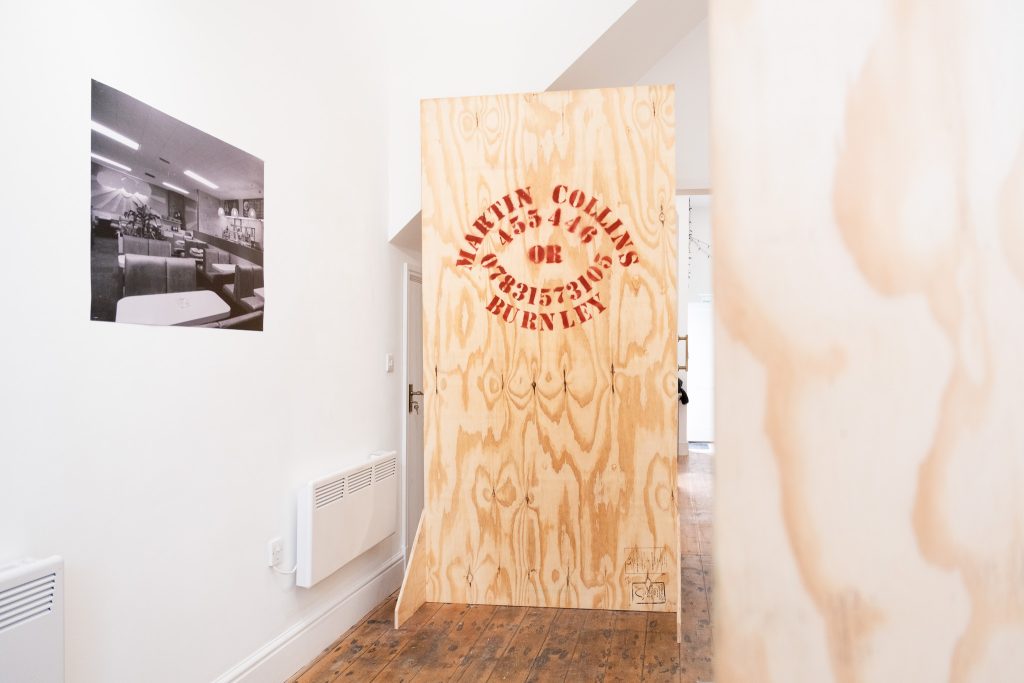
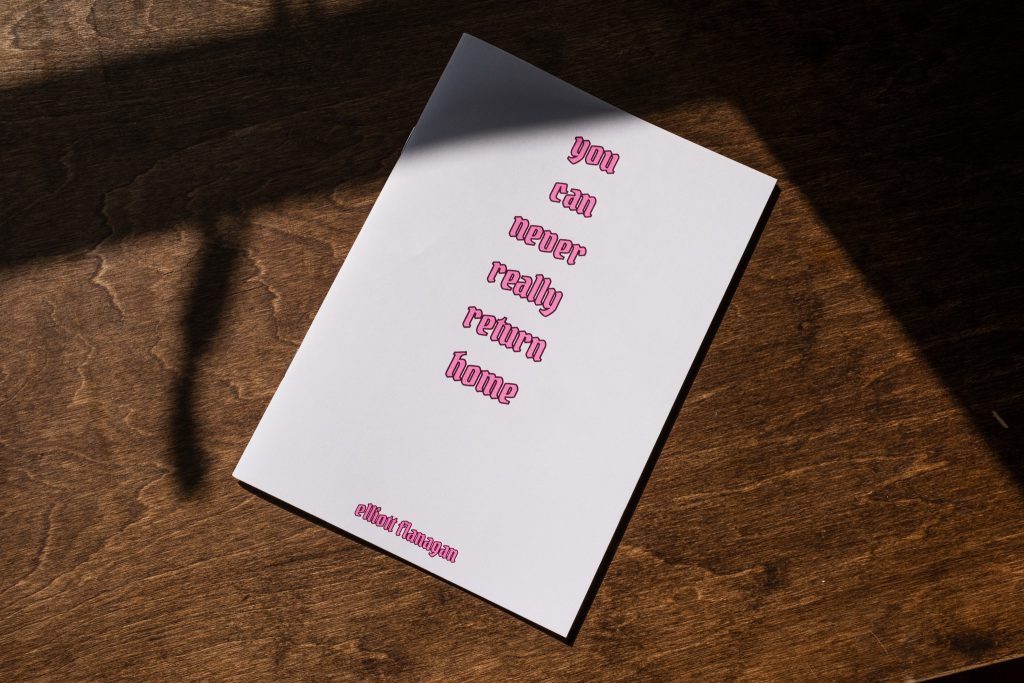
For the exhibition and accompanying book, You can never really return home, Elliott Flanagan returned to his hometown to reflect on memories of the Burnley he knew and the place he encounters today. Commissioned by East Lancashire’s Super Slow Way, Flanagan worked with a women’s group in Stoops Estate. The show at The Salon comprised an installation of the group’s precious objects, archive photos, film stills, sound and text-based work, and was dominated by two eight-foot timber boards stamped ‘MARTIN COLLINS BURNLEY’. Commonly used to secure vandalised buildings, they reference the riots of summer 1992 and in the gallery become towering monuments, an instant local memory trigger. The estate serves as a microcosm of the town: a place defined by old tropes that fail to tell the full story. Flanagan’s intention is to question regressive images of the town and offer an alternative to misrepresentation, class discrimination and stereotypes that Northern post-industrial communities like this endure.
In this artist-to-artist conversation, Flanagan talks to poet and writer Andrew McMillan.
Andrew McMillan: Tell me about that opening provocation; ‘You can never really return home’; where did that first arrive from, and did it immediately stand out to you as a central phrase of something?
Elliott Flanagan: The title arrived early and was the perfect overarching term for the work. I make notes and write every day. A lot of the time it’s the subconscious at play but I think it came from something I misheard on a podcast while driving.
I had been thinking about returning to one’s hometown after living away for years, as a way to explore identity, memory and class and tell a story about place that readdresses ideas about the North and its people. The film Get Carter (Mike Hodges, 1971) encapsulates returning to your hometown as a different person, but going back being this great leveller with history and unavoidable baggage that must be faced up to. I like the original title of the novel, Jack’s Return Home (Ted Lewis, 1970). A name that could be a children’s picture book but becomes much darker in the context of the story.
As an opening provocation, it sets out to explore how our formative years shape our impression of what home is for the rest of our lives. In my hometown, this was an act of reclaiming, redefining values and aspirations. During workshops with the group, we shared a recognition that our culture is valuable, our stories need to be told, documented and archived. A contemporary testament of Burnley by its people manifested itself in the exhibition and book.
AM: Could you talk to me about how you feel you can properly represent a place like Burnley through art?
EF: Northern towns like mine have been left to rot but they’re not dead. These are places not easily defined by post-industrial decline and deprivation. The working class is not one homogeneous blob that’s insular and intolerant. Working class culture is constantly reproduced in easy and toothless pastiche – I see this especially in the art world where cultural appropriation creates pale imitations through a lens of nostalgia, without authenticity or depth. Obviously it is important that there are genuine working class voices represented in art – one problem, however, is that organisations and institutions often go for low hanging fruit.
At worst, ideas of the working class are used to spread xenophobia and racial tension and simultaneously undermined as frivolous, regressive, inward looking, antisocial and of low intellect. When, in fact, these are diverse communities: thinking, curious people with vibrant inner lives, including strong opposition to the divisive narratives that continue to be shouted loudest.
AM: There’s something really important about time in what you make and what you write, the things which aren’t there anymore, but perhaps linger, or haunt us. Is there something uncanny about the places where we grow up, whether we choose to remain there or leave?
EF: During the show someone asked for labels on the archive photographs, but this lack of information was deliberate. I didn’t want time to be fixed, a straightforward retelling of history. I treat time as a malleable concept. The Burnley Civic Trust archive is huge, over 17,000 images spanning 1965 to the 2000s. I selected photographs where context was unclear, cinematic or weird, images that lent themselves to storytelling that invoke a place of imagination and memory coexisting.
Burnley is the perfect place for this, where my memory could come alive. Times I’d spent with people, places that don’t look the same or shops that aren’t there anymore: Variety Video in soft focus, my mum’s membership card curled at the corners and the life-size cutout of Kim Basinger waiting for me at the top of the stairs. The yellow Whizzard bus with Merlin on the side, pulling into town with my grandma, zigzag barriers, the din from the café, its windows steamed up with handprints, smudges from heads and messages to the outside world. The compere in a straw hat for karaoke every Thursday night at the Concert Artists Club, tables in long rows, spillages. Everybody there. Where we’ve grown up become places of longing and yearning.
AM: I’ve always felt, really because of the way I was raised, that great literature and great art can come from anywhere (in my case Barnsley), but did you always feel that about Burnley as well?
EF: I return to where I’m from in my work because I really do believe great art and literature reside there. From firsthand experience, the people share a non-conformist spirit. This place has cultures and specificities but is not afforded any nuance in the national narrative. I wanted to show that unfashionable towns like mine can be thought about the same way artists and poets have imagined Paris, New York or Berlin. That this can be a profound and cinematic place too.
I always felt creative but wanted to be a professional footballer. I went to state comprehensive, an all-boys Catholic school. It was a hard, tough place but I could hold my own. Being good at football and sports helped. You were respected. The fairytale that an art, English, drama or dance teacher plucks out a creative kid and helps them recognise their potential, from my experience it’s just not common. I was a good artist at school but I clashed with my art tutor. The teachers tried to intimidate you. It was a very macho place and I responded to that. I threw a piece of clay at him and spent the rest of my time sent to a room next door to work on my own. I liked it though, because the sixth form girls worked in there, but I didn’t do much work as a result.
As a kid, I used to draw and write stories. I wasn’t raised in an artistic or academic family. I was loved though, and this afforded me great freedom of self-expression. We consumed pop culture. I was lucky in that respect, and it is represented in my work. Enjoying the spread of stuff, unconcerned about whether something is considered high or low, alternative or popular culture.
I eventually found my way to art school as a mature student, and here I am now in an industry that is distinctly middle class. It’s a challenge to navigate sometimes. In professional settings I have had things repeated back to me mimicking my accent. I’ve been in an interview where it was presumed I came from poverty, that my life was basically the film Kes and they asked me to talk about how hard it was.
AM: What is it about a multimedia mode of practice that you think allows you to get under the skin of a place? You seem to use lots of different tools and techniques from the constellation of possibilities open to writers and artists to get at what it is you want to say.
EF: My aim is always to cut through artifice and get to the truth of something. I want to use all tools at my disposal. In the book, I reimagine this town everyone thinks they know as something else: a sacred place of the quotidian and sublime. I also collaborated with London-based electronic artist and producer Mailer who created the sound piece in the installation.
I wanted to create an immersive space: where the subconscious is an active participant, where ideas and the imagination tangle. A place of transformation where the work can unfold in the viewer’s mind. This translates to my practice; writing, performance, installation, moving image, sound, collaboration, archives etc. I research, develop, make, write, gather material and evidence. Art forms overlapping feels natural to me, different media offering various ways into the idea.
AM: At one point you write ‘I felt as big as a planet’; talk to me about scale- the notion of a so-called ‘small town’, and the self, and how those two things interact.
EF: Small towns can be just that, small. I have felt that suffocation. I love Burnley, but it is a complex relationship. I had this innate sense of wanting more, different things. A line from the book says ‘some people live here all their life and others can’t wait to get away – I’m somewhere in between’. That’s how I feel. I knew I had to move away – to grow, have the experiences I needed. I wanted all these things that were not on my doorstep.
I would be in pubs and clubs in town and have these transcendental moments, floating above, looking down on myself thinking, ‘there is more than this every single week, I’ve got to find it in some way’. I’ve made work about moments of epiphany in the backseat of taxis. My interests in the creative had to be hidden to survive.
Part of my development was getting into the sixties. I wore a paisley cravat for a night out in Burnley town centre. I had barely reached the bar from the taxi before I was clocked from the side by a headbutt: ‘who the fuck do you think you are?’
It was seen as not aligned to our working class ethos, not authentic to it in some way. Maybe it was seen as showing off. To be interested in and inspired by art, culture and literature, to be an active participant in it, these are not solely middle class pursuits. They are ours. They belong to us. To do so is not to abandon your class, your kind.
Where I’m from has given me so much, a way of seeing the world. But I am close enough to it not to kid myself. I know it has problems. I often feel doubt and wonder why I bother. When I see ragged St. George’s Cross flags tie-wrapped to every lamppost on Parliament Street, knowing it represents a particularly sinister strain of nationalism, or read an article about the Denton and Gorton by-election about a man who had travelled from Burnley, to walk around Denton for the day wearing an Advance UK sandwich-board. I say to myself, ‘what’s the point?’
AM: Is it ever, truly, possible to return home?
EF: No. The home you once knew can be evoked, celebrated, but it is time passed. Fragments left in our memory, our experience and the roots and traditions we live by. That’s what this exhibition was: time-travel.
We can authentically unearth ‘home’ via experiences and souvenirs. Working on Stoops Estate, I asked them to bring in objects for a shrine of their lives so that people could understand them and where they come from. You can never really return home became that shrine, and in turn a wider, Northern, working-class archive.
A taxidermy fox significant of a father-daughter relationship and a pack of eight Helter Skelter cassette tapes: a sign of youth spent with schoolmates converting the family living room into a rave most Friday nights. Reflections from the group appear in the book, particularly in the prose I wrote, like, ‘I walked in the rain up Stoops’ (2025). Taking as my starting point the nineteenth century Northern culture of broadsides, poetry and prose, I brought it up to date with contemporary meditations of my own.
There is nature writing too: Burnley is semi-rural. I walked the entirety of the River Brun, conceptualising animal life, plants, surroundings. This became a fictional account, the story of someone who has returned home after years, not through choice, but because he has nowhere else to go. He walks the river to try to reconnect with where he comes from.
You can never really return home exhibited at the Salon, Burnley, from August 16 to September 20, 2025. You can never really return home, the book by Elliott Flanagan is available to buy at Castlefield Gallery, Manchester.
Elliott Flanagan is a multimedia artist and writer working across identity, memory and class. He has worked with Venture Arts, A Modest Show and has exhibited nationally and internationally including Tate Liverpool, Baltic Gateshead, HOME Manchester and Venice Biennale. He is Curatorial Associate for Wales in Venice 2026.
Andrew McMillan is a poet. He is Professor of Contemporary Writing at Manchester Metropolitan University and is a fellow of the Royal Society of Literature. McMillan’s first collection, physical, was the first poetry collection to win the Guardian First Book Award; it also won a Somerset Maugham Award, an Eric Gregory Award, a Northern Writers’ Award and the Aldeburgh First Collection Prize. His second collection, playtime, won the inaugural Polari Prize, and his most recent collection is pandemonium. His debut novel, Pity, was published by Canongate in 2024.
This is a volunteer article for Corridor8. Please consider donating to support our work.
Published 01.09.2026 by Jazmine Linklater in Interviews
2,344 words