A sculpture of a crushed banana sits next to a box of nitrile gloves. A single purple glove drapes empty and inviting, gesturing to the piece’s instruction: ‘PLEASE DO TOUCH.’ The model is textured, rippled, its facsimile skin parted to reveal the mushy protuberances underneath. I’m standing in Nottingham’s Bonington Gallery, here to see It’s a Wonderful Protest, The inaugural exhibition by The Velvet Acronyms. Andy Warhol’s ‘Banana’ (1967) flashes in my mind. From Warhol’s pop-ish yellow and pink my thoughts drift to the black and white slapstick of Chaplin-era silent cinema. A misplaced foot, a slick of peel, an overdramatic tumble. But for The Velvet Acronyms, a collaboration between artists Anna Li and Simon Raven, the banana acts as more than just a site of slippage. It also provides a kind of fulcrum, a pivot point where the personal and the political meet. With a little effort, and a dose of the absurd, the exhibition uses humour to shatter already fractured logic.
‘Who are The Velvet Acronyms?’ I ask Li and Raven. We talked via videocall the day after my visit to the exhibition. Both artists glance between themselves and laugh. ‘That’s a difficult question,’ Li jokes. I get the standard script first. Li is originally from Odesa, Ukraine. Raven is from Nottingham and currently based in Newcastle. The duo met in Nottingham; they are both artists with wide ranging practices. But if you’re asking who The Velvet Acronyms are, you get a more colourful answer. Within their self-termed ‘little fictions’ they play-act a dozen mock-careers.They are ‘a famous rock band with ideas way ahead of their talents’, astronauts, tech tycoons, creators of ‘crip coin’, lifeguards, disco-dancers, protesters. These ‘fictions’ are often the subject of their works. In their practices, however, they are writers, actors, filmmakers, editors, sculptors, photographers, collagists and painters. Together, The Velvet Acronyms are geminite.
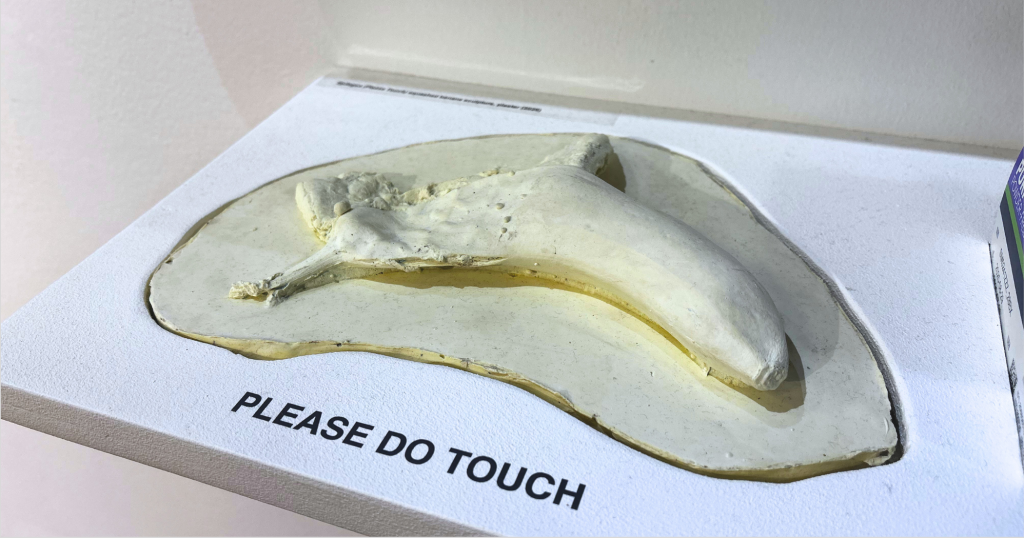
Back in the gallery a video plays above the banana sculpture. Li joins me before it begins. The inspiration, she tells me, comes from her own experience of the classic slapstick slip. A banana was crushed by her wheelchair whilst going about her day at college. On returning to the studio, Li decided to repeat the act to create a cast. The resulting work: ‘Epilogue’ (2026), is a squashed banana effigy made from plaster. The banana is an icon of physical comedy, a visual gag. It’s also quasi-erotic and suggestive. Touch me, it dares. The screen above displays the process of crushing, casting, moulding and sculpting this complicated fruit. A voiceover, provided by Raven, deepens the latent sexuality of the banana’s shape. It’s cheeky and awkward, and I can’t help but laugh at the encouraging utterances that play out over the sculpture’s casting. Li’s wheelchair seductively crushes the banana. A studio assistant’s hands and arms are filmed through the various stages as the squashed object is transformed. The video is titled ‘Hot Banana’ (2026), a sardonic nod to the film’s camp and sexual tone. Yet there are more than cheeky undertones at play.
Together, these banana works marry personal anecdotes with a public motif. Li’s own physical interaction is spliced with the cultural and art historical idea of the banana, and in this way the piece riffs on the pictorial and comedic legacy of the fruit through the specific lens of disability art. Elsewhere in the exhibition, I actually discover an image of Warhol’s hot pink banana sitting in a motorised wheelchair atop a giant mirror ball, used to advertise a live performance and disco entitled ‘The Awful Depths of Endless Space.’ (2026) The artist duo pay homage to art history whilst skewering it; a ‘cripping’ of culture, so to speak. Raven notes finding artistic thrill in performance that requires a full immersion of the self: ‘the thing that always excited me conceptually was performance art, being able to put yourself in the picture.’
The pulse at the heart of The Velvet Acronyms is ‘crip humour’, an often self-deprecating and absurd stylisation that is a recurrent strategy in the disability art movement. It’s A Wonderful Protest is a multimedia exhibition that pays homage to The Disabled Avant-Garde (DAG): a satirical organisation formed by artists Katherine Araniello and Aaron Williamson, active from 2006 to 2015. DAG were known for their vivacious performance art. Their work was featured in the Tate Modern, Gasworks and Serpentine Gallery. Both Li and Raven cite them as pivotal influences to their own works. Sadly, Araniello passed away in 2019. The Velvet Acronyms have moved to take up this helm. ‘It’s very symbolic that Araniello had the same disease that I have, spinal muscular atrophy,’ Li explains. ‘ We started [with] homages to their performances.’ As such, the work that Li and Raven create plays on societal expectations of disabled people through their gleeful assemblage of the absurd. ‘Everything here is vulgar,’ Li tells me, eyes glittering.
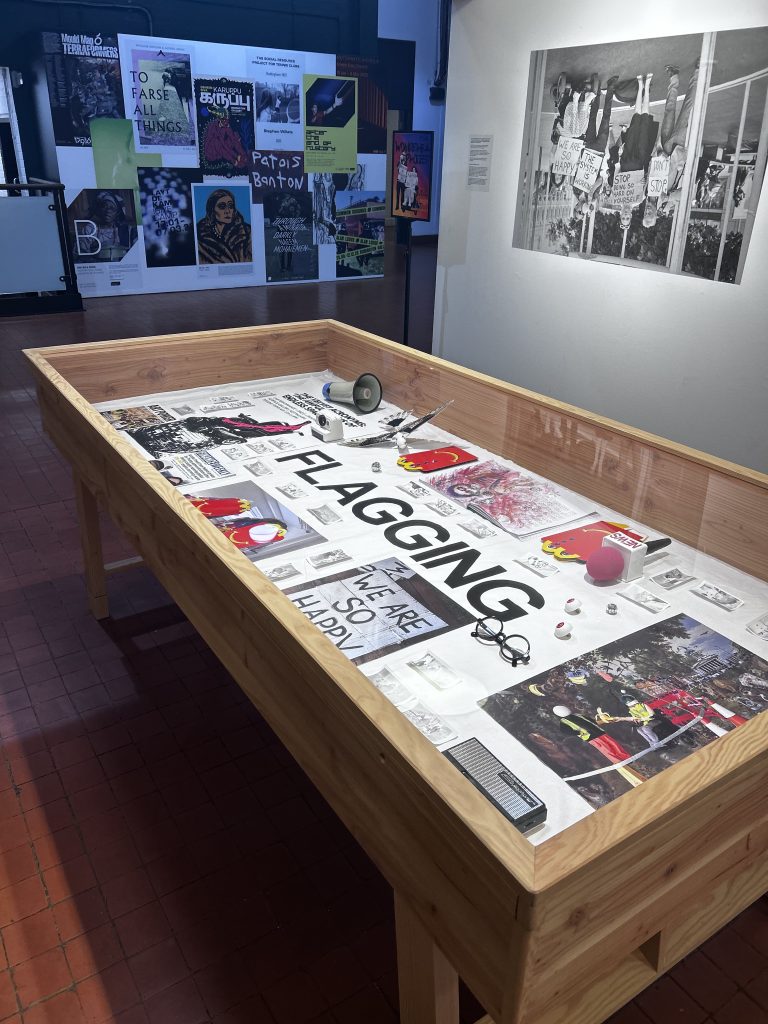
Display cases in the centre of the room are filled with ‘happy meal’ boxes bedazzled with jewelled tears alongside images of both artists wearing googly-eyed McDonald’s merchandise on their heads. There are megaphones and round costume glass assembled amongst spoofs of newspaper front pages: ‘Artists arrested outside CITY ART GALLERY for organising AFFIRMATIVE PROTEST!’ There are sketches, collages and photographic self-portraits.
To both artists, creating conceptual work is freeing. This kind of art, Li explains, is ‘a gesture of returning to power in the ways in which other conceptualists did under the political oppression of the Soviet Union (from 1922 until formal dissolution in 1991) during which time artists couldn’t speak for themselves.’ Li, originally from Ukraine, cites the Odesa conceptualist movement of the 1980s as a key inspiration for her work, noting that despite their disparate contexts and modes, the Odesa conceptualists and the British avant-garde were both driven by a shared sense of humour. Yet, as is often the case, there is something more cutting beneath the humour. The zany nature of the works is far from nonsensical or twee. Rather, they are often incredibly revealing.
Conceptual art is often, sometimes obliquely, linked to the concept of the body. Body-centric art not only introduces physical and ethical biomedical quandaries, but also asks some piercing questions about the art world itself. Picture an artwork that captures a body. What do you imagine? A Degas, a sculpture of Venus de Milo? A Pre-Raphaelite redhead? Disability art disrupts this concept of the normative body. ‘Yes, we can speak about ‘body art,’ Raven notes, ‘but what kind of body [are we referring to?] whose body?’ A wall of the gallery features a series of printed photos taken in Paris. One image features Li outside of the Louvre, a hand drawn moustache on her face, mimicking Marcel Duchamp’s moustachioed Mona Lisa in ‘L.H.O.O.Q’ (1919). The next photograph features Anna next to Edouard Manet’s ‘Olympia’ (1863), reclining in her wheelchair to mimic Olympia’s sexualised positioning. Following this is ‘A portrait of a web developer’ (2026) a large portrait of Li’s husband, a presentation of a reclining nude disabled man.The pairing of the two portraits asks us to reflect on the ethics of visibility and the desire to regulate who can or cannot be seen. Try to reduce us to our bodies, the works dare.
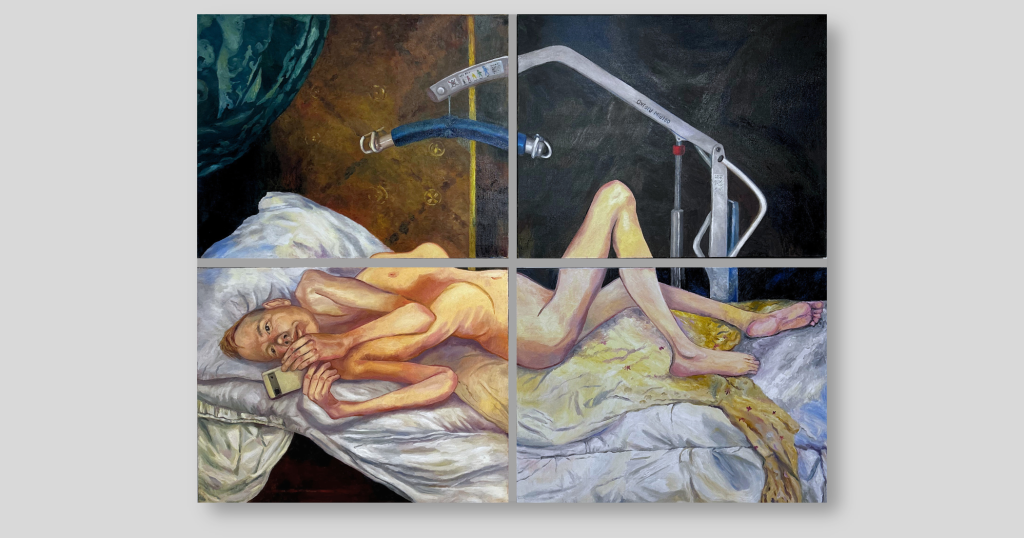
This leads backwards to the harrowing history of the segregation and social isolation of disabled people and the murky practice of using political violence, policy and erasure as a method of refusing to see different embodied realities. Both Li and her husband in these photographic works meet the gaze of the viewer directly. Here, absurdity is stripped back and a vital feeling is raised about both the value and the limitations of disability art. How can artists work within the genre of disability art without becoming typecast and trapped within it? There exists an issue within the arts in ‘the form of inclusion that’s actually exclusion’ for disabled artists, Raven explains via video interview. This exclusion can be physical, where artworks themselves are positioned in hallways or backrooms. Or it can be exclusionary in that it celebrates disability art without allowing space for meaningful critique, or conversation around topics outside of disability. Art by disabled artists deserves to be given the same level of critical attention and curatorial enquiry as work made by able bodied practitioners. The Velvet Acronyms satirise the idea of exclusion in their practice by creating literal exclusion zones. Within their active pieces, visitors are invited to join the artists in their performance spaces, delineated by crude boxes on the floor. In their topsy-turvy humour the artists employ a sardonic irony that seems to collapse the idea of debarment all together.
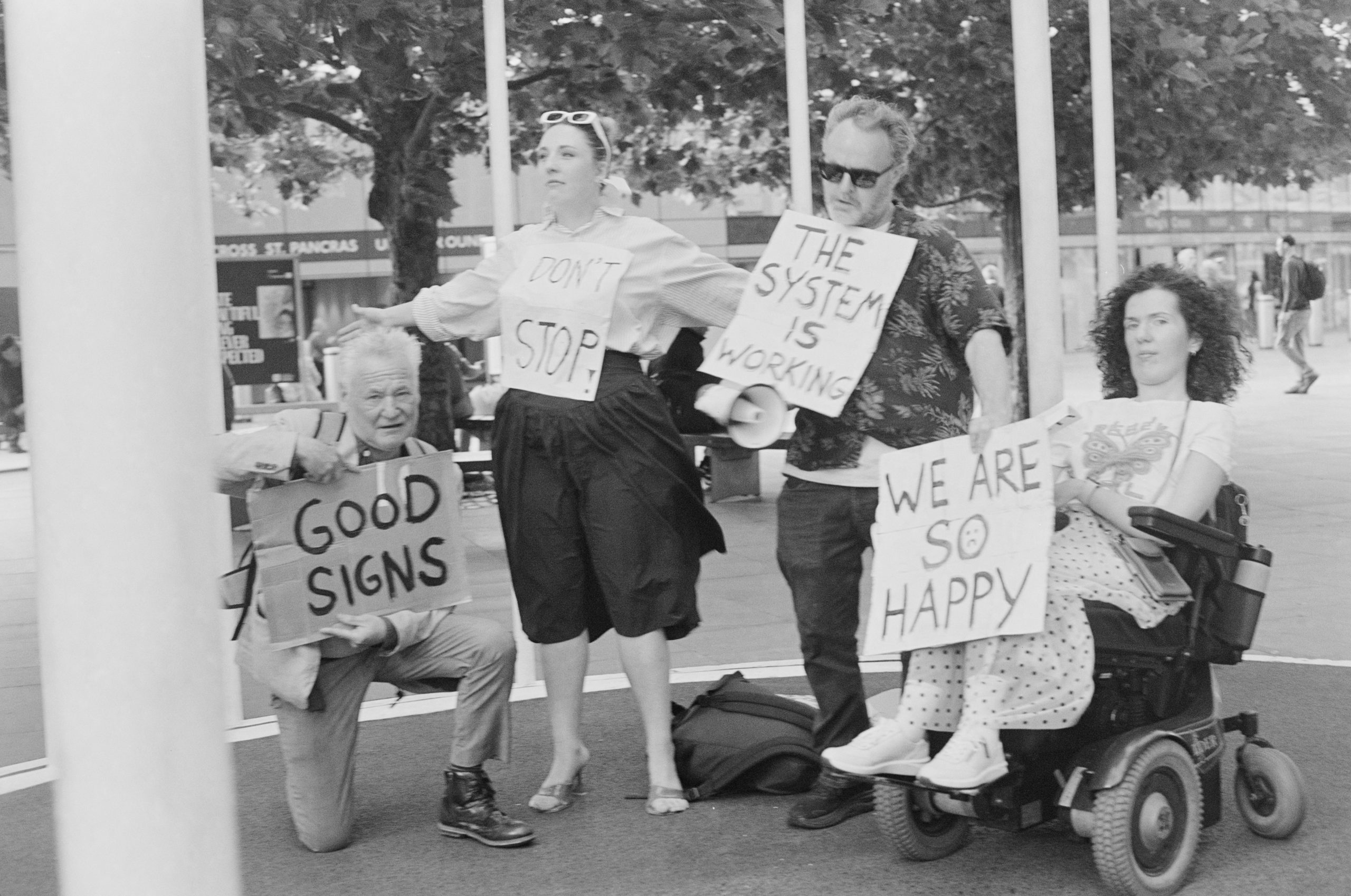
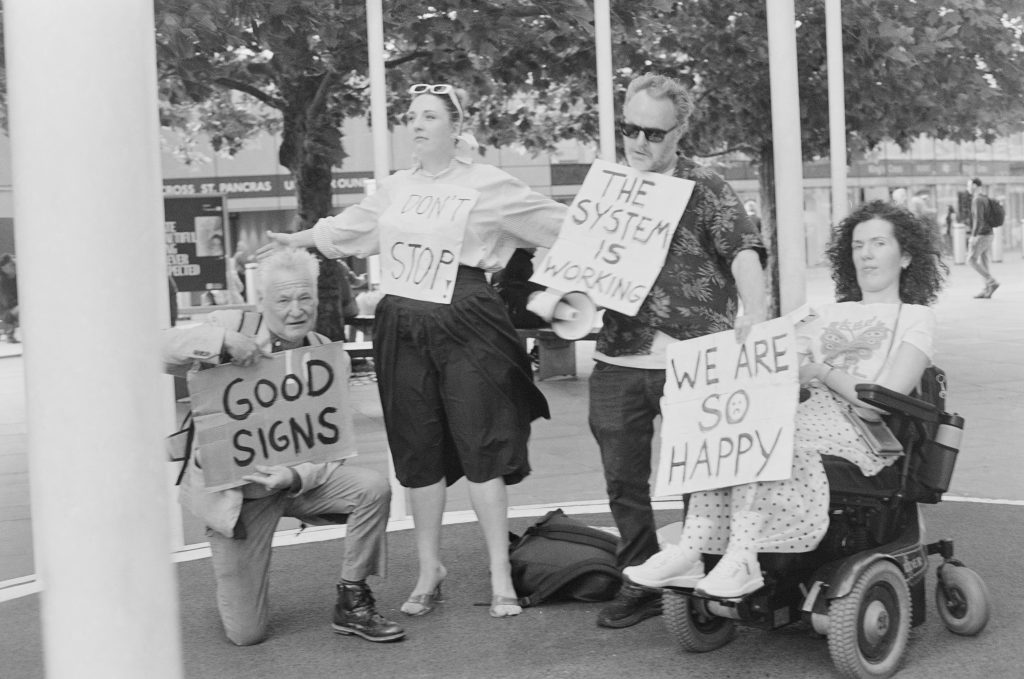
At the root of crip humour is a darker element: a moment of recognition where the nonsense of it all is found to have root in truth. In the words of the DAG website, crip humour is ‘both pitch-black and self-knowing.’ In this way, The Velvet Acronyms create a veritable cabaret, perhaps illustrated best by their most literal interpretation of the exhibition’s title, ‘It’s a wonderful protest photo-print’ (2026). Li and Raven are joined by artists Aaron Williamson and Alana Young in staging what the exhibition card terms an ‘absurdly upbeat’ protest in London. Their placards are eerily placating: ‘GOOD SIGNS’ and ‘DON’T STOP’ are joined by ‘THE SYSTEM IS WORKING’ and ‘WE ARE SO HAPPY’. On Simon’s sign, ‘IS’ is written in bolder letters; the O of Anna’s sign holds a doodled sad face, all four protesters look quietly serious, contemplative. The satire is pushed further with another strapline: ‘MAKE BRITAIN DISABLED AGAIN,’ an obvious play on the MAGA slogan popularised by Donald Trump. Under these images and (amongst the disco-balls and the faux-glamour) in the centre of the display case is a huge white flag printed with the word ‘FLAGGING’ in full caps. In the context of November 2026, when landmark reviews into disability support and the welfare state are taking place, these pieces feel all the gutsier for continuing to poke fun at the system.
Our bodies, disabled or otherwise, are not discrete binary entities. Li’s studio assistant physically crafted the banana cast. Raven credits Li in helping to tie his numerous ideas together. In the gallery hangs ‘It Depends’ (2026), ‘a collaborative mixed-media composition. The painting’s subject is Richard Park Bonington’s seascape ‘The Undercliff’ (1828). First, Li reproduces the painting in watercolour. In the foreground however, is the addition of ‘a wheelchair user [who] enters the historical landscape.’ Taking this further, Li dissects the painting into sixteen fragments and assigns them to a potential collaborator (students, staff or graduates associated with Bonington Gallery) to be replicated. The painting would only be complete with the cooperation of all sixteen artists. Strikingly, nine fragments are left blank, leaving only seven sections, abstracted and unmoored. One rectangle is filled with pencil-sketched rainbow lines. Another is an impressionistic tide-wrecked rock in cadmium yellow. With the missing pieces, the framing of the original painting is lost. By including the negative spaces left by those who declined the invitation, the piece takes on an eerily pixelated tone. Like a footprint, absence is still presence, it suggests.
Through conceptual artwork, the Velvet Acronyms track the various ways that our bodies both act on and are shaped through the world. The neoliberal concept of the individual self often butts against the sense of our bodies as inter-connected with one another, but for Li and Raven, interdependence is a huge factor in both life and art. The way we talk and think about disabled bodies is very revealing of how we think about all bodies. It is how we navigate our framing of the world. We exist, like art does, in an assemblage, a collage of sorts. Whether with the misplaced foot or the wheel of the chair, any of us may slide on the banana peel. We can all succumb to its slippage. It’s a Wonderful Protest serves as a reminder of this, as well as permission for us to laugh, even if we do fall down.
Zara-Louise Stubbs is a writer and PhD Researcher based in Derbyshire, UK.
The Velvet Acronyms: It’s a Wonderful Protest is at Bonington Gallery, Nottingham, 25 September – 12 December 2026.
This review was supported by Bonington Gallery.
Published 23.11.2026 by Rachel Graves in Features
2,121 words


