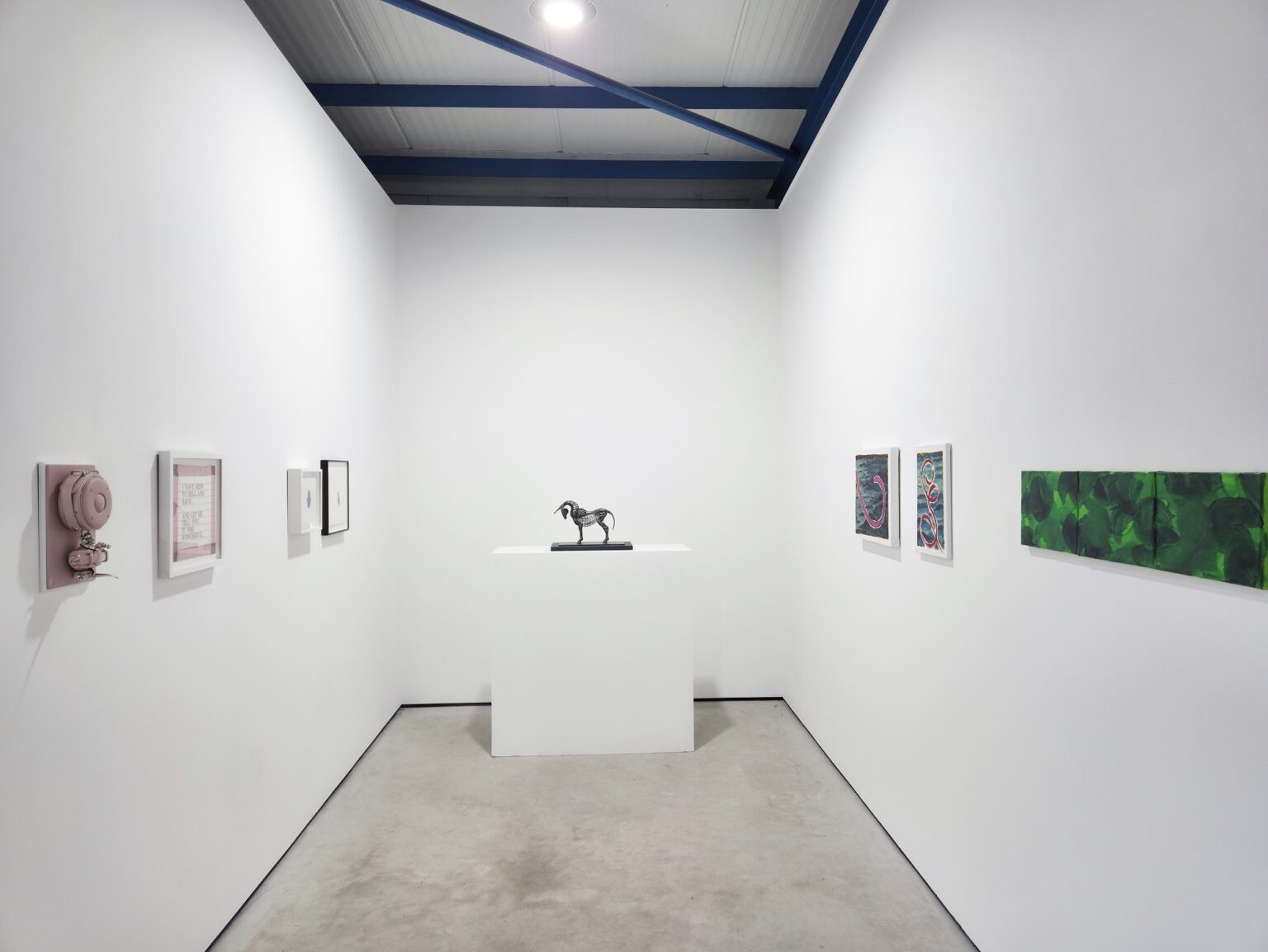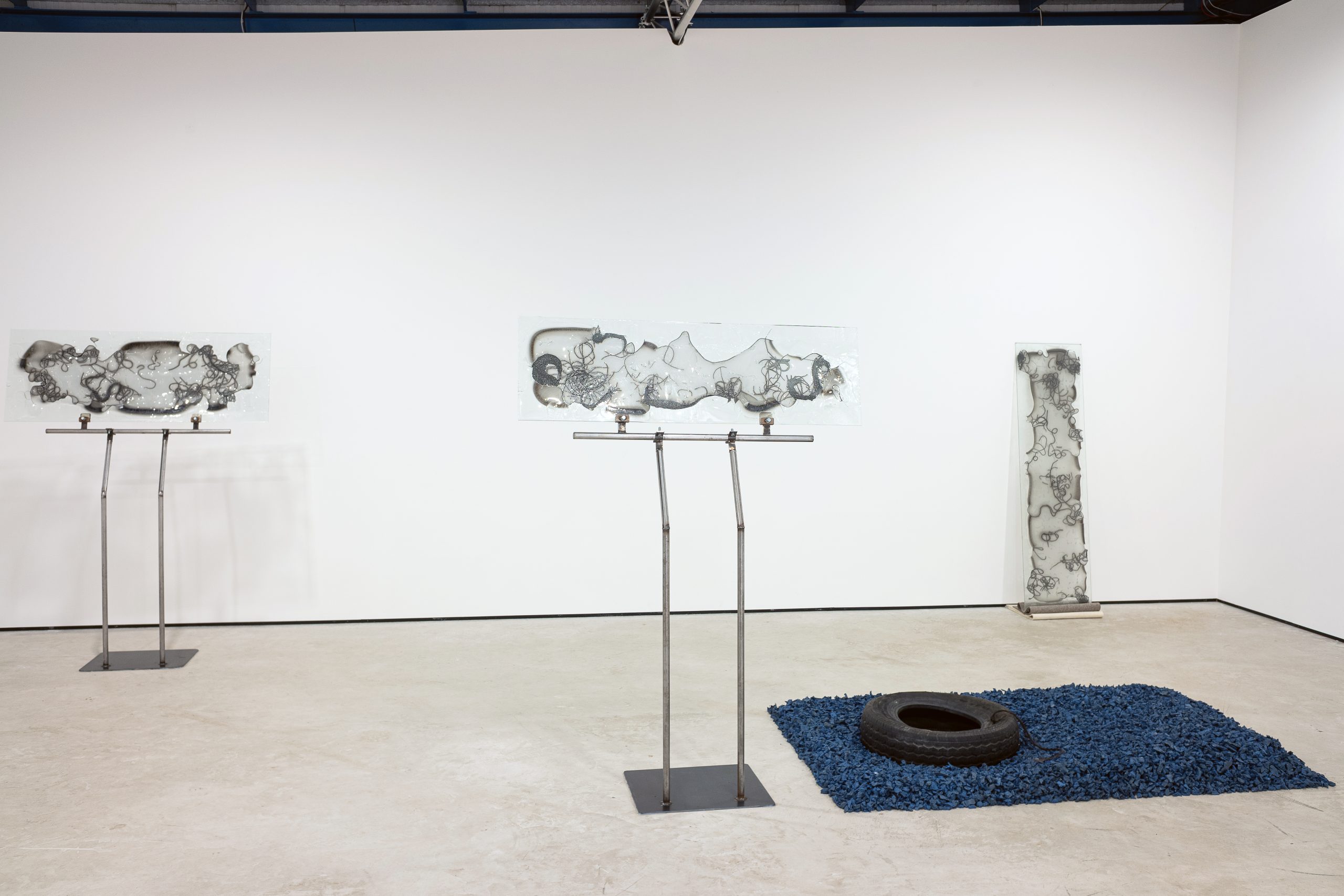
On this overcast late winter’s day, the wide windowed facade of Cross Lane Projects is a beacon on its suburban Kendal street. Harriet Bowman’s Slow Puncture is opening this evening and finishing touches are being made in the gallery space. Slow Puncture comprises twenty-five glass, metal, rubber and ceramic works, displayed across the gallery. These sculptural works are made from found materials: punctured or blown out tyres, smashed windscreen glass, clay from the family farm. Large pieces of fused glass, heated together in a kiln, are held up with welded metal frames and pulverised tyres, now chunks of rubber, are laid out across the floor.
Material, here, takes centre stage, as Bowman has devoted herself to understanding the materials she works with, pushing the boundaries of their purpose and studying them through their industrial contexts. Whether in a leather workshop when she was young, a tannery after art school, or most recently in a tyre yard, Bowman’s interest in these materials goes beyond the realm of the practical. Through the act of recycling, the materials’ story is transformed. From smashed car window or blown out tyre, into art.
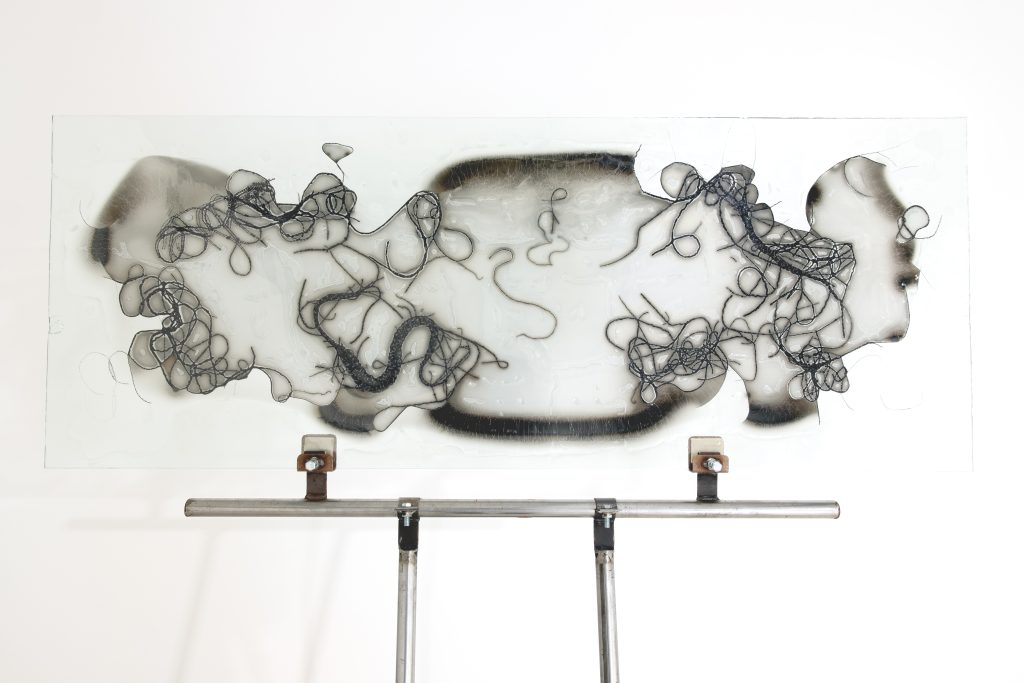
In ‘Rehearsal (ii, iii and iv)’ (2026), horsehair is carbonised between two fused glass plates, appearing as slick, cellular shadow worms that curve across a doubled pane. In these three pieces, Bowman’s signature style is everywhere. The glass panels are the length of her arm span and on either side, imprints of her fingers in the once-molten material are preserved forever. The fragility of glass is juxtaposed against the solidity of the metal frame that holds it in place. Like looking through a microscope, with Bowman’s work, the more you look, the more you understand. Each work feels somehow autobiographical. Horsehair from her mother’s horse, who was with her when she died, is a fragile love token of a mother-daughter relationship, suddenly, irrevocably, stopped. In ‘Rehearsal’ and in other pieces, this horsehair has been burned away in the heat of a kiln, its shadow remaining, like the ghosts at Pompeii. And although there are echoes of it, this inexplicable grief, that’s not what the work is about. It’s about provoked transformation, the point of change. It asks you to look closer, to reconsider preconceived notions of everyday, looked-over, functional objects and to start seeing them as elemental, precious.
The work is a rethinking of the assemblage for a post-industrial Britain. Here, the new meaning of these materials is unveiled as their destinies change. What happens after a life-altering event? What is left behind after the glass is shattered? How do we journey on when a tyre blows out? Bowman’s works capture a moment of instantaneous transformation. A moment in time in the process of changing state and the change’s inevitable permanence.
Collaboration runs through Bowman’s work and there’s a sense here that without the relationships developed with the people in the industrial settings where she finds her materials, the work wouldn’t happen. Just like the fine, delicate work of the welders who create the beautiful protective frames for the glasswork, or the man who collects glass from the roadside.
Despite everything, there’s a feeling of playfulness and discovery in the exhibition. All this started for Bowman in 2023, when she was the recipient of the South West Showcase and awarded a year’s access to facilities at The Arts University Plymouth as their Creative Associate in the glass and sound departments. Her 2024 show ‘taking care of the yolk’ at the university’s MIRROR and was the result of the research and development undertaken there, where she first started to work with glass and horsehair. After receiving the 2024/2025 Mark Tanner Sculpture Award she was awarded a further year at the university for further experimentation. Working with artist Amy Whittingham, the glass technician at the university, she was encouraged to stray beyond the boundaries of traditional glass and ceramic craft, trying out materials they hadn’t put through the kiln before including horsehair and smashed car window glass. And now, years later, she travels the breadth of the country chatting in tyre yards, making connections and, crucially, taking an interest in what she finds there. It’s from here that she sources shredded and blown out tyres for her works, similarly, working with friends to help her gather glass from crash sites or burglaries. Each material has a story, a person or family connected, a narrative that has suddenly shifted from industrial material to artwork. The building blocks are the people: the welders who fabricate the metal frames, the tyre yard workers and Bowman herself. Connected now, forever.
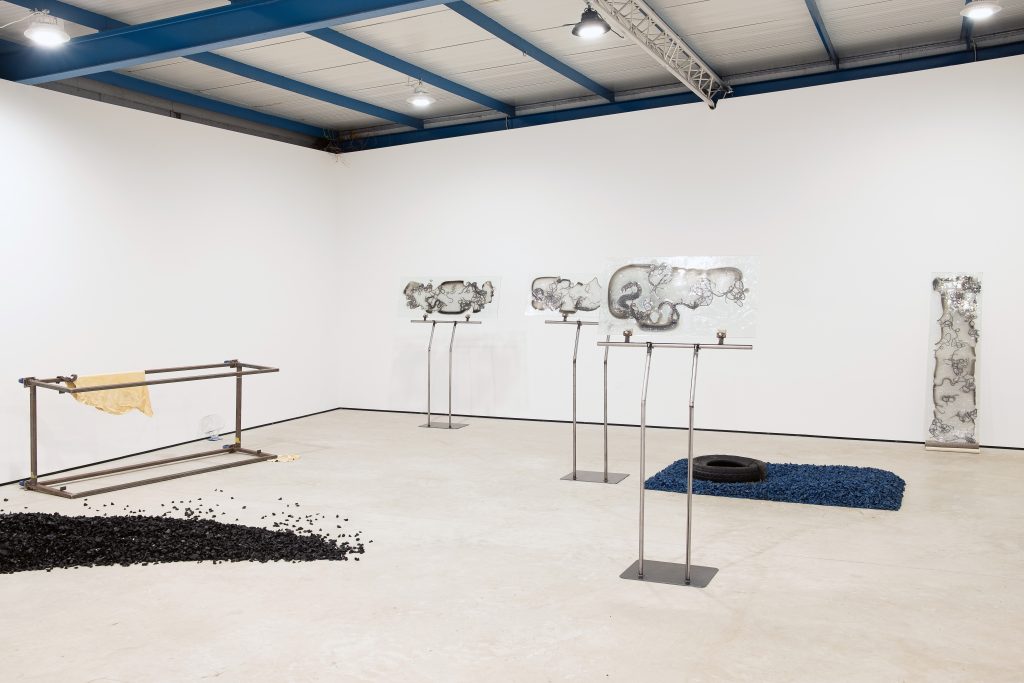
There’s a tension in the gallery. A pull; a stretch between what something once was and what it is now. In ‘Skid’ (2026), a tyre mark screams across the gallery floor, specks of black rubber in its wake. It’s a comma of black, so much rubber that you can smell it. Rectangles, squares, circles and loops are everywhere. In ‘Doughnut (full circle, attempt i, ii, iii, iv and v)’ (2026), smashed glass from car break-ins run up the wall, swept together from the pavement and transported into beautiful droplet loops, gallery light shining through. They’re held away from the gallery wall with metal clamps, some at head height, but most higher. At close range, echoes of their past life are abundant in their texture, with frit bands (the black enamel dotted edging that sits around the edges of a windscreen) visible inside.
Just like the Japanese enso, where the circle, formed in one brush stroke, captures a moment when the mind frees the body to create, the circles referenced in Bowman’s work can be expressive. A connection to the present moment, where imperfections, unclosed loops, represent the creator’s state of mind. Once made, they cannot be altered. Bowman has been photographing skid marks and doughnuts on tarmac for years, tracing the heat prints of these cars and mapping them into her work. She contemplates the juxtaposition of the performance of these manoeuvres with the authenticity of the reaction that comes after an accident or event. A controlled event, in the doughnut, versus an out-of-control moment, in the skid. In fact, she’ll soon learn to perform doughnuts herself, with plans to train with a stunt driver.
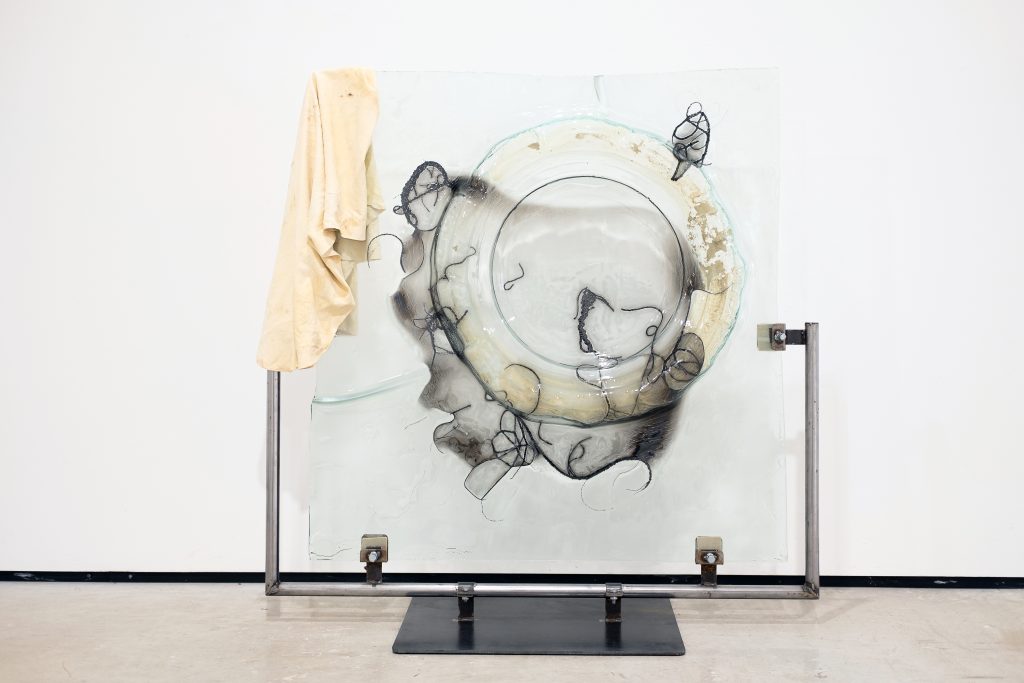
But, of course, perfect circles only exist in abstraction. In ‘Now is the time to drink’ (2025) a chamois leather is draped across the corner of a fused glass pane, ready to polish the circular tyre imprint left in the glass. To perfect it. The chamois is a functional animal skin, pulled from its original context through intervention after intervention, often used to finish and refine, but in its new life, viewed as part of an artwork. Suspended in glass forever beside it, carbonised horse hair loops around and under, in contrast to the sharp corners of its welded metal frame.
An overturned trolley, its redundant wheels in the air, self-conscious, shamed, draws you to the back of the room. ‘Car(cass)’ (2026) is the collapse of something or its fall from grace, an end and the inevitable beginning that comes after. The space inside the frame is pregnant with suggestion. Is it a vehicle? Or perhaps it’s an animal. It energises the space here and provokes the need for interaction, there’s an instinct to help – to set it right, to reach out and offer a hand. Draped softly over and resting just beneath, two more chamois leathers and a ceramic horseshoe are curved on top.
In ‘Full Body (large glass)’ (2026), a reference to Marcel Duchamp’s ‘The Bride Stripped Bare by Her Bachelors, Even (The Large Glass)’ (1923), Bowman has recreated her body in parts. Standing at her exact height, this is a stunning abstract self-portrait. Held between two rectangular panels of glass, looped carbonised horsehair darkens towards the top and sides, echoing the depth of life and the fragility of this material. It’s a feminine forever mark that navigates worlds still dominated by men – worlds of industry, cultural debris and auto art.
In Slow Puncture we also see collaboration in material. Glass against metal, rubber against concrete, glass against tyre. After these collaborations, these events, what is left behind? Imprints of tyres are set into glass like fingerprints and the strength of those metal frames give a sense of safety.
Life can move slowly, maintaining the status quo and then suddenly, an event can happen, beyond control, that throws everything into a new alignment. Slow Puncture is work that listens. To stories, narratives and identities, to material and to the power of transformation. It’s art influenced by sudden loss and that through reacting to a series of mini-events and accidents, exerts control. It’s an upturning of assumption that leads to renewal. It’s a woman, walking into a man’s world. It’s beautiful, inquisitive art made from punctured tyres, broken glass and chamois leather: imbued with stories, the materials mean so much more.
Harriet Bowman: Slow Puncture, Cross Lane Projects, Kendal, 7 March – 25 April 2026.
The Mark Tanner Sculpture Award is hosted by Standpoint.
Grace Edwards is a writer and ceramicist based in Liverpool.
This review is supported by Cross Lane Projects.
Published 27.03.2026 by Jazmine Linklater in Reviews
1,586 words