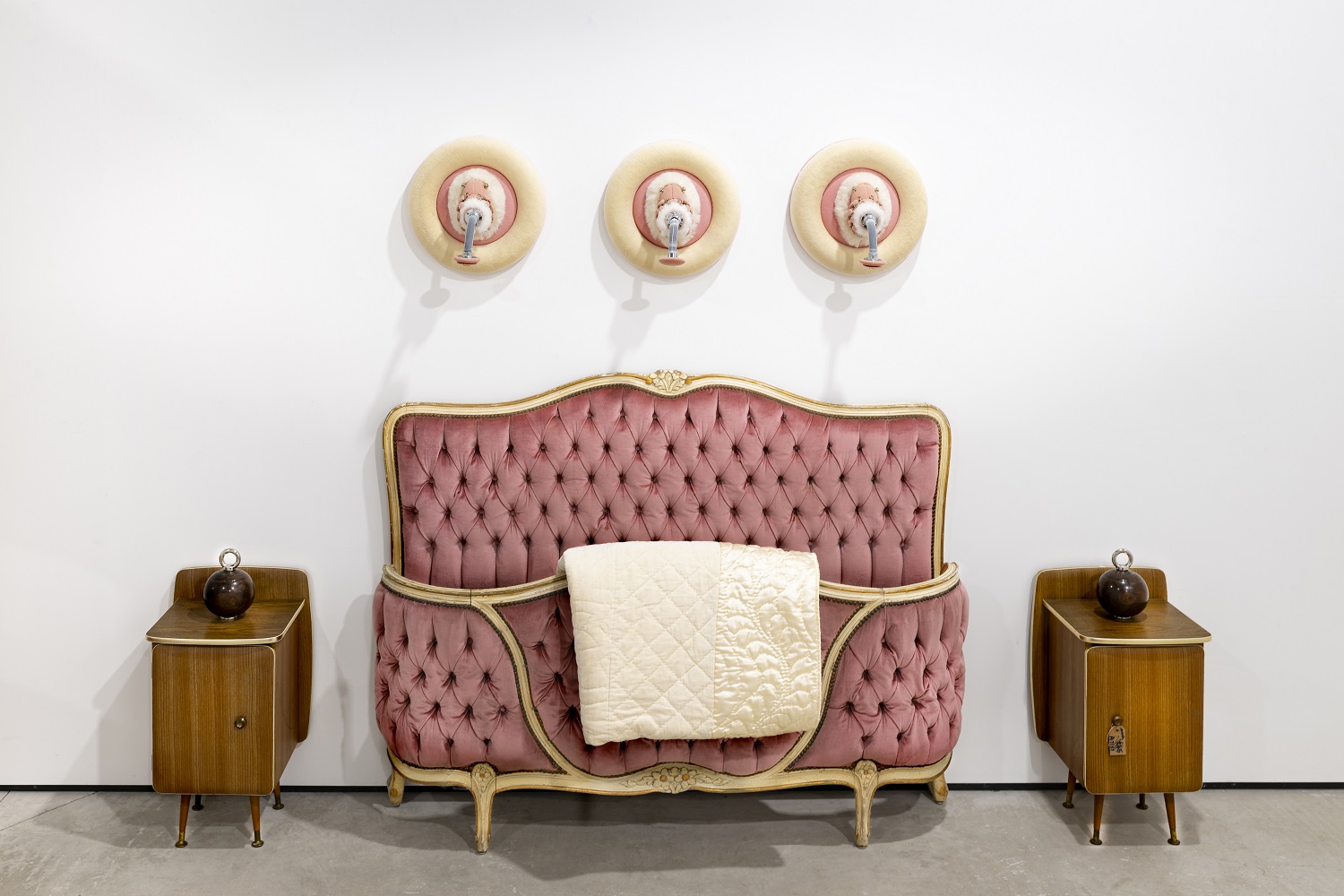
At first glance, Kendal appears to be a very strait-laced town. Antiques shops and tea rooms adorn the high street in a quintessentially chocolate box aesthetic. Students and septuagenarians sit beneath an idyllic sky. But like always, beneath the surface lies the truth of our desires. We all wear the mask of acceptability for fear of showing too much of ourselves. Normality is the weapon we use to punish the perverse, absurd and taboo thoughts we dare not entertain. What would happen if these worlds were to collide? Doilies and dressing tables, handbags and velvet-lined jewellery boxes acting as the code to unlock our as-yet-unknown pleasures. Could we create the tools we would need to aid our exploration of a thoroughly prim and proper British kink?
In Formula + Fetish by Mark Woods at Cross Lane Projects in Kendal, the artist’s vast and playful oeuvre invites you to release your inhibitions, but only so far. Each work treads a line between treasured keepsake and instrument of lust to be locked away. Initially, the shock value is set to low. The objects of the first room at first look suspiciously tame. Initially what greets me appears to be a set of wooden display drawers – the kind you would find holding specimens at a local museum – next to the customary art space bookshelf. On closer inspection, ‘The Collection’ (2016) appears to consist of tool chests, each slightly ajar to reveal a series of unusual items. As a form of foreplay, they appear to work rather well – the artist teasing us with suggestions about what is yet to come. Inside these walnut drawers are surreal instruments of titillation, each arranged in their proper place be they hairy, shiny, oiled or lubricated. Each appears reminiscent of the ‘corrective devices’ used to stimulate repressed Victorian women, perhaps a clue as to the artist’s own former repressed views regarding their own sexuality and sexual expression, as discussed in a 2021 interview about a previous show at Cross Lane Projects. There is a gentle voyeuristic invitation and playfulness to these initial works. Similarly, the use of a museum display cabinet to protect us from the barbed ferocity of ‘Spiky Totem’ (2025) speaks to the artist’s desire for a kind of acceptable shock. The slinky purple tube with silver spikes would, in any other environment, alienate or even frighten the viewer, but here there is a suggestion of safety afforded it by its setting within the glass cabinet. Please do not touch. Our hands are held. Have no fear, the beast within has been tamed.
Accompanying and perhaps guarding these objects are ‘Young Consumers’ (2025), a gang of child-sized mannequins each brandishing blades for hands. Each is clad in animal skin, feathers and classical depictions of the hunt. A social commentary on knife crime and its destructive but seductive nature? A comparison between hunting for sport and hunting for likes and subscribes? Either way, the image is arresting.
Moving past this throng of children I make my way into the next room. The space is set out in a narrow, elongated walkway, similar in style to a catwalk. The room feels as if it has been set up to be deliberately claustrophobic, lined with two shelves displaying opened leather cases containing more surreal sculptural objects that could be sex toys, but whose use it is difficult to imagine. More really is more in this room, which I find profoundly overwhelming because I was unprepared for the confrontation and intimacy of the space. Where others may relish its Freudian collage of sensation, I find the temperature change between the first and second exhibition spaces rather too abrupt.
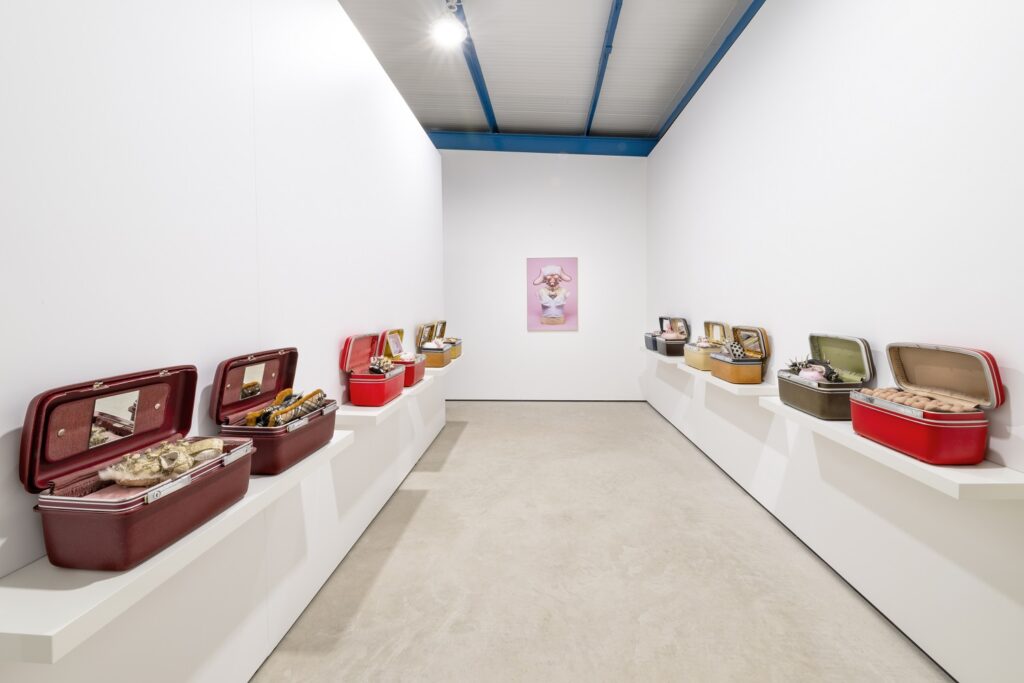
Exquisitely made fabric constructions, the items displayed are decorated variously with feathers, metal and other materials. The striking piece on the poster for the exhibition ‘Lambing Time’ (2019), seems to lose some of its tactile vulnerability here, in amongst the similarities of the other works on display. These carefully constructed forms using leather, fur and high fashion techniques put me in mind of luxe accessories like handbags, jewellery or watches. This use of ornamentation to ape the capitalist language of excess is exciting, and somehow simultaneously disgusting. I find myself asking, what is it that activates my feeling of disgust more? The suggestion of excess or the openly and overtly erogenous subject matter? ‘Tienes Huevos’ (2024), with its abundance of synthetic hair and scrotum/coin purse provocations, definitely treads this line most delicately. But overall, the works in this space celebrate desire. Grasping and suckling are our base instincts, and over time we are taught where and when it is acceptable to do these things – most usually not at all. Here those primal life-giving compulsions are celebrated.
Staring in adoration upon the trinkets on display is ‘Goatherd Poster Girl’ (2023). This pink leather, lace bra and anthropomorphized, masculine mannequin appears both brazen and coquettish, which I read as a proud display of the joyfulness in the subversion of gender and its conventions through attire. Clothes have no gender, why should a Poster Girl?
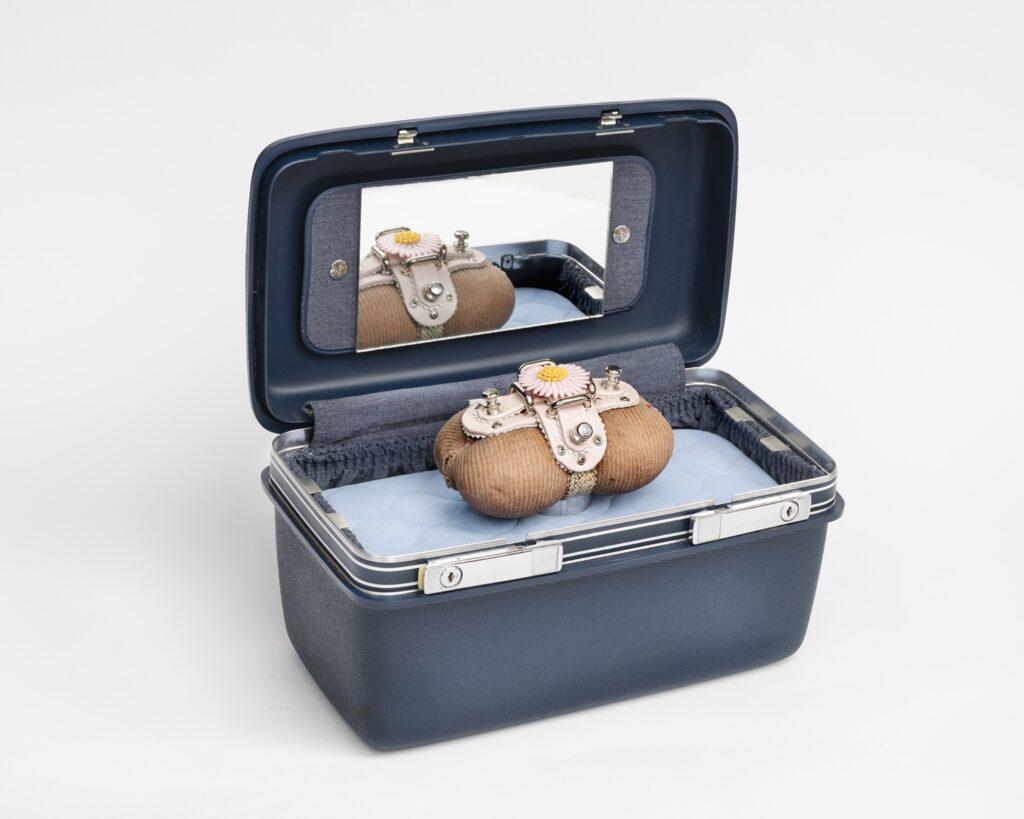
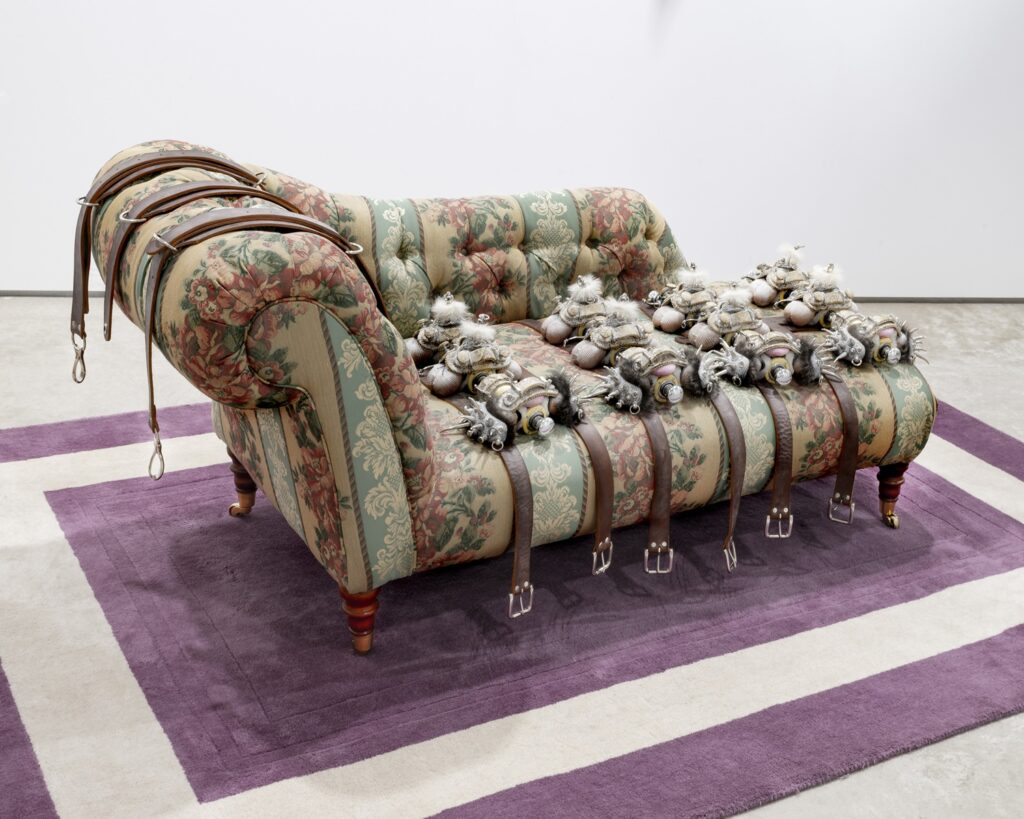
The penultimate space is perhaps the most subversive. A chintzy front room warped by the invasion of leather, metal and restraints. In this installation including coffee tables, a rug and a fireplace surround, the larger pieces are arranged in a pastiche of domesticity. The chintzy floral patterns of the ‘Prickly Chaise Longue’ (2025) struggle against the snakeskin, leather and fur flouncing atop it in ‘Domestic Bolt-on’ (2024). Here we see Woods’ tenderness creep in, with a restrained suggestion of the feminine. In the collection of pieces which make up ‘Mirrored Dressing Table’ (2014-2025), we see beneath the flounce and drapery a chest of make-up, nail varnish and mascara. In an unassuming blue trunk these items are hastily piled, almost hidden from view. The floral and the feisty act as camouflage. Much of the work seems to operate by both hiding and revealing parts of itself at once, tussling between the suggested nature of the work – domestic, decorative, suggestive – and the suggested nature of the artist – both feminine and masculine – in a tense confusion.
The final room shows three photographic self-portraits of the artist exploring the Freudian concepts of the ego, superego and id. The first and most confrontational is ‘Rose Garden Guard’ (2025), which shows the artist in a grey tweed skirt and blazer, brandishing a wooden truncheon and screaming towards the viewer – all rage and fire. This depiction of the id – the impulsive, subconscious, desirous part of us – is clear, the urges are released and unabashed. But the outfit the artist wears almost depicts them as a disciplinarian, which would be fundamentally at odds with the conventions of the basically instinctual id. The image suggests: I am the object of rage but also threatened with being disciplined. To my left is ‘Nylon Bon Bon’ (2025). Here we have the superego, the great moderator and source of shame. This portrait mediates the conventions of conformity, seemingly borne out of a fear of the femininity depicted. It is pink, frilly flouncy and submissive. All the things the artist purports to have feared, now bravely beamed out for all to see. The last image is of the ego. ‘Lolita’ (2025) depicts the artist in a sultry suggestive pose. Kilt, cardigan and golden bell end swaggering towards the viewer. We are being seduced. I feel like I can relate in different ways to all the portraits here. These three images tie together masterfully and act as an anchor for the other works in the exhibition. Like encountering religious icons at the end of a personal pilgrimage, these holy of holies add context and understanding to the harsh, the gentle and the taboo.
Leaving the gallery I ask myself, does this exhibition live up to its name? Formula? Yes. There is a set structure and ultimate destination to the collection of works which makes for an enjoyable ride. Fetish? Also yes, here explored as a means of finding acceptance within oneself and community through shared experience. The exhibition excels at using unconventional materials and emotional waypoints to mark the journey to feeling less othered. Some aspects of the experience I found shocking, while others decidedly vanilla. That is in no way a criticism of the work as a whole, but perhaps of the jaded state both I and others find ourselves in. The world has people like me on high alert, finding anything that will pierce the veil into that frisson of hot and heavy hyperventilation takes more than it once did. A little leather, lace and something locked away, however, makes for a pleasant distraction.
Mark Woods: Formula + Fetish, Cross Lane Projects, Kendal, 10 May – 28 June 2025. Formula + Fetish will continue in a new exhibition at Vestry St gallery, London until 26 July 2025.
Even Allen (AKA That Looks Queer) is an art writer and critic based in Sheffield.
This review is supported by Cross Lane Projects.
Published 26.06.2025 by Jazmine Linklater in Reviews
1,530 words


