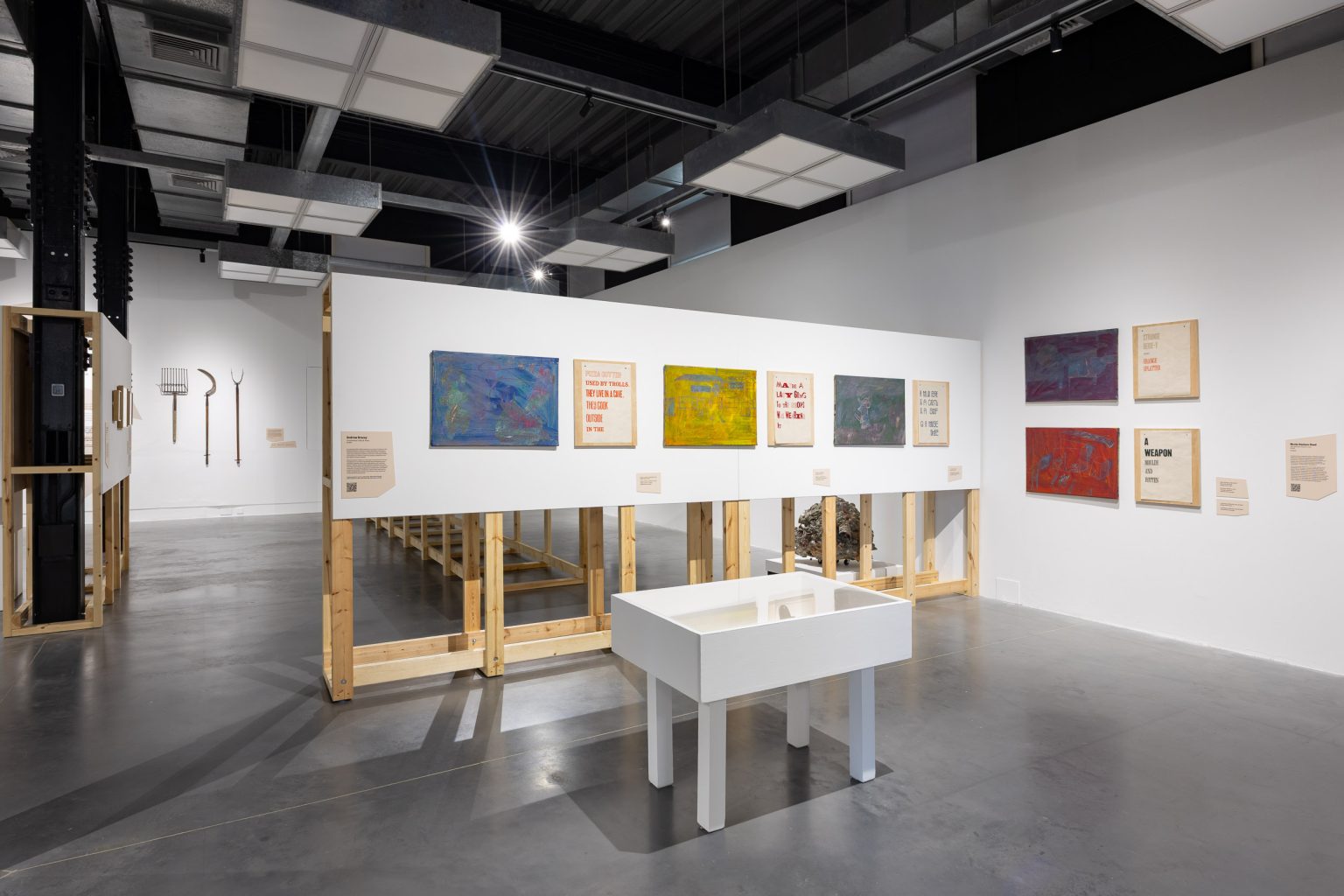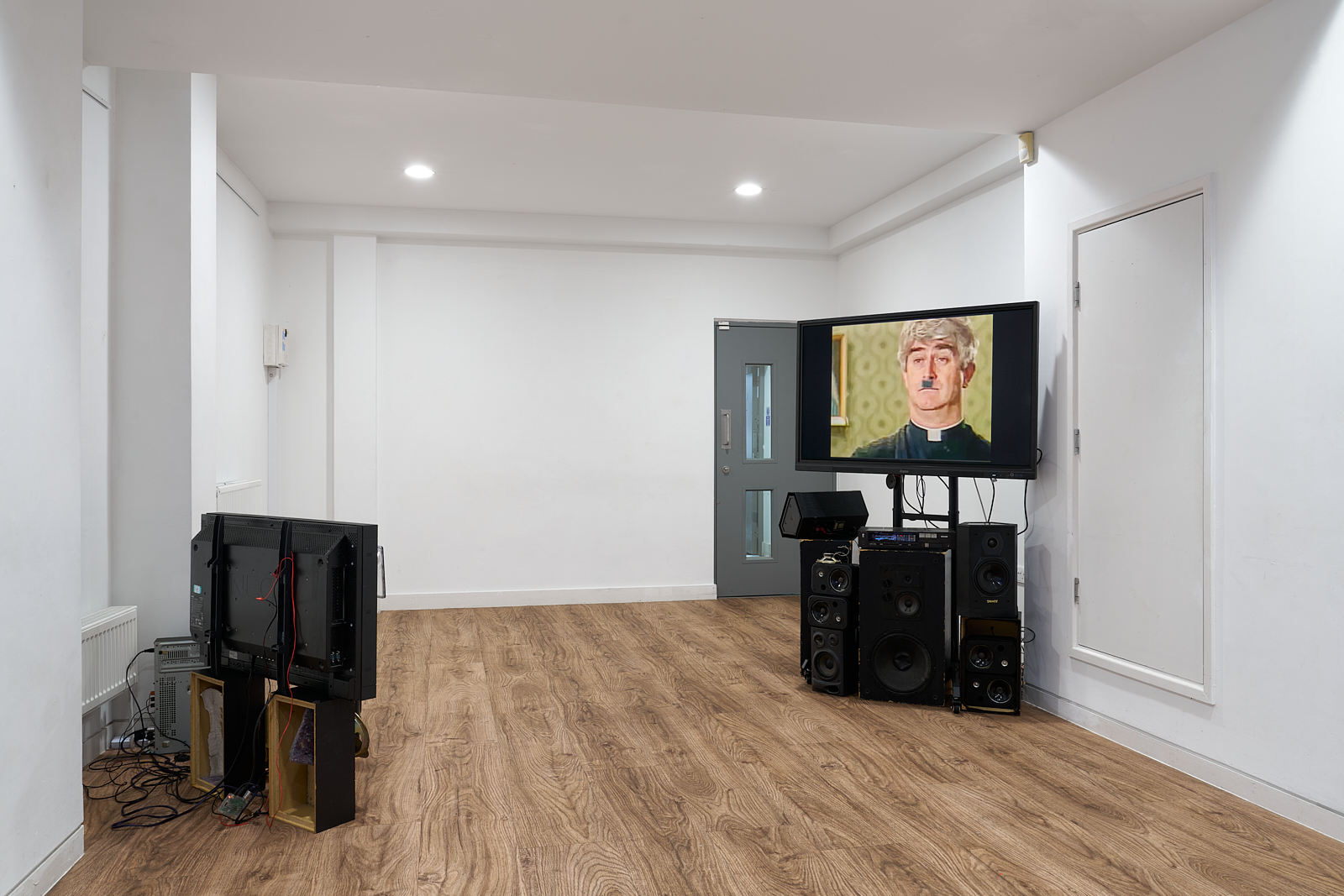
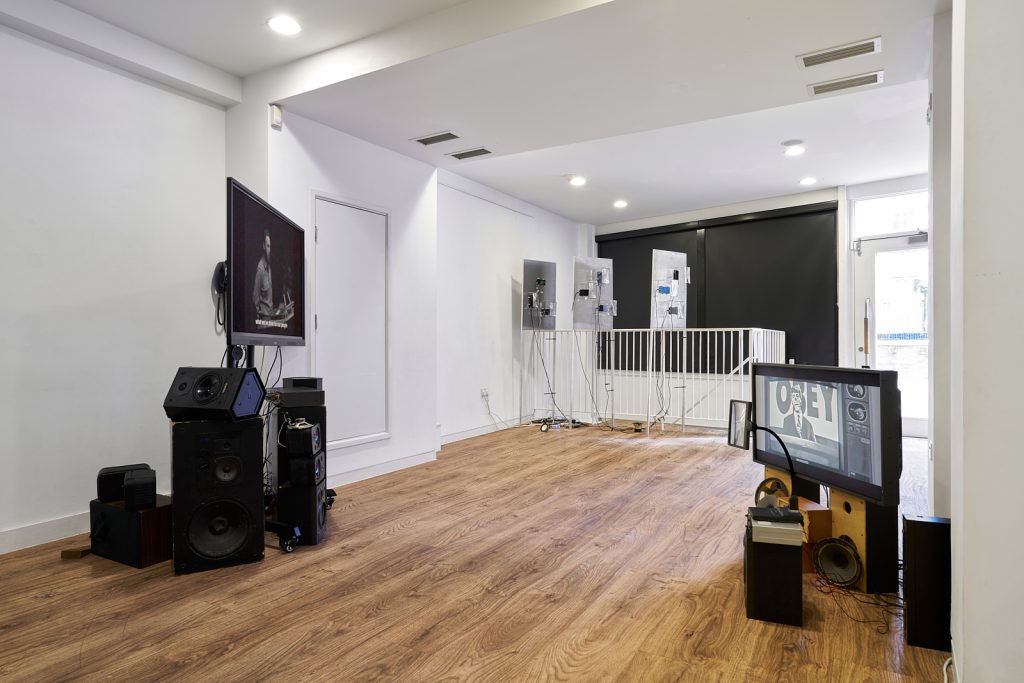
The immediate presence of Jas Singh’s ‘Cognitive Distortion’ when entering Broadway Gallery in Nottingham suggests the back room of an old electrical repair shop, with stacked speakers and screens, trailing cables and bolted-on magnification panels, giving the space the general air of a makeshift hacker’s den from a 1990s film. It’s not hard, at first glance, to imagine the gallery as a deconstructed set from Sneakers (1992) or The Net (1995), or a version of Keanu Reeves’s bolt-hole in Johnny Mnemonic (1995) stripped of its neon-lit cyberpunk trappings, but a more relevant influence is arguably that of the Ballardian. A dictionary definition notes that the Ballardian signifies “material pertaining to or reflected in the works of British science fiction author J.G. Ballard (1930 – 2009)”, while a secondary meaning adds that the Ballardian is “characterised by dystopian modernity, desolate man-made or artificial landscapes and the psychological effects of technological and environmental change”. This is clearly in sync with Singh’s interests, as displayed in ‘Cognitive Distortion’, and this notion of the Ballardian is present in terms of both the atmosphere and the presentation of the work. The loosely sculptural, often analogue, material presence of the installation, and the rapid-fire, kaleidoscopically remixed digital audio-visual media that comprises the work itself, when encountered simultaneously inside the space, strongly evokes these ideas.
‘Cognitive Distortion’ consists of texts and news footage, archival and fictional images, playing in constantly repeating loops, running in a kind of phased succession across various flatscreen TVs and smartphones. But these slick contemporary display methods are also mounted on piles of broken yet still functional audio speakers, from which blends of abstract and aggressively concrete sounds flow. TV screens and smartphones are appended with library magnification panels, through which segments of the repurposed moving images appear enlarged or distorted, their precise effects constantly shifting as I move around the space and view them from different angles and perspectives. At one end of the room a small flock of smartphones display generative texts suggestive of a kind of sentience or self awareness emerging within the devices themselves, as though the screens are explaining their own functions and effects. Others highlight sequences of surreal archival photographs: a zombie-like face with whited-out eyes, perhaps culled from an old Twilight Zone episode, or a 1950s scientist posed in front of an image of a girl in a bikini, adding a B-Movie air to their presence. One idea here might be that our constant handling of smartphones leads them to absorb our own subconscious desires and fears, much as medieval relics were once thought to absorb the prayers directed through them.
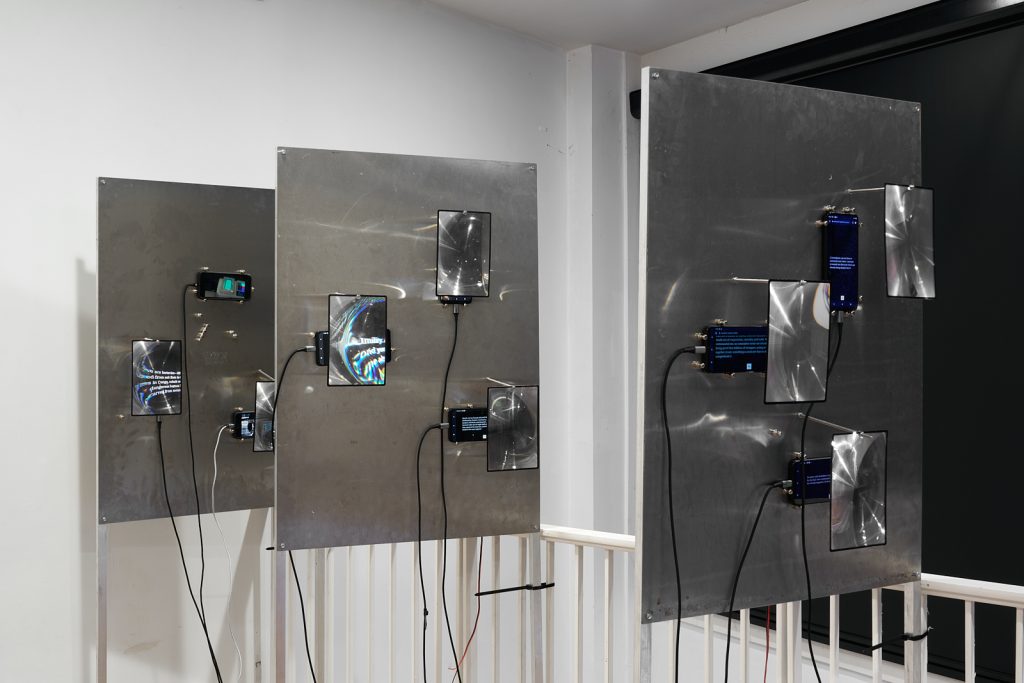
If the visual and audio work here is all very much in the digital realm, then its mode of presentation seems designed to break the usual illusion of seamless and weightless materialisation found in so much digital artwork, and exemplified in such evasive conceptualisations as ‘the cloud’ to describe vast industrial server farm networks linked together with undersea cables and orbital satellites. ‘Cognitive Distortion’ instead offers a physical and material framing, not just in real life, but through the partial use of specifically retro equipment that heightens our awareness of the hardware and infrastructure that underpins the work’s digital production and display. Singh’s smartphones, for example, are roughly bolted onto discoloured metal sheets, the wires powering them visibly dangling and trailing across the floor to plug into sockets and USB ports, whose own wires connect to other sockets and ports elsewhere. The effect of seeing all of these bluntly functional visual elements, acts as a kind of exposure to the raw materiality of these technologies IRL, highlighting their dependence on real world systems of power generation, physical resource extraction and of course, human labour.
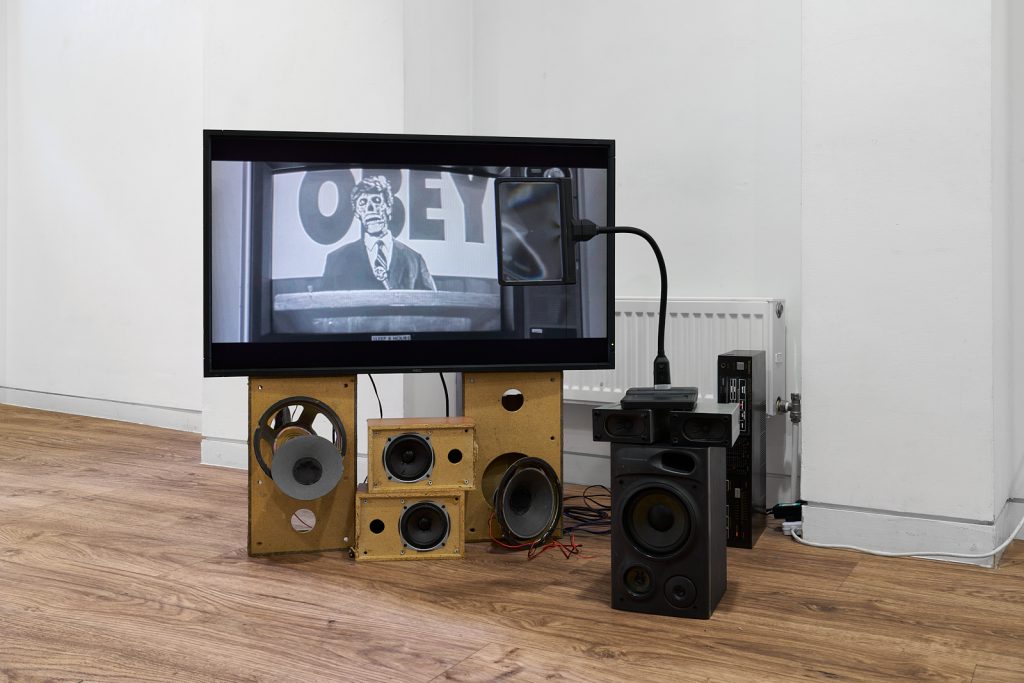
The flows of imagery and data through these systems, in the case of ‘Cognitive Distortion’ taking the specific form of layered sound and remixed media footage, is weighted with an almost apocalyptic tone as imagery of war zones and stock market graphics, recent insurgencies in Afghanistan, Congo and Yemen blur into mid-century dictatorships, and these into (only occasionally identifiable) TV comedies and Science Fiction cinema clips, all flashing briefly across our visual field and into our consciousness before cutting away into the next segment, and the next. The rapid flow of imagery and data renders the audio-visual experience of the work as something akin to fast forwarding through an Adam Curtis documentary, famed for their essayistic construction of historical arguments through a non-linear deployment of media imagery and nostalgic sounds. Or perhaps we are made to feel like Malcolm McDowell’s Alex in the iconic aversion therapy sequences of Stanley Kubrick’s A Clockwork Orange (1971), having our eyes forced open to absorb a reality altering cacophony of contradictory imagery that might be reprogramming our brains as we watch. Singh himself appears to encourage this reading, making sure to include a close-up visual of Alex’s forced-open eye in one of his streams (arguably performing a little of that cerebral rewriting himself by planting this particular idea in the viewer’s head).
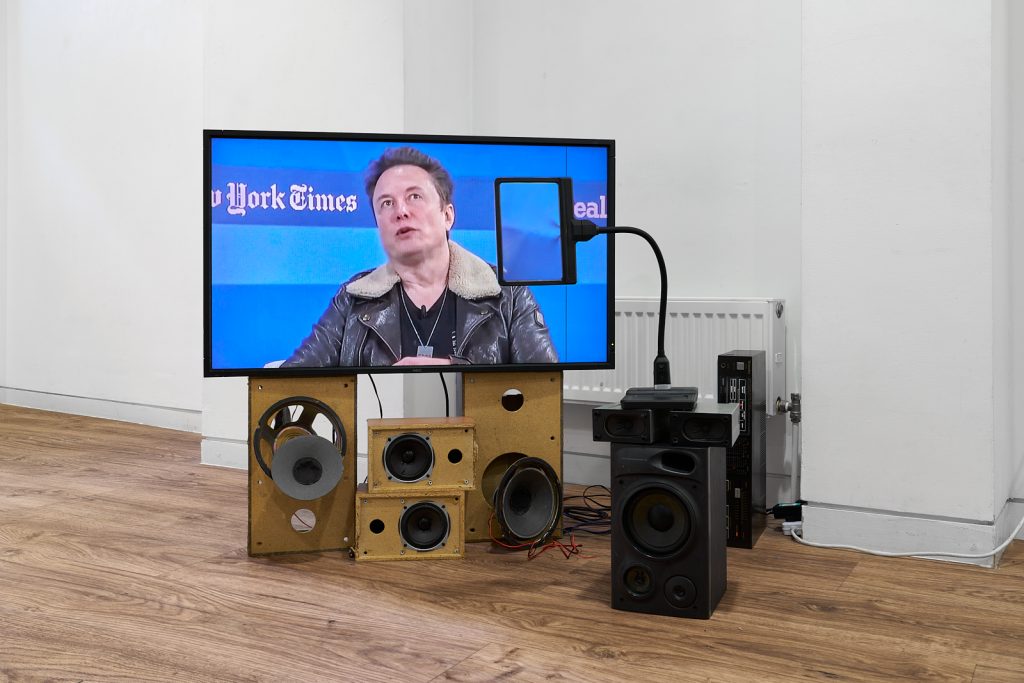
It’s in this sense that the impact of Singh’s work carries something akin to that of J.G. Ballard’s fictional imprint, in their work’s shared fascination with the potential for psychic rewiring and cultural mutation wrought by technology as its implementation and spread alter the culture and reconfigure human aspirations and desires. As in Ballard’s works The Atrocity Exhibition (1970) and Crash (1973), where politics, consumerism and mass media warp and derange human psychology, ‘Cognitive Distortion’ seems preoccupied with the similar effects latent in much of our contemporary reality, where political and economic instability is increasingly both caused by and refracted through the bleak funhouse mirrors of digital media, corporate algorithms and increasingly, of course, the development of AI. The flows of constantly changing imagery strobing across Singh’s multiple screens comprise both documentary (i.e. supposedly true) and entertainment (i.e. supposedly fictitious) footage, blurring the real and unreal in ways that seem intentionally impossible to fully separate or decipher.
On one level, this is because Singh, by his own account, is more interested in condensing and heightening the experience of existing media than directly interpreting or commenting on it, as though his own input, as the artist and author of the work, behaves in ways analogous to the algorithms that shape our consumption of similar imagery and sound outside the work itself. One fleeting sequence intercuts between 1960s footage of Fidel Castro talking about the Cuban revolution at the UN, Adolf Hitler gesticulating behind a microphone at some point in the 1930s and the late Irish actor Dermot Morgan, in character as sitcom priest Father Ted at some time deep in the 1990s, while himself sporting a Hitler moustache. The juxtaposition of these jarringly distinct elements feels both entirely random and potentially significant, their final meaning largely dependent on the perspective we ourselves bring to them. The point, made clearer by the fact that these apparent connections are embedded in (and singled out here from) a still wider range of seemingly disconnected fragments within the same short segment, is that both the artwork and the systems it explores tend less towards forcing a particular viewpoint onto us and more towards generating a sense of confusion, chaos and general instability that renders the act of definitive singular interpretation impossible.
Singh’s decision to utilise AI at selective points in his working process is also significant, feeding his own human-made initial scripts, soundfiles and edits through Large Language Models (LLMs, a type of algorithmic information processing tool, initially trained on vast quantities of text but more recently also fed on audio-visual data, scraped from vast digital libraries, mostly without consent) in ways expressly designed to warp and complicate the emergent work’s relationship to his own perspective. In doing so the artist, by his own account, allows the LLM to act as a kind of externalised consciousness that places distance between the effects generated by ‘Cognitive Distortion’ itself and Singh’s own personal interpretation of the world; much as social media sits between our shaping of it, and its potential for the exercise of control over us. The work that finally manifests from this layered development process seems fully embedded within that IRL world, but takes into account both its actual reality and its own technological mediation of that reality.
The traditional idea of an observing consciousness, capable of standing outside its subject, commenting authoritatively, remaining entirely uncorrupted by the algorithmic morass that engulfs it, is explicitly denied as a position here. In some respects, this might be seen as a refusal, on Singh’s part, of the interpretative role central to our ideas of what art and reportage are meant to do. Yet the work aims, at its core, to encourage an awareness of how meaning might be constructed under these circumstances, at this point in time. It enables critical reflection on the effects and potential implications of all this technological development on the assumptions we routinely make (and have taken for granted as being able to make) about the nature of our own identities and our many inherited and handed-down preconceptions. Perhaps, at least as far as our imminent future goes, more ancient mystical systems like Zen Buddhism, that once advised initiates to embrace a constant state of paradox and conscious uncertainty on the path towards enlightenment, will turn out to have been on the right track all along.
Cognitive Distortion was shown at Broadway Gallery, Nottingham, 3 – 13 September 2026.
Wayne Burrows is a writer based at Primary, Nottingham.
This feature was supported by the artist.
Published 16.10.2026 by Rachel Graves in Features
1,656 words