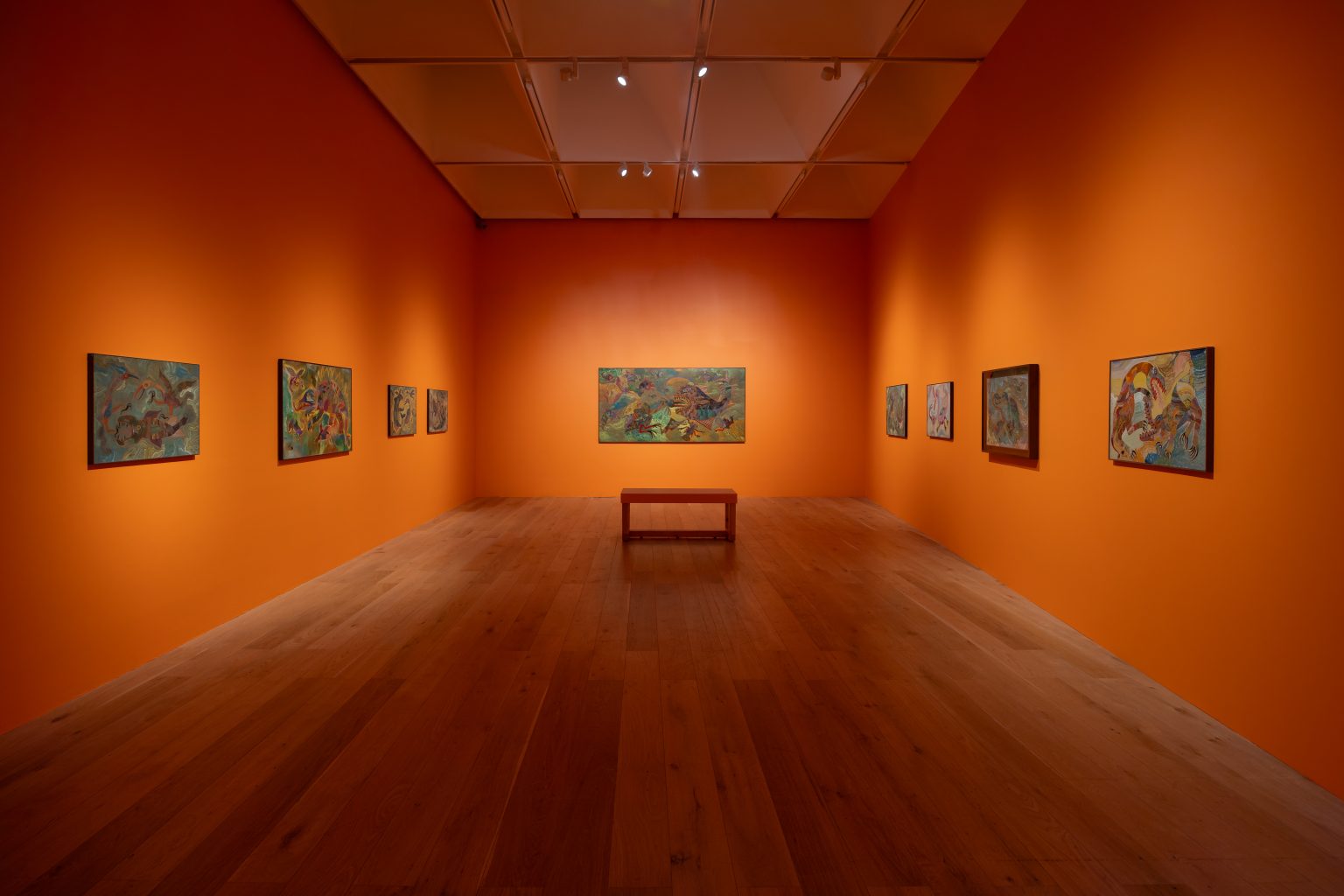
Common Ground: Sleaford’s Shared Stories is the first major collaboration between two cultural organisations in Sleaford: the Hub and Sleaford Museum. Themes of industry, migration and identity are explored in this multifaceted exhibition that takes place simultaneously across both sites, with commissioned artists responding to the town’s local histories and collections, offering new and layered perspectives on Sleaford’s heritage. By the very nature of contemporary art, the project also brings into focus Sleaford’s future and the wider complex issues that shape our changing world.
Common Ground is the sum of many parts, bringing together loaned works, museum artifacts, contemporary artworks, community participation and artist residencies, while standing as a testament to the power of partnership working. There are a number of new commissions by artists including Emily Andersen, Andrew Bracey, Nicola Davison-Reed, Liz Kelleher, Danica Maier, Madhu Manipatruni, Harriet Plewis, Madara Vimba and Dino Zhang. Kelleher, Manipatruni and Plewis also undertook residencies at the Hub and in the community as part of the project, working with different local groups.
Central to Common Ground is a question: who and what has typically been excluded from regional heritage? As a country we arguably have an unhealthy obsession with heritage. It can sometimes distract us from the present or obscure our view of what’s to come. At the Hub and Sleaford Museum, however, past, present and future sit side by side in equal measure.
Predominantly Lincolnshire-based artists were selected through an open call inviting proposals responding to Sleaford and its heritage, demonstrating that artists with ties to the region have an existing interest in exploring local stories. The Hub regularly works with artists from both its immediate locale, and the wider region, and does not simply look to serve an existing metropolitan arts audience. Instead, it has carefully developed a programme focused on craft, design, dance and creative arts that connects national and international contemporary dialogues and practice with the local communities of Sleaford, across the region of North Kesteven and beyond.
The histories we find on entering the Hub’s main gallery are presented to us as fluid, their relevance reliant in equal parts on the storyteller’s memory and the audience’s trust. Objects and their stories are open to (mis)interpretation. Drawn from memory almost sixty years after the scene it depicts, ‘A facade of Southgate c.1939-40’ (1999) created by Jack R Thompson fills a large vitrine at the Hub. A window cleaner by trade, Thompson’s detailed drawing recalls the buildings, businesses and daily rhythms of one of Sleaford’s main shopping streets. This sprawling work is part of Sleaford Museum’s collection, and until now has not been on public display because its size is incompatible with the scale of the museum, which is housed in a former 1930s public toilet block.
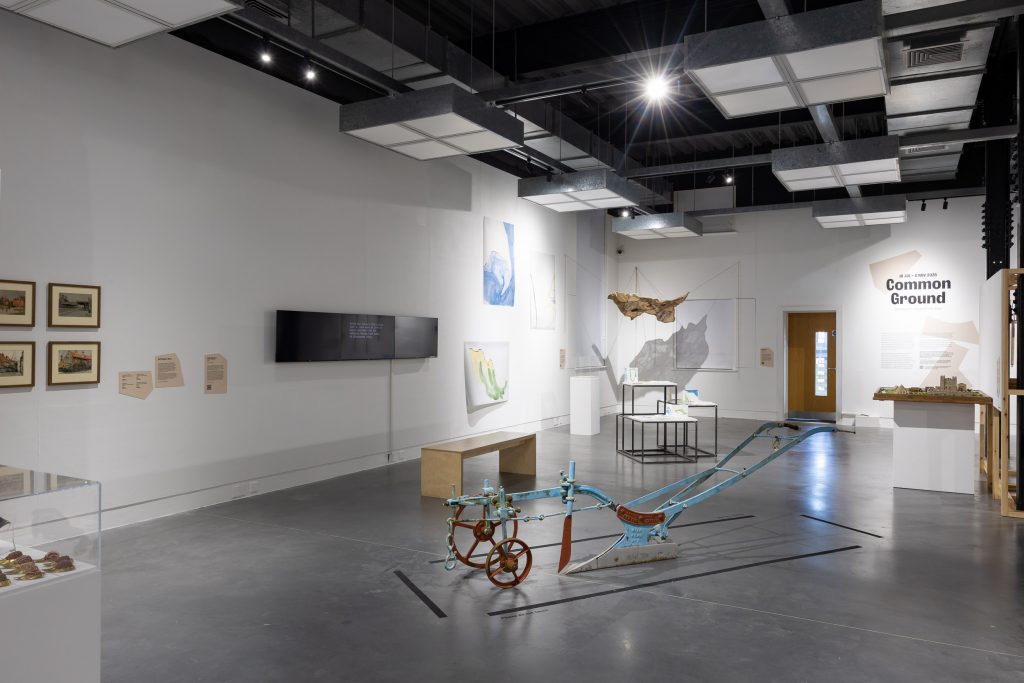
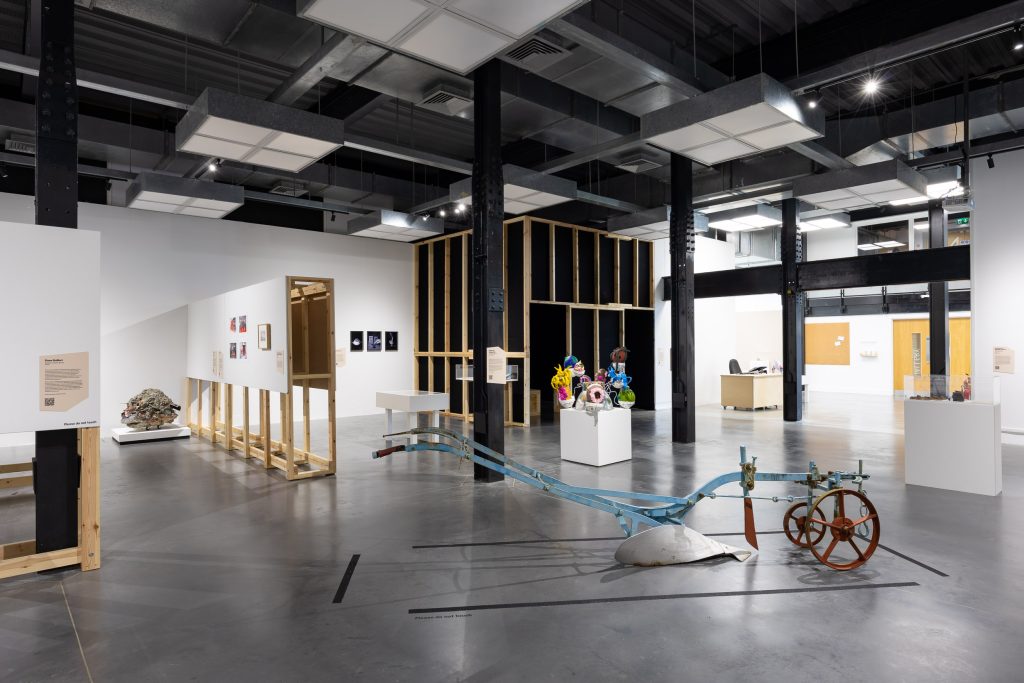
Many of the exhibition’s newly commissioned artworks become tools to reflect, process and understand contemporary moments. Moments such as the closure of Sleaford’s last remaining bank branch, which permanently closed its doors earlier this year. An example of local upheaval and national relevance, a significant decline in civic infrastructure that we see impacting small communities, suburban towns and older citizens across the country. Obsolete or endangered services, industries and tools are highlighted throughout the exhibition, which includes a Sleaford-made Single Plough, Iron Age coins and a photograph of Cottam Power Station and North Leverton Windmill.
Artists were invited to engage with and explore Sleaford Museum’s collections, facilitated by curator Jacqui Cleaver and archivist Jeannette Connelly. Their access included multiple visits to the museum’s off-site stores, each artist connecting with a different story, object or gap in the collection. Both Cleaver and Connelly feature in the exhibition at the Hub as subjects of Dino Zhang’s video piece ‘Punctum’ (2026). Filmed in Sleaford Museum’s stores, Zhang’s work presents the collection from the perspective of the artefacts themselves. This is where Common Ground’s commissioned artists come into play, doing what artists do best when given the opportunity to engage with archives and collections: reimagining, reinterpreting and re-presenting them in new and unexpected ways.
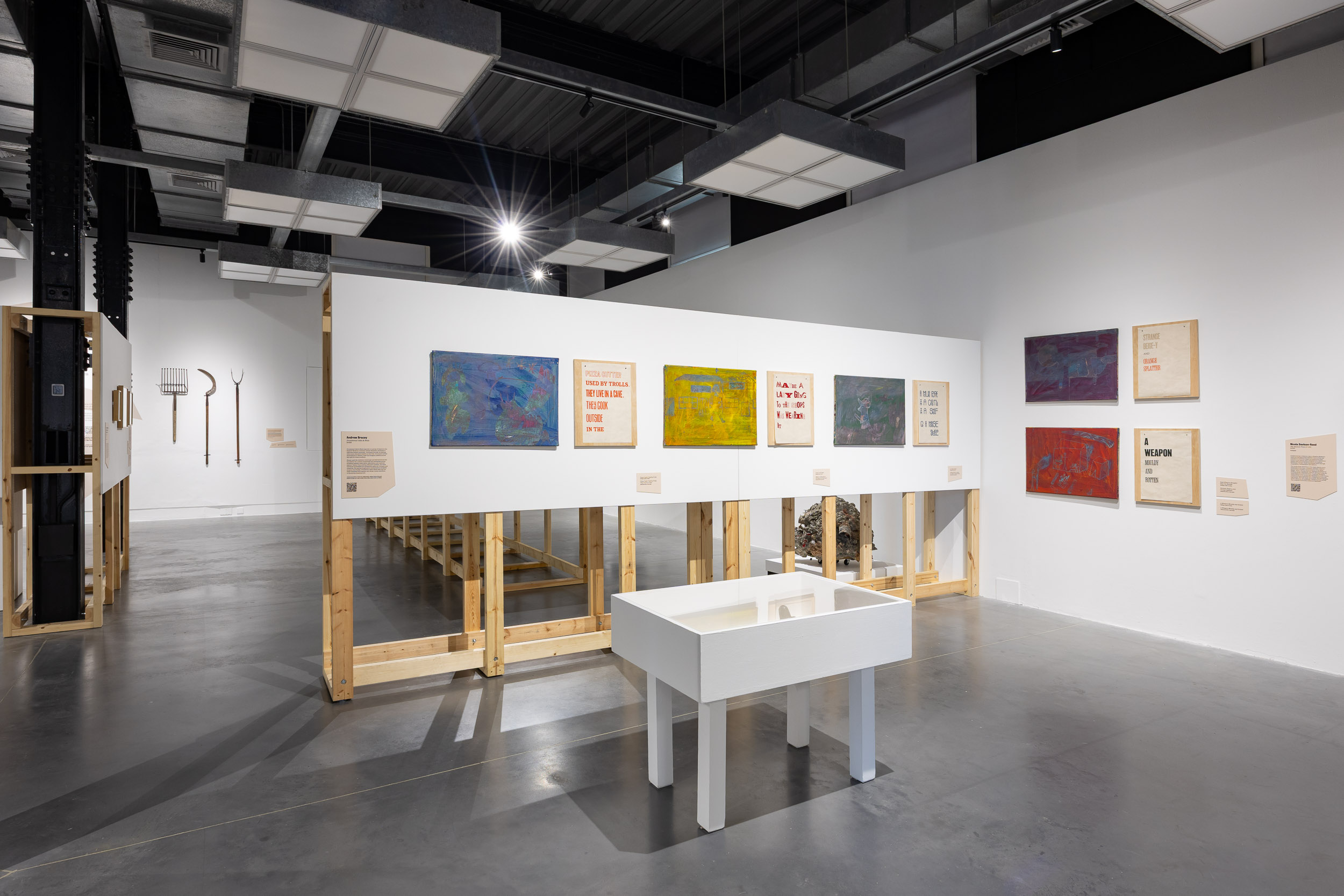
Andrew Bracey’s ‘Provisional Odds & Ends’ (2026) responds to a group of mysterious objects in Sleaford Museum’s collection whose identities, functions or histories remain unknown. The work was developed through workshops with local home-educated children Amelia, Annie, Bella, Caleb, Dorian and Molly, who were invited to imagine their own stories of the possible uses and previous owners for these mystery objects. Responses range in scale and plausibility from ‘a shield for a mouse’ to ‘a pizza cutter used by trolls’. Bracey’s collaboration with Sleaford’s youth invites us to question who holds the authority, privilege and, ultimately, the final word when it comes to shaping, validating and confirming the narratives and histories we too often take as given. The artist presents these imaginative interpretations as a series of letterpress posters and heavily layered acrylic laser-etched paintings at the Hub and Sleaford Museum. Each is presented as a pair, a painting proving a visual depiction of the narrative spelt out in the blocky text of its corresponding letterpress poster.
Museums typically present histories through static or long-term displays that seek to establish and communicate immutable facts. Galleries, by comparison, are often more flexible and experimental in how they interpret and present their stories. Small town-centre museums frequently operate with fewer staff, resources and funds and Sleaford Museum is run entirely by a team of volunteers. Opportunities such as Common Ground are unusual. Anecdotally, I don’t see many smaller museums collaborating with larger contemporary arts spaces, and it’s not necessarily a focus for funders. What feels special here is the support for two organisations, very close geographically but very different in most other ways, working on something new together. The partnership brings to the table complementary strengths: the Hub contributes commissioning expertise, larger gallery spaces and experience in working with contemporary artists, while Sleaford Museum brings historic knowledge, collections, community relevance and deep-rooted local devotion.
Common Ground provides a moment for the two institutions to share their different audiences, and for these to grow, stretching beyond the project’s duration. Considering local cultural ecosystems and thinking about how audiences move between different types of institutions, I’m drawn to reflect on my own experience of coming here today, travelling from Nottingham to Sleaford on the Skegness train, packed with families heading to the seaside for their summer holidays. As an arts and cultural worker based in the East Midlands I have made the journey to visit the Hub on several occasions, but I realise that until now I had never been five minutes up the road to visit Sleaford Museum.
A member of the Hub’s front of house team shared with me that they have noticed that Common Ground has, more than any previous exhibition they can recall, converted their café visitors into gallery visitors. Café and gallery audiences often remain distinct within arts institutions, a phenomenon that is by no means exclusive to the Hub. At Sleaford Museum, over 100 unique QR code scans have been recorded so far, directing visitors to the exhibition’s Bloomberg Connects page, a free mobile app providing information on thousands of museums, galleries and other cultural spaces. The Art Fund Reimagine grant supporting the project included a Project Assistant role, working across both sites and including focus on collating and uploading this digital content, growing the project and venues’ online audiences, and creating a lasting digital legacy.
Sleaford has a somewhat unusual cultural profile as a quite traditional agricultural market town in North Kesteven, Lincolnshire, but it also has a surprisingly significant contemporary arts infrastructure. With a population of just 20,000 it is also unusual for a town of this size to have three secondary schools. In 2009, Kelly Large’s ‘Our Name is Legion’ transformed the daily movement of around 2,500 of Sleaford’s secondary school students into a temporary public artwork, commissioned by Lincolnshire-born Beacon Art Project, who provided opportunities for people to experience contemporary visual art between 2004–15, often in non-gallery spaces. An important point of reference for Common Ground, Beacon Art Project developed a model of commissioning artworks, working with heritage sites, artists and audiences to create social, non-hierarchical and discursive spaces in which to encounter contemporary art. The Hub’s curator Joshua Lockwood tells me that Large’s work is the thematic and literal starting point to the exhibition at the Hub. Wearing high-vis vests, students leaving school in throngs suddenly became a significant presence, making visible a demographic that often remains largely invisible in the town’s streets and narrative.
Created during her Common Ground residency with the Hub’s National Saturday Club, Liz Kelleher’s ‘Seeded’ (2026) uses Sleaford Museum’s collection of Sharpe’s Seeds as its starting point. Sharpe’s seeds were exported from Sleaford around the world, and the company was innovative in its approach to seed packaging and distribution. Following the company’s closure in the 1990s its former warehouse was later converted into flats. Working with a group of local young people aged 13–16, Kelleher explored seeds as carriers of potential. Once again, we have an opportunity to learn about a defunct local company and to consider its loss, but also its enduring impact on the town’s inhabitants. All is not lost. The sculpture shown in the Hub’s gallery resembles an octopus, built from painted papiermaché, string and wire, a different imagined world is presented to visitors at the end of each of its tentacles.‘Seeded’ is fun, joyful and resourceful, taking inspiration from the seed packets’ zany colours and graphics, transforming their legacy into something new.
References to local landmarks and derelict sites continue with documentation from ‘The Engine Room’, another Beacon Art Project commission, which was presented in 2005 at the former Bass Maltings, one of Sleaford’s most significant former industrial landmarks. The maltings consist of eight large multi-storey buildings, sites where grains are converted into malt, built in the town because Lincolnshire was an important barley-growing county, while Sleaford had a good access to water. Responding to the layered history of the building, artist Phyllida Barlow installed large sculptural ruins-come-unfinished-stage-sets. Asbestos was found during the installation, preventing public access to the building. The artworks were not immediately removed and their fate remains uncertain, their whereabouts unknown to Barlow’s estate. Another local history that resurfaces in Common Ground and is presented to us as a mystery.
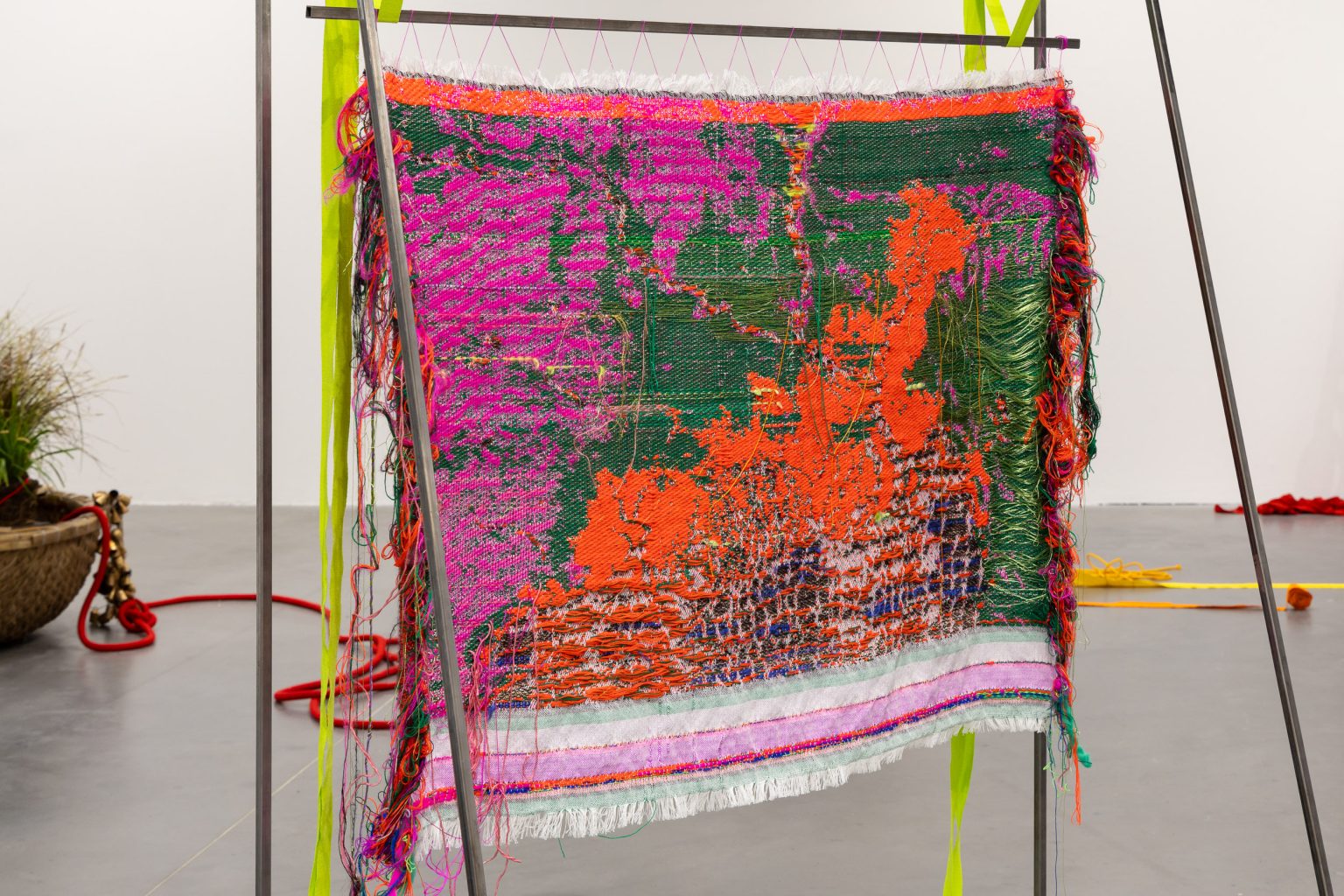
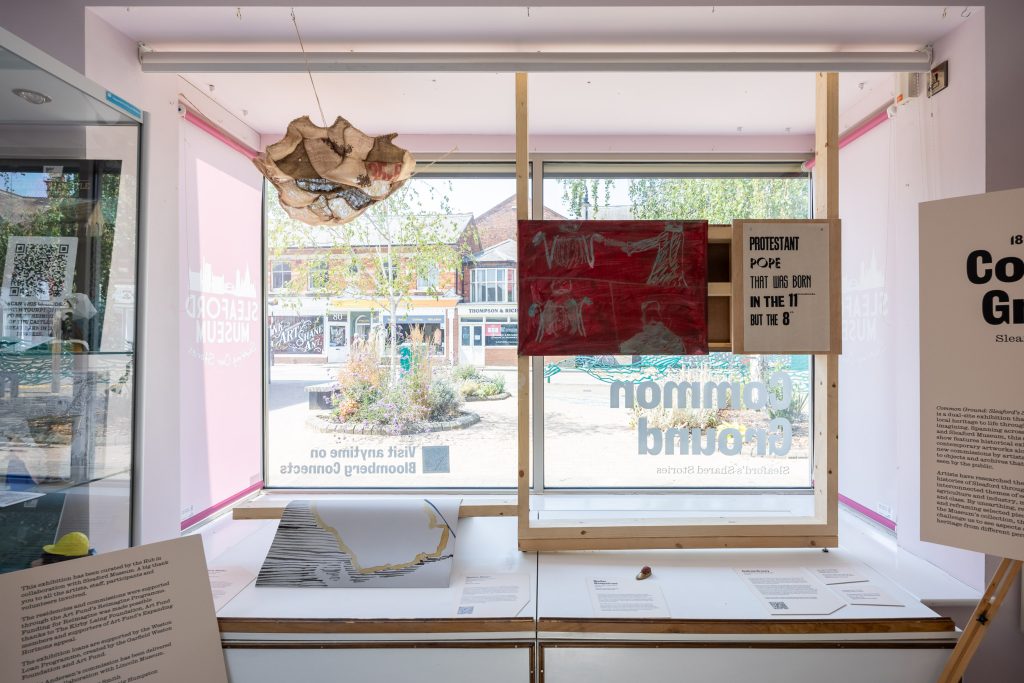
Other parts of Sleaford’s heritage remain largely untold, overlooked or excluded. Madara Vimba’s work refocuses our attention on the labour often carried out by Eastern European migrants, quietly sustaining rural life in Lincolnshire. ‘Land That Carries Labour Histories’ (2026) combines historical maps and land divisions with contemporary census data relating to agricultural workers. Vimba has translated these records into a hand-stitched visual language, beautifully embossed into what look like potato sacks. Lincolnshire recorded the highest proportion of Leave voters in the UK during the 2016 European Union referendum. Like Vimba’s suspended burlap sculpture, the outcome of this vote looms heavy over us.
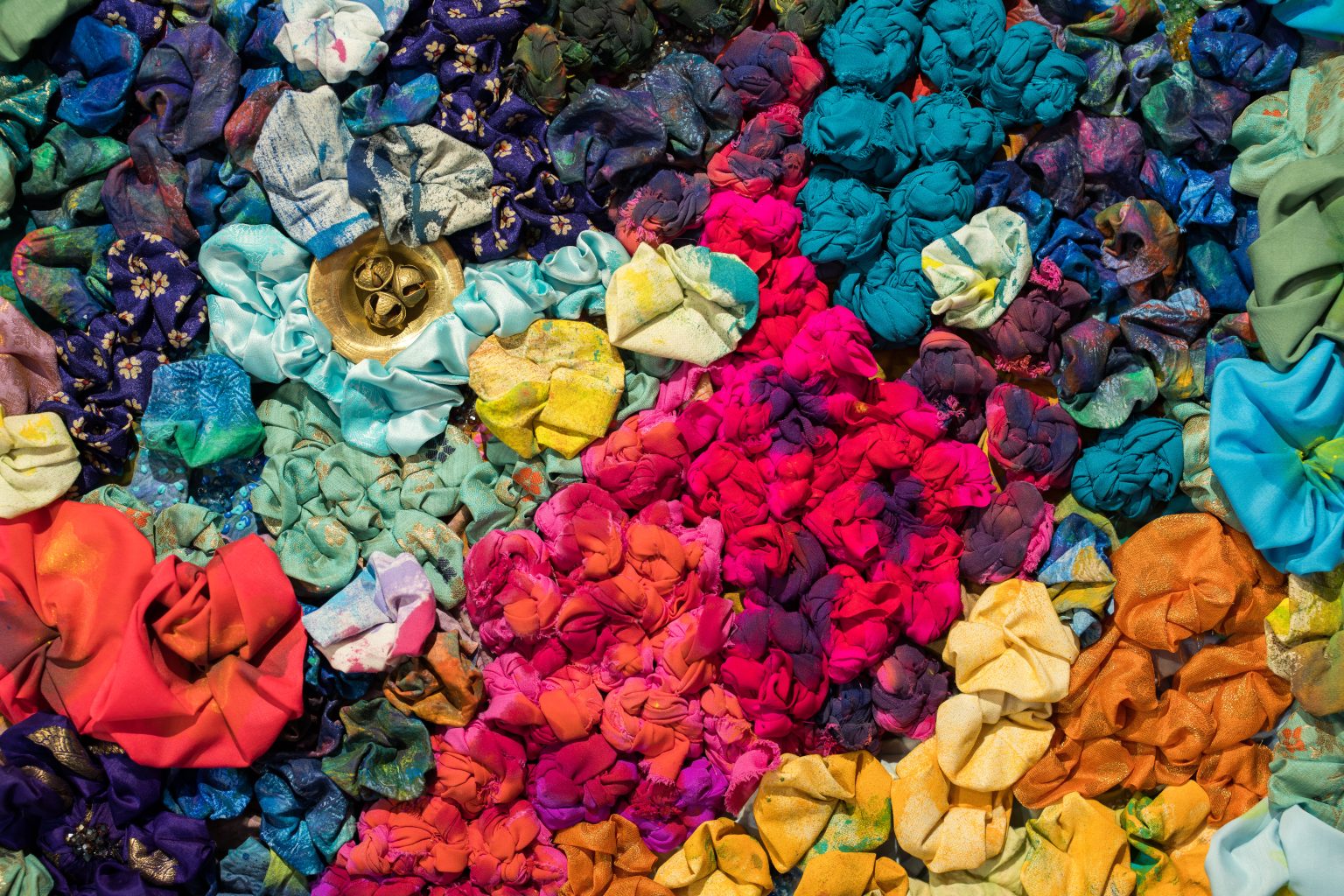
Both Vimba and Danica Maier draw on personal histories. Danica Maier’s ‘The Land Does not Know the Line is There’ (2026) is an installation of drawings from memory exploring geopolitical boundaries through a local and global lens. US-born Maier presents maps of Lincolnshire alongside Greenland, Cuba, Mexico and Venezuela, countries central to Donald Trump’s rhetoric around US territorial expansion. Madhu Manipatruni’s tiny, jewel-like sculptures similarly create connections between local histories and global journeys. ‘Shoe that ‘pin’ches’ (2026) is inspired by traditional juti footwear from the artist’s childhood in India, each dainty, brass souvenir shoe is transformed through Manipatruni’s addition of vintage textiles, to evoke the circulation of goods, materials and people across centuries of colonial trade.
Emily Andersen’s ‘Twilight of the Mills’ (2026) grew from research into the life and archive of Lincolnshire artist Karl Salsbury Wood. On loan from Lincoln Museum, Wood’s watercolours depicting local scenes have not been shown publicly since entering the collection in the 1970s. He was convicted and jailed in 1951 for ‘gross indecency’, a law that criminalised sex between men. He later left Lincolnshire and abandoned his ambition to paint every windmill in Britain. Andersen’s film provides an important opportunity to reappraise Wood’s work and legacy, reflecting on his exclusion from the county’s arts narrative, connecting landscape, cultural heritage and important local queer histories.
The word ‘common’ carries meanings of shared ownership, collective experience and belonging, while also raising questions about what or even who is considered ‘common’. In the context of Common Ground: Sleaford’s Shared Stories, I understand common as referring to a collection of narratives, distinct yet with a shared sense of place. The result is an exhibition across sites that feels considered, generous and important. Both the Hub and Sleaford Museum have understood the brief and delivered with their audiences at the forefront of their minds. Stories thrive in Common Ground beyond official histories. The project suggests that a sense of place is shaped and reshaped by the people who live, work in and pass through it. Perhaps this is where Common Ground is most successful, recognising that what we share is not a single story, but the opportunity to tell and hear many different stories together.
Colette Griffin is a curator, artist developer, artist mentor and arts writer based in Nottingham and working across the Midlands.
‘Common Ground: Sleaford’s Shared Stories’ is at the Hub, Sleaford and Sleaford Museum 18 July – 8 November 2026.
This review is supported by the Hub, Sleaford.
Published 24.08.2026 by Rachel Graves in Reviews
2,313 words