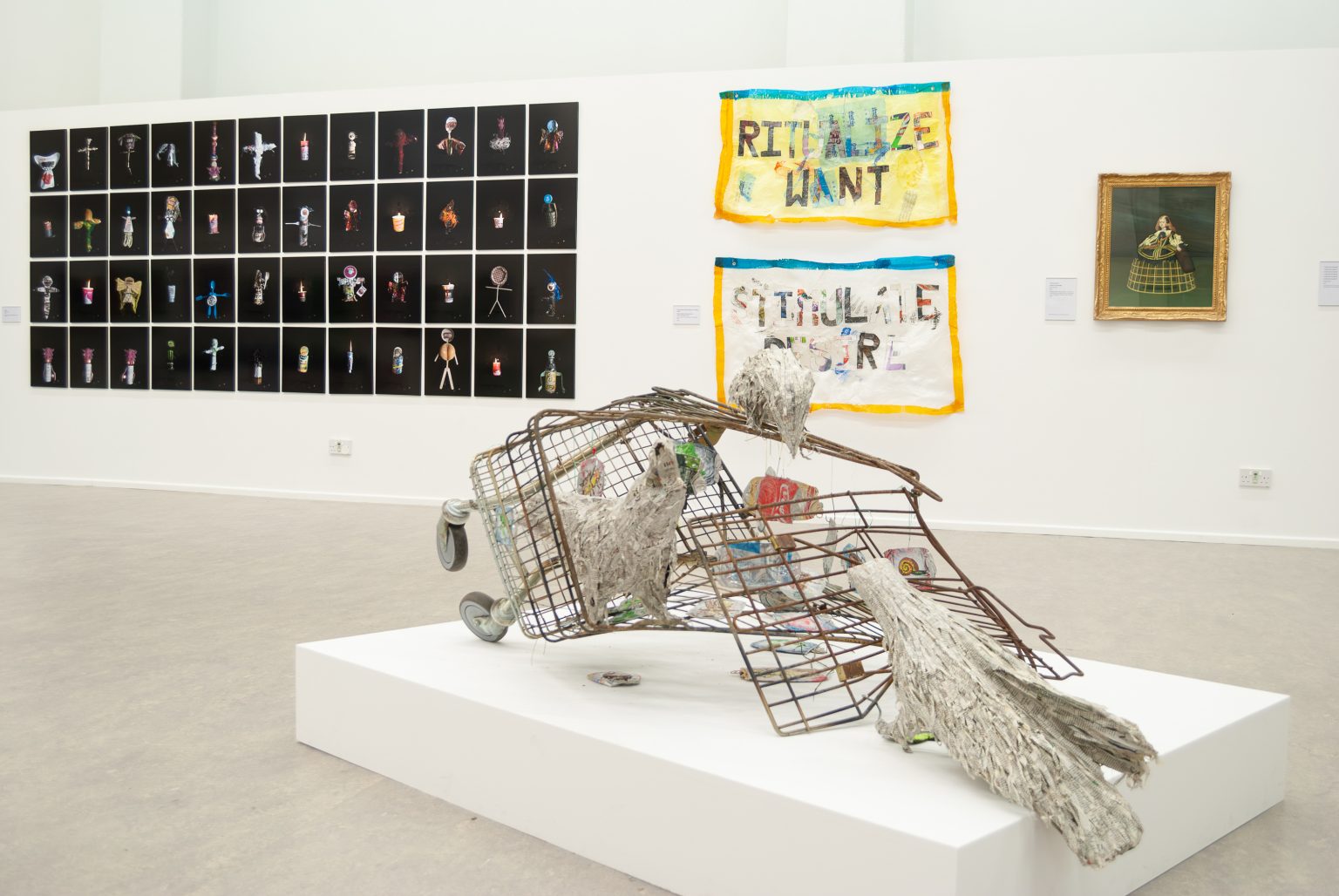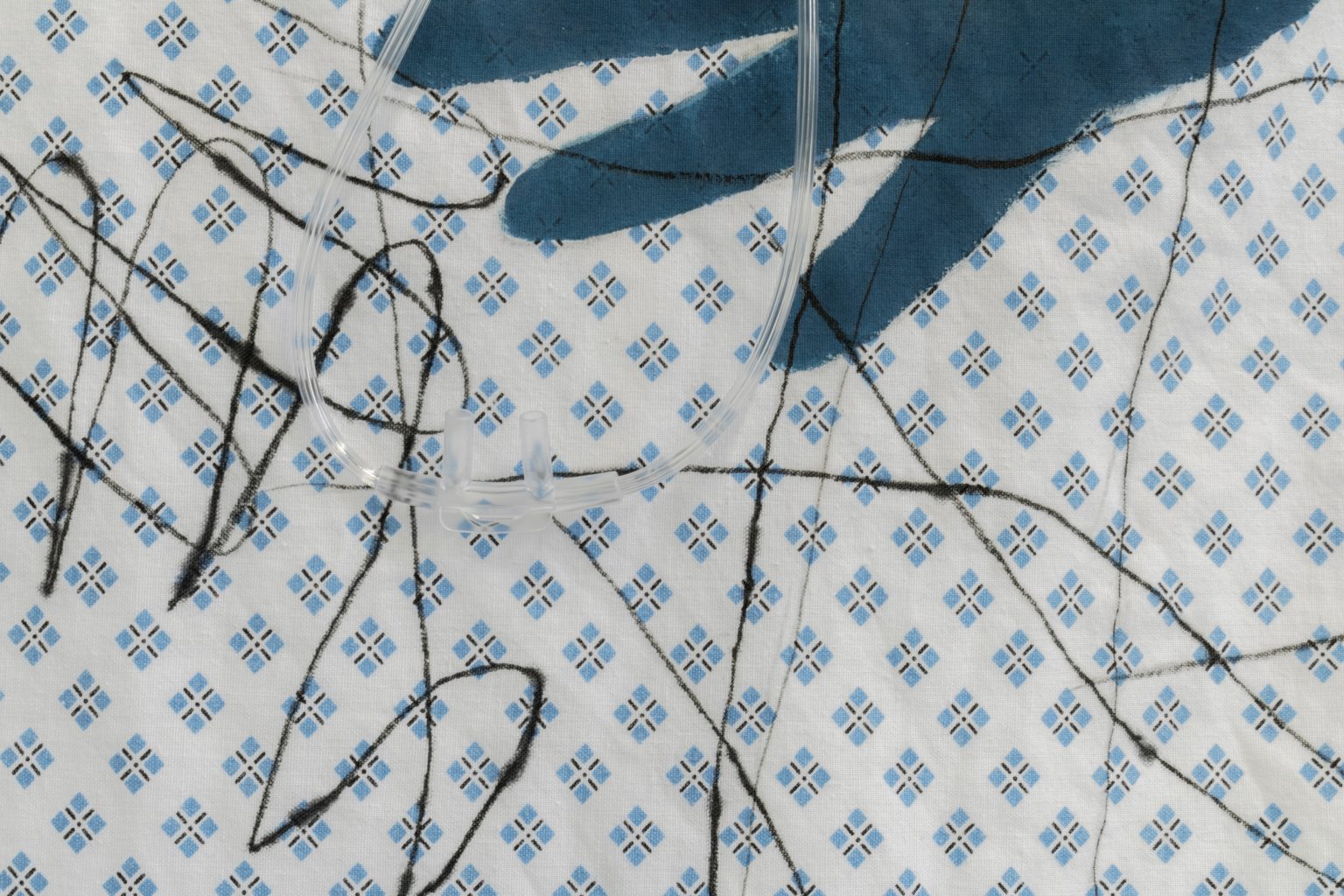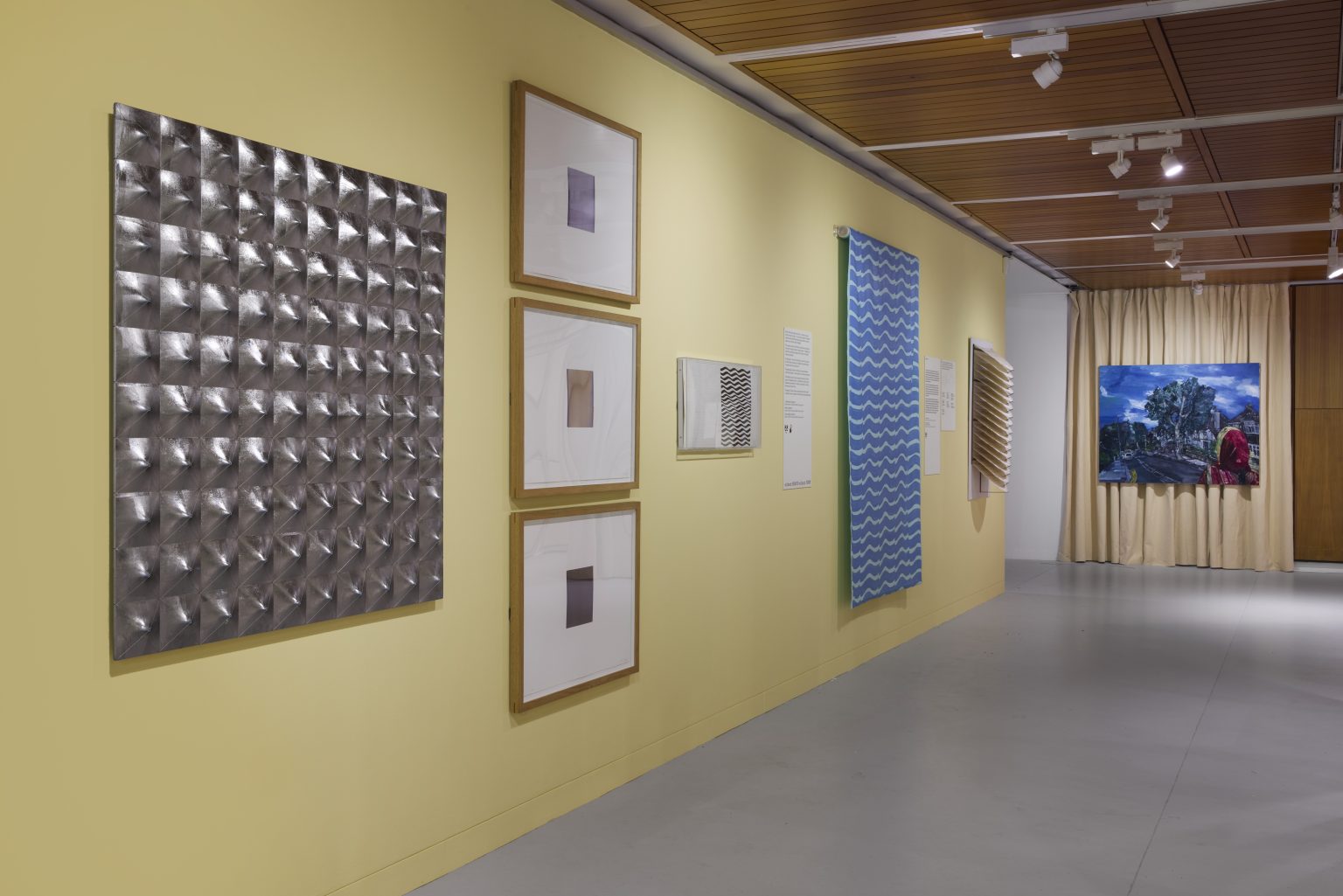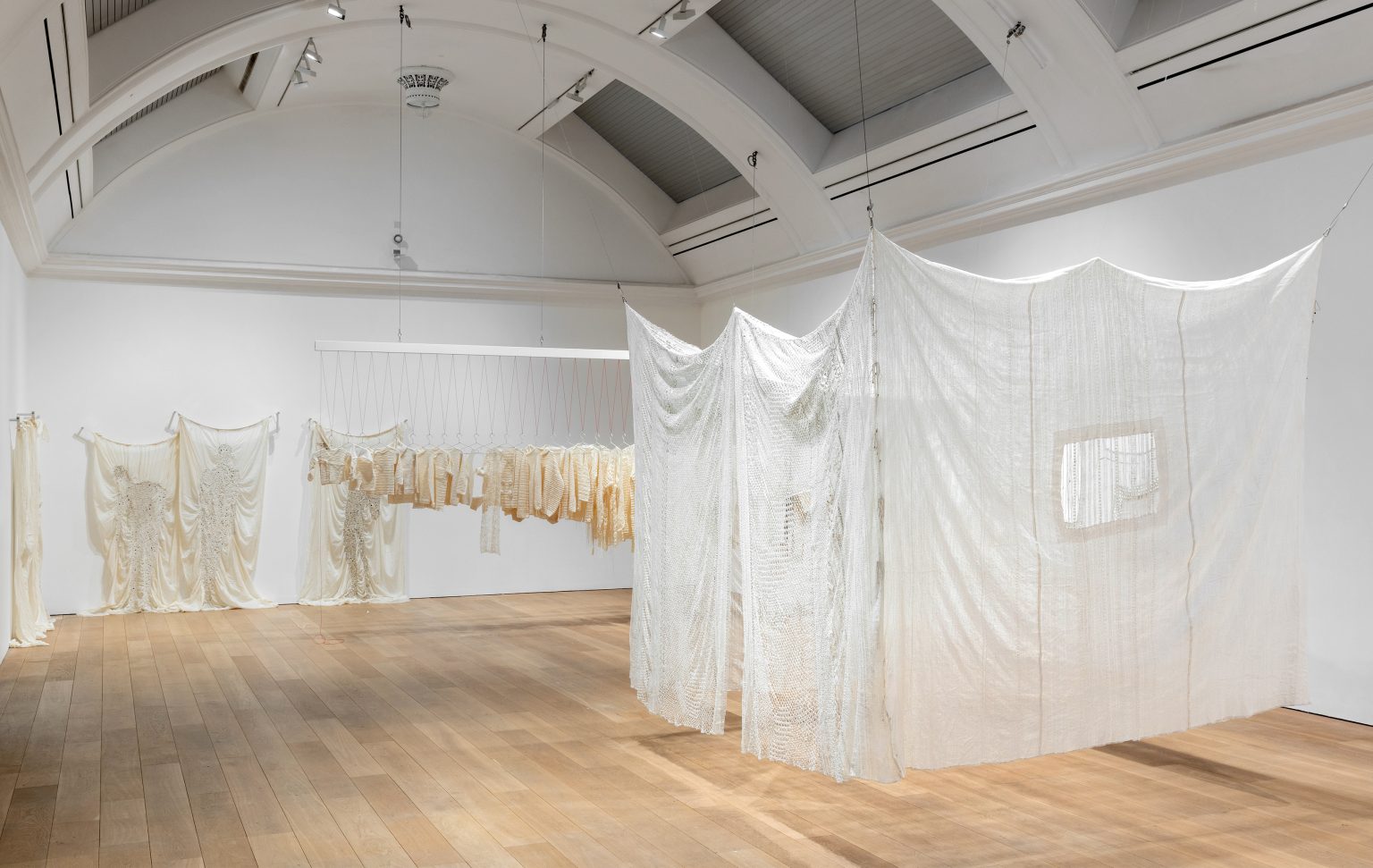
Contemporary Narratives at Salford Museum and Art Gallery is an exhibition that forms part of the city of Salford’s current centenary celebrations. In the exhibition, thirteen artists, working primarily in textiles and printmaking, have come together to reflect on Salford’s past and present and to dream about what the city’s future might look like. The artists have sought inspiration from the Museum and Gallery’s own collection, using the artworks and archival material that they’ve found there as jumping-off points for their own projects.
The focus on textiles and printmaking in this show works, of course, as a deliberate nod to Salford’s history. Salford being a city that, at the time of the industrial revolution, had a thriving textile industry, accompanied by a parallel, albeit much smaller, printing industry. My visit to the exhibition offered me an opportunity to reconnect with my own personal history as well; as, like all Salford school kids of my era (and, indeed, today’s), I remembered our class being taken by school on a visit to the amazing recreation of the Victorian street, Lark Hill Place, found on the Museum and Gallery’s ground floor.
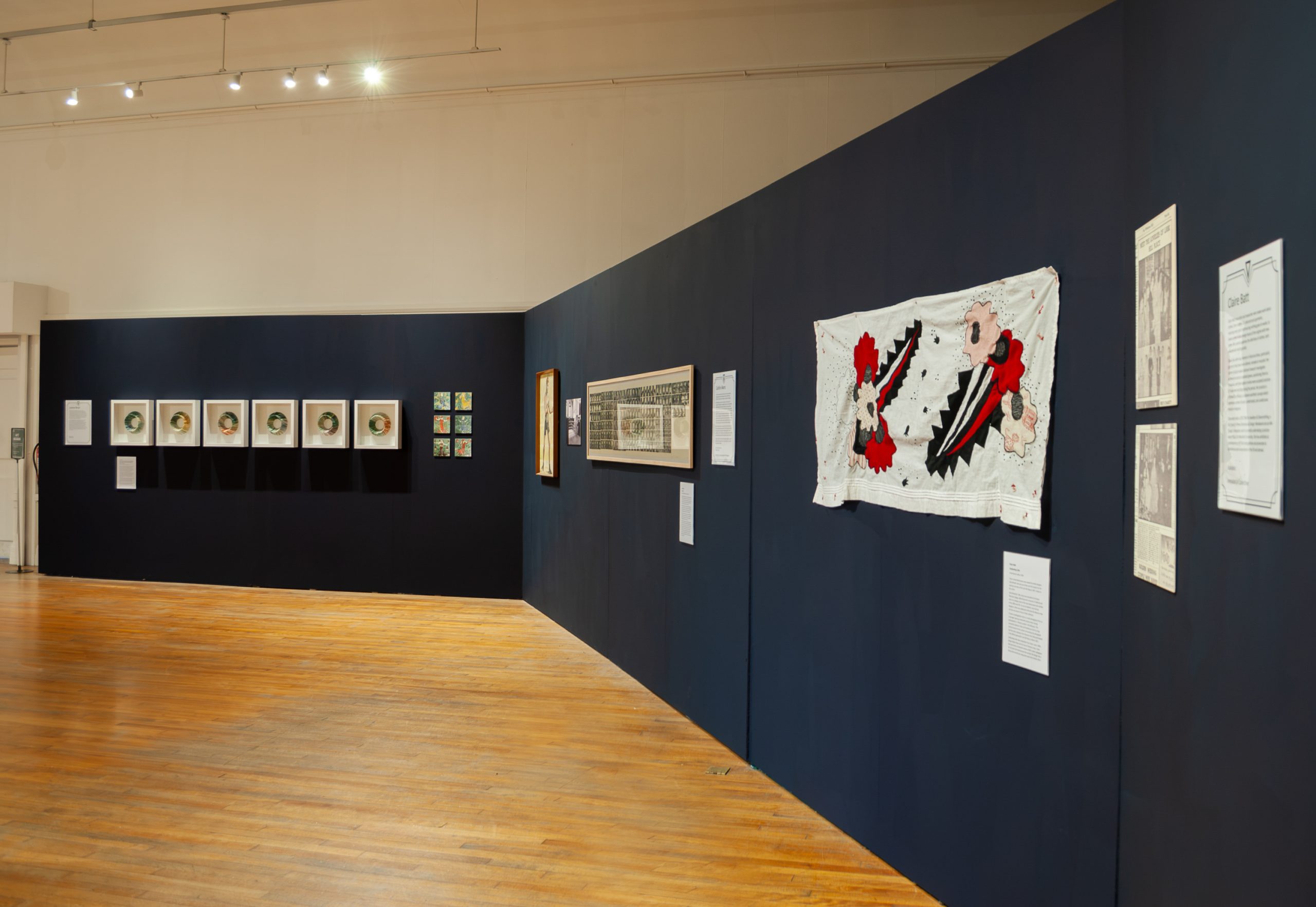
Entering the Contemporary Narratives room, the first piece we encounter, ‘Celebrating Celia’ (2026) by Claire Batt, references Lark Hill Place. Taking inspiration from Celia Birtwell, a famous textile designer of the 1960s and 70s, and someone who was involved in the official opening ceremony of Lark Hill Place in 1957, Batt has created a wall-hanging based on one of Birtwell’s original designs. Batt’s work shows a double bouquet of poppies in red and cream, seeming to issue forth from the original nineteenth-century garment she has re-purposed for the base of her piece. The poppies are depicted spreading their pollen on the wind. Batt’s poppies, along with the fine detail on one of the poppy heads of a tiny, printed lion, elephant and birds, represent the first appearance in Contemporary Narratives of the natural world, which we see emerging in the exhibition as something of a theme. Here is work exploring the past, present, and possible future relationships between animals, humans and plant life, alongside work raising questions regarding how Salford can most effectively provide for each of these groups, so that they can co-exist as equitably as possible.
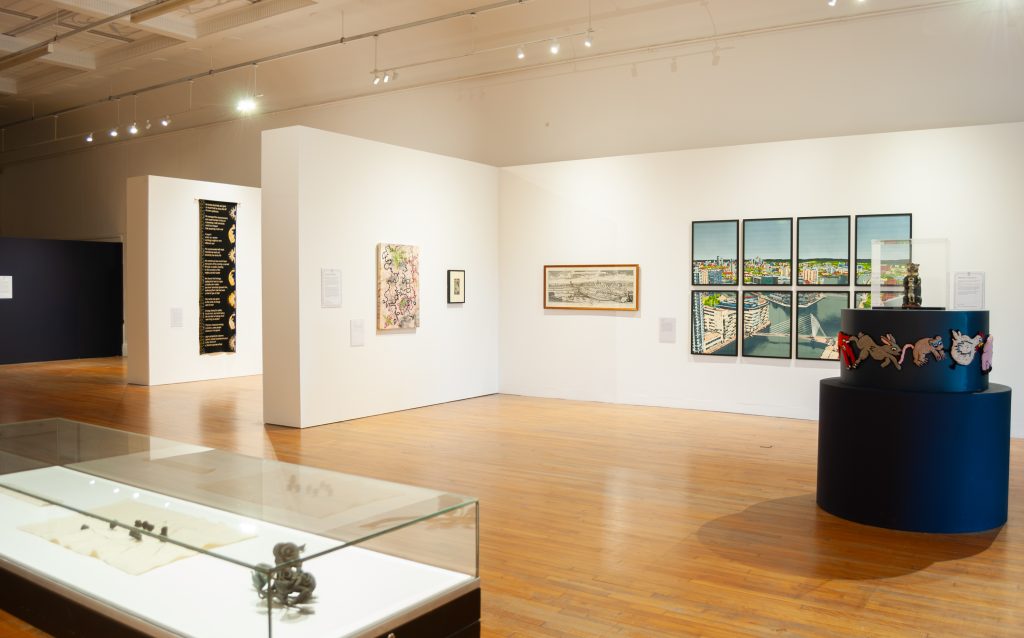
Indeed, in ‘Bait & Prey’ (2026), Alena Ruth Donely has created a series of pink, brown, white and grey 2D depictions of cartoon-like animals, made from hand tufted acrylic yarn. Donely shows them chasing each other round a circular plinth upon which stands the ‘Staffordshire Bear Baiting Jug’ (c.1800). The jug is formed in the shape of a large, chained black bear holding a much smaller animal between its paws, with the bear appearing ready to complete its kill. Donely is showing both the horror of the historical activity of bearbaiting and, in her own animals going round in a circle, asking us to be mindful of the fact that in some ways history continues to repeat itself, in as much as some animals continue to experience appalling treatment today. The colours and the texture of Donely’s animals, circling beneath the jug, invite the hand to reach out to pet and stroke them. Yet this invitation to touch also forces the viewer to confront their own complicity in the fate of these animals: how is it possible for us to feel tenderness towards these creatures yet at the same time participate in systems that routinely exploit or harm animals?
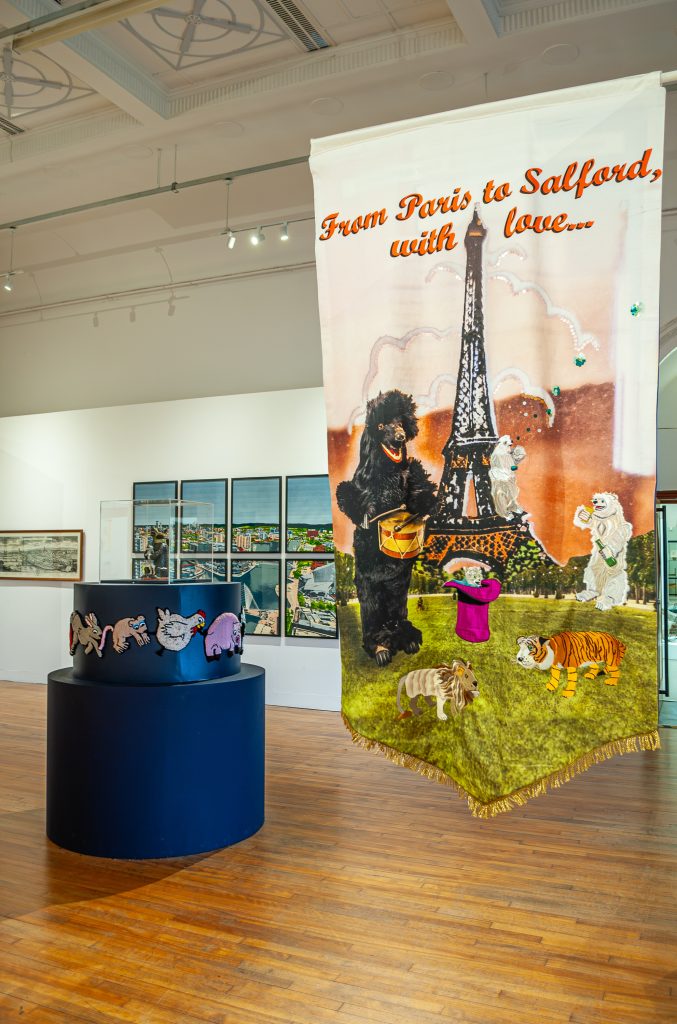
In humorous contrast to Donely’s piece, we see Mandy Tolley give new life to a drumming black bear automaton from the Museum and Gallery’s collection. Tolley has 3D printed a zoetrope containing digitally printed images of the bear which, when the zoetrope is spun, leaves the viewer able to watch the bear happily drumming again. Accompanying this piece is a wall hanging entitled ‘From Paris to Salford, with love’ (2026). The title alluding to the fact that the automaton that inspired Tolley was originally created in Paris, before then being acquired by Salford Museum and Art Gallery. The wall-hanging shows, on its front, the piece’s title above an image of the drumming bear standing at the foot of the Eiffel Tower, next to some of their animal friends. On the reverse of the hanging is an interview with the bear, detailing his background and some of his hopes for his move to Salford. I leave this piece wondering what happens next for the bear, wondering if maybe I’ll see him on the next season of Britain’s Got Talent, and then perhaps starring in his own fly-on-the-wall documentary series.
Wall-hangings feature elsewhere in Contemporary Narratives. Across the room from Donely’s pieces we find Jane Lawson’s ‘Chthulucene Domestic Heating Prototypes #3 and #4’ (both 2026). These are two complex works exploring, equally, the nineteenth century physicist James Joule’s experiments with electricity and heat, contemporary ‘research being done about electrical activity in fungus’ (so the wall text puts it), and the theories of philosopher Donna Haraway challenging human exceptionalism. Cerebral as these pieces are, they also have a beautiful aesthetic quality. Contemplating the swirling orange lines on a black background of ‘Chthulucene Domestic Heating Prototypes #4’, I felt myself getting lost in the piece, and experiencing a gently beautiful sense of hypnosis which I am only broken from when I happen to notice the words which constitute the particular line I’ve been looking at: ‘Salford was one of those towns in which so much of the nation’s wealth has been made and on which so little has been spent’. A sentiment alluding to the fact of Joule’s experiments contributing indirectly to the maximisation of UK wealth during the industrial revolution, and the bitter reality of so little of this wealth flowing back to Salford, Joule’s birthplace.
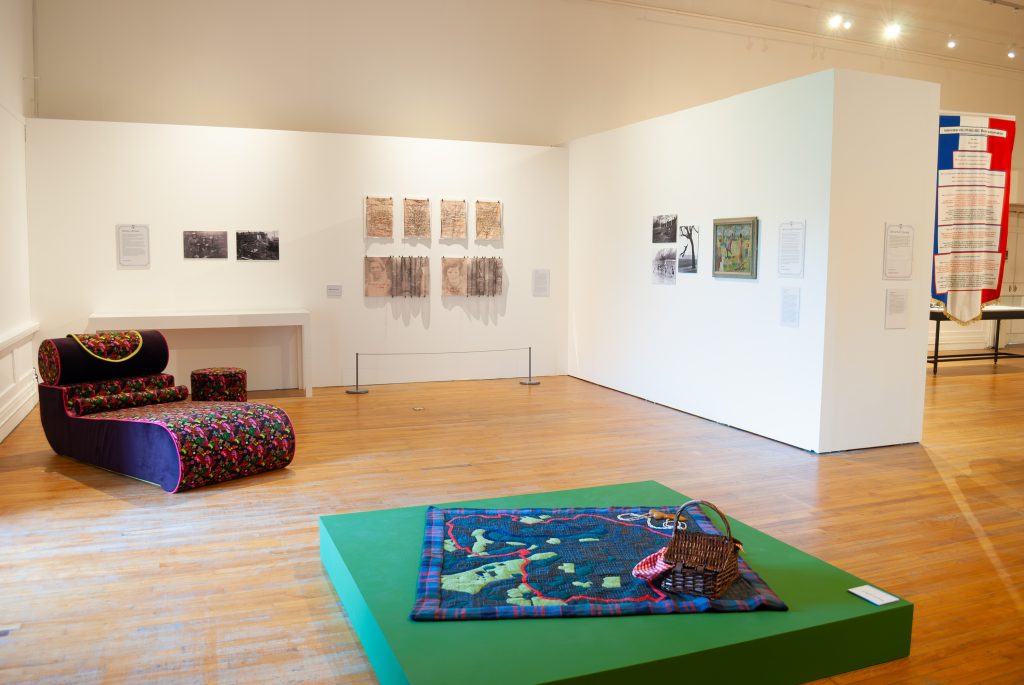
The exhibition’s focus on the natural world and green spaces continues with Lee Smith, who has created a very luxurious-looking and colourful chaise-longue, ‘Centenary Chaise’ (2026). The chaise-longue’s cover material is inspired by the layout of nearby Peel Park, which opened in 1846 and was paid for by public subscription. As a result, visitors who accept the invitation to recline on the chaise-longue can enjoy a sense of relaxing in Peel Park regardless of the weather outside.
Flowers also feature in Louisa Boyd’s ‘Kairos: Cornflower, Kairos: Daffodil, Kairos: Poppy; Kairos: Bluebell, Kairos: Columbine, Kairos: Anemone’ (2026). Boyd uses as the start point of her piece Walter Crane’s ‘Flora’s Train’ (c.1900): six tiles showing pre-Raphaelite inspired female figures in blue, yellow, red and brown, standing amongst backgrounds of similarly or differently coloured flowers. Boyd has hand-marbled paper following Crane’s colours, seemingly cutting the paper into triangular shapes, before then joining the triangular shapes together to form circular objects, wide at the base, with the sides meeting in a peak. These objects are displayed on the gallery wall like paper wheels, with each cycling through a spectrum of colours intended to capture the seasonal changes of flowers. It’s an aesthetically satisfying piece, and yet one which is at the same time quietly moving, in the way it captures the life cycle of these flowers. Interested visitors can see Boyd’s inspiration for her piece, Walter Crane’s ‘Flora’s Train’, on display in the Museum and Art Gallery’s Langworthy Gallery until Sunday 10 January 2027, being shown as part of Your Salford 100. For this complementary exhibition, 100 Salford residents were each asked to select an item from the gallery’s permanent collection that in some way spoke to them, with the residents then writing a short blurb explaining their rationale for selecting their piece.
We might also imagine Narissa Cargill Thompson’s piece laid out amongst a glade of flowers, as she gives us an installation of a picnic blanket, doubling as a map of the green spaces of Salford, in ‘Salford Picnic’ (2026). In the accompanying wall text, Thompson tells us she wants the piece to help people ‘remember the importance of these spaces for the health and wellbeing of the residents and continue to protect them’.
Louise A. Clarke’s ‘Memento of Vimto’ (2026), meanwhile, shows what might be interpreted as an embroidered map of black, red, purple and green routes extending spikily across a topographical rendering of an unidentifiable terrain. This second appearance in the room of a map, or map-like piece, may indicate a broader concern within the exhibition: how the people of Salford might navigate future iterations of their city. Clarke’s piece is informed by her research into the history of the Vimto company in Salford, and her walks in nature during the Covid-19 pandemic which she undertook to maintain her own mental health.
Besides a concern for the natural world, there’s some lovely humour to be found in this show as well. Alongside Tolley’s charming and amusing drumming bear we have the wonderful ‘a bra for a pig’ (2026) by Lowri Evans, which is inspired by a miniature porcelain pig from the Museum and Gallery’s collection, and her own experiences of motherhood and breastfeeding. The piece involves a number of nursing bras stitched together and hanging vertically from the wall, accompanied by an audio recording of her child feeding. The piece has a surreal, unexpected absurdity about it, which caused this viewer to burst out laughing. The vertical length of Evans’ work, coupled with the modular appearance created by its sewn-together bras, brought to mind Duchamp’s ready-mades, particularly Bottle Rack (1914).
Elsewhere in the exhibition we see the artists grappling with the ghosts of Salford past. Caitlin Akers celebrates her great great uncle, the Salford boxer Billy Marchant, in her piece, ‘Boxer Skip’ (2026). Akers presents a series of black and white drawings of her uncle training, laid out in an extended horizontal Warholian serial grid, reminiscent, from a distance, of strips of film negative arranged in rows on top of each other. Akers pays a forensic level of detail to the movement of the boxer’s body through the moments of time it occupies.
Claire Hignett finds further ghosts with the x-ray of the painting ‘Portrait of a Lady in Court Dress’ (no date given) from Ordsall Hall, showing a version of an entirely different person layered beneath the finished portrait. Hignett uses this ghost lady as inspiration for her own ‘Portrait of a Lady in Fury’ (2026), which she describes in the wall text as ‘an embroidery of a tracing of a collage’ made after a nightmare about her granny ‘surrounded by a vortex of fury’.
Sharon J Brown’s moving piece ‘Salford Blitz’ is a series of embroidered digital collages printed on vintage fabrics, containing words taken from a file of letters written during the Salford blitz of 1940. Each letter was a written by a resident or business owner from Salford to Salford’s Town Clerk requesting help and assistance for damages incurred during this time. Contemplating Brown’s piece, we get a real sense of the difficulties and hardships experienced by the people living in Salford then.
Finally, coming to the end of Contemporary Narratives, we encounter Michael Hitchens’ screenprint image of Media City on Salford Quays, ‘The Quays’ (2026). The image is in eight segments, displayed in a grid-formation, vertical and horizontal sections of the gallery wall visible between segments. What to make of this portrait of a part of Salford shown divided in this way? One possible way of reading the piece might be that Hitchens thinks the Salford of today lacks a coherent, unified identity. On the evidence of this thought-provoking, frequently moving, and often very witty exhibition, though, I don’t think that’s quite right. No, for me, Hitchens’ piece is saying that there’s not just one Salford, there are many; that, indeed, within the city boundaries there’s a Salford for everyone.
*
There’s a closing event for Contemporary Narratives due to take place at Salford Museum and Art Gallery on Saturday 26 September between 12.00 and 3.00pm. The Museum and Gallery’s website tells us, ‘The first half of the afternoon will be an hour-long gallery tour featuring six of the exhibiting artists and led by the Salford Museum Exhibition Manager, Claire Corrin’, followed by live demonstrations and drop-in craft activities. The event represents a great final chance for the people of Salford and beyond, to experience, enjoy and support this fantastic exhibition.
Your Salford 100: Contemporary Narratives, Salford Museum and Art Gallery, 28 March – 27 September 2026.
Richard Barrett is a poet and writer from Salford.
This review is supported by Salford Museum and Art Gallery.
Published 16.09.2026 by Jazmine Linklater in Reviews
2,144 words