This exhibition was curated by a collective under the umbrella of without SHAPE without FORM, who on their website describe themselves as ‘artists, thinkers and cultural practitioners… rooted in Sikh philosophical concepts’. It centres on the work of artists Jasmir Creed and Roo Dhissou, but expands into selected works from the Whitworth’s own collection. Artistic Director Deep Kaur Kailey led an attempt to ‘create an experience rooted in reflection, healing, and human connection’ through the art, according to their press release.
This particular exhibition has been transplanted from its previous home, without SHAPE without FORM’s ‘redesigned 7,500 sq ft contemporary art space in a former car showroom in Slough’, into a much smaller setting within the Whitworth. Whilst individual elements evoke the stated intentions of the exhibition well, the sheer volume of works and aspects within the space are not effectively scaled down to the gallery they have been allocated, in a way which runs counter to the expressed aims of the exhibition, to invite visitors to experience ‘the quiet power of reflection’.
The exhibition ‘underscores the Sikh belief that true and lasting healing begins within’, and this healing is brought about through a focus on three central notions from Sikh teachings- ‘Simran (focused practice), Shabad (Unstruck Melody) and Sangat (gathering and fellowship)’. The visitor should move through these ideas, as a means to ‘overcome isolation and division’. In this introduction, which welcomes visitors as they enter the space, we are encouraged to understand this as a place to ‘pause’, a place to go past the loneliness and sensory overwhelm of everyday life and enter transcendent quietude.
Creed’s work, which takes up a significant portion of the space, very much presents this reading of contemporary society – isolating, fast, full – by capturing glimpses of life on the move. Her work ‘Transience’ (2024) is the first you encounter upon walking up the stairs and entering the space. It portrays several figures sitting together in a tube carriage. Three unmistakable bright yellow stanchions run from the floor to the ceiling, markedly splitting the piece and the figures within it into three frames, making it a kind of wonky triptych. The smudged, deftly haphazard strokes turn adverts into indefinite writhing shapes, window reflections warp in their many grey hues; it is disorienting, but this disorientation is recognisable to anyone who’s taken the tube, as if its screech has infiltrated the visual element of the world.
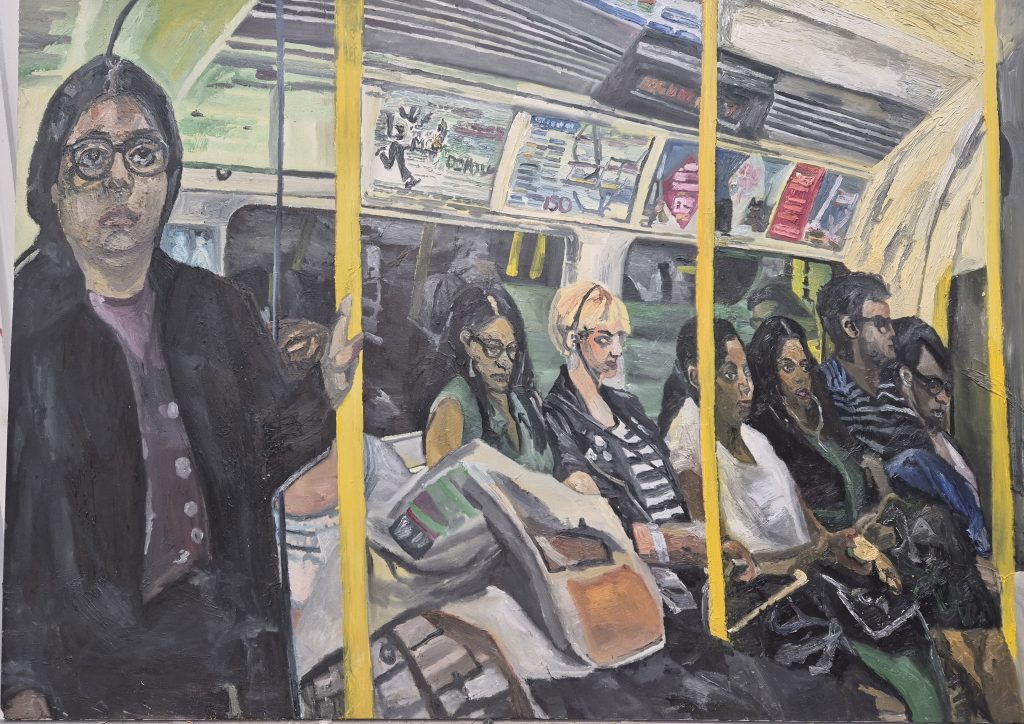
In this intensity, I am drawn to the stillness of figures sitting neatly in a row. The eyes differ wildly between each character, some entirely pupilless, some full and defined, some simple white palates with dots inside looking down, looking across. They are animated in their emptiness, in what they’ve grown attuned to hiding, some disappear in folds of shadow, some open wide. The woman in the forefront of the picture is the only figure standing, her hand reaching around the closest stanchion. Bodies stare passively on, but their passivity is betrayed by the motion the painting evokes from them. This draws me into conversation with how I move within the world, the bus I took to get here, the way I look at – or don’t look at, merely glance over – others in my surroundings.
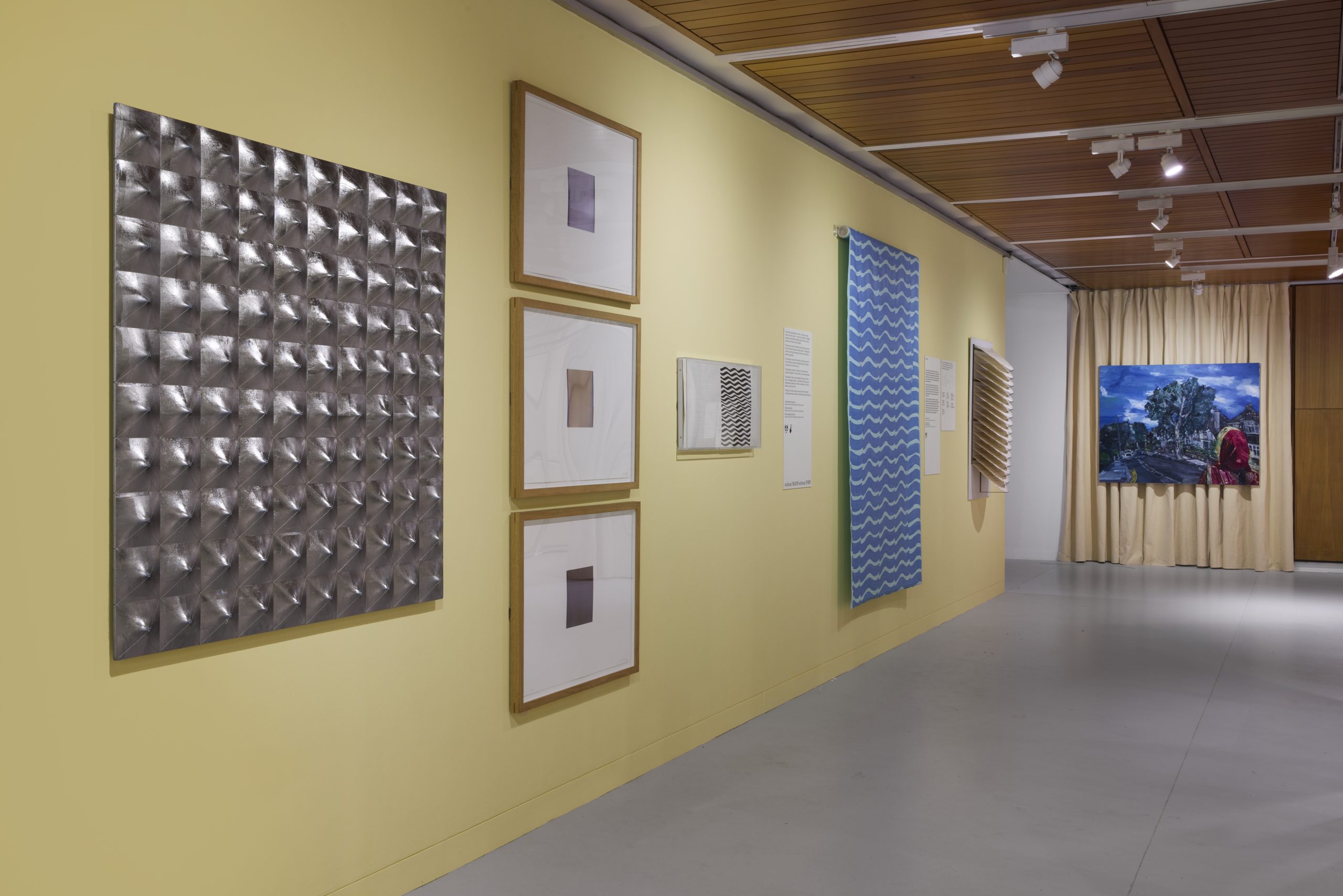
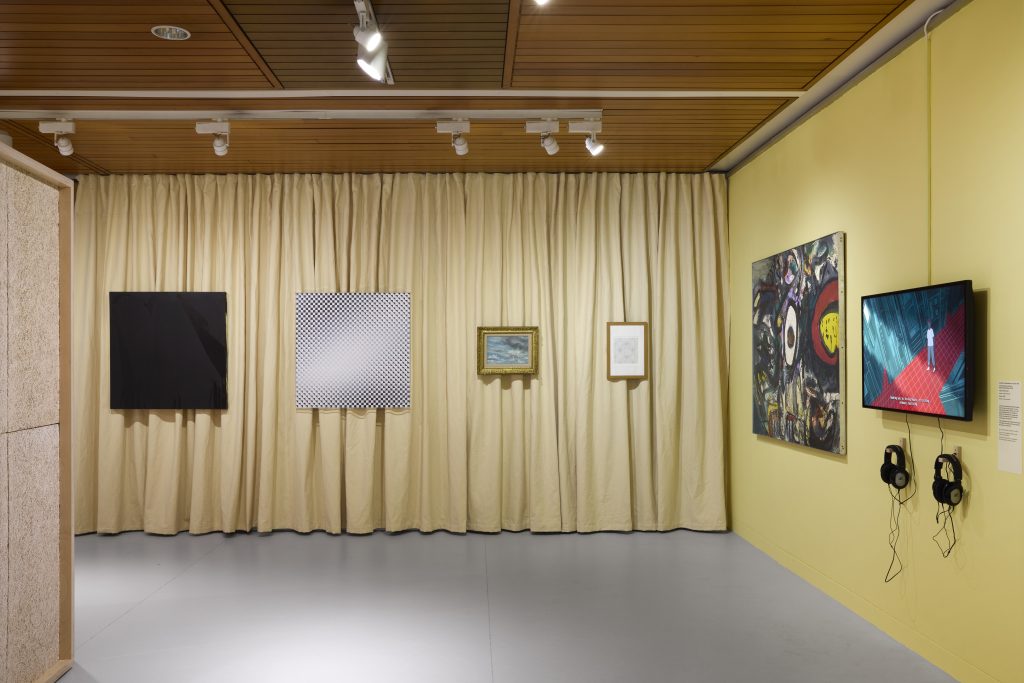
Apart from ‘Transience’ (2024) and one other painting, most of Creed’s work sits on wooden makeshift walls in the centre of the exhibition space. Whilst her works are admirable within themselves, they seem to compete, as opposed to resonate, with the gallery’s walls themselves, which are primarily taken up by the Whitworth’s collection. Each wall has been curated by without SHAPE without FORM, tailored to a particular theme to complement the understanding of Simran, Shabad, and Sangat. The first wall explores the Mind, the second Connections, and the third Practice.
It’s the Mind wall I spend the most time with. It begins with ‘Transience’, before, as you move along the wall, transforming into a constellation of nine paintings from ‘the Whitworth’s collection, placed in a kind of ordered sprawl. One particular moment I notice is Chris Ofili’s ‘Untitled’ (1996) his pencil microorganismic figures endlessly encountering each other on the paper like synapses, a kind of map. It is placed directly next to Anish Kapoor’s ‘Blackness from her Womb 13’ (2001), an aquatint which creates a sunken dark space, a kind of hole, an absence. The activity of the former’s lines squirming across the paper contrasts with the latter’s dense singularity of colour. A visual metaphor of the mind is at play here; moments of busy, active thought coexisting with an empty space – dark, unexplored parts of the psyche. I could look at this wall for hours; it gave me a feeling I was encountering my own consciousness, illustrated- I am unburdened of it, it is placed in front of me.
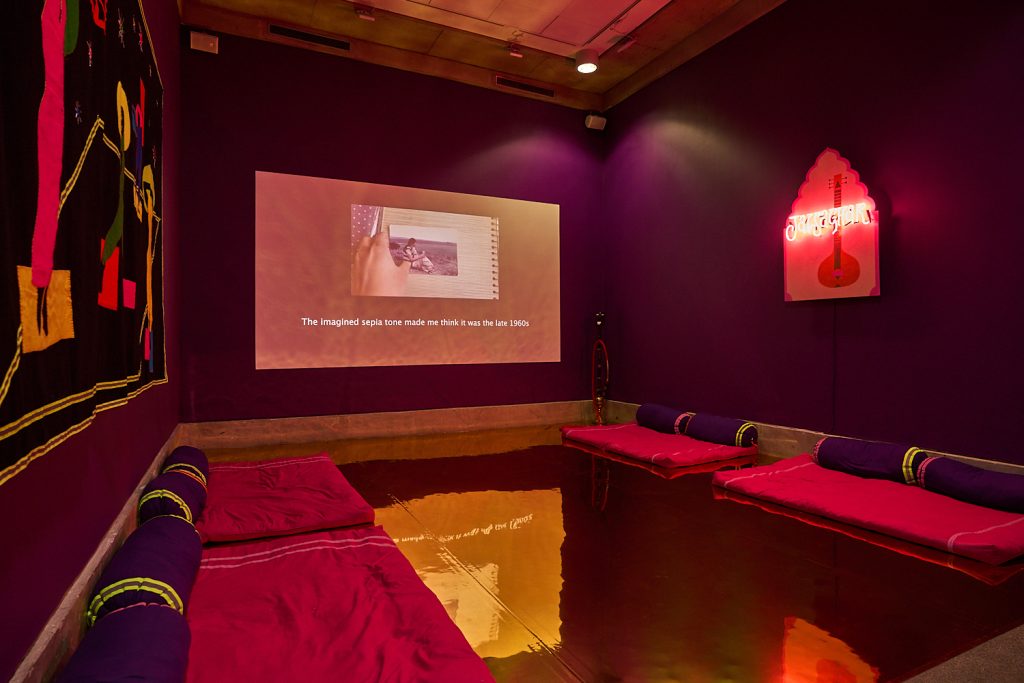
One stated aim of the exhibition is to ‘invite a more intuitive encounter shaped by feeling, memory, and attention’, and whilst this can be seen and understood through the art, one is also encouraged to engage in a practice to alleviate the isolation and overstimulation the art tries to address. Alongside a series of ‘workshops, wellbeing sessions and social gatherings developed with partners including Wellcome Collection, London’, parts of the exhibition itself are devoted to practices of Simran. This involves, for instance, the Whisper Box, a sequestered, empty room in the middle of the space which invites the individual visitor to practice Simran by repeating a chosen word in your mind, and focusing in on your voice. Roo Dhissou’s work, ‘A String of Love’ (2025) also entails and invites rest and dialogue. It consists of a manji, a South Asian woven bed, which one may sit or lie on, with enough space for perhaps three or four people to comfortably gather, alongside a painting of the sky on jagged silkscreen prints on polished brass, attached to the ceiling. It draws on the concept of ‘Riyaz, a repetitive practice of music, performance or other art forms’, wherein weaving is presented as a ‘meditative and enduring act’.
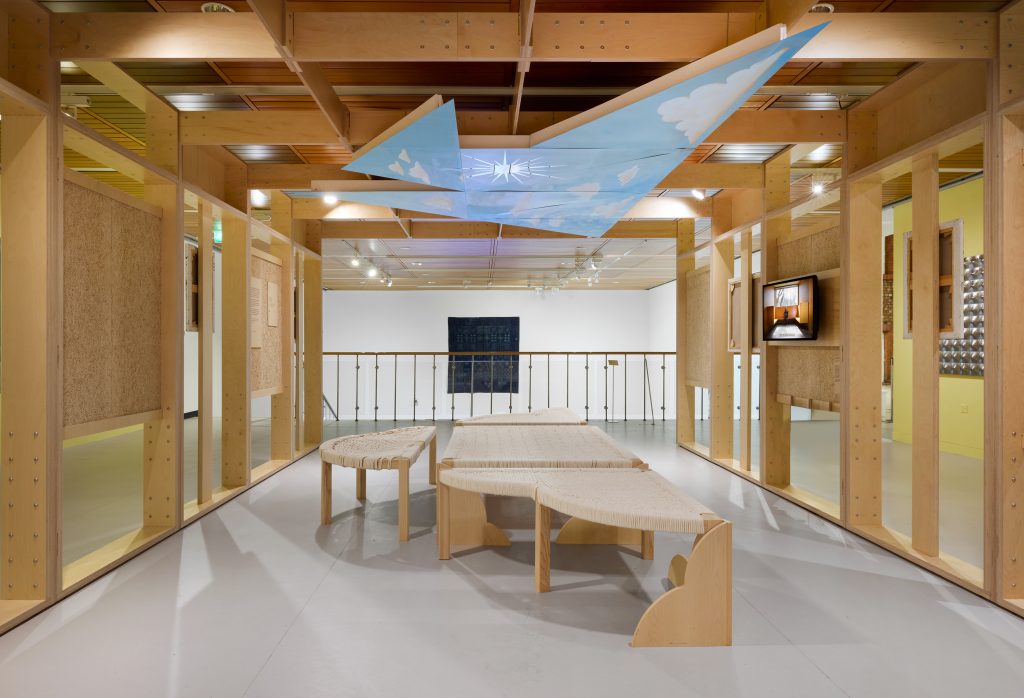
Whilst many aspects individually fit the stated intentions of the exhibition, when in the room itself I could not help but feel physically and mentally crowded by the level of artworks, aspects and concepts on display. Individual moments within the exhibition work beautifully and meaningfully evoke the exhibition’s stated aims- but the oversaturation of the space actively works against them.
Philosophical concepts such as ‘Shabad (Unstruck Melody)’, which require mental space to digest and encounter in a real, embodied way, find themselves in a relation of competition, as opposed to complement, with the space. Little space is made to step back from the works and text with the addition of the Whisper Box and ‘A String of Love’, as well as the extensive selection of Creed’s work, which requires more walls than the room previously allowed for. I find myself cramped. I required, when trying to engage with the reflective, meditative practices I was being asked to engage with, a horizon, empty space, and instead I was met with walls within walls.
I do not believe the exhibition to be a failure in this sense; I have already expressed how individual parts of the exhibition evoked a meaningful interaction with the stated aims of the exhibition. But the conflict between space allocated and ambitions creates a spatial discomfort which is hard to put to one side, and interferes with the experience. In Dhissou’s ‘A String of Love’, as one is invited to lie down on the woven bed and stare at the painted sky, you can glimpse a fragment of this stated aim; to gaze in wonder at the above, past the overstimulation of the surrounding world, into the atmosphere of your own mind, its clouds.
Reflections: Sangat and the Self, the Whitworth, Manchester, 1 August 2026 – 29 August 2027.
Joseph Conway is a writer in Manchester.
This review is supported by the Whitworth.
Published 07.09.2026 by Jazmine Linklater in Reviews
1,360 words