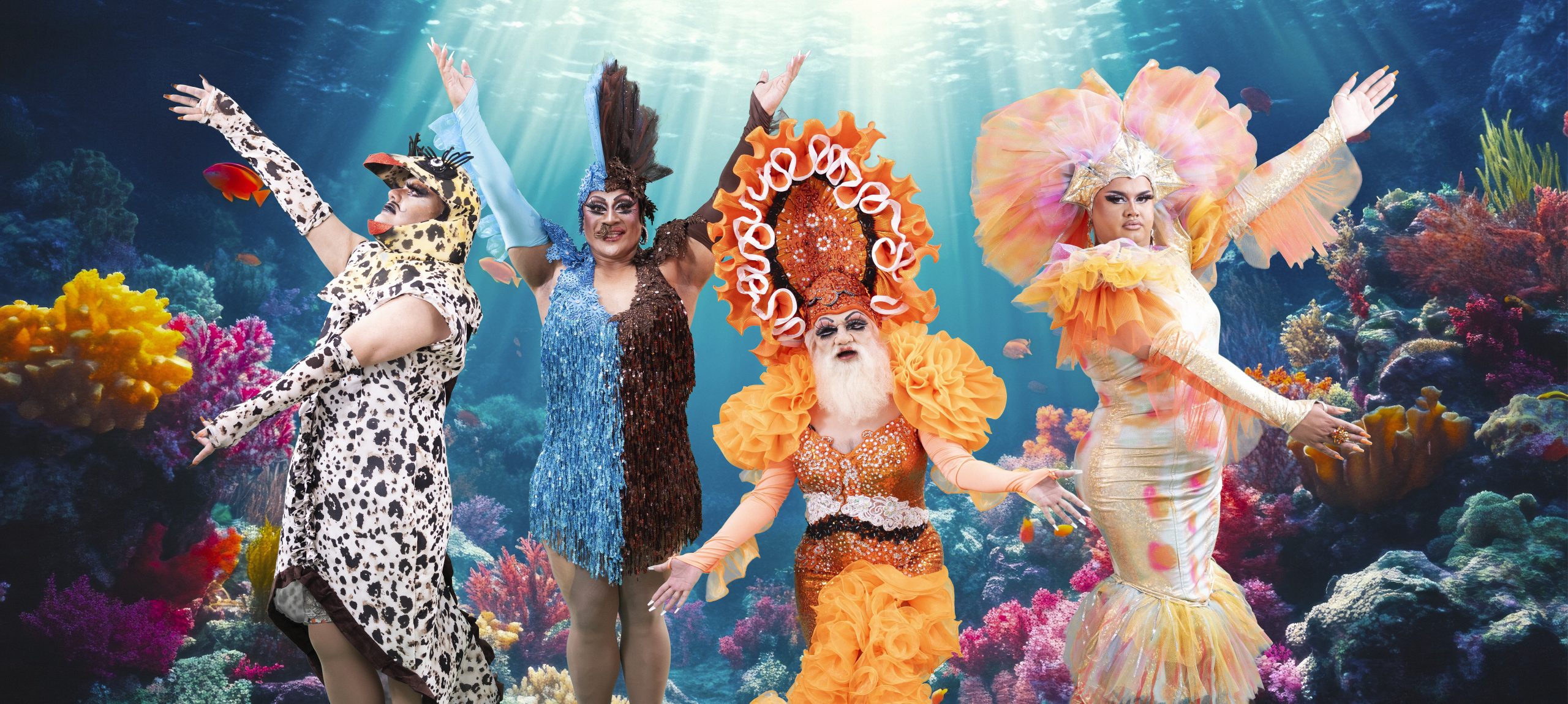
The world I am about to step into, Darwin in Paradise Camp, is a utopia that Japanese-Sāmoan artist Kihara has created for the Fa’afafine community to which she belongs. The Sāmoan word Fa’afafine means ‘in the manner of a woman’, but in contemporary usage it can also refer to the Fa’atama, ‘in the manner of a man’, and wider LGBTQ+ communities. The exhibition at the Whitworth is a love letter to them, with sale proceeds from Kihara’s publication Queer Sāmoa Lives going back to the Fa’afafine Society of Sāmoa. Kihara says in the opening night’s artist talk of the installation, which originally showed at the 2022 Venice Biennale in the Aotearoa New Zealand pavilion, that ‘it’s a space where nobody is being judged for who they are, who they love or how they live their life’.
One half of the exhibition is wrapped in a wallpaper bearing a traditional Sāmoan siapo print, this is a type of print design created on bark-cloth, typically made from the Paper Mulberry tree, whilst the other half’s wallpaper depicts an image of a Sāmoan beach, recognisable from stock image screensavers. The image also captures some of the devastation done to the island through extreme weather conditions, showing the deforestation of the Sāmoan coastline, echoing one of the key themes of the exhibition: the effects of the climate crisis on indigenous peoples.
The first artwork I encounter is a triptych of photographs of Kihara, ‘In the Manner of a Woman’ (2004-5), in various stages of undress, with the backdrop echoing the styling of colonial studio photographs taken by Aotearoa New Zealander photographer, Thomas Andrew, who visited Sāmoa between 1891-1939. There appears a challenge in Kihara’s expression as she looks directly down the camera. As both subject and director of the photograph, Kihara reverts the exoticising gaze that would have historically been behind such images.
In three stages, the photographs reveal that Kihara has both breasts and a penis; our guide trips over the word and refers to them as a ‘trip-dick’, something I can’t help but think Kihara would love. Throughout the exhibition, Kihara uses wordplay such as ‘his/her/theirstory’ and ‘in-drag-enous’ as a humorous, decolonial reclamation of power, challenging how Indigenous people are viewed. In her artist talk, Kihara reveals the importance of mimicking the humour of her community in her work, as a way of ‘diverting negative energy into something positive’.
Each iteration of this exhibition changes based on location. The Sāmoan iteration was based in a hotel resort which both challenged the ‘stock image screensaver’ view of Sāmoa (as these locations have been nurtured and not faced the impact of the tsunamis and earthquakes) and permitted the subjects of the photographs, the Fa’afafine community, to view the collection.

Ingenious and thorough as a researcher, Kihara creates a textured experience, confronting the viewer with the impact of colonialism on gender and ecology. In the ‘vārchive’, (named to evoke the Sāmoan concept of Vā, or the space between things, which gives meaning), Kihara uses archival materials, such as Paul Gauguin’s entry in the Auckland Art Gallery’s visitor book, personal photographs of the flooded streets of Upolu after the 2009 tsunami and a first edition of Darwin’s On the Origin of Species, to immerse the viewer in the research the collection is engaging with. Even the smaller details of the collection have a quiet power to them, like the samples of coral-reef sex-changing fish that have been sterilised and stored in jars, drained of their colour, underpinning Charles Darwin’s eradication of non-heteronormativity and same-sex attraction in animals from his biological research, to conform with conservative values of the Victorian period.
The English iteration of this exhibition includes the new video work ‘Darwin Drag’ (2025), in which Kihara engages with the work of Darwin and contemporary queer research on his work. Kihara problematises the way we view nature, arguing that capitalism and white supremacy have structured it with humans on top, but as the artist stated in her artist talk, ‘nature is queer’ and imposing categories and commodifying it ‘goes against the very fabric of being an indigenous queer person’. With irreverence and impersonation, Kihara interrogates the role Darwin has played in viewing ecology in this way.
Exuberant, Kihara drags herself as Darwin as a mermaid, confessing to fellow fa’afafine and renowned Sāmoan drag queen BUCKWHEAT that he has been unhappy keeping his secret about queer species ‘in the closet’. The video plays out loud in a fale, a traditional Sāmoan house with an open-sided structure, erected in the centre of the room. The video is one of three in the gallery, including ‘First Impressions: Paul Gauguin’ (2019), a series of conversations with Fa’afafine about nineteenth century painter Paul Gaugain’s work from which the photographs in the ‘(After Gauguin)’ series draws, and ‘Paul Gauguin with a hat (After Gauguin)’ (2020), Kihara drags herself as Gauguin, interviewing him about his paintings of Polynesia.

In Kihara’s terms, she ‘upcycles’ the work of Gauguin, whose paintings of Tahiti and the Marquesas Islands formed the late 1800s to early 1900s Western understandings of Polynesia. Gauguin visited Tahiti in 1891 in search of ‘paradise’ which he connected to his idea of ‘the savage’ and an escape from Western ‘civilisation’. Whilst Gauguin never visited Sāmoa, upon seeing his works in The Metropolitan Museum of Art, Kihara recognised the models and backdrops as Sāmoan and potentially depicting the Māhū, or trans and non-binary community in Tahiti and the Marquesas Islands. From archival research, Kihara found that when visiting Auckland’s Art Gallery, Gauguin viewed colonial photographs of Sāmoa that he referenced in his paintings, thus homogenising the entire Pacific.
Kihara repurposes these paintings, placing Fa’afafine and Fa’atama models into the photographs, so they speak for themselves. Despite the exoticisation of Gauguin’s work, his paintings are a historic record of an early queer indigenous history that might not otherwise exist. This tension animates the body of work. Kihara inverts Gauguin’s colonial imposition, offering something softer and more personal.
The largest photograph of the exhibition, ‘Fonofono o le nuanua: Patches of the Rainbow (After Gauguin)’ (2020) is a staggering 139 x 375cm and features the Fa’afafine community in vibrant dress, referencing both Western pride and Sāmoan symbolism of the rainbow as a connection to ancestors. Recognition strikes me when viewing this image, as I rarely see bodies like mine in art. By viewing it, I feel as though I have been given a precious gift, of reaching out to another place, finding others whose genders fall outside of Western and binary structures. I feel incredibly privileged to be viewing these images as a white trans person who is not the intended audience and I am grateful to Kihara for creating a body of work that is capable of being so specific and yet universal.

Many trans people in the west assert that we have always been here, drawing evidence from cultures with vastly different languages and understandings of their identities than we have today. We seek to find ourselves in history, to adopt a naturalness not often prescribed to us by contemporary society, or to seek a lineage that does not draw ancestral lines. It is moving viewing a body of work then, where the people’s connection to the land and their ancestors already provides this connection, and I can’t help but feel a sense of kinship, despite the disparities in our experiences.
Kihara’s final words of her artist talk invite you to come and experience the exhibition, but she accepts that if you don’t get it, she understands, because it wasn’t really made for you. It was made for the Fa’afafine and Fa’atama community.
Yuki Kihara: Darwin in Paradise Camp, The Whitworth, Manchester, 3 October – 1 March 2026.
Grey Marlow is a writer and they founded The Grey Area, a queer and trans bookshop based in Manchester.
This review is supported by The Whitworth.
Published 10.11.2025 by Jazmine Linklater in Reviews
1,384 words


